


1. Background
2. Objectives
3. Methods
3.1. Study Design
3.2. Participants
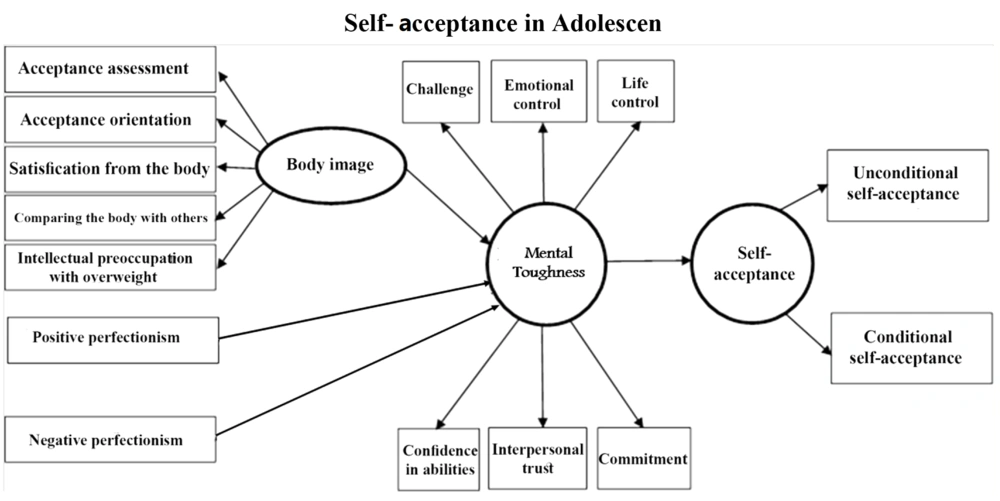
Conceptual model of structural relationships of self-acceptance based on body image and perfectionism concerning the mediating role of mental toughness
3.3. Scales
3.3.1. Demographic Information
3.3.2. Unconditional Self-acceptance Questionnaire (Chamberlain and Haaga)
3.3.3. Mental Toughness Questionnaire (Clough, P.J., Earle, K., & Sewell, D., 2012)
3.3.4. Body Image Questionnaire
3.3.5. Perfectionism Questionnaire (Short et al., 2010)
3.4. Data Collection
3.5. Data Analysis
3.6. Ethical Consideration
4. Results
| Variables | Mean ± SD | P-Value |
|---|---|---|
| Self-acceptance | ||
| Self-acceptance | 76.91 ± 18.84 | 0.054 |
| Unconditionally self-acceptance | 30.98 ± 10.25 | 0.401 |
| Conditional self-acceptance | 42.07 ± 9.79 | 0.281 |
| Perfectionism | ||
| Perfectionism | 117.39 ± 23.29 | 0.388 |
| Positive perfectionism | 47.23 ± 9.61 | 0.071 |
| Negative perfectionism | 61.78 ± 11.78 | 0.215 |
| Mental toughness | ||
| Mental toughness | 147.81 ± 21.87 | 0.240 |
| Life control | 21.34 ± 4.42 | 0.990 |
| Emotional control | 21.92 ± 4.40 | 0.130 |
| Challenge | 25.02 ± 4.02 | 0.213 |
| Commitment | 3.07 ± 6.31 | 0.063 |
| Confidence in your abilities | 28.31 ± 4.86 | 0.269 |
| Interpersonal trust | 18.15 ± 4.04 | 0.060 |
| Body image | ||
| Body image | 174.74 ± 29.70 | 0.432 |
| Evaluation of appearance | 30.40 ± 4.93 | 0.408 |
| Appearance orientation | 38.01 ± 6.00 | 0.051 |
| Satisfaction from different parts of the body | 62.73 ± 12.18 | 0.071 |
| Comparing the body with others | 12.89 ± 3.23 | 0.066 |
| Intellectual preoccupation with overweight | 36.01 ± 5.27 | 0.110 |
a P < 0.01 correlation at the 99% confidence level.
| Model Suitability Indices | χ2 | df | χ2/df | NPAR | GFI | IFI | TLI | CFI | RMSEA |
|---|---|---|---|---|---|---|---|---|---|
| Developed model | 1307.33 | 88 | 14.86 | 32 | 0.666 | 0.651 | 0.581 | 0.649 | 0.186 |
| Corrected model (final) | 336.26 | 79 | 4.26 | 41 | 0.90 | 0.926 | 0.902 | 0.926 | 0.078 |
| Independence model | 3579.10 | 105 | 34.09 | 15 | 0.344 | 0.001 | 0.001 | 0.001 | 0.288 |
Abbreviations: df, degree of freedom; NPAR, number of parameters for each model; GFI, Goodness-of-Fit Index; IFI, Incremental Fit Index; TLI, Tucker-Lewis Index; CFI, Comparative Fit Index; RMSEA, Root Mean Square Error Of Approximation.
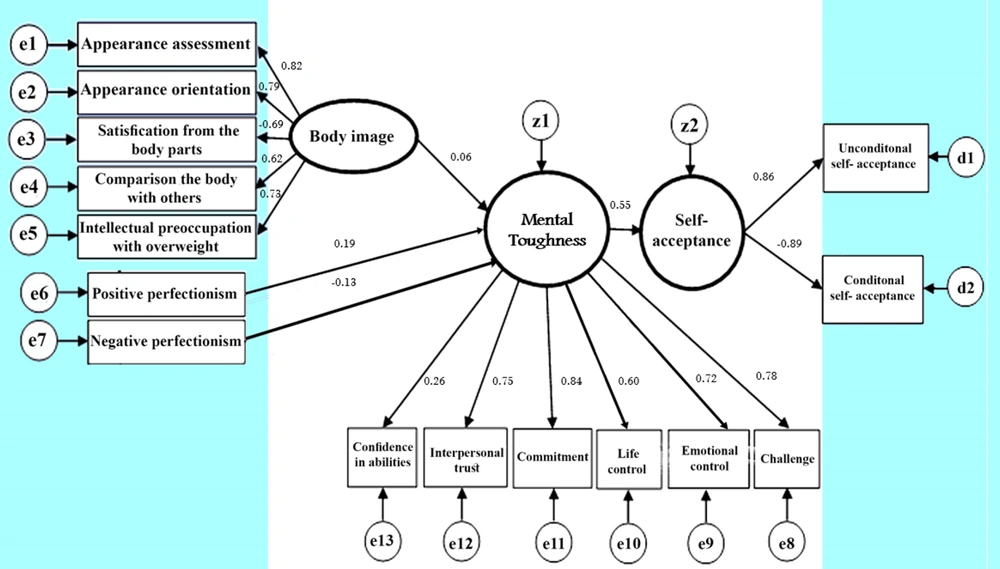
The compiled model of the structural relationships of self-acceptance based on body image and perfectionism concerning the role of mediator mental toughness
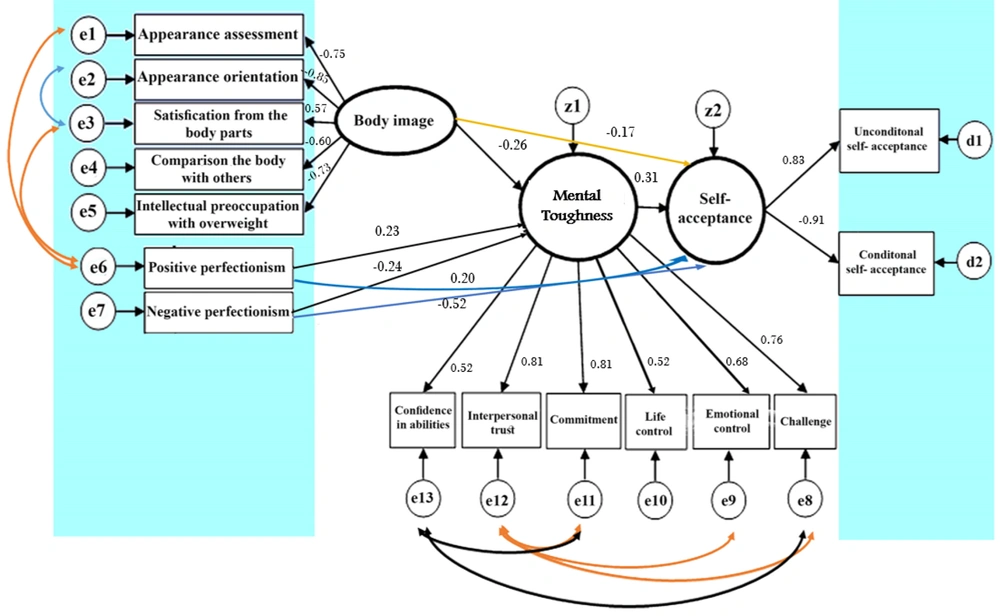
The modified model of the structural relationships of self-acceptance based on body image and perfectionism concerning the mediating role of mental toughness
| Path | B | S. E. | β | R2 | t | P-Value |
|---|---|---|---|---|---|---|
| Body image → mental toughness | -0.053 | 0.019 | -0.26 | 0.068 | -2.80 | 0.001 |
| Positive perfectionism → mental toughness | 0.084 | 0.031 | 0.23 | 0.053 | 2.70 | 0.007 |
| Negative perfectionism → mental toughness | -0.03 | 0.011 | -0.24 | 0.058 | -2.73 | 0.004 |
| Body image → self-acceptance | -0.366 | 0.08 | -0.17 | 0.029 | -4.58 | 0.001 |
| Positive perfectionism → self-acceptance | 0.173 | 0.052 | 0.20 | 0.04 | 3.33 | 0.001 |
| Negative perfectionism → self-acceptance | -0.373 | 0.043 | -0.52 | 0.27 | -8.70 | 0.001 |
| Mental toughness → self-acceptance | 0.751 | 0.101 | 0.31 | 0.096 | 7.49 | 0.001 |
| Variables | a | b | c | Sa | Sb | z | VAF | P-Value |
|---|---|---|---|---|---|---|---|---|
| Body image, mental toughness, self-acceptance | -0.26 | 0.31 | -0.17 | 0.019 | 0.101 | -7.38 | 0.321 | 0.001 |
| Positive perfectionism, mental toughness, self-acceptance | 0.23 | 0.31 | 0.20 | 0.031 | 0.101 | 4.85 | 0.263 | 0.001 |
| Negative perfectionism, mental toughness, self-acceptance | -0.24 | 0.31 | -0.52 | 0.011 | 0.101 | -5.08 | 0.126 | 0.001 |
Abbreviation: VAF, variance accounted for.
