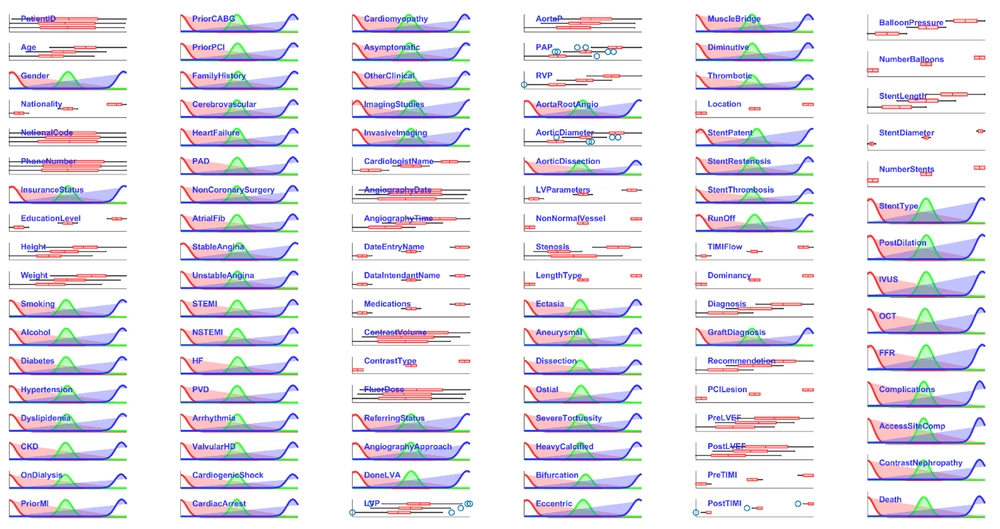
The cohort’s mean age was 65 ± 10 years (gender coded male = 0, female = 1). Smoking and alcohol use each affected approximately 30% of the cohort, while diabetes mellitus, hypertension, dyslipidemia, and chronic kidney disease (30% of whom were on dialysis) were present in 25%, 40%, 35%, and 10% of patients, respectively. Prior myocardial infarction, PCI, and CABG occurred in 15%, 20%, and 10% of cases; heart failure, atrial fibrillation, peripheral arterial disease, and cerebrovascular disease each affected 5 - 15% of the cohort.
In class 1 lesions, mean side-branch stenosis was 35 ± 10%, compared to 65 ± 12% stenosis and 75 ± 8° bifurcation angles in class 2 lesions. Post-PCI TIMI grade 3 flow was achieved in 92% of class 1 and 85% of class 2 lesions. Dual-stent techniques were used in 10% of class 1 lesions versus 35% of class 2 lesions, and adjunctive IVUS/OCT and FFR were employed in 50% and 30% of all cases, respectively.
The present investigation assessed bifurcation angioplasty complexity using ten patient- and lesion-specific parameters — demographics (age, sex, hypertension, diabetes), anatomic characteristics (side-branch stenosis, bifurcation angle, side-branch diameter, heavy calcification, pre-PCI TIMI flow), and stenting strategy (single vs. dual). Advanced age, female sex, hypertension, and diabetes predispose individuals to diffuse, calcified disease in smaller vessels, thereby increasing procedural risk and guiding device selection. Lesion severity — defined by stenosis ≥ 50%, wide bifurcation angles, larger diameters, pronounced calcification, and impaired TIMI flow — and the choice of a dual-stent approach further amplify technical challenges.
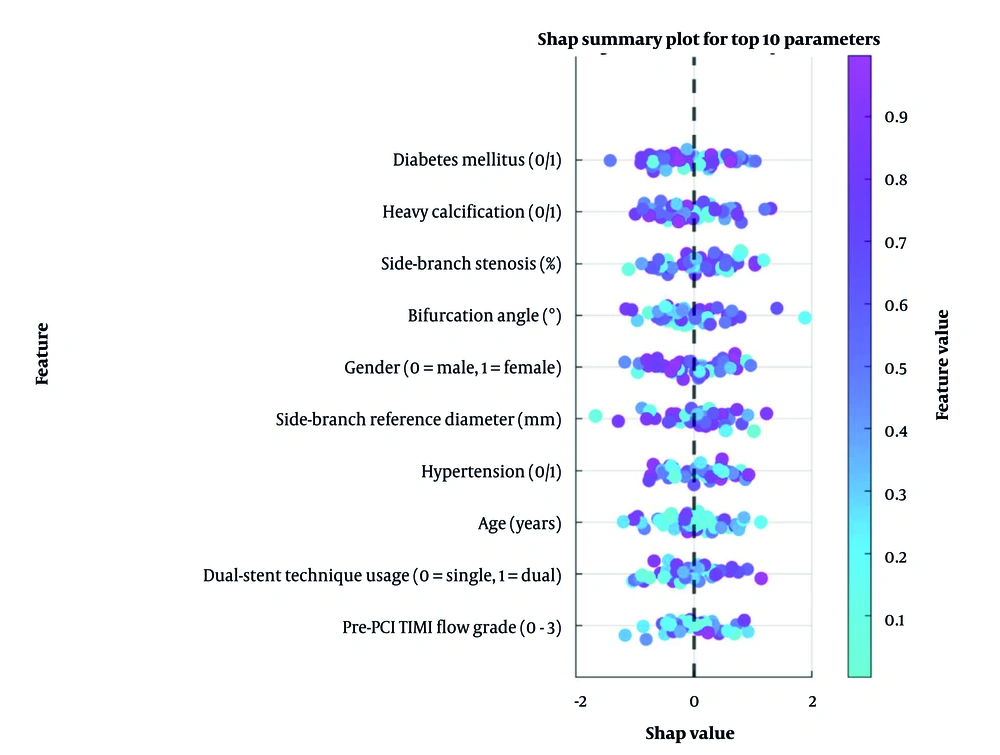
The SHAP were applied to the SVM model to decompose its predictions into feature-level contributions. In
Figure 2, each of the 500 patient samples is represented as a point along the horizontal axis corresponding to its SHAP value, with color denoting the raw feature magnitude. Side-branch stenosis, heavy calcification, and dual-stent utilization emerged as the most influential predictors. This high-resolution SHAP summary plot elucidates both individual and interactive feature effects, thereby underpinning transparent, patient-tailored interventional strategies.
SHapley Additive exPlanations (SHAP) summary plot of ten key clinical and procedural features in bifurcation angioplasty. The x-axis shows each feature’s additive impact (SHAP value) on model output, while the color gradient reflects raw feature values across 500 patients — enabling detailed analysis of feature interactions for personalized intervention strategies.
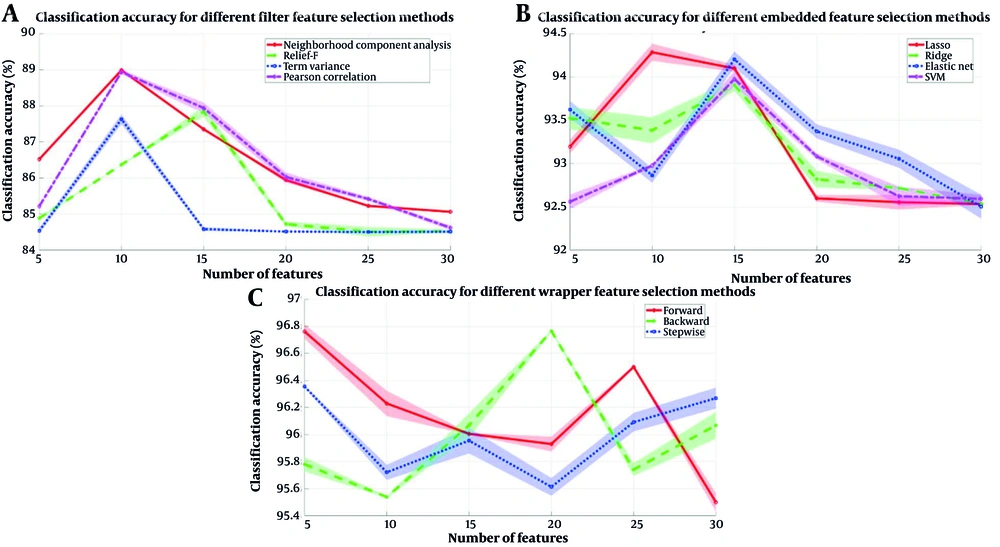
The performance of the SVM classifier was evaluated across three distinct feature-selection paradigms — filter, embedded, and wrapper — by examining classification accuracy as a function of the number of selected features (
Figure 3).
Classification accuracy of the support vector machines (SVM) classifier using three categories of feature selection methods: A, filter methods; B, embedded methods; and C, wrapper methods. The horizontal axis indicates the number of selected features, and the vertical axis represents classification accuracy (%). NCA and Pearson correlation (filter methods) achieved ~ 88.9% accuracy with 10 features. Lasso and elastic net (embedded methods) achieved 94.2% and 94.1% accuracy with 10 and 15 features, respectively. Forward and backward selection (wrapper methods) reached the highest accuracies of 96.5% and 96.8% with 25 and 20 features, respectively.
Filter-based techniques, illustrated in the top-left panel of
Figure 3, demonstrated rapid, model-agnostic selection. Neighborhood component analysis and Pearson correlation each achieved a maximum accuracy of 88.9% when restricted to ten features, indicating their efficacy in identifying informative variables despite computational simplicity.
Embedded methods, depicted in the top-right panel, integrate feature selection within the model training process via regularization. The Lasso method attained an accuracy of 94.2% with ten features, while the elastic net approach reached 94.1% using fifteen features, underscoring the advantage of simultaneous dimensionality reduction and decision-boundary optimization.
Wrapper strategies, presented in the bottom panel, yielded the highest classification performance at the expense of increased computational cost. Forward selection achieved a peak accuracy of 96.5% with twenty-five features, whereas backward selection attained 96.8% using twenty features, thereby confirming the superior predictive power of exhaustive, model-guided searches.
Collectively, these findings reveal that wrapper methods offer the greatest accuracy, embedded techniques provide a favorable balance between performance and feature parsimony, and filter approaches afford efficient preliminary screening. The integration of multiple selection strategies through hybrid frameworks may further enhance model robustness and applicability in clinical settings.
In this study, we performed a unified evaluation of diverse classifiers on a three-class bifurcation angioplasty dataset — no bifurcation, simple bifurcation, and complex bifurcation — by systematically tuning hyperparameters through cross-validation and varying the number of selected features (
5,
9,
13,
17,
22,
28). We assessed KNN variants (weighted, cosine, and Gaussian kernels at fine-, medium-, and coarse-scale granularities), SVM (linear, polynomial degrees 2 - 5, and radial basis function kernels with γ = 0.001 - 10 and C = 0.1 - 1,000), regularized discriminant analyses (LDA and covariance-regularized QDA), decision and regression trees (depths 3 - 20 with impurity-decrease thresholds 0.001 - 0.1 and feature subsampling), ensemble learners (boosted, bagged, subspace discriminant, subspace KNN, and RUSBoost with 50 - 500 estimators, learning rates 0.01 - 0.3, and sampling or under-sampling ratios of 0.8 and 0.5), and naive Bayes models (Gaussian and kernel).
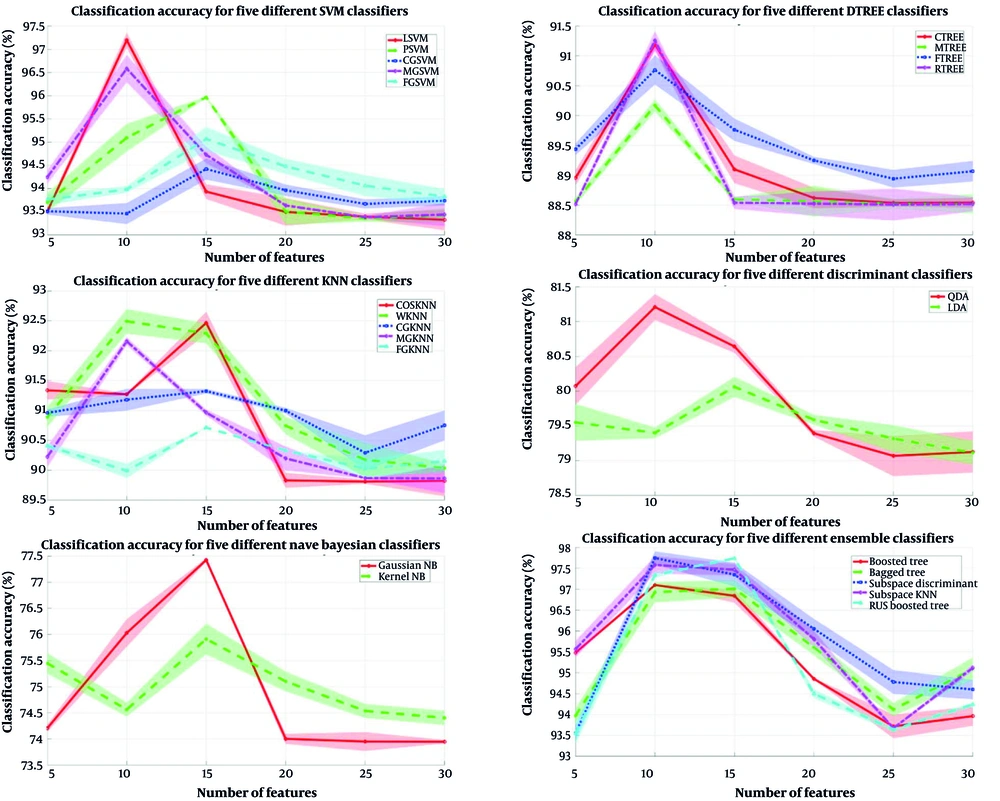
As shown in
Figure 4, most classifiers peaked in accuracy with 10 - 15 features: Linear SVM and medium-scale RBF SVM reached approximately 97.2% at 10 features; subspace discriminant and subspace KNN ensembles achieved approximately 97.8%; cosine and weighted KNN variants attained approximately 92.5%; coarse and regression trees peaked at approximately 91.3%; QDA reached approximately 81.3%; and Gaussian naive Bayes approximately 77.3%. These results highlight that careful algorithm selection, targeted feature dimensionality, and rigorous hyperparameter optimization are essential for maximizing predictive performance in complex, multiclass vascular-bifurcation classification tasks.
Comparative accuracy of hyperparameter‐optimized machine learning (ML) models — including k-nearest neighbors (KNN) variants, support vector machines (SVM) kernels, decision trees, and probabilistic classifiers — in classifying angioplasty lesions as no, simple, or complex bifurcations, demonstrating each model’s accuracy and robustness across varying lesion complexities.