


1. Background
Migraine, a prevalent neurological disorder, affects approximately 15% of the global population, with a higher prevalence among women (18 - 20%) compared to men (6 - 8%) (1, 2). In Iran, epidemiological data indicate a similar prevalence of 14 - 18%, predominantly among women (3). Characterized by recurrent, severe headaches accompanied by symptoms such as photophobia, phonophobia, and nausea, migraine imposes significant physical and psychological burdens. Women, who are three times more likely to experience migraines than men, face elevated levels of anxiety, depression, and stress, which can exacerbate headache frequency and intensity, perpetuating a cycle of distress and disability (4, 5). This underscores the need for psychological interventions to address the emotional and cognitive challenges associated with migraine, enhancing quality of life and reducing psychosocial impacts.
Distress tolerance, the ability to endure negative emotional or physical states without maladaptive coping, is critical in managing chronic pain (6, 7). Low distress tolerance in migraine sufferers often leads to avoidance behaviors, such as social withdrawal or overuse of medication, which intensify the pain-distress cycle (8). Enhancing distress tolerance empowers individuals to confront challenging emotions and sensations, mitigating psychological distress and fostering resilience (9). This capacity enables patients to engage more effectively in daily activities, breaking the cycle of avoidance and improving overall well-being.
Cognitive flexibility, the ability to adapt thoughts and behaviors to changing circumstances, is equally vital (10). In migraine, cognitive inflexibility may manifest as fixation on pain, catastrophic thinking, or difficulty adapting to functional limitations (11). Cultivating cognitive flexibility allows individuals to reframe experiences, embrace uncertainty, and pursue value-driven actions despite symptoms, promoting psychological resilience and a sense of purpose (12, 13). Interventions targeting cognitive flexibility are essential for helping migraine sufferers navigate the disorder’s challenges with greater adaptability.
Acceptance and commitment therapy (ACT), a well-established intervention for chronic pain, promotes psychological flexibility by encouraging non-judgmental acceptance of internal experiences, present-moment awareness, and value-driven actions (14-16). A meta-analysis by Ye et al. (17) highlights ACT’s efficacy in enhancing pain acceptance and reducing disability in chronic pain populations, making it a promising approach for migraine management. Similarly, compassion-focused therapy (CFT), rooted in evolutionary psychology, targets self-criticism and shame through compassionate imagery and mind training, activating a biological soothing system to manage distress (18, 19). The CFT’s focus on self-compassion reduces emotional distress, enhancing well-being in chronic illness populations (20, 21).
Despite the proven efficacy of ACT and CFT in chronic pain, their comparative effectiveness in women with migraine, particularly regarding distress tolerance and cognitive flexibility, remains underexplored. Given ACT’s emphasis on acceptance and value-driven action and CFT’s focus on self-compassion, understanding their relative efficacy is crucial for developing targeted, evidence-based interventions tailored to this population, informing clinical practice, and optimizing therapeutic outcomes.
2. Objectives
The present study was conducted to compare the effectiveness of ACT and CFT in improving distress tolerance and cognitive flexibility in women with migraine.
3. Methods
3.1. Study Design
This was a quasi-experimental study with a pre-test-post-test, 3-month follow-up design and a control group.
3.2. Participants
The study population comprised all women diagnosed with migraine in Ahvaz, Iran, in 2023. A sample of 108 participants was determined using G*Power software, calculated with a power of 0.80, an alpha of 0.05, and an effect size of 0.25, considering three groups and two dependent variables (distress tolerance and cognitive flexibility) across three time points. Participants were selected via convenience sampling from neurological clinics in Ahvaz and randomly assigned to two experimental groups (ACT and CFT) and a waitlist control group (n = 36 each). Randomization utilized a computer-generated random number sequence for balanced allocation.
Inclusion criteria included a neurologist-confirmed migraine diagnosis per the International Classification of Headache Disorders (ICHD-3), age 18 - 50, and willingness to participate. Exclusion criteria encompassed missing over two treatment sessions, initiating other psychotherapies, or altering medication during the study. No participants were excluded, ensuring all 108 completed the study. A CONSORT flowchart (Figure 1) details the study design and participant flow.
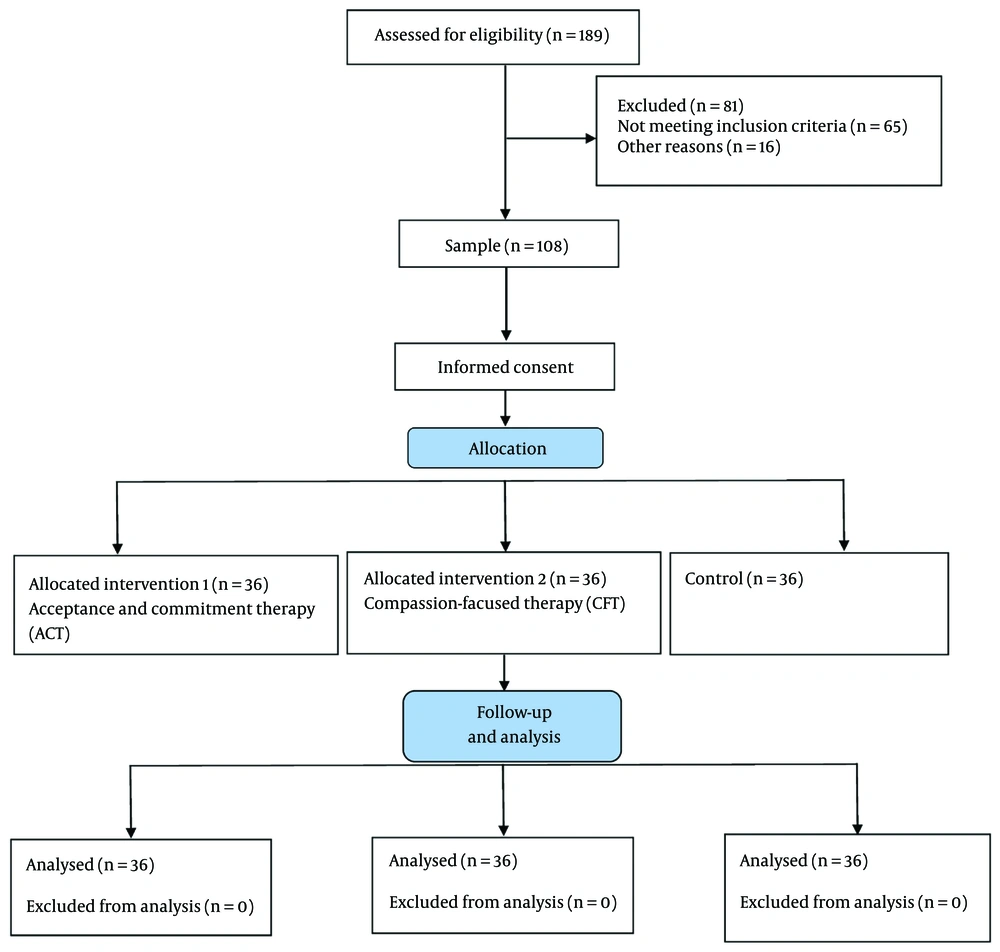
Figure 1.
CONSORT flowchart of participant recruitment and study design
3.3. Scales
3.3.1. Distress Tolerance Scale
Distress tolerance was assessed using the Distress Tolerance Scale (DTS), developed by Simons and Gaher (22). This 16-item self-report measure employs a 5-point Likert scale (1 = completely unlike me, 5 = completely like me), with total scores ranging from 16 to 80; higher scores reflect greater distress tolerance. Comprising four subscales, the DTS shows good psychometric properties (α = 0.82) (22). Its Persian translation demonstrates strong validity and reliability (α = 0.85) (23). In this study, the DTS achieved a Cronbach’s alpha of 0.83, indicating robust internal consistency.
3.3.2. Cognitive Flexibility Inventory
Cognitive flexibility was measured using the Cognitive Flexibility Inventory (CFI), developed by Dennis and Vander Wal (24). This 20-item self-report questionnaire assesses adaptability, problem-solving versatility, and openness to change, rated on a 6-point scale (1 = strongly disagree, 6 = strongly agree), with total scores ranging from 20 to 120. Higher scores indicate greater cognitive flexibility. The CFI demonstrates strong reliability (α = 0.86 - 0.91) and convergent validity (24). In Iranian populations, it shows robust psychometric properties (α = 0.90) (25). In this study, the CFI’s Cronbach’s alpha was 0.89, confirming excellent reliability.
3.4. Interventions
The interventions were conducted at the Labkhand Zendegi Counseling Center in Ahvaz, with each session lasting 90 minutes, delivered weekly over 8 weeks. The ACT and CFT protocols followed established curricula [Hayes et al., (26) for ACT; Gilbert, (27) for CFT], facilitated by the first author, a trained clinical psychologist. The control group received no intervention during the study but was offered access to therapy post-study. The follow-up assessment was conducted 3 months after the post-test (Table 1).
Table 1.Summary of Session Plans for Acceptance and Commitment Therapy and Compassion-focused Therapy
| Session | ACT Content | CFT Content |
|---|---|---|
| 1 | Introduction to ACT and the concept of psychological flexibility, learning the principles of acceptance | Introduction to the CFT model and the role of emotional regulation systems (threat, drive, and soothing) |
| 2 | Creative hopelessness and coping with painful thoughts | Training in self-compassion and its evolutionary roots |
| 3 | Training in present-moment awareness, including mindfulness exercises | Cultivating the "compassionate self" and compassionate awareness |
| 4 | Defining personal values and their importance in life | Practicing compassionate imagery, creating a safe internal space |
| 5 | Distinguishing between the self-as-context and thoughts as content | Addressing self-criticism and shame using compassion |
| 6 | Training in committed action and setting values-based goals | Exploring blocks to compassion and practicing compassion for others |
| 7 | Addressing obstacles and challenges on the path to committed action | Applying the "compassionate mind" in daily situations |
| 8 | Summary and review of learnings, planning for the future | Summary and review of learnings, planning for ongoing practice |
Abbreviations: ACT, acceptance and commitment therapy; CFT, compassion-focused therapy.
3.5. Data Analysis
Data analysis was performed using SPSS 20. Normality was confirmed via the Kolmogorov-Smirnov test (P > 0.05), homogeneity of variances by Levene’s test (P > 0.05), and sphericity by Mauchly’s test (P > 0.05). One-way ANOVA verified no baseline differences in DTS and CFI scores (P > 0.05). Repeated measures ANOVA compared distress tolerance and cognitive flexibility across pre-test, post-test, and follow-up, with α = 0.05. Bonferroni post-hoc tests examined pairwise differences. All 108 participants were included in the per-protocol analysis.
3.6. Ethical Consideration
This study, approved by the Ethics Committee of Ahvaz Branch, Islamic Azad University (IR.IAU.AHVAZ.REC.1401.185) and registered with the Iranian Registry of Clinical Trials (IRCT20220517054892N1), secured written informed consent from all participants, who were informed of the study’s purpose, procedures, and withdrawal rights. Data were anonymized and securely stored, ensuring confidentiality. Control group participants were offered ACT or CFT interventions post-study.
4. Results
This study involved 108 women with migraine, equally distributed across three groups: The ACT, CFT, and a control group. The mean ages were 32.45 ± 3.12 years for ACT, 33.21 ± 2.88 years for CFT, and 31.88 ± 3.05 years for the control group. Approximately 65% of participants held a university degree, with 35% having a high school diploma or less; 55% were homemakers, and 45% were employed. A one-way ANOVA confirmed no significant baseline differences in distress tolerance (F = 0.47, P = 0.63) or cognitive flexibility (F = 0.22, P = 0.80), ensuring group equivalence.
Table 2 illustrates that both ACT and CFT groups showed significant improvements in distress tolerance and cognitive flexibility from pre-test to post-test, sustained at the 3-month follow-up, unlike the control group, indicating the efficacy of both interventions.
Table 2.Mean and Standard Deviation of Distress Tolerance and Cognitive Flexibility Scores Across Three Stages for Research Groups a
| Variables | Pre-test | Post-test | Three-Month Follow-up |
|---|---|---|---|
| ACT | |||
| Distress tolerance | 29.70 ± 4.13 | 50.40 ± 4.72 | 49.95 ± 4.95 |
| Cognitive flexibility | 46.06 ± 5.28 | 78.12 ± 5.88 | 75.80 ± 5.00 |
| CFT | |||
| Distress tolerance | 30.00 ± 3.99 | 49.35 ± 4.25 | 49.05 ± 3.66 |
| Cognitive flexibility | 46.60 ± 4.92 | 68.00 ± 5.43 | 67.46 ± 5.08 |
| Control | |||
| Distress tolerance | 28.95 ± 4.05 | 31.20 ± 4.11 | 31.52 ± 3.99 |
| Cognitive flexibility | 47.20 ± 5.10 | 48.33 ± 5.02 | 47.64 ± 5.06 |
Abbreviations: ACT, acceptance and commitment therapy; CFT, compassion-focused therapy.
a Values are expressed as mean ± SD.
Prior to conducting the repeated measures analysis of variance, statistical assumptions were examined as described in the data analysis section. Sphericity was assumed for all analyses (Mauchly’s test, P > 0.05).
Table 3 presents the results of the repeated measures analysis of variance, examining the differences between the groups on the variables of distress tolerance and cognitive flexibility. The results revealed a significant main effect of time and a significant interaction effect of group by time for both variables. These findings indicate that the pattern of changes in distress tolerance and cognitive flexibility scores over time (pre-test, post-test, and follow-up) was different across the groups, confirming the effectiveness of the interventions (P < 0.001).
Table 3.Results of Repeated Measures Analysis of Variance for Research Variables
| Sources | SS | df | MS | F | P | ηp2 |
|---|---|---|---|---|---|---|
| Distress tolerance | ||||||
| Group | 1189.84 | 2 | 594.92 | 41.64 | < 0.001 | 0.35 |
| Time | 6229.17 | 2 | 3114.58 | 125.17 | < 0.001 | 0.70 |
| Group × time | 2118.05 | 2 | 1059.02 | 42.49 | < 0.001 | 0.44 |
| Cognitive flexibility | ||||||
| Group | 4546.23 | 2 | 2273.11 | 54.33 | < 0.001 | 0.34 |
| Time | 27642.45 | 2 | 13821.22 | 87.44 | < 0.001 | 0.63 |
| Group × time | 10053.18 | 2 | 5026.59 | 31.85 | < 0.001 | 0.38 |
Table 4 shows the results of the Bonferroni post-hoc test for pairwise comparisons of the group mean scores (Bonferroni-adjusted P-values). The results indicated that at the post-test and follow-up stages, both the ACT and CFT groups showed a significant increase in distress tolerance and cognitive flexibility scores compared to the control group (P < 0.001). This demonstrates the effectiveness of both interventions relative to the control group. However, a comparison between the two experimental groups revealed that a significant difference existed only for the variable of cognitive flexibility, where the ACT group had significantly higher scores than the CFT group (P < 0.001). For distress tolerance, no significant difference was observed between the ACT and CFT groups (P > 0.05).
Table 4.Results of Bonferroni Post-hoc Test for Pairwise Group Comparisons at Post-test and 3-Month Follow-up (Bonferroni-Adjusted P-Values)
| Variables | Mean Difference (I-J) | SE | P |
|---|---|---|---|
| Distress tolerance | |||
| ACT | |||
| CFT | 1.05 | 1.06 | 0.325 |
| Control | 19.20 | 1.04 | 0.001 |
| CFT | |||
| Control | 18.15 | 0.99 | 0.001 |
| Cognitive flexibility | |||
| ACT | |||
| CFT | 10.12 | 1.33 | 0.001 |
| Control | 29.79 | 1.29 | 0.001 |
| CFT | |||
| Control | 19.67 | 1.23 | 0.001 |
Abbreviations: ACT, acceptance and commitment therapy; CFT, compassion-focused therapy.
5. Discussion
This study provides critical insights into the efficacy of ACT and CFT in improving distress tolerance and cognitive flexibility among women with migraine. The results demonstrate that both interventions significantly enhanced these psychological outcomes compared to a control group, reinforcing the value of third-wave cognitive-behavioral therapies in addressing the psychological dimensions of migraine. Notably, while ACT and CFT were equally effective in improving distress tolerance, ACT showed a superior effect on cognitive flexibility. This differential impact may be attributed to ACT’s focus on cognitive defusion and values-based action, which directly address cognitive rigidity, in contrast to CFT’s emphasis on emotional soothing, which has a less direct influence on cognitive flexibility (18, 28). These findings elucidate the distinct therapeutic mechanisms of ACT and CFT, offering a foundation for developing targeted treatment protocols for this population.
The significant improvement in distress tolerance observed in both intervention groups aligns with extensive research on chronic pain management. Distress tolerance, the ability to endure aversive emotional and physical states without maladaptive avoidance, is essential for individuals with chronic conditions (7). The ACT promotes this through non-judgmental acceptance, enabling individuals to reframe pain and distress as manageable experiences rather than threats (17). Similarly, CFT cultivates a compassionate inner dialogue and physiological soothing, fostering an environment where difficult emotions are approached with kindness (19). The comparable outcomes in distress tolerance may reflect both therapies’ focus on emotional regulation, albeit through distinct pathways: The ACT via mindfulness and acceptance, and CFT through self-compassion and emotional soothing (15, 19). This finding is supported by Padesky and Mooney (29), who demonstrated that resilience-focused therapies significantly enhance distress tolerance in clinical populations. The present study suggests that both acceptance-based and compassion-focused approaches are equally effective in bolstering this critical capacity.
A key finding is ACT’s greater efficacy in enhancing cognitive flexibility compared to CFT. While both groups showed significant gains, the ACT group achieved higher scores. This aligns with ACT’s core techniques, which foster psychological flexibility by encouraging individuals to view thoughts as transient events (cognitive defusion) rather than absolute truths, thereby reducing rigid thinking patterns (28). In contrast, CFT’s focus on reducing self-criticism and promoting compassion indirectly supports cognitive flexibility but lacks the direct cognitive restructuring emphasis of ACT (18). This finding is consistent with Martinez-Calderon et al. (30), who reported significant improvements in cognitive flexibility among chronic pain patients following ACT interventions.
The absence of significant differences in distress tolerance outcomes between ACT and CFT is noteworthy. Despite their differing approaches — ACT emphasizing action despite distress and CFT focusing on soothing distress — both therapies achieved similar results. This suggests that radical acceptance and self-compassion are equally effective mechanisms for enhancing distress tolerance, likely due to shared elements like mindfulness and emotional validation (15, 19). Clinicians may choose between ACT and CFT based on patient preferences, with potential for an integrated approach, though further research is needed.
The study’s strengths include its rigorous quasi-experimental design, balanced demographics, validated psychometric tools, and a 3-month follow-up demonstrating sustained effects. However, limitations include the quasi-experimental design and convenience sampling, which may limit generalizability, and reliance on self-report measures, which are susceptible to bias. While measures were taken to prevent information dissemination between groups, this risk cannot be fully ruled out.
5.1. Conclusions
This study demonstrates that ACT and CFT effectively enhance distress tolerance and cognitive flexibility in women with migraine. Both interventions foster adaptive coping through acceptance and self-compassion. Notably, ACT significantly outperformed CFT in improving cognitive flexibility, while their impact on distress tolerance was comparable. These findings guide clinicians in tailoring interventions to optimize psychological outcomes and quality of life.
