



1. Background
Hospitalization is a process in which, a health problem is diagnosed and it lasts from the hospital admission to discharge (1). Hospital admission is a stressful experience at all ages, especially childhood (2). About 30% of children are hospitalized at least once during their childhood and about 5% of them are admitted several times. About 5 million children are admitted annually to hospitals for diagnosis or treatment in the United States (3). Hospitalization is stressful for children and parents. Uncertain outcomes, frequent hospitalization, special treatments for the child, and watching children’s pain and fear would increase the stress level of parents and affect their performance and future planning (4). Accordingly, the hospitalization of children is always considered a stressor for the children and their parents as parents often experience psychological problems such as stress and anxiety (5, 6). Hospitalization of children is accompanied by the feelings of guilt, confusion, hopelessness, and anger for the parents (7). Parents’ concerns, especially in mothers, are often associated with problems in child-rearing and motherhood, and prevent them from playing their parental role, which can affect children’s development (8).
The concern is a cognitive process which is associated with persistent and repeated thoughts about personal anxieties and the difficulty in ending this chain of thoughts (9). Parents’ concern is often related to the severity of disease and the methods of treatment used for their children, and is caused by the lack of information about procedures and treatments, unfamiliarity with hospital rules, unfriendly behavior of the personnel, and fear of asking questions (10). Mothers’ anxiety is very important because the psychological problems, especially concern, in mothers may lead to emotional and behavioral problems in children. It can also negatively affect the ability and self-efficacy of caregivers, especially mothers. Therefore, anxiety and concern management can be particularly helpful (11). In fact, when parents, especially mothers, feel empowered in a critical condition, they support their sick children and facilitate their treatment process (12). As a result, it is possible to reduce or eliminate the concerns of parents by identifying the factors associated with parental concern and introducing them to counselors and education specialists (13).
Since parental support is the most important factor in determining the child’s reaction to nursing care, parents who are frequently informed of the health status of their children by healthcare personnel are less likely to have stress and can help their children to adapt better to the hospital environment (14). Therefore, involving parents in the care process causes professional knowledge of nurses to be added with the knowledge of mothers taking care of their children and this results in better care and treatment (15).
2. Objectives
Accordingly, the aim of this study was to determine the relationship between the concerns of mothers and the nursing support of children admitted to Baqiyatallah Al-Azam Hospital in Ali Abad Katoul.
3. Methods
This descriptive cross-sectional study was conducted in 2018 on the mothers of children admitted to Baqiyatallah Al-Azam Hospital in Aliabad Katoul city in Golestan province, Iran. The sample size in this study was determined based on the following formula:
The sample size was calculated as 147 subjects according to the significance level of α = 0.05, Z.975 = 1.96, p = 0.25, and d = 0.07. To increase generalizability, the researcher enrolled 150 subjects by the convenience sampling method. The criteria for entering the study were the admission to the hospital for at least 24 h, the presence of mother during the hospitalization of the child, maternal reading and writing skills, no mental/psychological disease, and age between 2 and 12 years. The exclusion criteria were the unwillingness of mothers to participate in the study and incomplete questionnaires.
The data collection tools were a demographic information questionnaire (mother’s age, child’s age, child’s sex, mother’s educational and economic status) and a researcher-made questionnaire to measure the concerns of mothers, which included 15 close-ended questions. The items of this tool were scored as follows: 0 = never, 1 = a little, and 2 = very much. The total score of the questionnaire varied from 0 to 30, with higher scores reflecting higher maternal concerns and lower scores indicating lower maternal concerns (16). In the study by Sayedamini (17), the reliability of this questionnaire was evaluated by Cronbach’s alpha coefficient (α = 0.69) for all items. The nurses’ support of parents questionnaire was developed using the 21-option tool (NPST) introduced by Margaret Miles in 1988, which included 21 items and 4 subscales (informational support, emotional support, parental credibility, and financial support). The questions were rated based on a five-point scale ranging from 1 to 5, as follows: 1 = never, 2 = rarely, 3 = sometimes, 4 = most often, and 5 = almost always. The Cronbach’s alpha coefficient was 0.58 for emotional support, 0.81 for informational communicational support, 0.66 for self-confidence, 0.79 for qualitative care, and 0.91 for total support. In the study by Sanjari et al. (18), the reliability of this questionnaire was confirmed by Cronbach’s alpha coefficient of 0.95. The face and content validity of these two questionnaires were approved by 10 faculty members of clinical nursing education of Golestan Islamic Azad University.
After approval of the project and receiving the code of ethics, the researcher attended the hospital and obtained permission for sampling in the pediatric ward from the hospital authorities. She explained the purpose and objectives of the study to the mothers of admitted children and obtained their written consent for participation in the study. The participants were also assured about the principles of anonymity and confidentiality of their personal information. The time to complete each questionnaire was 15 - 20 min, during which the researcher was available to answer the questions of participants on how to complete the tool.
Pearson correlation coefficient was used to examine the relationship between the concerns of mothers and nursing support. The independent t-test was used to examine the relationship between the concerns of mothers and nursing support, the children gender, and history of admission to the hospital. The variance analysis was used to investigate the relationship between the concerns of mothers and mothers’ education, mothers’ age, and children age. Finally, the collected data were entered into SPSS version 21 software.
4. Results
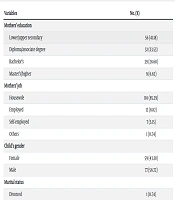
The mean age of mothers was 30.1 ± 5.4 years, and most of them (46.2%, n = 74) had under diploma education with 2.5% (n = 4) having M.Sc. degrees. In terms of occupation, 71.2% of the mothers (n = 114) were housewives, 13.1% (n = 21) self-employed, 11.9% (n = 19) employees, and 3.8% (n = 6) farmers. Also, 61.2% of them (n = 98) had the experience of child hospitalization and 38.8% (n = 62) did not have such experiences. The mean age of hospitalized children was 3.68 ± 2.17 years and in terms of gender, most of them (55.6%; n = 89) were males while 44.4% (n = 71) were females. The mean duration of hospitalization of children was 2.5 ± 0.75 days.
According to Table 1, most of the mothers (59.4%; n = 95) had a moderate concern and 10% (n = 16) had a low concern. Also, 30.6% of the mothers (n = 49) had a high concern.
Table 1.Frequency Distribution of Concerned Mothers of Children Admitted to the Hospital
| Mothers’ Concern | Frequency | Percentage |
|---|---|---|
| Low (0 - 10) | 16 | 10 |
| Moderate (11 - 20) | 95 | 59.4 |
| High (20 - 30) | 49 | 30.6 |
| Mean ± SD | 6.16 ± 4.5 | |
According to Table 2, the mean score of nursing support was 72.01 ± 16.52, with 55% of the mothers (n = 88) perceiving a high level of support, 41.9% (n = 67) a moderate level of support, and 1.3% (n = 5) a low level of support. The highest score was related to parental credibility support.
Table 2.The Nursing Support Understanding of Mothers of Children Admitted to the Hospital
| Domain of Support | Mean ± SD |
|---|---|
| Information support | 16.95 ± 4.28 |
| Emotional support | 16.71 ± 4.36 |
| Parental credit Support | 24.88 ± 5.57 |
| Care or maintenance support | 13.45 ± 3.62 |
| Total support | 72.1 ± 16.52 |
As can be seen in Table 3, Pearson correlation coefficient showed a significant relationship between nursing support and mothers’ concern (r = -0.22, P = 0.004) so that with increasing nursing support, the level of mothers’ concern decreased by 0.22.
Table 3.The Relationship Between Nursing Support and Mothers’ Concerns About Hospitalized Children
| Variable | Mean ± SD | P Value |
|---|---|---|
| Nursing support | 72.01 ± 16.52 | P = 0.004; R = -0.22 |
| Mothers’ concern | 16.45± 5.18 |
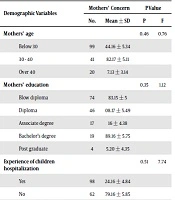
Based on Table 4, in terms of the relationship between mothers’ concern and demographic information, the results of variance analysis showed no significant relationship between the mothers’ concern and mothers’ age (P = 0.46), children age (P = 0.43), and mothers’ education (P = 0.35). The two-sample t-test showed no significant relationship between the mothers’ concern and children gender (P = 0.30) and the experience of children hospitalization (P = 0.51).
Table 4.The Comparison Between Mothers’ Concern and Demographic Characteristics of Parents of Children Admitted to the Hospital
| Demographic Variables | Mothers’ Concern | P Value | ||
|---|---|---|---|---|
| No. | Mean ± SD | P | F | |
| Mothers’ age | 0.46 | 0.76 | ||
| Below 30 | 99 | 44.16 ± 5.34 | ||
| 30 - 40 | 41 | 82.17 ± 5.11 | ||
| Over 40 | 20 | 7.13 ± 3.14 | ||
| Mothers’ education | 0.35 | 1.12 | ||
| Blow diploma | 74 | 83.15 ± 5 | ||
| Diploma | 46 | 08.17 ± 5.49 | ||
| Associate degree | 17 | 16 ± 4.38 | ||
| Bachelor’s degree | 19 | 89.16 ± 5.75 | ||
| Post graduate | 4 | 5.20 ± 4.35 | ||
| Experience of children hospitalization | 0.51 | 7.74 | ||
| Yes | 98 | 24.16 ± 4.84 | ||
| No | 62 | 79.16 ± 5.85 | ||
| Children gender | 0.30 | 0.63 | ||
| Female | 71 | 92.16 ± 5.21 | ||
| Male | 89 | 07.16 ± 5.15 | ||
| Children age | 0.43 | 0.84 | ||
| 1 - 3 | 99 | 44.16 ± 5.34 | ||
| 3 - 5 | 41 | 82.17 ± 5.11 | ||
| 6 - 12 | 20 | 7.13 ± 3.14 | ||
Based on Table 5, the analysis of variance did not show a significant relationship between the nursing support and mothers’ age (P = 0.63), mothers’ education (P = 0.20), and children age (P = 0.93). The two-sample t-test did not show a significant relationship between nursing support and children gender (P = 0.16) and the experience of children hospitalization (P = 0.60).
Table 5.The Comparison Between Nursing Support and Demographic Characteristics of Mothers of Children Admitted to the Hospital
| Demographic Variables | Mothers’ Concern | P Value | ||
|---|---|---|---|---|
| No. | Mean ± SD | P | F | |
| Mothers’ age | 0.64 | 0.43 | ||
| Below 30 | 70 | 73.4 ± 16.65 | ||
| 30 - 40 | 41 | 70.91 ± 16.43 | ||
| Over 40 | 20 | 71.14 ± 18.71 | ||
| Mothers’ education | 0.20 | 1.7 | ||
| Blow diploma | 74 | 12.75 ± 15.78 | ||
| Diploma | 46 | 65.68 ± 14.85 | ||
| Associate degree | 17 | 83.69 ± 20.52 | ||
| Bachelor’s degree | 19 | 74.74 ± 5.17.59 | ||
| Post graduate | 4 | 25.63 ± 21.23 | ||
| Experience of children hospitalization | 0.60 | 0.08 | ||
| Yes | 98 | 55.72 ± 16.26 | ||
| No | 62 | 16.71 ± 16.86 | ||
| Children gender | 0.16 | 0.49 | ||
| Female | 71 | 98.69 ± 15.83 | ||
| Male | 89 | 62.73 ± 516.96 | ||
| Children age | 0.93 | 0.06 | ||
| 1 - 3 | 99 | 05.72 ± 16.29 | ||
| 3 - 5 | 41 | 41.71 ± 15.29 | ||
| 6 - 12 | 20 | 05.73 ± 20.52 | ||
5. Discussion
Along with the needs of children as major caregiver clients, the mothers’ needs should also be addressed to meet the comprehensive needs of the child and the family, which forms the basis of the family-centered care (19). The results of this study showed a high level of concern among mothers of hospitalized children. In other words, a mother who is experiencing the hospitalization of her child develops mental-emotional disturbances. On the other hand, entering an unfamiliar environment causes anxiety and fear, and limits the verbal mothers’ expression of their own needs (20). In this study, establishing a stressful relationship was a major barrier to trusting nurses. Ineffective communication, inappropriate communication for the child’s age, and communication without ethical consideration (impatience, insult, and desecration) are the characteristics of a stressful relationship. In this way, the resulting relationship becomes a source of fear and concern for mothers. Lotour et al. (2008) stated that effective and understandable communication can be beneficial to the child and reduce the stress and worries of parents (21). Parents feel the need for expressing their emotions and want the nurses to be available for them, giving them the opportunity to express their feelings and emotions (22). Nurses who play a supportive role for mothers contribute to relieving anxiety and stress of mothers (23). Thompson et al. (24) stated that understanding parents and meeting their needs are important to increase the trust of parents in nurses.
The results of this study showed that the level of the understanding of nursing support was higher than the mean level, indicating the mothers’ awareness of nursing support. Brudgasgard and Wanger (2005) showed that nursing support was important from the perspective of parents (25). Nursing support of the family has different forms. Information support means giving the parents information about their child’s illness. Emotional support includes listening to the parents and helping them adapt to the child’s illness. Credit or value support is used to empower parents to take their parental role. Caring or instrumental support, also called tangible support, includes financial, time, and occupational support, environmental change, or adjustment (19). In determining the aspects of provided support for the parents of hospitalized children, the results of this study showed that the highest support was related to parental validity support and the lowest support was related to caring support. The results by Valizadeh et al. (26) study showed that the highest level of support was related to qualitative and communicative-information services and the least support was related to self-confidence and emotional support. In the study by Pourmovahed and Roozbeh (27), parents referred to the need for knowing their reactions, the need for support, the need for information, the need for allocating time to themselves, and the need for getting help in parenting skills as their main needs. Providing information and increasing awareness at an appropriate level along with suitable technical care can give parents parental confidence in undertaking their parental role. In fact, information collected at the hospital can not only help parents adapt to their child’s hospitalization, but also can help strengthen childcare management after the discharge (26). In the study by Adamson et al. (28), entitled “examining the patients’ viewpoint of emotional support”, the results of narrative analysis revealed empathy, deep communication, presence and availability, giving hope, considering the uniqueness of the patient, supportive behaviors, friendly manner, and friendly environment. In a study by Franck and Axelin (29), the highest support was related to the qualitative care and least support was related to emotional support. In the study by Bailey et al. (30), families who received more support, particularly information support, had more satisfaction than others and there was a significant relationship between the understanding of information support and meeting the needs, followed by satisfaction with care. In fact, one of the main goals of pediatric nursing is to provide comprehensive care and facilitate the best possible outcomes and to reach this goal, the understanding of mothers’ concerns is of particular importance (31). The results of this study showed that with increasing nursing support, the level of mother’s concern decreases. By explaining the nature and cause of disorder, nurses can correct the parents’ misconceptions about themselves and their children, and reduce their perceived sense of guilt. This will increase the behavioral performance of children and their parents by reducing negative emotions, such as concern, facilitate better relationships with children, and create a feeling of happiness and liberation (32). It will also reduce the stress and sense of parental insecurity and improve parents’ satisfaction with nursing care (33).
The findings of this study showed no significant relationship between the level of mothers’ concern, nursing care, and any of the demographic characteristics. In the study by Ionio et al. (34), the prolonged hospital stay was associated with higher levels of stress and more negative emotions such as anxiety, depression, and anger in mothers and fathers. In the study by Lee et al. (35), the amount of parental care decreased with increasing age and there was no significant difference between maternal education and care burden. Bowden and Greenberg (36) showed that older parents had more need to be respected by the healthcare team and expected to be more involved in the care for their children. Turchi et al. (37) found that parents with more experience of child hospitalization understood the importance of participation in care more than others, and were more sensitive towards the issues related to the care of children. The findings of the study by Mitchell et al. (38) showed that the higher the level of parental education, the more the importance of respect for them.
Among the limitation of the present study is the condition of Iran’s public hospitals, which allows only the mother to have a constant presence at the child’s bedside. Thus, we could not enroll the fathers in the study.
5.1. Conclusions
Parents have an important role in childcare and the provision of family-based care requires a certain level of sensitivity and understanding. Nurses’ efforts to provide family-based care can be a way to alleviate parents’ concerns and subsequently, improve the quality of childcare. Therefore, interventional studies are recommended in this field.