
1. Background
Futsal is a high-intensity sport that demands agility, speed, quick decision-making in tight spaces, fast physical reflexes, and strategic precision. Agility is crucial for rapid directional changes, dribbling, and evasion, enhancing both individual and team performance. It is a key factor for success, as all futsal players must demonstrate agility at all times, both with and without the ball (1). High-intensity interval training (HIIT) involves exercising at high intensity (≥ 80 - 95% HRmax or 80 - 90% VO2max) alternating with low-intensity intervals or short recovery periods (2, 3), which improves performance and physiological characteristics (4-7). Recent studies indicate that HIIT enhances anaerobic capacity, including repeated sprints, straight-line sprints, and explosive power in young and elite soccer players (1, 8, 9). Various interval protocols (short or long) offer moderate to high benefits (10-12). In futsal, HIIT enhances intermittent work performance and overall fitness, benefiting players during high-intensity phases of the game (13). Step aerobics (SA) training has been shown to improve coordination, balance, and agility by integrating low-impact aerobic dance movements. Moreover, it enhances reaction time and cardiovascular endurance, making it an effective tool for athletes to optimize agility and sustain high performance (14, 15). Step aerobics training uses a 4 - to 12-inch adjustable box to increase training intensity while controlling stride cadence during exercise in the range of 120 - 140 beats per minute, improving coordination, balance, and agility (14, 15).
Currently, as athletes play more games each season, schedules are often congested, reducing the time available for training. The HIIT using SA is a short-duration, simple training method ideal for sports with year-round competition schedules (14). It is crucial to implement exercises that are both time-efficient and effective to enhance performance and influence competition outcomes. Studies have shown that HIIT improves athletes’ anaerobic capacity, short-term speed, and muscular power. When combined with the SA pattern, which requires athletes to step in different directions at controlled speeds consistent with the movement of each sport, athletes can improve their agility. This research aimed to investigate the acute effects of combined HIIT and SA training on agility performance in male futsal athletes during the pre-season.
2. Objectives
This study aimed to investigate the acute effects of combined HIIT and SA training on agility performance in male futsal athletes during the pre-season, focusing on short-term performance improvements through a specialized training protocol.
3. Methods
3.1. Participants
This research is an experimental study using a randomized design, involving 15 male professional futsal players competing in Thailand's first-division league. Eligibility criteria included a minimum of one year of active participation in futsal, age between 18 and 22 years, Body Mass Index (BMI) between 18.5 and 22.9 kg/m2, absence of injury, acute illness, unstable hypertension, and angina, as well as regular engagement in standardized training for at least three weeks before the trial. Exclusion criteria included any known exercise-limiting cardiovascular or respiratory condition, lower limb fractures, or musculoskeletal injuries within three months prior to study initiation (14).
Participants were allocated into two groups: One group engaged in HIIT combined with SA (HIITSA, n = 8), while the other group continued their regular futsal training without high-intensity interval training with SA training (HIITSA) (CON, n = 7). Both groups maintained their standard futsal training routines throughout the study. A priori power analysis was conducted using G*Power software (version 3.1.9.4) to ascertain the appropriate sample size required for the study (14). For this sample, the statistical power was calculated to be 87%, based on a two-tailed t-test with a moderate effect size and an alpha level of 0.05. During the initial visit, participants were thoroughly informed of the study’s objectives, potential benefits, risks, and participation requirements, and they signed a written informed consent before entering the research procedure. This study was granted ethical approval by the Human Research Ethics Committee of Khon Kaen University (approval number: HE672108).
3.2. Procedures and Measurements
A parallel two-group experimental study design was conducted over four weeks of pre-season training. Participants attended the laboratory on two occasions. All testing sessions were conducted at the same time of day for each individual, and the study protocol was explained during the initial training session. Tests were conducted at least 48 hours apart and completed within a one-week period. During the assessment phase, participants were instructed to maintain their regular training routines but refrain from engaging in strenuous or prolonged exercise for 24 hours prior to each assessment. The research was conducted by qualified personnel and consisted of three stages.
Stage one involved the measurement of baseline characteristics, including body height, body weight, fat mass, fat-free mass, and leg muscle mass, which were assessed using a stadiometer and the bioelectrical impedance method (InBody Body Composition Analyzer, Tanita Company). Body Mass Index was calculated based on body height and weight. Agility tests, including the futsal-specific change of direction speed (CODS) and reactive agility (RAG) tests, were conducted in pre- and post-test sessions, separated by a 1-hour resting period between the tests to complete fitness tests one week before and after the training intervention.
Stage two of the experiment involved performing HIITSA exercises three times per week on Mondays, Wednesdays, and Fridays. The total duration of the experiment was four weeks, comprising twelve training sessions. During the HIITSA exercises, each participant wore a Polar10 HR monitor (Polar team system, Finland), which included a watch for real-time exercise intensity monitoring.
The final stage assessed changes in physiological parameters resulting from the applied training by repeating the measurements from stage one. The experimental period lasted four weeks, with evaluations conducted one week before and one week after the pre-season training period.
3.3. High Intensity Interval Training with Step Aerobics Intervention
The HIITSA included seven exercises combined with 6-inch SA using training moves consisting of the following movement patterns: (1) Side tap, (2) knee up, (3) over the top, (4) turn step, (5) cross back, (6) across the top chasse, and (7) indecision, performed with rhythmic music (170 bpm exercise period/70 bpm recovery period) (14). The maximum heart rate (HRmax) for each session was determined by performing a 20-second exercise interval at 90% HRmax using a movement velocity of 170 bpm, interspersed with a 10-second recovery interval at 60% HRmax using a movement velocity of 70 bpm. Each set was performed 5 times, with a 30-second rest between sets for a total of 10 sets. During the sessions, participants received qualitative feedback, such as “You should go faster” or “You did a good job”, to help them understand and adapt to the required intensity during the training. All sessions began with a standardized warm-up followed by a 10-minute jog and concluded with a cool-down followed by a 10-minute jog, with a total duration of 50 minutes.
3.4. Agility Tests
The agility components were evaluated using newly developed futsal-specific CODS and RAG tests by Sekulic et al. (1). The Witty SEM system (Microgate, Bolzano, Italy) was used to assess agility in this study (16).
Performance during these assessments was determined by two main methods: (1) participants performed ball-contact tests (CODS_T and RAG_T); and (2) participants dribbled the ball throughout each trial (CODS_D and RAG_D). Each test is illustrated in Figure 1. The assessments were conducted on both the dominant and non-dominant legs.
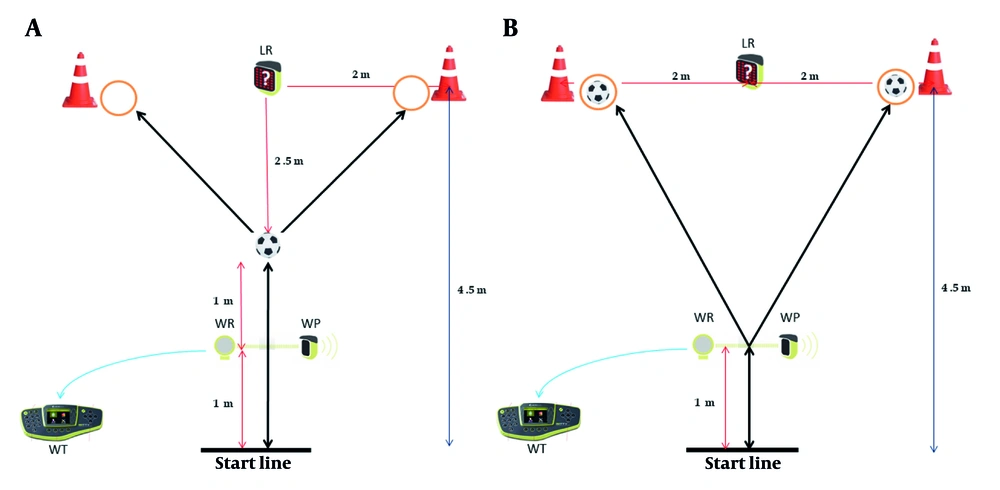
Figure 1.
Testing of the agility performance including A, dribbling and B, ball touching test ( abbreviations: WP, Witty photocell; WR, Witty reflector, LR; WT; Witty timer via a radio transmission system, LR; LED reaction smart indicators)
In the RAG_D and CODS_D tests, participants were instructed to dribble a ball toward a marked circle in front of a designated cone. Upon reaching the circle, they were to leave the ball inside and quickly change direction to sprint back to the starting line (Figure 1A). In the CODS_T and RAG_T tests, participants were required to run toward the ball placed in front of the cone, touch it with the sole of their foot, and then sprint back through the infrared signal (WP: Witty photocell, WR: Witty reflector) as quickly as possible to stop the timer (Figure 1B). The rest periods between each trial and test were standardized to 2 minutes. For statistical analysis, each variable was tested twice, and the best performance score for each participant from each test, recorded by the Witty timer via a radio transmission system, was used for analysis.
3.5. Statistical Analysis
Data obtained from the study were analyzed using SPSS software, version 28. Descriptive statistics were presented as mean ± standard deviation (mean ± SD). Paired-sample t-tests were conducted to compare pre- and post-intervention measurements within each group. Independent-sample t-tests were used to compare differences between groups. A statistical significance level of P ≤ 0.05 was adopted.
4. Results
4.1. Baseline Characteristic
Fifteen male futsal players participated in the study. Paired-sample t-tests and independent-sample t-tests were used to analyze the baseline characteristics. There were no significant differences in age, height, body mass, fat mass, fat-free mass, leg muscle mass, or BMI between the groups when comparing pre- and post-intervention measurements (Table 1).
Table 1.
The Demographic and Anthropometric Data of the Futsal Players Included in Two Groups a
| Variables | HIITSA (n = 8) | CON (n = 7) | P-Value | ||
|---|---|---|---|---|---|
| Pre-test | Post-test | Pre-test | Post-test | ||
| Age (y) | 19.89 ± 0.93 | 19.89 ± 0.93 | 19.78 ± 0.97 | 19.78 ± 0.97 | 0.40 |
| Height (cm) | 170 ± 4.06 | 170 ± 4.06 | 172.89 ± 5.57 | 172.89 ± 5.57 | 0.11 |
| Body mass (kg) | 60.17 ± 3.73 | 60.47 ± 3.53 | 59.71 ± 6.90 | 58.90 ± 4.70 | 0.23 |
| Fat mass (%) | 13.60 ± 3.47 | 11.74 ± 3.63 | 12.44 ± 3.41 | 11.64 ± 3.02 | 0.47 |
| Fat free mass (%) | 36.96 ± 1.68 | 37.61 ± 1.71 | 37.55 ± 1.10 | 37.75 ± 1.15 | 0.42 |
| Leg muscle mass (%) | 53.76 ± 1.40 | 54.78 ± 1.48 | 54.52 ± 1.04 | 54.81 ± 1.12 | 0.12 |
| BMI (kg/m2) | 20.88 ± 1.03 | 20.92 ± 0.68 | 19.95 ± 1.55 | 19.84 ± 1.31 | 0.06 |
Abbreviations: HIITSA, high-intensity interval training with step aerobics training; BMI, Body Mass Index.
a Values are expressed as mean ± SD.
4.2. Agility Performance
The statistical analysis of agility performance RAG before and after the HIITSA revealed effects on RAG_DND (P = 0.051). However, no significant effects were observed on RAG_DD (P = 0.134), RAG_TD (P = 0.226), and RAG_TND (P = 0.348) (Table 2 and Figure 2).
Table 2.
Comparison of Changes in Agility Performance RAG from Pre-training to Post-training Following HIITSA Training of Futsal Players is Presented a
| Variables | HIITSA (n = 8) | CON (n = 7) |
|---|---|---|
| RAG_DD (s) | ||
| Pre-test | 3.03 ± 0.12 | 3.19 ± 0.21 |
| Post-test | 2.95 ± 0.13 b | 3.11 ± 0.04 |
| RAG_DND (s) | ||
| Pre-test | 3.38 ± 0.53 | 3.27 ± 0.22 |
| Post-test | 3.03 ± 0.15 c, b | 3.28 ± 0.24 |
| RAG_TD (s) | ||
| Pre-test | 2.68 ± 0.09 | 2.71 ± 0.17 |
| Post-test | 2.67 ± 0.06 | 2.72 ± 0.13 |
| RAG_TND (s) | ||
| Pre-test | 2.65 ± 0.12 | 2.70 ± 0.09 |
| Post-test | 2.68 ± 0.12 | 2.70 ± 0.09 |
Abbreviations: HIITSA, high-intensity interval training with step aerobics training; RAG_DD, reactive agility with dribbling on the dominant side; RAG_DND, reactive agility with dribbling on the non-dominant side; RAG_TD, reactive agility with ball touching on the dominant side; RAG_TND; reactive agility with ball touching on the non-dominant side; s, second.
a Values are expressed as mean ± SD.
b Indicates a significant difference between groups (P ≤ 0.05).
c Indicates a significant difference from pre-training (P ≤ 0.05).
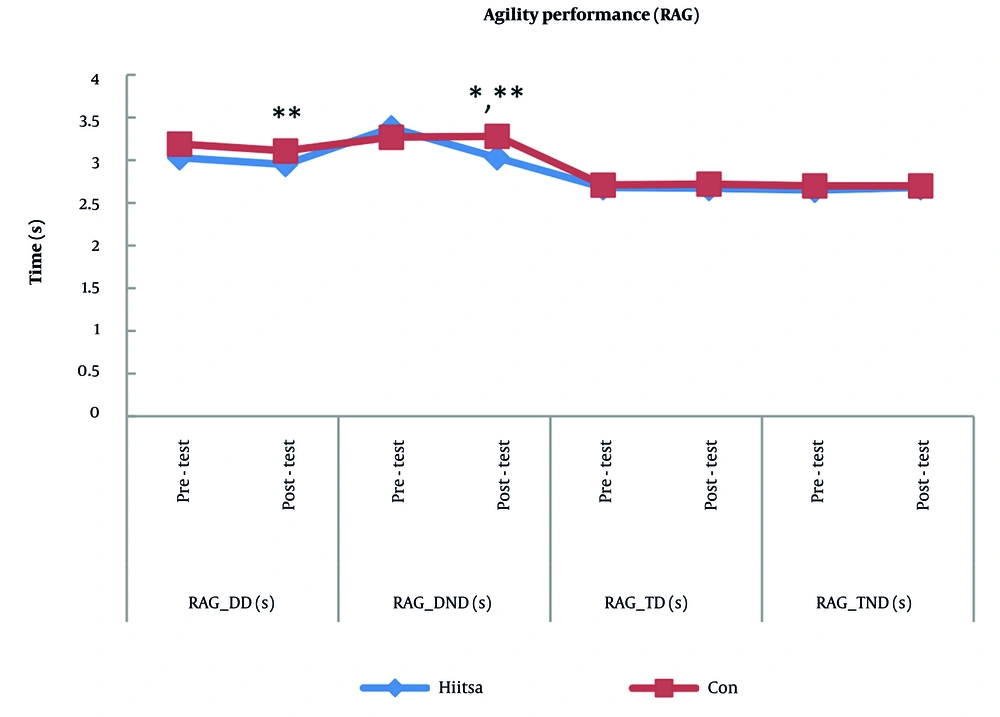
Figure 2.
The effect of agility performance reactive agility (RAG) response following high-intensity interval training with step aerobics training (HIITSA) training of futsal players is presented. Abbreviations: RAG_DD, reactive agility with dribbling on the dominant side; RAG_DND, reactive agility with dribbling on the non-dominant side; RAG_TD, reactive agility with ball touching on the dominant side; RAG_TND, reactive agility with ball touching on the non-dominant side; s, second. An asterisk (*) indicates a significant difference from pre-training (P ≤ 0.05), (**) indicates a significant difference between groups (P ≤ 0.05).
The statistical analysis of agility performance RAG between the HIITSA and control group revealed effects on RAG_DD (P = 0.007) and RAG_DND (P = 0.031). However, no significant effects were observed on RAG_TD (P = 0.226) and RAG_TND (P = 0.348) (Table 2 and Figure 2).
The statistical analysis of agility performance (COD) before and after the HIITSA revealed effects on CODS_DD (P = 0.003), CODS_DND (P = 0.001), CODS_TD (P = 0.030), and CODS_TND (P = 0.038) (Table 3 and Figure 3).
Table 3.
Comparison of Changes in Agility Performance (Change of Direction) from Pre-training to Post-training Following HIITSA Training of Futsal Players is Presented a
| Variables | HIITSA (n = 8) | CON (n = 7) |
|---|---|---|
| CODS_DD (s) | ||
| Pre-test | 3.09 ± 0.19 | 3.00 ± 0.12 |
| Post-test | 2.88 ± 0.15 b, c | 3.14 ± 0.23 |
| CODS_DND (s) | ||
| Pre-test | 3.05 ± 0.17 | 3.15 ± 0.21 |
| Post-test | 2.87 ± 0.15 b, c | 3.10 ± 0.21 |
| CODS_TD (s) | ||
| Pre-test | 2.71 ± 0.12 | 2.69 ± 0.07 |
| Post-test | 2.62 ± 0.09 b | 2.76 ± 0.23 |
| CODS_TND (s) | ||
| Pre-test | 2.70 ± 0.16 | 2.72 ± 0.10 |
| Post-test | 2.64 ± 0.13 b | 2.75 ± 0.11 |
Abbreviations: HIITSA, high-intensity interval training with step aerobics training; CODS_DD, change-of-direction speed with dribbling on the dominant side; CODS_DND, change-of-direction speed with dribbling on the non-dominant side; CODS_TD, change-of-direction speed with ball touching on the dominant side; CODS_TND, change-of-direction speed with ball touching on the non-dominant side; s, second.
a Values are expressed as mean ± SD.
b Indicates a significant difference from pre-training (P ≤ 0.05).
c Indicates a significant difference between groups (P ≤ 0.05).
![The effect of agility performance [change of direction (COD)] response following high-intensity interval training with step aerobics training (HIITSA) training of futsal players is presented. Abbreviations: CODS_DD, change-of-direction speed with dribbling on the dominant side; CODS_DND, change-of-direction speed with dribbling on the non-dominant side; CODS_TD, change-of-direction speed with ball touching on the dominant side; CODS_TND, change-of-direction speed with ball touching on the non-dominant side; s, second. An asterisk (*) indicates a significant difference from pre-training (P ≤ 0.05), (**) indicates a significant difference between groups (P ≤ 0.05).](https://brieflands.com/journals/mejrh/articles/158636/figures/mejrh-158636-i003-F3-preview.webp "The effect of agility performance [change of direction (COD)] response following high-intensity interval training with step aerobics training (HIITSA) training of futsal players is presented. Abbreviations: CODS_DD, change-of-direction speed with dribbling on the dominant side; CODS_DND, change-of-direction speed with dribbling on the non-dominant side; CODS_TD, change-of-direction speed with ball touching on the dominant side; CODS_TND, change-of-direction speed with ball touching on the non-dominant side; s, second. An asterisk (*) indicates a significant difference from pre-training (P ≤ 0.05), (**) indicates a significant difference between groups (P ≤ 0.05).")
Figure 3.
The effect of agility performance [change of direction (COD)] response following high-intensity interval training with step aerobics training (HIITSA) training of futsal players is presented. Abbreviations: CODS_DD, change-of-direction speed with dribbling on the dominant side; CODS_DND, change-of-direction speed with dribbling on the non-dominant side; CODS_TD, change-of-direction speed with ball touching on the dominant side; CODS_TND, change-of-direction speed with ball touching on the non-dominant side; s, second. An asterisk (*) indicates a significant difference from pre-training (P ≤ 0.05), (**) indicates a significant difference between groups (P ≤ 0.05).
5. Discussion
This study aimed to evaluate the impact of a 4-week HIITSA program on agility performance during the pre-season in professional futsal players. The major findings indicate that the short-term HIITSA protocol, which integrates HIIT with bench SA, effectively enhances agility performance among players (9, 14).
The observed enhancement in agility in this study can be attributed to the combination of HIIT and SA. The HIIT emphasizes high-velocity, intense movements, which enhance muscle reactivity and neuromuscular adaptations essential for rapid directional changes and acceleration (17, 18). This is evident from the assessment of agility by dribbling of athletes in the HIIT group using SA, which induced significant cognitive adaptation compared to the control group on the CODS and RAG tests with the Witty SEM Smart light transmitter. Conversely, SA, characterized by repetitive and choreographed movements, significantly contributes to improving agility by training players to perform swift transitions and maintain balance efficiently (19-21). This combined training approach optimizes neuromuscular signaling efficiency, allowing players to respond rapidly to game dynamics (22), while also increasing balance and muscle responsiveness through rhythm-based movements (23).
These results align with previous research showing that HIIT enhances anaerobic capacity, cardiovascular endurance, and explosive strength (8, 12, 24), while SA improves coordination and agility through rhythm-based movements (14). The combination effectively addresses the agility demands of futsal matches. Ultimately, this approach equips players with the agility skills critical for success in the fast-paced environment of futsal (9, 25, 26).
It is interesting to note that HIITSA training enhanced agility in both the dominant and non-dominant legs. This outcome may suggest that HIITSA contributes to the development of neurocognitive function responsible for controlling movements on the non-dominant side of the body (4, 27). Additionally, no significant muscle hypertrophy was observed post-training, likely due to the brief four-week duration, which aligns with previous research suggesting that a longer period is generally required to achieve statistically significant muscle growth. An earlier narrative review presented by Caparrós-Manosalva et al., and Neves et al., shows that HIIT requires at least 6 to 12 weeks to begin seeing an increase in muscle hypertrophy (3, 8). These findings demonstrated that the HIITSA program directly impacts the nervous system by enhancing cognitive processes, including anticipation, perception, and optimal decision-making (28, 29), contributing to improved motor control and cognitive processing abilities (30). These enhancements play a pivotal role in significantly improving agility, achieved through just 4 weeks of HIITSA training (31). The resulting effect is highly beneficial, as it enables players to execute actions more efficiently during the most intense phases of a futsal match.
In summary, the study highlights the effectiveness of a combined HIIT and SA program in significantly improving agility performance within a short time. As one of the first studies to examine this protocol for futsal, it observed notable improvements in CODS and RAG on both dominant and non-dominant sides. These findings contribute to advancing knowledge in pre-season training, offering a strategic approach to enhance agility, response time, and decision-making, which are critical for futsal performance.
5.1. Limitations
This study demonstrates the short-term effects of HIIT using SA. Although the results are valuable, there are some limitations to this study. First, the distribution of participants between the two groups was slightly unequal; however, the impact on the results of the analyses should be carefully considered. Second, participants were not controlled or given any weight training outside of the experiment, and future studies should control for these limitations.
5.2. Conclusions
It was found that the short-term effects of 4 weeks of combined HIIT and SA training promote increases in the agility level of futsal players, which is closely associated with futsal competitions. These agility gains are likely driven by cognitive adaptations, particularly faster perception and decision-making processes, which are crucial determinants of success in competitive futsal.