
1. Background
The complexities of today's healthcare system necessitate skilled managers who can coordinate services effectively (1). Occupational therapy literature highlights the need for training therapists to become strong leaders and managers to further the profession (2, 3). Consequently, equipping newly graduated therapists or students with management skills is advantageous (4). Although evidence regarding occupational therapists' leadership and management capabilities is limited, it suggests they can significantly contribute as influential managers (4-8). Some disciplines, like occupational therapy, recognize the eventual need for management principles and skills in their careers, yet only receive a brief introduction to management in their curriculum (9). Many new graduates and occupational therapy students prioritize clinical practice, often neglecting the acquisition of management principles and skills (10).
The curriculum for occupational therapy students includes a management and administration course designed to equip them with essential skills for the healthcare system, aligning with their goal of empowering individuals in daily life activities (11). This course expects foundational skills in assessing healthcare system needs, planning to address health issues, coordinating and collaborating with relevant departments, managing personnel and resources, as well as communication and management abilities (12). The knowledge, attitude, and practices (KAP) model is widely utilized in the medical field, indicating that a person's behavior is shaped by their knowledge and attitudes towards those behaviors (13). This study did not address practice as it attempted to apply this model.
Few studies in other disciplines have investigated the importance of the attitude of students toward management skills. A study analyzed the knowledge of dental students about the management skills necessary to create a quality laboratory, and the results showed that they believed management skills would help their career advancement (14). However, this study showed that undergraduate students have limited knowledge and awareness of management skills (14). Furthermore, another study showed that business education significantly influences students to become entrepreneurs by enhancing their awareness of business development through skill acquisition programs (15). However, studies examining the relationship between occupational therapy students' knowledge, attitudes, and management skills have been overlooked. Therefore, it seems that this exploration can determine the effect of this course in enhancing professional goals and the success or failure of an educational process.
2. Objectives
This mixed methods study evaluated the knowledge and attitude related to a management course aimed at improving management skills and job attitudes among occupational therapy students at Semnan University of Medical Sciences.
3. Methods
3.1. Study Design
An Explanatory Sequential Mixed Methods Design was adopted to evaluate the effectiveness of the management course based on the occupational therapy curriculum and to explore the perspective of the occupational therapy students about the outcomes of this course (16). A pre- and post-experimental design without a comparison or control group was implemented during the quantitative phase. In the qualitative phase, a focus group was conducted to explore the benefits, challenges, and efficiency of the course (17).
3.2. Participants
Participants in both the quantitative and qualitative phases were final-year occupational therapy students required to pass their management course. This research utilized a convenience sampling method to gather opinions from all final-year occupational therapy students, resulting in an estimated sample size of 24 participants. The inclusion criteria were final-year occupational therapy students, while those absent from more than one class session or who did not complete questionnaires at each stage were excluded. Additionally, students who had previously studied another field before occupational therapy were also excluded.
3.3. Procedure
Before the course, clear explanations of the course process and research objectives were provided in an orientation session. Interested students completed a consent form for both the quantitative and qualitative research components, which were optional. They could choose to complete the management module without participating in the research if they preferred. Participants completed questionnaires on demographic status, an adapted version of Whetten's managerial skills, and attitudes toward their future job at the end of the orientation session.
The management course was conducted based on the occupational therapy curriculum in 8 sessions. At the end of the last session, the students completed the surveys again. A week later, the students were divided into three groups of 6 - 7 and each participated separately in an in-person focus group session. Following the presentation of the focus group's objectives, the discussion began, focusing on usability, efficiency, generalizability to real conditions, delivery methods, challenges, and benefits. Students outlined the course's challenges, benefits, and key elements. The final question solicited their suggestions for future course adjustments. The focus group started with a general question: "How will this academic course benefit your future career?" followed by additional inquiries.
The focus group sessions were led by an experienced occupational therapist in both academic and clinical background. Field notes on non-verbal communication and key statements were taken during the sessions. The focus groups were recorded and transcribed verbatim, and the transcripts were compared to the session notes.
3.4. Course Description
This study evaluated the knowledge and attitudes of Semnan University of Medical Sciences occupational therapy students towards the management course through eight two-hour sessions based on the occupational therapy curriculum, which included:
- Session 1: Course introduction, objectives, resources, components of the healthcare system, and its significance. Group discussion focused on the relevance of management principles.
- Session 2: Overview of leadership and management traits in healthcare, the history of these roles in occupational therapy, and informal leadership approaches. The group discussed the consequences of new graduates' disinterest in management.
- Session 3: Attributes of an occupational therapy (OT) service manager and introduction to the managerial hierarchy in the OT profession. Group discussion analyzed the tasks and responsibilities within this hierarchy.
- Session 4: Focused on essential communication skills for management, including speaking and writing, handling interpersonal challenges, and promoting collaboration. The group engaged in role-playing to address difficult workplace scenarios and examined ethical dilemmas.
- Session 5: Focused on management functions, opportunities, administrative and organizational processes in OT service provision, personnel management, and HR responsibilities. The group discussed hiring processes in various settings.
- Session 6: Management strategies for maintaining staff competency, performance monitoring, team relationship management, and personnel dismissal policies. Group discussion focused on the disciplinary process for addressing employee issues.
- Session 7: Focused on financial resource management, encompassing budgeting, revenue, expenses, and performance reporting. The group discussed calculating net income and tackling insurance issues in occupational therapy.
- Session 8: Addressed professional conduct, the importance of teamwork in interdisciplinary settings, the interplay between management and teamwork, workplace regulations, and ethical principles in OT services. The group explored ethical work environments and management strategies for resolving ethical dilemmas.
3.5. Measures
3.5.1. Demographic Questionnaire
The demographic questionnaire included age and gender.
3.5.2. Adapted Whetten Management Skills Assessment Questionnaire
This questionnaire assesses three key categories of management skills: Personal, interpersonal, and group skills, using 73 questions. Personal skills encompass self-awareness, stress management, and problem-solving. Interpersonal skills include supportive communication, power and influence strategies, motivating others, and conflict management. Group skills involve effective empowerment, delegation, team development, and leading positive change. The questionnaire, originally published in "Developing Management Skills," was reported by Whetten to have favorable validity and a reliability score of 0.80 based on Cronbach's alpha. Responses are scored on a five-point Likert scale (1 = completely disagree, 5 = completely agree), with total scores ranging from 72 to 432. A score of 350 or higher indicates excellent management skills, 320 - 349 suggests good skills, 300 - 319 indicates moderate skills, and below 300 reflects poor skills (18).
3.5.3. Attitude Toward Field of Study and Future Job
A self-made questionnaire inspired by Hafferty and Boulger's research was utilized (19). It consists of 20 items assessing attitudes toward the field of study and future career using a five-point Likert scale (ranging from completely disagree to completely agree). A score of 20 reflects a negative attitude, while a score of 100 indicates a positive outlook on the future career. The tool's validity and reliability were deemed acceptable (20).
3.6. Ethical Consideration
The ethics committee of Semnan University of Medical Sciences has approved the study procedure (IR.SEMUMS.REC.1401.215).
3.7. Date Analysis
Information was entered into SPSS software version 26. Descriptive statistics included the mean and standard deviation for the studied variables. The normal distribution of the variables was confirmed by the Kolmogorov-Smirnov test. Therefore, the paired t-test was used to compare the variables before and after the management course.
Content analysis was used in the qualitative phase. The transcription of the focus group session interviews was read several times by the first and second authors. Initially, semantic units were obtained, followed by subthemes, and finally themes. These authors analyzed the interviews separately to increase trustworthiness (21). The interviews were read line-by-line, and data were initially coded to identify all the issues discussed. The first and second authors coded all three focus groups. The coding items were discussed and agreed upon in a meeting with all research team members after independent analysis. Finally, themes were identified.
4. Results
4.1. Participant Characteristics
The management course was a mandatory module in the occupational therapy program. All 24 students participated in the study and completed the questionnaires, with none having studied in another field. In the quantitative phase, the results of 21 students (mean age 22.24 ± 0.83 years), including 11 men (52.4%) and 10 women (47.6%), were analyzed. Three students missed more than one class. All 24 students (mean age 22.25 ± 0.79 years), comprising 12 men and 12 women, participated in the qualitative phase.
4.2. Quantitative Phase: Effects of Management Course on Management Skills and Attitude Toward Future Job
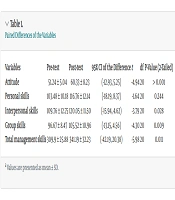
The management skills assessment questionnaire indicated differences between pre- and post-course scores. There was no significant change in personal skills (t = -1.64, df = 20, P = 0.244). However, interpersonal skills (t = -3.79, df = 20, P = 0.028) and group skills (t = -4.30, df = 20, P = 0.009) significantly improved, as did the total questionnaire scores (t = -5.98, df = 20, P < 0.011). Additionally, the "attitude toward the field of study and future job questionnaire" scores (t = -4.941, df = 20, P < 0.001) reflected increased motivation and a more positive outlook on their field and future career after the course (Table 1).
Table 1.
Paired Differences of the Variables
| Variables | Pre-test | Post-test | 95% CI of the Difference | t | df | P-Value (2-Tailed) |
|---|---|---|---|---|---|---|
| Attitude | 51.24 ± 5.04 | 60.33 ± 8.23 | (-12.93, -5.25) | -4.94 | 20 | > 0.001 |
| Personal skills | 103.48 ± 10.18 | 116.76 ± 12.14 | (-18.19, -8.37) | -1.64 | 20 | 0.244 |
| Interpersonal skills | 109.76 ± 12.75 | 120.05 ± 11.50 | (-15.94, -4.62) | -3.79 | 20 | 0.028 |
| Group skills | 96.67 ± 8.47 | 105.52 ± 10.96 | (-13.15, -4.56) | -4.30 | 20 | 0.009 |
| Total management skills | 309.9 ± 25.88 | 341.19 ± 32.23 | (-42.19, -20.38) | -5.98 | 20 | 0.011 |
a Values are presented as mean ± SD.
4.3. Qualitative Phase: Focus Group Feedback
4.3.1. Theme 1: The Job Knowledge
Students reported that the management module helped them focus on issues beyond just treating patients, such as their future job. The first sub-theme was "career readiness." The majority of the students stated that this module effectively enhanced their understanding by increasing knowledge about future job issues. One student said, "Well, until now I've been thinking more about assessing and managing my clients. This course has introduced me to many of the challenges I'm going to face in the work environment and prepared me on how to approach a job situation in the future and how to face possible challenges" (P9).
The second sub-theme was "career insight." This module was a great opportunity for students to address their weaknesses or strengths in career issues. One student remarked, "Before this course, I had a minimal view of the field and career issues, and I realized that if I face a challenge in the job situation, I can find a solution by knowing rules and related principles. I think we need to acquire more rich information in some of the topics that we have learned" (P12).
4.3.2. Theme 2: Important and Practical Topics
The sub-themes identified in this section were "workplace relationships" and "financial management." Students indicated that the material taught in this course was relevant and integrated. However, some course topics were reported as more necessary and important according to the students' opinions. One student stated, "...for example, if we have to make a judgment between our patient and one of our clinic staff, what should we do and how should we behave so that no party is morally harmed.... I found this section in this course to be both useful and interesting" (P21). Another said, "...the important and useful part of this course, in my opinion, was the part related to the relationship between a manager with personnel or solving contradictions between two colleagues" (P15).
Another student pointed out, "One of the discussions that was taught in this course was the types of work groups... Well, when we enter the job environment, we may be offered various suggestions, such as cooperation in teams and groups, or management and leadership of those teams. It is crucial that we have the ability to manage finances at different levels" (P9). One of the other students said, "... I want to earn income from my profession in the future so I have to learn more and more about financial accounts and management... To avoid getting into trouble later, it's important to practice this part more in this course" (P2).
4.3.3. Theme 3: Adapting the Course to Real-Life Practice
Students' comments on this theme shed light on their perception of the course design. The adapting course theme revealed sub-themes of "real-life practice" and "practical presentation." Students made suggestions for using other learning methods, especially the applied approach, in this course and mentioned using these approaches to increase their understanding of useful educational content. For example, one student said, "... Well, I was less able to communicate with the topics of this course, which means it was difficult for me and I did not understand.... How to use some topics in the future...... It would be better understood if it was more practical. For example, if we wrote a letter nearly or communicated with personnel through role-playing, could have a better understanding" (P18).
Students suggested being in work environments related to occupational therapy services, observing some communication characters in the workplace, and interviewing managers to better understand the concepts of this course. They stated that maybe adding a practical part can help to make this lesson more effective. One of them stated, "...Another thing is that this lesson may need to observe or practice in real life so that we can better understand how a manager deals with his work issues and learn how to implement some rules in practice, but I don't know exactly how to add an observation or practical part to it ..." (P11) (Table 2).
Table 2.
Focus Group Themes
| Themes | Subthemes |
|---|---|
| Job knowledge | Career readiness; career insight |
| Important and practical topics | Financial management; workplace relationships |
| Adapting the course | Real-life practice; practical presentation |
5. Discussion
This study showed that the management course in the occupational therapy curriculum significantly enhanced occupational therapy students’ knowledge and attitudes, such as interpersonal skills, including communication, motivation, and conflict management. Additionally, students improved in group skills like empowerment, delegation, and leadership. While some skills come from experience (18), this course effectively cultivated essential management attitudes and skills. Management courses have limited evidence of improving competencies in higher education, especially in medical sciences and occupational therapy. However, they do enhance personal insight and learning, emphasizing the importance of teacher training and support (22, 23). Clark et al. discovered that students enrolled in a management skills course showed notable increases in emotional intelligence, unlike the control group (24). However, no significant improvements were noted in personal skills like self-awareness, stress management, and problem-solving, despite the importance of self-awareness for leadership.
Though students felt the course enhanced their readiness and knowledge, quantitative analysis contradicted this. The course lacked depth in stress management and problem-solving techniques, which are vital for qualities like self-control and resilience essential for job challenges (25). A qualitative study evaluated personnel management in occupational therapy with 30 students, focusing on health service and human resource management principles. It enhanced Fazio's curriculum by incorporating leadership skills and characteristics to better equip students for relevant leadership styles (9). Tempest and Dancza highlighted the need for a leadership style in occupational therapy that resonates within and outside organizations (3). Evidence shows that occupational therapists can lead effectively within health systems, necessitating curriculum changes to include leadership training.
With the growing use of technology in health services, students need to receive training in this area. New graduates can take on leadership roles through collaboration, innovation, and understanding of regulations. Thus, renaming the management course to "Management and Leadership" would better serve the needs of occupational therapy.
In the qualitative phase of this study, the first theme indicated that students were able to grasp course concepts in alignment with their professional needs, supporting Fazio's findings (9). Students noted improvements in their knowledge, attitudes, and preparation for future work, gaining greater awareness of their strengths and weaknesses. In the second theme, they highlighted the significance of financial management and ethical workplace relationships, although they felt constrained by time to explore these topics. Some topics in Fazio's study were deemed excessive and unnecessary, with students noting insufficient time for discussion and opinion exchange (9).
The third theme emphasized the need to change the course's presentation style. Current methods rely on lectures and discussions, but student feedback indicated that practical exercises or role-playing could improve effectiveness. Evidence-based management training, like Behavior Modeling Training (BMT), has been shown to enhance student performance compared to traditional approaches (26-28). Fazio's study also indicated a preference for active learning styles, such as group participation (9).
5.1. Limitations
This study faced several limitations, including a small sample size and the absence of a control group, as participation in the course was mandatory for final-year occupational therapy students in Iran. Additionally, the course's short duration of 17 hours over eight sessions limited the depth of coverage on certain topics. It is important to acknowledge that a 17-hour program cannot comprehensively address all management topics. The current study utilized a limited number of outcome measures; therefore, future research should assess self-efficacy, awareness, self-confidence, and related factors.
5.2. Conclusions
The findings indicate that the management course significantly improved students' management skills and attitudes toward their field of study and future careers. These results, supported by focus group insights, highlight the positive impact of targeted management education on both practical skills and perceptions. Based on student feedback, revisions to the course materials and methods are needed to address certain topics more thoroughly.