
1. Background
Volleyball is one of the most popular sports in the world and because of its popularity, many studies have attempted to find the most comprehensive training program to improve the physical performance of volleyball players (1). In addition to tactical and technical skills, muscular strength and power have proven to be crucial to success in high-level volleyball competitions (2). On the other hand, this sport is considered a serious competitive sport with a high level of skeletal muscle injury. About 63% of musculoskeletal injuries are seen in jump and landing movements, which form an essential part of volleyball defense and attack (3). Deciding on having a training program is an important task for coaches. Among other things, coaches need to decide which type of physical activity is most effective for the athlete to perform and to prevent possible injuries. From this point of view, choosing the training that has a positive effect on more than one factor at a time seems interesting (4).
The FIFA Medical Research and Evaluation Center, in collaboration with the Oslo Sports Injury and Research Center and the Santa Monica Sports Medicine and Orthopedic Center, has expanded a comprehensive 11+ warm-up program aiming at preventing injuries in football. The program consists of three parts: slow running training, strength training, plyometric, balance training and quick running training (5). Despite the success of the FIFA 11+ program in preventing sports injuries (6-8), it seems difficult to persuade athletes and coaches to perform this training solely to prevent injury, unless the training has a positive significant effect on their performance. There is evidence that training programs, including plyometric, balance training and lumbar pelvic stabilization training, can directly improve athlete performance variables, especially those associated with vertical jump height, strength, and agility (9, 10). In this regard, it was reported that although both plyometric and skill training programs made positive changes in athlete jumping and throwing capacity, plyometric training was more effective than skill training in improving these capacities in elite female volleyball players (11). Fazl Ersi et al. (12) stated that central stability is effective in power transfer during exercises; therefore, a greater emphasis on strengthening these muscles may be effective in improving athletic performance. Eight weeks of strength and plyometric training led to improved height jump in young female volleyball players (13). FIFA 11+ training improved the speed, jump, and stability of young amateur soccer players (14). Also, eight weeks (15), four weeks (16), and nine weeks (17) of the FIFA 11+ training resulted in improved jump height in young soccer players (15). However, contrary to the above results, some studies indicated the ineffectiveness of FIFA 11+ injury prevention program in promoting athletes' performance. For example, in Zarei et al. study (18), a 10-week FIFA 11+ injury prevention program had no significant effect on the improvement of zigzag dribbling, Illinois, sitting and reaching, vertical jump, 20 m sprint, and Planck sideways. Also, nine weeks of FIFA 11+ training had no significant effect on improving balance, speed, agility, and vertical jump (19).
2. Objectives
There has been a great deal of research on the impact of the FIFA 11+ injury prevention program on athletes’ performance in soccer (16, 17, 20). In this regard, researchers have recently conducted some research in other sports, including handball (21) and basketball (22), but a few studies have examined the impact of the FIFA 11+ program on the performance of volleyball players. Therefore, this study aimed to investigate the impact of this type of injury prevention program on the performance of male volleyball players. On the other hand, if FIFA 11+ training improves the agility and explosive power of volleyball players, which is an important factor in volleyball defense and spike movements, it can be expected that coaches and athletes are more inclined to accept this warm-up program.
3. Methods
In this quasi-experimental applied study, 24 male volleyball players from the Islamic Azad University of Marvdasht were selected as the sample. The inclusion criteria comprised having at least three years of teamwork in volleyball and being at a level of ability to play in the college team. The exclusion criteria included the subjects’ lack of consent and willingness to continue the research process, lack of participation in two consecutive training sessions, inappropriate cooperation during the study, and having injury and pain during the study and at the posttest.
Before starting the intervention program and learning how to perform correctly, all the players participated in a training workshop where they received video training and explanations about the intervention program. In the end, a summary of the training style guidelines was provided to the athletes and they were asked to study it and sign consent forms.
First, the agility (by Illinois test) and explosive power (by horizontal jump and vertical jump test) were measured (23, 24). The Illinois test was used to measure agility. The length of the Illinois test is 10 meters by 10 meters, which is determined by the cones of the track. Four cones were centered at a distance of 3.3 m from each other and the other four cones were 2.5 m away from the central cones. Participants lay behind the starter line on the abdomen as the hands were held next to the body and the head either turned sideways or looked forward. With the “move” command, participants stood on their feet and moved rapidly to the first marker cone, turned it around, and moved to the first central cone, and then they ran up and down the cones. The participants, then, rotated around the second marker on the endpoint at their maximum speed, and moved to the finish line and passed it. The duration of tests being performed correctly was recorded in seconds (25). To evaluate the Sargent jump, participants inked their right fingers, stood on the right side of a wall, and lifted their right hand as high as possible, marking the highest point they could touch. At the moment of jumping, participants could freely bend their lower limbs and use their upper limb movement to reach the peak of the jump. At the highest jump point, participants had to touch the highest possible point with their right hand against the wall. The height of the jump was the difference between the points marked on the wall.
All subjects completed three attempts with a minimum of 45-second intervals between each attempt and only the best jump was considered as their jump height (26). To measure the jump length, participants stood behind a line. They made the long jump by using their hands’ movement. The distance between the heel to the starting line was calculated as the length of the jump. Each subject made the jump twice and the maximum jump length was recorded (27). Subjects were then divided into two groups of 12, including 11+ training (Table 1) and control. The 11+ training group performed FIFA 11+ training for eight weeks, three sessions per week and 20 minutes each session (28). It is worth noting that this training was designed with a focus on central muscle stability, neuromuscular control, eccentric hamstring strength, and agility. During this period, the control group performed only their usual activities. Twenty-four hours after the last training session, similar to the pretest, the agility and explosive power of the subjects in the 11+ training and control groups were measured. The Shapiro-Wilk and independent/dependent sample t-tests were used to analyze the data (P ≤ 0.05).
Table 1.
The 11+Training Protocol
| Training | Part | ||
|---|---|---|---|
| Part 1 | Part 2 | Part 3 | |
| Type of training | Slow running, active stretching, and player-controlled collisions | Six sets of training focusing on strength, balance, muscle control, and central muscle stability | High speed running with diversion |
| Duration, min | 8 | 10 | 2 |
4. Results
The demographic characteristics of the subjects are presented in Table 2. Also, the pretest levels of agility and explosive power are presented in Table 3.
Table 2.
Demographic Characteristics of Subjects in Six Groups of Research at the Beginning of the Research Period
| Age, y | Height, cm | Weight, kg | |
|---|---|---|---|
| Training | 20.31 ± 1.16 | 189.75 ± 5.62 | 79.52 ± 7.71 |
| Control | 22.12 ± 2.53 | 191.31 ± 4.77 | 81.57 ± 9.88 |
Table 3.
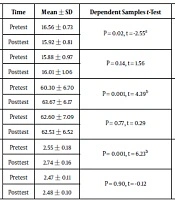
The Results of Independent Samples t-Test and Dependent Samples t-Test to Examine the Effect of FIFA 11+ Training on Agility and Explosive Power
| Variable | Group | Time | Mean ± SD | Dependent Samples t-Test | Independent Samples t-Test |
|---|---|---|---|---|---|
| Illinois test record | Training | Pretest | 16.56 ± 0.73 | P = 0.02, t = -2.55a | P = 0.008, t = -2.91c |
| Posttest | 15.92 ± 0.81 | ||||
| Control | Pretest | 15.88 ± 0.97 | P = 0.14, t = 1.56 | ||
| Posttest | 16.01 ± 1.06 | ||||
| Horizontal jump test record | Training | Pretest | 60.30 ± 6.70 | P = 0.001, t = 4.39b | P = 0.001, t = 4.25d |
| Posttest | 63.67 ± 6.17 | ||||
| Control | Pretest | 62.60 ± 7.09 | P = 0.77, t = 0.29 | ||
| Posttest | 62.53 ± 6.52 | ||||
| Vertical jump test record | Training | Pretest | 2.55 ± 0.18 | P = 0.001, t = 6.23b | P = 0.001, t = 4.67d |
| Posttest | 2.74 ± 0.16 | ||||
| Control | Pretest | 2.47 ± 0.11 | P = 0.90, t = -0.12 | ||
| Posttest | 2.48 ± 0.10 |
aSignificant decrease in the posttest compared to the pretest
bSignificant increase in the posttest compared to the pretest
cSignificantly lower in the 11+ training group than in the control group
dSignificantly higher in the 11+ training group than in the control group
The results of the independent samples t-test showed that the Illinois test record was significantly lower in the 11+ training group than in the control group (P = 0.008, t = -2.91). However, the horizontal jump test record (P = 0.001, t = 4.25) and vertical jump test record (P = 0.001, t = 4.67) were significantly higher in the 11+ training group than in the control group. The results of dependent samples t-test showed that in the 11+ training group, the Illinois test record at the posttest significantly decreased compared to the pretest (P = 0.02, t = - 2.55); however, the horizontal jump test record (P = 0.001, t = 4.39) and vertical jump test record (P = 0.001, t = 6.23) significantly increased at the posttest compared to the pretest. In the control group, there was no significant difference in the pretest and posttest results of Illinois test record (P = 0.14, t = 1.56), horizontal jump test record (P = 0.77, t = 0.29), and vertical jump test record (P = 0.90, t = -0.12). The results of the present study showed that eight weeks of FIFA 11+ training had a significant effect on improving vertical jump and long jump in young college volleyball players, implying that athletes who performed FIFA 11+ training had significantly better explosive performance (vertical and long jumps) than control subjects.
5. Discussion
The results showed that eight weeks of FIFA 11+ training had a significant effect on improving vertical jump and long jump in young volleyball players. Consistent with the findings of the present study, Ayala et al. (14), Akbari et al. (15), and Costa Silva et al. (17) reported that FIFA 11+ training improved vertical jump in young male soccer players. Fazl Ersi et al. (12) showed that strengthening the central stability of the body was effective in transmitting power in high jump motion. Also, Gjinovci et al. (11) reported that plyometric training improved the jumping capacity of female volleyball players. Similarly, Hale et al. (13), Marques et al. (2), and Pereira et al. (1) stated that strength training and plyometric training were effective on vertical jump in young female volleyball players. Nevertheless, inconsistence with the results of the present study, Gomes Neto et al. (20) in a systematic review and meta-analysis showed that FIFA 11+ training did not improve jump height among football players. Gatterer et al. (29) reported that five weeks of FIFA 11+ training did not affect standing long jump performance in children aged < 14 years. Inconsistency between the results of the present study and Gatterer et al. (29) study can be due to different samples. Since the second part of FIFA 11+ focuses on lower extremity strength, central stability, plyometric/agility, and balance training (19), it seems that one of the important reasons for the positive impact of FIFA 11+ on the explosive power of volleyball players could be the existence of a second part training.
The results of the present study also showed that eight weeks of FIFA 11+ training had a significant effect on improving (decreasing) the time of Illinois agility test in male college volleyball players. In line with the findings of the present study, Hale et al. (13) showed that plyometric and strength training improved the agility of young female volleyball players. Also, Daneshjoo et al. (30) suggested that the 11+ warm-up program could improve the Illinois agility test in soccer players. Besides, Pomares-Noguera et al. (16) reported that the 11+ training could improve the agility time in adolescent soccer players. In this respect, it can be stated that since the third part of the 11+ training involves running training with diversion (crop motions) (19), the agility time improvement was seen in these studies. However, contrary to the findings of the present study, Zarei et al. (18) reported that the FIFA 11+ program for children did not affect vertical jump performance and agility of adolescent soccer players. Moreover, Impellizzeri et al. (19) suggested that the 11+ training, despite its effect on knee flexing muscle strength, did not have a real impact on the agility and vertical jump of soccer players. One of the reasons why the findings of these two studies are inconsistent with the present study findings is the difference in age and exercise type (i.e., the two studies were performed on soccer players).
5.1. Conclusions
According to the findings of the present study, it seems that the 11+ training increases athletic performance by improving lower limb explosive power and Illinois agility in male volleyball players. Therefore, it is suggested that volleyball players, like football players, use this injury prevention program to improve their athletic performance in addition to reducing injury.