
1. Background
Futsal, which originated in South America in the 1930s as “Futebol de Salão,” is now globally recognized by FIFA (1). In addition to tactics and technique, optimal performance depends on physiological and biomechanical conditioning. Key determinants, including acceleration, reaction time, stride length, and step frequency, are critical but often overlooked.
Regular physical activity prevents chronic diseases and improves health (2); however, adherence remains a challenge (3). Professional success requires high levels of strength, endurance, speed, and flexibility (4). In futsal, inadequate conditioning can impair tactical execution, reduce endurance, and increase injury risk (5). This issue is particularly relevant in Iraq, where league transition periods are short and teams have only about six weeks, with four sessions per week, to prepare players. These constraints limit physical and biomechanical development and make nutrition and supplementation increasingly important (2).
The increasing use of supplements in sports reflects athletes’ pursuit of strategies to reduce fatigue and improve performance (6). One widely used product is C4 pre-workout, which contains caffeine, beta-alanine, creatine nitrate, and other compounds (7). Because caffeine is known to influence endurance and power, this supplement has gained popularity, although its effects remain debated. Meanwhile, pulse oximetry provides a noninvasive method for monitoring peripheral capillary oxygen saturation (SpO2), a critical determinant of athletic performance (8).
The high-intensity nature of futsal requires both anaerobic and aerobic fitness (9). Physiological monitoring, including heart rate, blood pressure, and respiratory rate, helps coaches assess players’ adaptation and readiness (10). Strength development, particularly explosive strength, is essential for acceleration, jumping, and rapid offensive or defensive transitions (11, 12). Explosive strength directly supports reaction time and speed, both of which are decisive in goal-scoring and counterattack situations (13).
From a biomechanical perspective, speed is determined by stride length and step frequency (14). Improving either component increases velocity, although their interdependence makes isolated training challenging (15). Moreover, external factors, such as footwear, surface interaction, and ground compliance, affect in-game speed (10). Research also indicates that lean muscle mass is strongly correlated with strength and speed, whereas a higher fat percentage reduces performance (16).
Collectively, these physiological and biomechanical insights underscore the need for targeted training and supplementation strategies tailored to futsal players, particularly given their limited preparation time and the sport’s explosive demands.
2. Objectives
This study evaluated the effects of a six-week targeted training program, with and without C4 supplementation, on Iraqi Premier League futsal players during the fitness maintenance phase. Specifically, it examined changes in biomechanical variables (acceleration, stride length, step frequency, and reaction time), explosive strength, speed, and blood oxygen saturation (SpO2). The study also aimed to determine whether C4 supplementation provides measurable benefits beyond structured training alone.
3. Methods
A quasi-experimental design with three groups, including two experimental groups (EX1 and EX2) and one control group (CON), each comprising 15 players, was used.
3.1. Assessment Phases
Baseline measurements included SpO2, explosive strength, acceleration, reaction time, step length, and step frequency. Variables were reassessed at weeks 3 and 6. EX1 received specialized training plus C4 supplementation, EX2 received the same training plus a placebo, and CON received standard club training.
3.2. Participants
Forty-five male players aged 18 - 22 years volunteered and were randomly assigned to the groups. A G*Power analysis (version 3.1) indicated that 36 participants were required (f = 0.25, 80% power, α = 0.05). Forty-five participants were recruited to account for attrition.
3.3. Inclusion and Exclusion Criteria
Players were included if they were active in the league and in good health. Exclusion criteria included medical issues, withdrawal, or missing more than three sessions. Participants completed dietary, medical, and sleep questionnaires to assess nutrition, health, and sleep; height and weight were recorded.
3.4. Measurement Tools
SpO2 was measured using a Beurer PO 30 pulse oximeter, which estimates blood oxygen levels via a fingertip sensor and provides real-time data for respiratory assessment.
Explosive strength was assessed using a validated jump protocol in which maximal vertical jumps were used to measure lower-body power.
Biomechanical variables were assessed using 15-meter sprints, which were recorded and analyzed with Kinovea software to determine stride length, stride frequency, and sprint time.
Heart rate (HR) was monitored using a Polar heart rate monitor. Maximum HR was estimated as 220 minus age.
3.5. Training Program
The six-week progressive program comprised four weekly sessions at 65% - 100% intensity and included a warm-up, main phase, and cool-down. Full details of the exercises, intensity, repetitions, and duration are shown in Table 1. Safety protocols required immediate cessation if adverse symptoms occurred.
Table 1.
Six-Week Training Program
| Training Phases (week) | Stretching (min) | Dynamic Warm-up (min) | Training Intensity | Cool-Down (min) | Repetitions | Training Duration (min) |
|---|---|---|---|---|---|---|
| First | 7 | 12 | 65 - 70 | 10 | 3 | 20 |
| Second | 7 | 12 | 70 - 75 | 11 | 3 | 25 |
| Third | 7 | 12 | 75 - 80 | 12 | 3 | 30 |
| Fourth | 7 | 12 | 80 - 85 | 13 | 3 | 35 |
| Fifth | 7 | 12 | 85 - 90 | 14 | 3 | 40 |
| Sixth | 7 | 12 | 90 - 100 | 15 | 3 | 45 |
3.6. Supplementation Protocol
C4 Pump (Cellucor, USA), containing caffeine, beta-alanine, creatine nitrate, and vitamins, was administered twice weekly (5 g in 300 mL of water, 30 minutes before a workout). The placebo was identical in appearance and schedule. Supplements were coded by an independent researcher to maintain blinding. Daily food logs were used to monitor nutrition.
3.7. Statistical Analysis
Descriptive statistics (mean ± SD) were used to summarize all variables. The Shapiro-Wilk test was used to assess normality. Repeated-measures analysis of variance was used to examine between- and within-group differences over time, with Bonferroni post hoc correction applied for multiple comparisons. Full statistics (F, df, P, and ηp2) were reported, and P values < 0.05 were considered statistically significant.
4. Results
Baseline participant characteristics, including age, height, weight, SpO2, and biomechanical variables, are presented in Table 2. Both experimental groups (EX1: training + C4; EX2: training + placebo) showed significant improvements in SpO2, explosive power, starting speed, reaction time, and step length compared with the control group (CON). Step frequency remained unchanged in all groups.
Table 2.
Baseline Characteristics and Normality a
| Variables | Pre-test | 3-Week | 6-Week | Shapiro-Wilk W (P) |
|---|---|---|---|---|
| Age (y) | 19.56 ± 1.40 | - | - | 0.53 (NS) |
| Height (cm) | 167.83 ± 2.44 | - | - | 0.86 (NS) |
| Weight (kg) | 72.61 ± 1.60 | - | - | 0.06 (NS) |
| SpO2 (%) | 96.72 ± 1.03 | 97.05 ± 0.92 | 97.63 ± 1.04 | 0.31 - 0.80 (NS) |
| Explosive power (m) | 1.98 ± 0.14 | 2.08 ± 0.13 | 2.17 ± 0.16 | 0.12 - 0.62 (NS) |
| Start speed (m/s) | 1.48 ± 0.11 | 1.63 ± 0.19 | 1.72 ± 0.23 | 0.35 - 0.71 (NS) |
| Reaction time (s) | 0.80 ± 0.02 | 0.78 ± 0.02 | 0.75 ± 0.04 | 0.12 - 0.48 (NS) |
| Step frequency | 44.36 ± 1.47 | 45.08 ± 1.36 | 45.08 ± 1.51 | 0.12 - 0.43 (NS) |
| Step length (m) | 0.68 ± 0.03 | 0.71 ± 0.03 | 0.73 ± 0.04 | 0.18 - 0.48 (NS) |
a Values are expressed as mean ± SD.
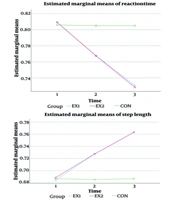
No significant differences were observed between EX1 and EX2 for any variable (all P > 0.05), indicating that C4 supplementation conferred no additional benefit. However, both experimental groups differed significantly from CON in all variables except step frequency (P ≤ 0.009 for SpO2; P < 0.001 for explosive power, starting speed, reaction time, and step length). Temporal changes over the six-week intervention are summarized in Tables 2 and 3 and Figure 1. Except for step frequency, all variables improved consistently in both experimental groups, whereas the control group showed no significant changes.

Figure 1.
Temporal Changes for All Variables (abbreviations: EX1, experimental group one; using the training program and C4 supplement; EX2, experimental group two; using the training program and placebo; CON, control group; continuing their gym's training program).
Between-group comparisons showed no significant differences between EX1 and EX2 (SpO2: t= 0.00, P = 1.00; explosive power, starting speed, reaction time, and step length: all P > 0.05). EX1 showed significant improvements compared with CON in SpO2 (t= 3.21, P = 0.009), explosive power (t= 4.57, P < 0.001), starting speed (t= 3.89, P < 0.001), reaction time (t= 4.12, P < 0.001), and step length (t= 3.98, P < 0.001), with no change in step frequency (t= 0.50, P = 0.62). EX2 showed similar improvements compared with CON in SpO2 (t= 3.18, P = 0.009), explosive power (t= 4.51, P < 0.001), starting speed (t= 3.92, P < 0.001), reaction time (t= 4.08, P < 0.001), and step length (t= 3.95, P < 0.001), whereas step frequency remained unchanged (t= 1.27, P = 0.21).
Within-group analyses showed that both EX1 and EX2 improved significantly from baseline to week 3 and week 6 in SpO2, explosive power, starting speed, reaction time, and step length (all P < 0.05; Table 3). The CON group showed no significant changes in any variable over six weeks, and step frequency remained unchanged across all groups (all P > 0.05; Table 4).
Table 3.
Repeated-Measures ANOVA (Within-Group Differences) a
| Variables and Comparison | F(2, 42) | P | ηp2 | Post-hoc (Bonferroni) b |
|---|---|---|---|---|
| SpO2 | ||||
| EX1 vs. EX2 | 0.15 | 0.87 | 0.007 | NS |
| EX1 vs. CON | 8.72 | 0.008 | 0.29 | S |
| EX2 vs. CON | 8.41 | 0.009 | 0.28 | S |
| Explosive power | ||||
| EX1 vs. EX2 | 0.10 | 0.91 | 0.005 | NS |
| EX1 vs. CON | 15.3 | < 0.001 | 0.42 | S |
| EX2 vs. CON | 14.8 | < 0.001 | 0.41 | S |
| Reaction time | ||||
| EX1 vs. EX2 | 0.12 | 0.89 | 0.006 | NS |
| EX1 vs. CON | 16.0 | < 0.001 | 0.43 | S |
| EX2 vs. CON | 15.5 | < 0.001 | 0.42 | S |
| Step frequency | ||||
| EX1 vs. EX2 | 0.05 | 0.95 | 0.003 | NS |
| EX1 vs. CON | 0.49 | 0.62 | 0.02 | NS |
| EX2 vs. CON | 1.62 | 0.21 | 0.07 | NS |
| Step length | ||||
| EX1 vs. EX2 | 0.08 | 0.92 | 0.004 | NS |
| EX1 vs. CON | 14.9 | < 0.001 | 0.41 | S |
| EX2 vs. CON | 14.3 | < 0.001 | 0.40 | S |
a EX1: Experimental group one, which used the training program and C4 supplement. EX2: Experimental group two, which used the training program and placebo. CON: Control group, which remained in its gym's training program.
b NS: Not significant (P ≥ 0.05); S: significant (P < 0.05).
Table 4.
Key Finding a
| Variables | EX1 vs. EX2 (P) | EX1 vs. CON (P) | EX2 vs. CON (P) | Interpretation |
|---|---|---|---|---|
| SpO2 | 0.87 (NS) | 0.008 (S) | 0.009 (S) | EX1/EX2 > CON, but no difference between experimental groups. |
| Explosive power | 0.91 (NS) | < 0.001 (S) | < 0.001 (S) | Both experimental groups improved compared with CON. |
| Reaction Time | 0.89 (NS) | < 0.001 (S) | < 0.001 (S) | Both experimental groups improved compared with CON. |
| Step Frequency | 0.95 (NS) | 0.62 (NS) | 0.21 (NS) | No improvements were observed in any group. |
| Step Length | 0.92 (NS) | < 0.001 (S) | < 0.001 (S) | EX1/EX2 > CON |
a NS: Not significant (P ≥ 0.05); S: significant (P < 0.05).
5. Discussion
This study examined the effects of six weeks of intensive training, with or without C4 supplementation, on SpO2, explosive power, and biomechanical variables in Iraqi futsal players. Both experimental groups improved significantly in all variables except step frequency. Between-group comparisons indicated that C4 supplementation did not provide additional performance benefits beyond the training program, as no significant differences were observed between the two experimental groups (all P > 0.05; Table 3).
Participants in both EX1 and EX2 showed improvements in all measured variables, except step frequency, following the specialized training regimen. Notably, EX1 demonstrated significant progress between the pre-test and the post-tests conducted at three and six weeks. A similar trend was observed in EX2, whereas CON showed no improvement. The structured training protocol used in this study (17) improved SpO2 levels. This improvement can be attributed primarily to the aerobic exercises incorporated into the training program, which were designed to optimize the players’ physiological capabilities.
The use of cloth masks and hypoxic training may have contributed to moderate oxygen-regulation adaptations, although causal effects cannot be confirmed without direct physiological measurements. Effective preparation for competition requires both general and sport-specific physical fitness, as well as efficient management of time and effort during training. Training under hypoxic conditions induces an oxygen deficit, triggering physiological adaptations that improve the body’s capacity to perform under low-oxygen stress (18).
Physical exertion induces adaptations across multiple systems, including changes in respiratory mechanics and cardiac morphology, depending on the type of exercise (19). Consistent with previous research showing that at least four weeks of training enhances SpO2 (20), the six-week training regimen in this study effectively promoted SpO2 development. Normal oxygen saturation ranges from 95% to 100% according to World Health Organization standards. The attainment of optimal SpO2 levels in participants demonstrates the efficacy of the training program in improving oxygen utilization and overall physiological performance.
High-threshold neuromuscular activation is required to generate the explosive forces needed for the complex, multidirectional movements characteristic of futsal (21). Developing explosive power through plyometric training (jump training) and sprint-specific exercises is particularly important to meet the high-velocity demands of the sport (22). The present training protocol incorporated both modalities to optimize these adaptations. Reaction time, defined as the temporal interval between stimulus detection and movement initiation (23), directly influences a player’s ability to generate maximal power output during explosive movements. Speed capacity, operationally defined as the ability to minimize movement time over a given distance (24), represents another critical determinant of performance. The intermittent nature of futsal requires repeated maximal-effort movements, making the development of both anaerobic power and reactive strength essential (25). The periodized training specifically targeted: 1) rate of force development, 2) movement efficiency, and 3) sport-specific energy-system development.
The integration of these principles reflects the complex neuromuscular demands of competitive futsal, where milliseconds and millimeters often determine performance outcomes. Targeted biomechanical training played a pivotal role in enhancing speed and jumping performance. Both experimental groups demonstrated significant improvements in step length after the structured training program, which incorporated short-distance sprint drills with and without ball control, plyometric exercises, and agility training. Interestingly, although step length increased substantially, step frequency remained unchanged. This selective adaptation likely reflects the physiological challenge of simultaneously developing both parameters within a single training cycle. Running velocity depends on the interaction between step length and step frequency, making the observed enhancement in step length a meaningful contributor to overall speed. The absence of improvement in step frequency does not diminish the effectiveness of the program because gains in step length directly translate into enhanced on-court performance.
Specialized training significantly improved key performance metrics, including SpO2, explosive power, reaction time, and stride length. Under the tested conditions, twice-weekly C4 intake over six weeks had no notable effect on performance. These outcomes are consistent with the descriptive and inferential statistics in Tables 2 and 3.
Previous investigations of C4 and similar pre-workout supplements have reported mixed outcomes, with some studies showing transient improvements in anaerobic capacity or endurance and others reporting no measurable effects. These inconsistencies may stem from variations in active ingredient concentrations, particularly caffeine and creatine nitrate, supplementation frequency, or training intensity. In the present study, twice-weekly intake over six weeks may have been insufficient to elicit significant ergogenic effects. Future research should explore higher dosing frequencies, longer intervention durations, and direct biochemical monitoring to clarify the potential mechanisms underlying the effects of C4 on performance.
Only step length improved significantly. Future studies should test a higher intake frequency or longer intervention durations. Overall, the study highlights the crucial role of well-structured training programs, with supplement effects likely depending on dosage and duration.