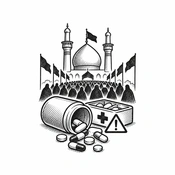
Cover image of the article: Medication Errors During Arbaeen: A Hidden Challenge in Health Services (AI-generated illustration)

Image Credit:AI-generated illustration

Medication Errors During Arbaeen: A Hidden Challenge in Health Services

Authors

Milad Ahmadi MarzalehMilad Ahmadi Marzaleh ORCID1, Zahra EskandariZahra Eskandari ORCID2,*
How to Cite:Ahmadi Marzaleh M, Eskandari Z. Medication Errors During Arbaeen: A Hidden Challenge in Health Services. Mass Gather Med J. 2026;3(2):e173985. doi: https://doi.org/10.69107/mgmj-173985

Dear Editor,
The Arbaeen March is one of the largest religious and peaceful mass gatherings in the world, bringing millions of people from around the world to Karbala each year (1). The lack of health facilities in the host city can create serious problems and risks to people’s health (2). Despite apparent efforts to provide health care to this large population, serious safety challenges, such as medication errors, remain hidden.
Based on the authors’ field experience as medical staff attending this ceremony on multiple occasions, one of the most critical challenges for clinics serving pilgrims—particularly along the Karbala route—is the occurrence of medication errors and the lack of a structured system for reporting, recording, and learning from them.
Medication errors are a complex issue that can arise at any stage of the intricate medication prescribing process. Statistical evidence confirms the alarming extent of these errors, which affect patient safety and the quality of health care (3).
Contributing factors include congestion and noise in health care settings (4), lack of access to patients’ medication records (5), inadequate communication skills among health care staff (3), high workload, staff fatigue (6), and a shortage of skilled personnel (7). This failure to report errors, in turn, allows them to remain hidden. The result of this silence is the continued repetition of errors and the loss of valuable opportunities for learning and prevention.
Practical measures that policymakers can plan and implement to reduce medication errors include the following: 1) designing and establishing a voluntary, nonpunitive, and confidential electronic reporting system; and 2) conducting short, standardized, and mandatory predeployment training courses on medication safety for all health care staff, covering topics such as identifying high-risk medications and accessing patients’ medication histories. Pilgrims are also required to record their medication summaries, complete their vaccinations, and carry their chronic disease medications before the journey. The scientific community and health policymakers are urged to take a fundamental step toward enhancing pilgrim safety by conducting in-depth research and optimally allocating resources; breaking the silence surrounding medication errors will be the first essential step in this endeavor.
Footnotes

  • AI Use Disclosure:The authors declare that no generative AI tools were used in creating this article.

  • Authors' Contribution:All authors contributed equally to this article.

  • Conflict of Interests Statement:The authors have no conflicts of interest to declare.

  • Funding/Support:No funding was received for this study.

References

  • 1.
    Safipour M, Zaeimdar M, Omidvari M, Naserifar R. Presentation of the content network of HSE systematic management components and operational plan in the Arbaeen procession. Journal of Ilam University of Medical Sciences. 2025;33(3):53-66.
  • 2.
    Choi YW, Eltahir EAB. Heat stress during Arba’een foot-pilgrimage (World’s largest gathering) projected to reach “dangerous” levels due to climate change. Geophys Res Lett. 2022;49(19). e2022GL099755. https://doi.org/10.1029/2022gl099755.
  • 3.
    Kwiecień-Jaguś K, Mędrzycka-Dąbrowska W, Kopeć M. Understanding medication errors in intensive care settings and operating rooms—A systematic review. Medicina (Kaunas). 2025;61(3):369. [PubMed ID: 40142180]. [PubMed Central ID: PMC11943574]. https://doi.org/10.3390/medicina61030369.
  • 4.
    Mohebbifar R, Bay V, Alijanzadeh M, Asefzadeh S, Mohammadi N. Factors influencing the incidence of medication errors: The perspective of nurses in teaching hospitals. Payesh (Health Monitor) Journal. 2015;14(4):435-442.
  • 5.
    Manskow US, Kristiansen TT. Challenges faced by health professionals in obtaining correct medication information in the absence of a shared digital medication list. Pharmacy (Basel). 2021;9(1):46. [PubMed ID: 33671820]. [PubMed Central ID: PMC8006028]. https://doi.org/10.3390/pharmacy9010046.
  • 6.
    Ghasemi F, Babamiri M, Pashootan Z. A comprehensive method for the quantification of medication error probability based on fuzzy SLIM. PLoS One. 2022;17(2). e0264303. [PubMed ID: 35213625]. [PubMed Central ID: PMC8880918]. https://doi.org/10.1371/journal.pone.0264303.
  • 7.
    Walton SM. The pharmacist shortage and medication errors: Issues and evidence. J Med Syst. 2004;28(1):63-69. [PubMed ID: 15171069]. https://doi.org/10.1023/b:joms.0000021521.22689.15.

Copyright

Copyright © 2026, Mass Gathering Medical Journal. This open-access article is available under the Creative Commons Attribution 4.0 (CC BY 4.0) International License (https://creativecommons.org/licenses/by/4.0/), which allows for the copying and redistribution of the material only for noncommercial purposes, provided that the original work is properly cited.

Similar Articles

24
Sep
2016
Medical Error as a Challenge in Iran’s Health System

Medical Error as a Challenge in Iran’s Health System

Mohammad Khammarnia,
Fatemeh Setoodehzadeh

Khammarnia M, Setoodehzadeh F. Medical Error as a Challenge in Iran’s Health System. Health Scope. 2017;6(1):e61597. doi: https://doi.org/10.17795/jhealthscope-39743

8
Feb
2017
Medication and Human Errors in Emergency Medicine

Medication and Human Errors in Emergency Medicine

Hassan Motamed,
Mohammad Davood Sharifi

Motamed H, Sharifi MD. Medication and Human Errors in Emergency Medicine. Jundishapur J Nat Pharm Prod. 2017;12(1):e13863. doi: https://doi.org/10.5812/jjnpp.13863

29
Oct
2024
Mass Gathering Medicine: An Emerging Educational Field with a Focus on the Arbaeen Pilgrimage

Mass Gathering Medicine: An Emerging Educational Field with a Focus on the Arbaeen Pilgrimage

Hajar Nikbakht Fini

Nikbakht Fini H. Mass Gathering Medicine: An Emerging Educational Field with a Focus on the Arbaeen Pilgrimage. Mass Gather Med J. 2024;1(2):e160451. doi: https://doi.org/10.69107/mgmj-160451

30
Oct
2025
Barriers and Challenges for Healthcare Professionals in the Context of the Arbaeen Pilgrimage

Barriers and Challenges for Healthcare Professionals in the Context of the Arbaeen Pilgrimage

Leila Mohammadinia,
Elham Safi Najaf Abadi

Mohammadinia L, Safi Najaf Abadi E. Barriers and Challenges for Healthcare Professionals in the Context of the Arbaeen Pilgrimage. Mass Gather Med J. 2025;2(1):e161999. doi: https://doi.org/10.69107/mgmj-161999

30
Oct
2024
Empowerment of Emergency Medical Services Workers in Physiologic Delivery Mass Religious Gatherings: The Neglected Educational Need

Empowerment of Emergency Medical Services Workers in Physiologic Delivery Mass Religious Gatherings: The Neglected Educational Need

Tahereh Yaghoubi,
Marzieh Azizi

Yaghoubi T, Azizi M. Empowerment of Emergency Medical Services Workers in Physiologic Delivery Mass Religious Gatherings: The Neglected Educational Need. Mass Gather Med J. 2024;1(2):e160310. doi: https://doi.org/10.69107/mgmj-160310

More by these authors

Milad Ahmadi MarzalehPubMedScholar
Zahra EskandariPubMedScholar
Share
Cited by
Metrics