
1. Background
Aging is an inevitable biological process accompanied by both pleasant and unpleasant experiences (1). Social, economic, and scientific developments in recent years have led to higher life expectancy and lower mortality rates. The resulting population growth is far greater in developing countries than in developed countries. Iran, a developing country, is no exception to these demographic changes (2). As the number of older adults grows rapidly, the issue of their hygiene, health, and well-being in societies becomes ever more complicated and involves new areas. Aging is associated with both physical changes such as heart diseases and psychological changes like death anxiety (3).
Death anxiety is one of the main issues that older people deal with. Death is an inevitable phenomenon, and thinking about it has played a decisive role in human life since the beginning of history. Some people see death as one stage of life, but some others regard it as the end of life (4). Death anxiety is a latent sentiment that makes one feel the taste of death in everything. Death anxiety is normal, but if it is too severe, it weakens one’s performance (3) and negatively affects physical and mental health, especially in the elderly who feel it approaching after retirement (4). Death anxiety refers to the fear of dying, being cut off from the world, or dreading what happens afterward. While death anxiety is a single experience, people react to it differently. Thus, individual differences such as age, gender, occupation, and the experience of death, along with its confrontation, can affect the level of death anxiety one might have (5). In other words, people’s attitude to death is shaped both consciously and unconsciously by individual, cultural, social, and philosophical variables (6).
Retirement is a formative transition in an older person's life, and it entails important changes in lifestyle and social roles. There is no predetermined age for retirement, but it often comes after old age. The World Health Organization has proposed 60 - 65 years as a convenient yardstick to mark old age. Coupled with retirement, old age gives rise to several losses, including function, friends, and freedom, that might compromise one's mental health (5).
However, studies suggest that army retirees have experienced differently from other retired people, which can influence their physical and mental health. A study of more than 800 military retirees indicated that over half of these individuals had poor mental health (6). The findings from a cohort study addressing factors affecting the mental health of army retirees in 2001 - 2011 demonstrated that these older adults were more likely to experience psychological disorders such as depression and insomnia (7). In addition, the results of another study underscored that, despite the passage of many years since their experience in the Vietnam war, veterans still referred to medical centers because of psychological symptoms (8).
The lack of health can drive a person to social isolation (9). Mehri Nejad et al. (10) reported a significant relationship between social support and death anxiety in the elderly population. The results of another study in Turkey confirmed a significant relationship between death anxiety and depression in older adults living at a nursing home (11).
There is a variety of non-pharmacological therapies for old people with psychological problems such as anxiety, depression, and social isolation. Most notably, one may point to psychological interventions like cognitive therapy, narrative therapy, problem-solving therapy, bibliotherapy, movie therapy, and reminiscence therapy. In this context, reminiscence therapy can positively affect different aspects of social and mental health in the elderly. Musavi et al. (12) observed that reminiscence therapy could influence mental health, especially anxiety, of old people.
Reminiscence therapy is an intervention often used for older people. In the area of nursing interventions, it is used to evoke past events, feelings, and thoughts to promote mental and social health by establishing a happy and active atmosphere. Reminiscence therapy is an attractive, preventive, and therapeutic intervention for the elderly (12). People feel more valued by remembering memories. Indeed, those who successfully recreate their life story will acquire a sense of coherence (3). The results of a meta-analysis of clinical trials emphasized that reminiscence therapy should be integrated into routine care programs designed for older adults with depressive symptoms (13). recalling memories reveals an individual’s philosophy of life and the purpose he/she attaches to living. It helps represent the meaning of life and provides a framework for people’s beliefs about this meaning, which also includes the concept of death. Older adults can release their daily anxieties by telling their past stories (3). Reminiscence therapy has patterns such as reviewing life based on different periods (2) or important life events (14).
Few studies have explored the impact of reminiscence therapy on depression and anxiety in older adults, and such studies have even been conducted on different populations (8, 12, 13, 15). The results of a systematic review, which proposed reminiscence therapy as a non-pharmacological intervention with many benefits, confirmed that group reminiscence therapy affected older people’s depression, yet the authors also noted the need for further research into the effects of this therapeutic approach on anxiety and loneliness (16). Meanwhile, the results of a study conducted in a nursing home in Korea demonstrated that reminiscence therapy is beneficial for older adults with death anxiety (17). Iran’s population is aging, and many old people are retired. Retirees have different experiences that can affect their psychological problems, such as death anxiety.
2. Objectives
The present study attempted to explore the impact of reminiscence therapy on the death anxiety of army retirees living in Zahedan in 2019.
3. Methods
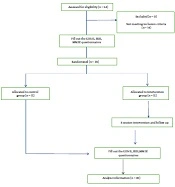
We performed a quasi-experimental study in 2019 on 90 elderly people retired from the Islamic Republic of Iran Army. The study population consisted of all men over 60 years of age who referred to the Army Retirement Center in Zahedan. Convenience sampling was used to recruit eligible retirees, who were then randomized into the intervention and control groups. The grouping was done randomly by asking each person to choose a card, on which was written the name of each of the two groups. The number of cards equaled the sample size.
The inclusion criteria were men aged 60 - 75 years, relatively good physical and mental health to take part in the study (based on the statement of participant’s family), acceptable hearing (based on participant’s statement), a cognitive assessment score of higher than 7 (based on the Abbreviated Mental Test score (AMTS), willingness to participate, and the passage of at least six months since retirement. On the other hand, the exclusion criteria were failure to attend more than one session, the occurrence of severe family crisis during the study (e.g., loss of a family member), and intolerance to the group.
The sample size was estimated at 14 for each group based on the mean total score of death anxiety reported by Jo and An (17), a confidence level of 95%, and statistical power of 95%, as well as the mean scores of
Data were collected using a self-report questionnaire consisting of two parts. The first section included personal and clinical information, age, education, retirement duration, number of children, post-retirement occupation, and AMTS. The AMTS scale has 10 questions designed to screen cognitive disorders in the elderly. The correct and incorrect answers to each question are scored 1 and 0, respectively, and the total score (ranging from 1 to 10) is the sum of correct answers. This instrument has been psychometrically tested in different countries. In Spain, it had a sensitivity of 100%, a specificity of 53%, and a cutoff point of 7 - 8. In Iran, the AMTS has been psychometrically evaluated, and its cutoff point has been reported at 7 (18). In the second part of data collection, we used the Death Anxiety scale (Templer, 1970) to assess participants’ death anxiety. This questionnaire comprises 15 items that are scored based on a five-point Likert scale from 1 “strongly disagree” to 5 “strongly agree” (19). Questions 2, 3, 6, 7, and 15 give scores in the reverse order. The minimum and maximum scores of this instrument are 15 and 75, with higher scores indicating higher levels of death anxiety. This questionnaire has been psychometrically evaluated in Iran. The reliability (Cronbach’s alpha) and internal consistency of the Death Anxiety scale have been appropriate (20). In our study, the reliability of this questionnaire was confirmed with Cronbach’s alpha of 0.82.
We first examined the characteristics of those retirees who met some of the inclusion criteria (age and retirement duration) and found their phone numbers from their records. Then, we contacted these people and recruited those who had the rest of the inclusion criteria and were willing to participate in the study. In the next stage, they were randomly divided into the control and intervention groups. The subjects provided their written informed consent. The AMTS scale was completed for all of them before group allocation.
The subjects were then invited to the Army Retirement Center. The questionnaires were completed on the first day, and the dates for holding group sessions of 5 - 8 people were determined. Overall, six reminiscence therapy sessions were held twice a week for three weeks. Each session lasted 45 to 60 minutes. The questionnaires were filled out again two months after the end of the intervention. At all sessions, the researcher, a psychiatric nurse, had the role of a leader. In other words, he would invite all individuals to participate in discussions and direct their attention to the main subject matter whenever a person diverted the discussion into current political or economic issues. The research assistant also attended all sessions to assess and care for the physical condition of elderly participants. The content presented in the sessions was based on the standards of reminiscence therapy, including attractiveness, and the characteristics of participants. More precisely, we addressed important life events like major (non-)occupational and post-retirement experiences (Table 1). To manage the time of the sessions, we gave each person an average of 5 - 7 minutes to talk in each session. The control group did not receive any intervention during this period, yet they underwent the post-test at the same time as the intervention group. At the end of the study, participants in the control group were contacted and invited to a reminiscence therapy session at the center. Some but not all of the control group members accepted the invitation.
Table 1.
Structure of Reminiscence Therapy Sessions
| Session | Content |
|---|---|
| 1. Influential life events | Creating a friendly atmosphere for the expression of memories |
| recalling a decisive life event | |
| Illustration: A major life event is one that you have experienced and has significantly changed your life. | |
| 2. Family history | A brief review of memories narrated in the previous session |
| Illustration: Who are your family members, or who have had a positive or negative impact on your life? who helped you most in your life and contributed to your progress? | |
| 3. Occupational memories | A brief review of memories narrated in the previous session |
| Discussing occupational memories | |
| Illustration: How has your work influenced your roles in society and the family? | |
| 4. Stressful experiences | A brief review of memories narrated in the previous session |
| Illustration: Love is an emotional attachment to a person, place, or something special. What are the major loves of your life? have you ever fallen in love or hated someone? | |
| 5. Meaning and purpose of life | A brief review of memories narrated in the previous session |
| Illustration: Have you achieved any of your life goals? have you strived for the goals you have not reached? | |
| 6. Summing up | Evaluating memories |
| Illustration: Pleasant and unpleasant memories |
The obtained data were analyzed in SPSS-21 using descriptive statistics (Shapiro-Wilk test) and inferential statistics (independent t-test, paired t-test, and chi-squared test) at the significance level of less than 0.05.
4. Results
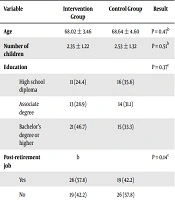
Eventually, 90 participants completed the study. The mean age of the study subjects was 68 years in both intervention and control groups, and no significant difference was found in this regard (P = 0.47). Over 57% of the intervention group had a post-retirement job, whereas 42% of the control group reported such an occupation; nevertheless, the difference was not significant (P = 0.14) (Table 2).
Table 2.
Demographic Characteristics of Army Retirees in the Two Study Groupsa
| Variable | Intervention Group | Control Group | Result |
|---|---|---|---|
| Age | 68.02 ± 3.46 | 68.64 ± 4.60 | P = 0.47b |
| Number of children | 2.35 ± 1.22 | 2.53 ± 1.32 | P = 0.51b |
| Education | P = 0.37c | ||
| High school diploma | 11 (24.4) | 16 (35.6) | |
| Associate degree | 13 (28.9) | 14 (31.1) | |
| Bachelor’s degree or higher | 21 (46.7) | 15 (33.3) | |
| Post-retirement job | P = 0.14c | ||
| Yes | 26 (57.8) | 19 (42.2) | |
| No | 19 (42.2) | 26 (57.8) |
aValues are expressed as mean ± SD or No. (%).
bIndependent t-test.
cChi-square test.
The results showed that the mean score of death anxiety after reminiscence therapy decreased significantly in the intervention group, but this change was not significant in the control group. The results indicated no significant difference in the baseline scores of death anxiety between the two groups. After reminiscence therapy, however, the two groups exhibited a significant difference, with the intervention group reporting a lower score of death anxiety (Table 3).
Table 3.
Comparison of Participants’ Death Anxiety on the Two Groups Before and After the Interventiona
| Stage Group | Before Intervention | After Intervention | Changes | Paired t-test |
|---|---|---|---|---|
| Intervention | 25.37 ± 1.89 | 9.09 ± 1.79 | 16.28 ± 1.94 | 0.0001b |
| Control | 25.17 ± 1.61 | 25.04 ± 1.62 | 0.13 ± 1.87 | 0.63b |
| Independent t-test | 0.59c | 0.01c | 0.005c |
aValues are expressed as mean ± SD.
bPaired t-test.
cIndependent t-test.
5. Discussion
The findings of the present study highlight the significant impact of reminiscence therapy on death anxiety in older adults. In the same vein, Ataie Moghanloo et al. (21) found that integrative reminiscence therapy focusing on cohesive memory could reduce anxiety in old widowers. Likewise, the results of a study conducted in Korea by Jo and An (17) supported the reminiscence therapy effect on the anxiety of older adults living at nursing homes.
In the present study, the opportunity was provided to reduce the psychological burden of death anxiety in older adults by allowing them to interact with their peers through sharing their memories. The results of the study by Sadri Damirchi et al. (22), which examined the impact of reminiscence therapy on old women, displayed that older people who had a meaning and purpose in their life were less afraid of death and more likely to accept it. In addition, Moetamedi et al. (23) observed that life review therapy introduced consistency in the personality of the elderly. In our study, the elderly found the meaning of their life by telling their memories and reviewing their past. The final stage of Erik Erikson’s theory (i.e., ego integrity versus despair) states that the elderly look at their past life and reexamine its positive and negative aspects (24), which was made possible in our study through reminiscence therapy. Indeed, by recollecting their memories, our study subjects developed a feeling of content and satisfaction, which, in turn, reduced their death anxiety.
Similarly, Moetamedi et al. (23) suggested that group therapy could reduce the death anxiety of older adults. The results of some studies support that group reminiscence therapy can also increase the life expectancy of the elderly (8, 16, 25). Thus, group therapies can help this population understand the meaning of their life. Such interventions seem to be more appropriate in terms of social support, coping with grief, losses of any kind, dealing with chronic illnesses, and ultimately acceptance of death (26). In line with our study, Garrow and Walker (26) concluded that group therapy created social cohesion in the elderly and provided conditions for them not to feel lonely; this homogeneity helps reduce anxiety.
Death anxiety is one of the components of mental health, yet older people experience high levels of this anxiety. The findings by Ghorbanalipour et al. (27) show that people with high death anxiety may especially benefit from health-promoting behaviors. Moreover, the results of the study by Soleimani et al. (28) emphasized that death anxiety is a predictor of poor quality of life. On the other hand, Siverova and Buzgova (29) studied older adults at a senior care center and noted that reminiscence therapy positively affected the quality of life and the attitude to aging and reduced the symptoms of depression in this population. These findings corroborate that reminiscence therapy is interesting to the elderly and it will be more durable and satisfying when conducted in a group setting.
While most related studies on older people have been undertaken in senior care centers, Chueh and Chang (30) investigated the effect of reminiscence therapy on veterans’ depressive symptoms in Taiwan and observed that these symptoms declined three months and six months after the intervention. It could be concluded that reminiscence therapy, in the long run, can also have a positive impact on the mood of army retirees who have experienced differently from those of other elderly people.
One of the limitations of this study concerns the physical health status of participants, such that in some cases, their relatives were reluctant to leave them alone. Consequently, these companions were also allowed to attend the sessions, which was beyond our control.
5.1. Conclusions
The results of our study demonstrated that group reminiscence therapy could alleviate the death anxiety of older adults. Thanks to its great appeal, this method might be used to enable these people to reexamine different aspects of their lives. In fact, by encouraging older adults to look back on their life, this intervention can provide them with a sense of satisfaction, which, in turn, mitigates their death anxiety. It is suggested that this easy-to-use therapy be implemented in retirement centers and nursing homes.