
1. Background
Although surgical procedures are performed to ensure patients’ health and eliminate their existing symptoms, they may have several side effects on the patient. Several complications may occur during the surgical process, especially in the postoperative period. One of these complications is paralytic ileus or postoperative ileus. The incidence of postoperative ileus after abdominal surgery varies between 10% and 30% (1, 2).
Ileus results in the absence of decreased flatus or delayed intestinal movements and the accumulation of gas and fluid in the gastrointestinal tract. Patients may experience symptoms similar to intestinal obstruction, such as nausea, vomiting, and abdominal pain (3). Delayed gastric emptying is observed after exposure to anesthesia, with the most powerful effects of anesthetic agents on the intestinal tract due to neural integration. Delayed gastric emptying increases the risk of postoperative nausea and vomiting. Postoperative nausea and vomiting occur within the first 24 and 72 hours after surgery (4).
Postoperative nausea and vomiting may cause dehydration, electrolyte imbalance, pulmonary aspiration, and acid-base balance deterioration. These cause the patient to remain in the recovery unit longer after surgery, adversely affecting patient comfort, lengthening hospital stay, and thus increasing hospital costs (5).
Oral feeding in the early postoperative period is an important factor supporting the return of intestinal functions (6). However, several attempts have been made to initiate and increase intestinal movements in the postoperative period, such as early lifting and chewing gum (7).
Chewing gum is recommended as an alternative to early oral feeding (8) and is of importance in eliminating the risks that may arise because of early feeding. It has been reported that chewing gum accelerates the transition to early feeding after surgery and the normalization of intestinal functions (6). Chewing gum is considered a form of pseudo nutrition, in which a nutrient is chewed, but nothing enters the stomach (9).
Studies have reported that chewing gum after surgery influences variables such as average gas release time, average time of intestinal movements, initial defecation, and hospital discharge time (10-13).
Previous studies have stated that chewing gum after surgery is useful in improving intestinal functions. It is cheap, safe, well-tolerated, and widely used with no side effects; it can be used as a new method to resolve the ileus after surgery (14, 15).
It has been reported that chewing gum stimulates the myoelectric action of the intestines by blocking the activation of gastrointestinal opioid receptors, but enabling the activation of the cephalic-vagal pathway (14, 16); it also activates the release of gastric, duodenal, and pancreatic secretions, fights pathogens in the mouth and intestines and nitric oxide production by stimulating salivary secretion, quenches thirst after surgery, and reduces patients’ anxiety and makes them feel better (14, 15, 17-19).
It has been reported that chewing gum is an inexpensive, safe, and practical method, which does not have any side effects as in medicine, does not require training or storage space, and is easily accessible (20, 21). Therefore, it is important to ensure that chewing gum is used in the postoperative nursing care process. For this, there is a need for evidence-based research on the subject.
In addition, not only have there not been enough studies done about chewing gum after surgery in Turkey, but there have also not been studies done to examine the effect of chewing gum on nausea and vomiting.
2. Objectives
This study contributes to the acquisition of evidence-based data on evaluating the effect of chewing gum on the regulation of intestinal functions in surgical patients.
3. Methods
The study was planned as a controlled experimental study. It was carried out in the General Surgery Department of Celal Bayar University Hospital in Manisa, Turkey.
3.1. Population and Sample of the Study
The population of the study consisted of patients who had undergone cholecystectomy and herniotomy in the General Surgery Department of Celal Bayar University Hospital in Manisa, Turkey (N = 319). A total of 60 patients with cholecystectomy and herniotomy (30 controls [non-chewing gum] and 30 interventions [chewing gum]) were enrolled in this study. The sampling method of this study was purpose-based according to the inclusion criteria. Thirty patients, according to the inclusion criteria, were included in the control group. The intervention group (30 patients) was formed similar to the independent variables (ie, age, sex, diagnosis, preoperative defecation habits, operation time, and diagnoses) of the control group. The intervention group was provided to chew gum 3 times for 15 - 30 minutes with a 2-hour interval, starting from the second hour after admission to the surgical clinic. Both control and intervention groups were evaluated 6 and 24 hours after surgery using the nausea-vomiting, intestinal functions monitoring form.
To ensure that the control and intervention groups were not influenced by one another, the data of the control group were collected before the intervention group.
3.2. Inclusion and Exclusion Criteria
Patients over the age of 18 who chose to participate in the study and had undergone cholecystectomy and herniotomy under general anesthesia were included in the study. Patients with chronic constipation, intestinal surgery with inappropriate cognitive level, pregnancy, or dental prostheses, as well as diabetics and those who dislike chewing gum, were excluded from the research.
3.3. Data Collection Method
After hospitalization, patients who met the criteria to participate in the study and agreed to participate were informed about the purpose and subject of the study, and their consent was obtained with an informed consent form.
For patients in both the control and intervention groups, data were collected using a patient information form, as well as a nausea-vomiting, intestinal functions monitoring form, prepared by the researcher. The control group was given care within the framework of routine postoperative procedures in the surgical service, and then the data were collected using the forms at the determined postoperative times (6 and 24 hours after admission to the surgical ward). In the intervention group, after chewing sugar-free gum for 15 - 30 minutes with a 2-hour interval, the forms and nausea-vomiting status (twice, specifically 6 and 24 hours after admission to the surgical ward) were evaluated. The average duration of chewing gum was 17 ± 4.66 minutes. There was no statistically significant difference between postoperative gum chewing times and postoperative nausea, level of nausea, vomiting, vomiting between 0 and 6 hours, vomiting between 6 and 24 hours, the first hearing of intestinal sounds, the first flatus, and the first defecation.
The patient information form was used as a data collection tool. The form included sociodemographic characteristics, such as age, gender, marital status, body mass index (BMI), education, employment status, health status, defecation habits (ie, the number of defecations per week and difficulty during defecation), duration of surgery, postoperative period, nausea, vomiting, time of the first intestinal sounds, flatus, and defecation time.
A numerical nausea scale was used to evaluate the severity of nausea. Scores are based on a scale of 0 to 10, with 0 indicating “no nausea” and 10 indicating “severe nausea.” The patient was asked to select a number between 0 and 10 that best reflected nausea by marking the scale.
Data analysis was performed using SPSS version 15.0 (SPSS Inc, Chicago, Ill, USA). The chi-square (χ²) test was used to determine the difference between the sociodemographic characteristics of the control and those of the intervention group. The groups were not normally distributed. The chi-square test was used for quantitative data between the groups.
4. Results
In this section, the sociodemographic characteristics of patients and problems related to the operation and postoperative digestive system are explained regarding the control and intervention groups.
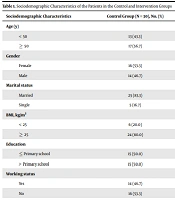
Table 1 shows the type of surgical procedure and sociodemographic characteristics of patients in the control and intervention groups. There was no statistically significant difference between the groups in terms of sociodemographic characteristics (P > 0.05).
Table 1.
Sociodemographic Characteristics of the Patients in the Control and Intervention Groups
| Sociodemographic Characteristics | Control Group (N = 30), No. (%) | Intervention Group (N = 30), No. (%) | χ² | P-Value |
|---|---|---|---|---|
| Age (y) | 0.067 | 0.795 | ||
| < 50 | 13 (43.3) | 14 (46.7) | ||
| ≥ 50 | 17 (56.7) | 16 (53.3) | ||
| Gender | 0.271 | 0.602 | ||
| Female | 16 (53.3) | 18 (60.0) | ||
| Male | 14 (46.7) | 12 (40.0) | ||
| Marital status | 0.131 | 0.665 a | ||
| Married | 25 (83.3) | 26 (86.7) | ||
| Single | 5 (16.7) | 4 (13.3) | ||
| BMI, kg/m2 | 1.364 | 0.243 | ||
| < 25 | 6 (20.0) | 10 (33.3) | ||
| ≥ 25 | 24 (80.0) | 20 (66.7) | ||
| Education | 0.268 | 0.605 | ||
| ≤ Primary school | 15 (50.0) | 13 (43.3) | ||
| > Primary school | 15 (50.0) | 17 (56.7) | ||
| Working status | 0.610 | 0.432 | ||
| Yes | 14 (46.7) | 11 (36.7) | ||
| No | 16 (53.3) | 19 (63.3) | ||
| Diagnose-surgical intervention | 0.073 | 0.787 | ||
| Cholelithiasis-laparoscopic surgery | 19 (63.3) | 20 (66.7) | ||
| Abdominal hernia-open surgery | 11 (36.7) | 10 (33.3) | ||
| Defecation habits (per week) | 0.073 | 0.787 | ||
| < 10 | 20 (66.7) | 19 (63.3) | ||
| ≥ 10 | 10 (33.3) | 11 (36.7) |
Abbreviation: BMI, body mass index.
a Fisher's exact test
As shown in Table 2, there was no significant difference between the control and intervention groups in the duration of surgery (P = 0.795), postoperative nausea (P = 0.390), postoperative nausea and vomiting levels (P = 0.263), vomiting in 0 - 6 hours (P = 0.080) / 6 - 24 hours after surgery (P = 0.601), postoperative vomiting (P = 0.104), postoperative intestinal sounds (P = 0.796), time of postoperative flatus (P = 0.787), and defecation habits (P = 0.787).
Table 2.
Duration of Surgery, Nausea, Postoperative Nausea and Vomiting Levels, Vomiting 0 - 6 / 6 - 24 Hours After Surgery, Postoperative Intestinal Sounds, Time of Postoperative Flatus, Time of Defecation, and Discharge of Patients in the Control and Intervention Groups
| Variables | Control Group (N = 30), No. (%) | Intervention Group (N = 30), No. (%) | χ² | Z | P-Value |
|---|---|---|---|---|---|
| Duration of surgery | 0.067 | 0.795 | |||
| < 80 minutes | 16 (53.3) | 17 (56.7) | |||
| ≥ 80 minutes | 14 (46.7) | 13 (43.3) | |||
| Postoperative nausea | 0.739 | 0.390 | |||
| Yes | 10 (33.3) | 7 (23.3) | |||
| No | 200 (66.7) | 23 (76.7) | |||
| Postoperative nausea & vomiting levels | 1.252 | 0.263 | |||
| < 8 | 3 (10.0) | 4 (13.3) | |||
| ≥ 8 | 7 (23.3) | 3 (10.3) | |||
| Without nausea | 20 (66.7) | 23 (76.7) | |||
| Mean ± SD | 7.60 ± 3.65 | 5.42 ± 3.69 | 1.086 | 0.364 | |
| Postoperative vomiting | 2.783 | 0.104 a | |||
| Yes | 8 (26.7) | 3 (10.0) | |||
| No | 22 (73.3) | 27 (90.0) | |||
| Vomiting 0 - 6 hours after surgery | 4.320 | 0.080 a | |||
| No vomiting | 22 (73.3) | 28 (93.3) | |||
| < 3 | 8 (26.7) | 2 (6.7) | |||
| Vomiting 6 - 24 hours after surgery | 1.018 | 0.601 | |||
| No vomiting | 29 (96.7) | 28 (93.3) | |||
| < 3 | 1 (3.3) | 1 (3.3) | |||
| ≥ 3 | 0 (0) | 1 (3.3) | |||
| Postoperative intestinal sounds | 0.067 | 0.796 | |||
| < 1 hour | 16 (53.3) | 15 (50.0) | |||
| ≥ 1 hour | 14 (46.7) | 15 (50.0) | |||
| Mean ± SD | 0.89 ± 0.96 | 0.94 ± 1.12 | -0.256 | 0.798 | |
| Time of postoperative flatus | 0.073 | 0.787 | |||
| < 13 hours | 10 (33.3) | 17 (56.7) | |||
| ≥ 13 hours | 20 (66.7) | 13 (43.3) | |||
| Mean ± SD | 16.48 ± 10.05 | 11.59 ± 8.85 | -0.268 | 0.788 | |
| Postoperative defecation condition | 0.268 | 0.605 | |||
| < 40 hours | 13 (43.3) | 15 (50.0) | |||
| ≥ 40 hours | 17 (56.7) | 15 (50.0) | |||
| Mean ± SD | 43.94 ± 25.72 | 39.08 ± 18.95 | -0.513 | 0.608 |
a Fisher's exact test
In the logistic regression analysis, it was determined that the intervention group experienced 5.09 times less vomiting compared to the control group between 0 and 6 hours after surgery (Table 3).
Table 3.
Logistic Regression Analysis According to Vomiting Between the Control and Intervention Groups
| Dependent Variables | Groups | Logistic Regression | |||
|---|---|---|---|---|---|
| Intervention Group | Control Group | χ2 | P | OR | |
| Vomiting (0 - 6 hours) | 4.32 | 0.38 | 5.09 | ||
| No | 28 | 22 | |||
| Yes | 2 | 8 | |||
Abbreviation: OR, odds ratio.
5. Discussion
the results determined the positive effects of chewing gum on nausea, vomiting, intestinal function, and early discharge were found postoperative nausea and vomiting are important symptoms of postoperative ileus and are the most important criteria for discharge (11, 22). In a meta-analysis study conducted by Şarkı et al. (which examined 26 chewing gum studies with 2214 patients who had undergone colorectal surgery), postoperative nausea and vomiting were evaluated in 3 studies, and in only 1 study in the meta-analysis, the group that chewed gum stated that they had lower nausea and vomiting after surgery (23). In the study by Abd-El-Maeboud et al., less vomiting was observed in patients in the intervention group (1). Jernigan et al. found a significant difference in postoperative nausea between chewing gum and non-chewing groups (20).
In a meta-analysis study conducted by Liu et al. (24) (which examined the effect of gum on ileus improvement in patients who had undergone colorectal surgery), 18 randomized controlled studies were included with 1736 patients; nausea and vomiting were evaluated in 3 studies. According to a randomized controlled study (which investigated the effect of chewing gum on postoperative ileus in primary anastomosis colonic surgery [N = 64]), less vomiting was seen in the chewing gum group (25). The results of these studies are consistent with the results of our study. However, some studies have reported that chewing gum does not affect nausea, vomiting, and bowel functions. In this regard, it was found that postoperative chewing gum did not show significant advantages in complications, nausea-vomiting, or bloating (24). Further, in the study by Darvall et al. (which compared chewing gum with dexamethasone in women who had undergone laparoscopic or breast surgery), there was no difference in the incidence of nausea and vomiting between the chewing gum and non-chewing gum groups (13). Also, in a meta-analysis of 17 studies involving 1845 patients, Mei et al. examined the effect of chewing gum on intestinal function in patients who had undergone colorectal cancer surgery and found no statistical difference in postoperative nausea and vomiting between the groups (25).
In the current study, there was no statistically significant difference between the first hours of intestinal sounds after surgery. In two separate meta-analysis studies, Xu et al. and Huang and He investigated the effect of gum on intestinal functions after cesarean and found that chewing gum after surgery made a significant difference (18, 26). However, Atkinson et al., Şenol et al., and Short et al. found opposite results in their respective studies (4, 27, 28).
In the present study, there was no significant difference in the first flatus of patients after surgery between the control and intervention groups. However, the average time of postoperative flatus of patients in the intervention group was less than in the control group. In the study by Ertas et al., the average time of the first flatus after surgery was 43.6 ± 14.0 hours in the control group and 34.0 ± 11.5 hours in the intervention group postoperatively, and a significant difference was found between the 2 groups (11). Ledari et al. (29) found that the average time of the first flatus was 30.0 ± 9.7 hours in the control group and 24.8 ± 6.4 hours in the chewing gum group postoperatively. Also, Abd-El-Maeboud et al. stated that the average time of the first flatus was 24.4 ± 7.1 hours in the control group and 17.9 ± 4.6 hours in the chewing gum group postoperatively (1). Rashad and Yousef found the average time of the first flatus to be 9.97 ± 3.87 hours in the control group and 3.90 ± 1.37 hours in the chewing gum group postoperatively, and the times of postoperative flatus were significantly lower in the intervention group than in the control group (30). Kalamak et al. found the time of the first flatus to be 9 hours after surgery in the control group and 7 hours after surgery in the chewing gum group and reported a significant difference between the 2 groups (21). In a study (which examined over 100 women and the effect of chewing gum on intestinal functions in patients with cesarean section), Ledari et al. described chewing gum as an acceptable method for reducing the flatus time (29). In a study of chewing gum in patients who had undergone laparoscopic colectomy for colorectal cancers, Asao et al. found that the flatus time was shorter in the chewing gum group than in the control group (3). According to a systematic analysis of studies on chewing gum after colorectal resection, the time of postoperative flatus was reported to be 24.3% earlier in the chewing gum group than in the control group (8).
In a meta-analysis of 7 randomized controlled studies (including 1462 women who had undergone cesarean section), researchers examined the effectiveness of chewing gum in preventing postoperative ileus and found that the time of postoperative flatus was significantly lower in the intervention group than in the control group (31). It was found that the intervention group had earlier defecation of gas and stool compared to the control group. It was thought that this study would inform studies to be carried on different patient groups (32). In the present study, the postoperative defecation time of patients in the intervention group was less, but the difference was not significant between the groups. In a study performed on 34 patients with colorectal surgery at Gazi University, Duluklu found that the average time of first-time stool was 81.6 hours in the non-chewing gum group and 55.8 hours in the chewing gum group (10). According to the results of 272 patients undergone gastrointestinal surgery in 7 randomized controlled studies by Fitzgerald and Ahmed, it was found that chewing gum reduced the time of first intestinal sounds and flatus (14).
In the study by Wang et al., (33) in 60 patients who had undergone radical cystectomy (followed by ileum urinary diversions), it was found that the defecation time of patients who chewed gum to improve intestinal functions after cesarean section was significantly shorter than that of non-chewing patients (34). In a meta-analysis study (including 274 patients who had undergone radical cystectomy), researchers investigated the effectiveness of chewing gum on postoperative outcomes and reported that postoperative stool was found to be 19 hours earlier in the intervention (chewing gum) group compared to the control group (35). In the study by Urcanoğlu, it was found that in the non-chewing gum and chewing gum groups, the first-time stools were 45.86 and 21.07 hours, respectively (36). However, Husslein et al. (19), Ge et al., and De Leede et al. found no significant difference between the defecation times in the chewing gum and non-chewing gum groups (9, 15).
In the present study, it was determined that chewing gum after surgery had a positive effect on the digestive system functions. Therefore, hypothesis H1 was accepted.
5.1. Limitations
This study has some limitations. First, data were obtained only from patients with cholecystectomy and herniotomy. Although this provides a homogeneity in the sample, the inclusion of other patient groups in the study prevents the generalization of the results of this study in general surgery patients. Further, the patients’ attitudes toward chewing gum decreased the number of participants, leading to a small sample size; thus, randomized controlled studies with larger sample sizes are recommended.
5.2. Conclusions
According to the findings of this study, there was no statistically significant difference between the postoperative nausea findings of patients in terms of vomiting 6 - 24 hours after surgery, the first hours of postoperative intestinal sounds, the first flatus, and defecation times regarding the control and intervention groups. Patients who chewed gum experienced 5.09 times less vomiting 0 - 6 hours after surgery than those who did not chew. Accordingly, chewing gum is suggested to regulate digestive system functions after surgery.