
1. Background
Information on maternal mortality and tracking the causes of maternal deaths are the two main indicators of maternal general health and health system performance (1). The World Health Organization (WHO) defines maternal mortality rate as “the death of a woman during pregnancy or up to six weeks after the end of pregnancy for any reason exacerbated by pregnancy or related to medical or midwifery procedures during pregnancy” (2).
Maternal death has important negative social and economic consequences for the society and the health and life of family members, especially newborns, in conditions of economic deprivation (3). Maternal mortality rate (MMR: the number of maternal deaths per 100,000 deliveries) is an important indicator of public health that reflects both the quality of health services and the status and importance of women in society (4, 5). According to a WHO report in 2019, about 295,000 women died during pregnancy and childbirth in 2017. The vast majority of these deaths (94%) had occurred in deprived areas, most of which could be prevented (2).
Studies have shown that women die from complications of pregnancy and after giving birth. Most of these complications occur during pregnancy, and they can be prevented or treated to a large extent (6, 7). Other complications may exist before pregnancy but deteriorate during pregnancy, especially if they are not controlled as a part of women’s routine care (8). These complications include severe bleeding (mostly postpartum hemorrhage), infection (usually postpartum), hypertension during pregnancy (preeclampsia and eclampsia), complications from childbirth, unsafe abortion, diabetes, malaria, acquired immunodeficiency syndrome (AIDS), obesity, and other causes (9-11). According to various studies conducted in Iran, four major causes of maternal mortality are bleeding, high blood pressure, infection, and difficult delivery (12). Iran has been one of the most successful countries in achieving the millennium development goals (MDG), by reducing MMR by 75% in 2015. In comparison with the neighboring countries other than Turkey, Iran has had the highest rate of decline in MMR. However, the main causes and determinants of MMR are still to be studied, especially as there is evidence that the most common causes continue to be the most significant causes of maternal deaths in Iran (13).
In 2017, the global MMR was estimated at 211 per 100,000 live births; in Iran, this index had risen from 19.7 per 100,000 live births in 2013 to 20 per 100,000 live births in 2017, and among the ten existing planning districts in Iran, Zahedan University of Medical Sciences is in District 8, in which the three-year estimate of MMR (2016 - 2018) was the highest figure of 31.2 per 100,000 live births. In line with the global goal of justly reducing maternal mortality, the international development target of “ending avoidable deaths” has been set, and it has been suggested that by 2030, many countries, including Iran, should decrease their indices by two-thirds of their estimated indexes in 2010 (14). Therefore, it is necessary to study these statistics and identify the causes of maternal mortality. Furthermore, women make up almost half of the human resources of any society, and trying to improve their health is one of the priorities of health programs.
2. Objectives
The purpose of this study was to investigate the prevalence and causes of maternal mortality in the population covered by Zahedan University of Medical Sciences.
3. Methods
The present study was a retrospective, descriptive, cross-sectional study conducted during five years. The research population consisted of census data (file reading) from the files available in the archive of deceased pregnant mothers (Midwifery Department) of Zahedan University of Medical Sciences, based on the data obtained from four cities, including Zahedan, Khash, Saravan, and Chabahar in Sistan and Baluchestan province. This province is located in southeast of Iran, Central Asia (Figure 1). Data were collected from April 2013 to the end of March 2017. Pregnant mothers who died before 2013 and after 2018 or were not in the above-mentioned four cities were excluded from the study. Finally, the files of 126 deceased pregnant mothers were examined as the research sample.
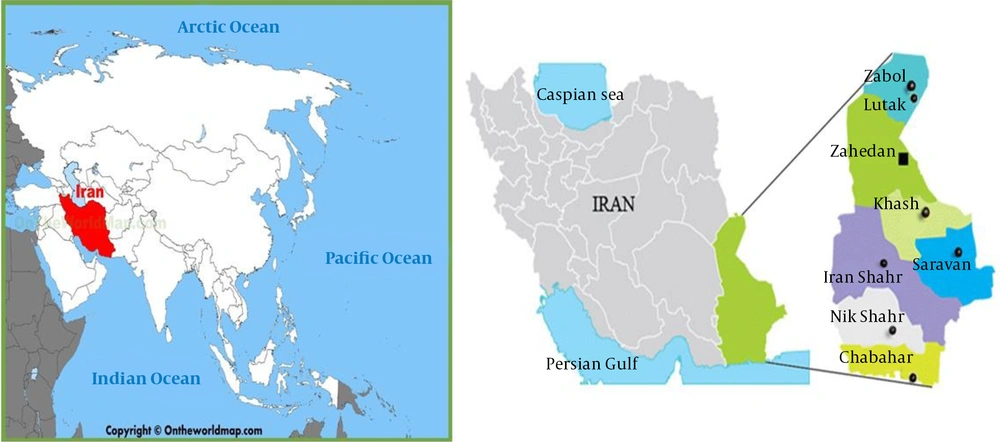
Figure 1.
Sistan and Baluchestan province, located in the southeast of Iran, Central Asia
Demographic information such as mother’s age, level of education, place of residence in terms of being a city or village, access to health centers, and midwifery variables such as gestational age, number of pregnancies, pregnancy interval, type of delivery (Cesarean section/normal/no delivery), history of underlying disease, pregnancy care, and its number, and variables related to maternal mortality such as maternal mortality rate (MMR), the cause of mother’s death, the time of mother’s death, place of death, and the cause of delivery were extracted from their files and examined. To calculate the MMR, the number of pregnant mothers who had died in each city (i.e., Zahedan, Khash, Saravan, and Chabahar) was used as the nominator, and the number of live births in each city (i.e., Zahedan, Khash, Saravan and Chabahar) was used as the denominator. Then, the resulting quotient was separately multiplied in the coefficient of 100000. The designed data collection tool was a maternal death review form of maternal death files. This study was conducted after its approval by the Research Ethics Committee of Zahedan University of Medical Sciences with the code of ethics: IR.ZAUMS.REC.1397.391.
Data were entered into the Microsoft Excel sheet, and data analysis was performed using SPSS version 25. Based on descriptive statistics and according to the nature of the variables, the quantitative variables were described as mean (standard deviation), and qualitative variables were described by mentioning their frequency (percentage).
4. Results
The total number of live births during five years was 397727 in Zahedan, 29032 in Khash, 50398 in Saravan, and 52054 in Chabahar. During this period, 126 maternal deaths with the maternal mortality ratio (MMR) of 31.68 per 100,000 live births were reported. In a study of 126 deceased pregnant women, the examination of the mortality rate of pregnant mothers based on demographic characteristics showed that the age group of 30 - 39 years had the highest rate of maternal deaths with 56 cases (44.4%), and the highest rate of illiterate pregnant mothers’ death was seen in Chabahar (24 people, 60%). Considering the place of residence, the highest number of pregnant mothers’ death was seen in Chabahar, with 34 cases (85%) and Saravan with 33 cases (89.2%) (Table 1).
Table 1.
Demographic Characteristics
| Characteristics | No. (%) |
|---|---|
| Age (y) | |
| ≤ 19 | 12 (9.5) |
| 20 - 29 | 52 (41.3) |
| 30 - 39 | 56 (44.4) |
| ≥ 40 | 6 (4.8) |
| Education Level | |
| Illiterate | 60 (47.61) |
| < Diploma | 47 (37.30) |
| Diploma | 12 (9.52) |
| University | 7 (5.5) |
| Residence | |
| Urban | 48 (38.1) |
| Rural | 78 (61.9) |
Based on the related obstetric characteristics such as gestational age, number of pregnancies, pregnancy interval, prenatal care, history of underlying diseases, type of delivery, time and place of death of the mother, and cause of delivery, it was revealed that 101 (80.2%) of the deceased mothers had a gestational age of more than 28 weeks, 50 (39.68%) had 2 - 4 pregnancies, 28 (22.2%) had 12 - 24 months interval of deliveries, 91 (72.22%) did not receive care, 65 (51.6%) had a history of an underlying disease, 57 (45.23%) had vaginal delivery, 54 (42.9%) died in less than the first 24 hours after delivery, 89 (70.6%) died in hospitals, and 45 (35.7%) were under the supervision of a specialist (Table 2). It was also found that 28 deaths had occurred during the first pregnancy, and in other words 50% of deaths had occurred in the first to the third pregnancies. In terms of direct and indirect causes of mothers’ death, the most common cause of death was bleeding with 41 (32.53%) cases, followed by cardiac problems with 27 (21.42%) cases, respiratory problems (acute respiratory distress syndrome [ARDS], embolism, edema, pneumothorax, H1N1 influenza, tuberculosis, and aspiration) with 18 (14.28%) cases, eclampsia and preeclampsia with 13 (10.3%) cases, septic shock resulted from infections with 12 (9.5%) cases, liver and kidney problems with 5 (3.9%) cases, drug poisoning with 4 (3.1%) cases, cerebral hemorrhage with 3 (2.38%) cases, scorpion or snake bites with 2 (1.58%) cases, and suicide with 1 (0.79%) case.
Table 2.
Obstetric Characteristics Among Cases of Maternal Mortality (n = 126)
| Characteristics | No. (%) |
|---|---|
| Gestational age (week ) | |
| < 14 | 6 (4.8) |
| 14 - 28 | 19 (15.1) |
| > 28 | 101 (80.2) |
| Gravida | |
| 1 | 28 (22) |
| 2 - 4 | 50 (39.68) |
| ≥ 5 | 48 (38.09) |
| Pregnancy interval (mon) | |
| Prim pregnant | 29 (23) |
| < 12 | 13 (10.3) |
| 12 - 24 | 28 (22.2) |
| 24 - 36 | 23 (18.3) |
| 36 - 60 | 20 (15.9) |
| > 60 | 13 (10.3) |
| Antenatal checkup care | |
| Yes | 35 (27.7) |
| No | 91 (72.22) |
| Medical history | |
| Yes | 65 (51.6) |
| No | 61 (48.4) |
| Mode of delivery | |
| Vaginal | 57 (45.23) |
| Cesarean | 36 (28.57) |
| No delivered | 33 (26.19) |
| Period of death | |
| Antepartum | 33 (26.19) |
| Intrapartum | 4 (3.17) |
| postpartum ≤ 24 h | 54 (42.9) |
| postpartum > 24 h | 35 (27.74) |
| Place of death | |
| Hospital | 89 (70.6) |
| Home | 24 (19) |
| On the way to the hospital | 10 (7.9) |
| Maternity facility center | 3 (2.4) |
| Assistance with childbirth | |
| No history of skilled childbirth | 33 (26.2) |
| Of Ob & PhD Gyn | 45 (35.7) |
| A trained midwife | 32 (25.4) |
| Not trained midwife | 16 (12.7) |
Moreover, the most common causes of maternal deaths in each city were identified. In Zahedan, heart problems, in Khash, HELLP syndrome, eclampsia, and preeclampsia, and in Saravan and Chabahar, bleeding were identified as the most common causes of mortality. The prevalence of maternal mortality according to the history of underlying diseases showed that among the population of deceased mothers, 65 mothers suffered from an underlying disease (51.6%), and sometimes one mother had several underlying diseases, the most common of which was hypertension followed by heart disease, addiction, anemia, and diseases such as AIDS, TTP, asthma, and cancer.
The MMR in Zahedan, the capital city of Sistan and Baluchestan province, was 174.96 per 100,000 births, in Khash 190.56 per 100,000 births, in Saravan 371.87 per 100,000 births, and in Chabahar 384.03 per 100,000 births. The lowest and highest mortality rates of pregnant mothers belonged to Zahedan [4 (10.25)] and Khash [3 (27.27) cases] in 2013, Khash [1 (9.09)] and Chabahar [13 (32.5) cases] in 2014, Khash [5 (13.52)] and Zahedan [11 (28.20) cases] in 2015, Khash [1 (9.09)], and Zahedan [8 (20.51) cases] in 2016, and Khash [4 (36.36)] and Zahedan [4 (36.36) cases] in 2017. Besides, Chabahar with 40 cases and Khash with 11 cases had the highest and lowest maternal mortalities (Table 3).
Table 3.
Maternal Mortality Ratio (MMR) Per 100000 Births and the Frequency of Maternal Deaths During Five Years
| Variables | Chabahar | Saravan | Khash | Zahedan | City/Year |
|---|---|---|---|---|---|
| MMR | 76.65 | 86.90 | 53.66 | 16.61 | 2013 |
| 115.17 | 85.30 | 17.94 | 23.83 | 2014 | |
| 79.74 | 47.70 | 33.18 | 45.56 | 2015 | |
| 27.84 | 57.30 | 16.47 | 28.92 | 2016 | |
| 84.63 | 94.67 | 69.31 | 60.04 | 2017 | |
| 384.03 | 371.87 | 190.56 | 174.96 | Total | |
| Maternal Deaths; N (%) | 8 (20) | 8 (21.62) | 3 (27.27) | 4 (10.25) | 2013 |
| 13 (32.5) | 9 (24.32) | 1 (9.09) | 6 (15.39) | 2014 | |
| 9 (22.5) | 5 (13.52) | 2 (18.19) | 11 (28.20) | 2015 | |
| 3 (7.5) | 6 (16.21) | 1 (9.09) | 8 (20.51) | 2016 | |
| 7 (17.5) | 9 (24.33) | 4 (36.36) | 10 (25.65) | 2017 | |
| 40 (100) | 37 (100) | 11 (100) | 39 (100) | Total |
The lowest and highest MMR per 100,000 live births belonged to Zahedan in 2013 (16.61) and in 2017 (60.04), Khash in 2016 (16.47) and in 2017 (69.31), Saravan in 2016 (47.70) and in 2017 (69.31), and Chabahar in 2016 (27.84) and in 2014 (115.17) (Table 3).
5. Discussion
This study aimed to investigate the prevalence and causes of pregnant mothers’ mortality in the population covered by Zahedan University of Medical Sciences. The results showed that the rate of maternal mortality during 2013 - 2017 in the center of Sistan and Baluchestan province, which is a level 3 central referral care, was less than those of one close center (Khash) and two far cities in the south of the province (Saravan and Chabahar). This could indicate that referrals were made from the southern maternity facilities to the center of the province, and that Khash, which is at a less distance from the center, has a closer maternal mortality rate to this center. Therefore, one of the reasons could be the geographical vastness of the province (the second largest province of Iran) and long distances of southern cities to the center of the province, which has more facilities. Moreover, in the present study, the MMR index in the two southern cities of the province (371.87/100000, and 384.03/100000 births) is much higher than the global MMR (211/100000 births) (14), which needs to receive a closer attention. Since the maternal mortality rate of Iran is obtained from 10 districts by merging the statistics of several provinces and the MMR statistics of Sistan and Baluchestan province are announced together with several other southern provinces which form District 8, it is necessary to announce the province statistics separately so that the results of maternal death receive full and close attention and the authorities propose specific solutions for the problem.
The results also showed that the age group of 30 - 39 years had the highest mortality rate, which can be attributed to being in the age range of high-risk pregnancies and the fact that underlying diseases show themselves more seriously during this period (15). Moreover, at this age, the uterus may become atonic due to several pregnancies, and bleeding which is the most common cause of maternal death, will occur more at this age; conversely, first pregnancy at this age may be dangerous for the mother (16). In this age group, the occurrence and appearance of heart problems and aggravation of their symptoms after pregnancy are further causes of mortality (17). Sageer et al. also reported that, on average, mothers were in their 30s at the time of death (18).
In the present study, the most common causes of maternal death were bleeding, followed by heart problems, respiratory problems, eclampsia and preeclampsia, and infections. In some studies, bleeding was the leading cause of maternal death (19-22). Heart diseases, whether caused by the aggravation of heart problems during pregnancy, emboli, myocardial infarction, or the use of MgSO4 causing cardiac arrest, were also the second most common causes of maternal death in all the cities covered by Zahedan University of Medical Sciences. In the study conducted by Farrokh-Eslamlou et al. also heart problems and blood pressure were the second most common causes of death in pregnant women (23). In the present study, respiratory problems including ARDS, pulmonary embolism, and H1N1 flu were in the third place. The fourth most common causes of mortality were eclampsia and preeclampsia and increased complications of hypertension during pregnancy, whose control may prevent many maternal deaths. Perhaps, there is a genetic component in the development of gestational hypertension in women living in the southern regions of the province.
In the present study, most of the deaths had occurred in rural areas, which were probably due to lack of access to health facilities in remote areas of the province and the traditional methods of home delivery. In the study by Singh et al., economic, social, and cultural factors were influential in the use of health and medical services by rural mothers in India. Therefore, the existing health care programs should address vulnerable groups such as rural married women with low economic status. Programs should be developed which allow them to use health services and address their medical and health needs (24).
In the present study, the highest maternal mortality had occurred in the third trimester of pregnancy and in the first 24 hours after delivery, possibly due to postpartum hemorrhage or aggravated complications of childbirth and underlying diseases such as hypertension in the third trimester whose management requires teams of efficient care providers. Although in some centers emergency teams have been organized to some extent, the workload is high as a result of the high number of deliveries in comparison with the number of health care providers, which can affect their efficiency, and this can be one of the reasons which have increased the maternal mortality rate. Most of the deaths had occurred in the first delivery, and 50% of the deaths were in the first to third pregnancies, which may be due to the early marriage of girls in this province, the low age of mothers in the first pregnancy, and their resistance to cesarean section and insistence on vaginal delivery in their first pregnancy (the most common method of delivery in deceased pregnant mothers) and severe bleeding afterward.
Besides, 52% of mothers had an underlying disease, led by hypertension, a disease that is detected with the least facilities and has the most available drugs and can be controlled. This was followed by heart diseases, secondary addiction, anemia, HIV, TTP, and cancer. In a systematic study on the causes of maternal mortality, pre-imminence cardiovascular disease was identified as the most significant medical cause of death of non-obstetric mothers in the developed and developing countries (25).
In the present study, out of 126 deaths, only 35 mothers had received prenatal care. However, it seems that maternal mortality had increased due to the lack of equipment in remote centers and diagnostic laboratories, and paraclinics. A study by Howell reported that a comprehensive method for improving quality throughout the care period (from pre-pregnancy to postpartum and pregnancy care) is needed to reduce disease severity and maternal mortality (26). It was also found that the highest rate of death had occurred in hospitals, which could be due to late hospitalization and critical conditions. In addition, most deaths had occurred in Zahedan Hospital, but Saravan had more deaths in comparison with the other cities, which indicates the need for more attention to the city’s connecting roads and people’s access to equipped centers. Besides, the problem of rural areas of Saravan city, which has one of the highest maternal mortality rates, is the long border with the neighboring country, Pakistan, and according to health care providers, their daily commute to the other side of the border has caused them to be not present at their place of residence, and this has made care process weaker. The results of the present study showed that only 5.6% of mothers had academic education, which shows the vital role of education in preventing the death of a pregnant mother. Studies conducted by other researchers (27-29), in line with the results of the present study, showed the positive effect of education on reducing pregnant mothers’ mortality. Most of the deaths had happened in hospitals, because they are level 2 or 3 referral centers.
On the whole, according to the present study, high or very low age during pregnancy, underlying diseases or exacerbation of symptoms, lack of any control before or during pregnancy, several pregnancies, bleeding during pregnancy, and low literacy are among the factors that make a pregnancy high-risk and increase the risk of maternal and fetal mortality.
The strength of the present study was that it was a comprehensive and complete study of the factors affecting maternal mortality in each of the cities. The limitations of the present study included the time it took to find all the files or questionnaires of the subjects, lack of any record of the accurate death cause of some of the individuals as a result of dying at home, and the companions’ incomplete information about the underlying disease of the deceased mother. It is suggested that further studies be conducted in the future to examine the economic condition and jobs of mothers and their spouses, the effects of maternal death on the child and family, and the importance of the MMR index.
5.1. Conclusions
The results of identifying the causes of maternal deaths in Sistan and Baluchestan showed that there are avoidable deaths among them, which according to the global goals of “ending avoidable deaths” should be avoided by intensive, accurate, and regular planning for health care, especially in rural areas and reference centers. It is also necessary to improve midwifery emergencies management with intensive monthly courses so as to increase team capabilities for making the best use of the golden time measures.