
1. Background
Chronic kidney disease (CKD) is characterized by the persistent, progressive, and irreversible loss of renal function and is manifested by a decreased filtration rate for at least 3 months (1). The global prevalence of CKD is 13.4% (2). According to the statistics released in the United States in 2021, one in three adults (approximately 80 million individuals) is at risk of kidney disease (3). The Management Center for Transplantation and Special Diseases reported that the prevalence and incidence of end-stage renal disease have increased significantly in recent years in Iran (4). The aforementioned figure is 15.4% in Iran, indicating the high prevalence of CKD in Iran (2).
There are numerous treatments for CKD, including hemodialysis, peritoneal dialysis, and kidney transplantation (4). Hemodialysis is the most common treatment method in patients with CKD, whose treatment effect depends on the knowledge of patients and their caregivers (5, 6). Caregivers are the individuals who have the most involvement in patient care and assistance during the disease to help patient adaptation and management (7). Family caregivers are the core of patient care and directly deal with healthcare and social service centers (8). Caregivers of hemodialysis patients assist patients with many of their daily activities, including personal hygiene, attention to patient nutrition, accompanying and transferring patients to dialysis centers, symptom management, mobility, bathing, and medication, and an effective renal diet at home (9). In the absence of adequate awareness and knowledge, caregivers have difficulty providing care (10).
The absence of care knowledge and the issue of patient care expose patients’ families to numerous problems, such as stress, anxiety, and physical and psychological distress (11, 12). Isenberg and Trisolini (13) and Taghizadeh Afshari et al. (14) showed that caregivers need more information and knowledge about the disease to care for hemodialysis patients. Since many families attribute their care problems to the lack of knowledge about the disease and the type of necessary and effective care for their patient (15), family-centered care that involves family members in solving care problems can be an effective step and help family members increase their care knowledge (16). Family-centered care can also improve the quality of care and the physical and mental health of caregivers (17). Family-centered interventions as cost-effective programs can enhance the knowledge and performance of patient caregivers in social settings (18). Family-centered education provides adequate and helpful information to caregivers. Therefore, it will make the family members more compatible with dialysis and the patient (19).
Nurses can also play a pivotal role in educating patients and caregivers about treatment regimens (20) to enhance the ability and awareness of family members to provide unique care for each patient (21). Khorami Markani et al. showed that family-centered care education is effective in the improvement of the knowledge of caregivers of hemodialysis patients, and family-centered care can contribute to the physical and mental improvement of patients with renal failure and enhance the quality of life of these patients (22).
Family relationships and ties have deep roots in the Iranian community, and Iranian families often tend to take care of their patients. Moreover, Iranian families receive less formal support than families in Western societies; therefore, family-centered care education is of considerable importance and is considered the best source for caring for patients undergoing hemodialysis. This rich resource can be used to raise family members’ awareness and improve patients’ health.
2. Objectives
This study aimed to examine the effectiveness of family-centered care education in the care knowledge of family caregivers of hemodialysis patients.
3. Methods
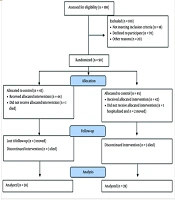
This quasi-experimental study was conducted using a pretest-posttest design. The research population consisted of all main primary caregivers of hemodialysis patients who visited two teaching hospitals associated with Zahedan University of Medical Sciences, Zahedan, southeast Iran, in 2021. The participants were 80 caregivers of hemodialysis patients who met inclusion criteria. The inclusion criteria were age over 18 years, undergoing dialysis at least twice a week and each time 3 to 4 hours, and no history of kidney transplantation. The main caregiver was the individual who was primarily responsible for caring for the hemodialysis patient at home, spent the most time with the patient (as confirmed by the patient), and was willing to participate in the study. The exclusion criteria were being a candidate for kidney transplants during the study, any changes in the patient’s diet or medication program by the physician, unwillingness to participate in the study, absence in at least one training session, or attendance at similar training interventions at the same time. The sample size was estimated using the following equation with a 95% confidence interval, 95% statistical test power, and a comparison of the mean and standard deviation of care stress score in a similar study (Ghane et al.) (23). Since the value obtained for sample size was very small, 40 individuals were considered the sample size per group (80 subjects in total) based on similar studies.
After obtaining a permit from the Ethics Committee of Zahedan University of Medical Sciences (IR.ZAUMS.REC.1400.175), the researcher attended the hemodialysis wards of the hospitals. Then, the researcher provided some information about the objectives of the study, selected the participants, and obtained informed consent from them. Then, the selected caregivers were randomly assigned to the intervention and control groups using permuted block technique. The caregivers were assigned to six quadruple blocks (A: the intervention group and B: the control group; e.g., AABB, ABAB, and BBAA). There were two individuals in each block from each group. The order of the blocks was randomly determined using a random number table, and then the caregivers were placed into the intervention or control group based on the blocks.
The instruments used to collect the data in this study were a demographic information questionnaire that assessed the patients’ and caregivers’ demographic information and a 30-item questionnaire (Khorami Markani et al.) to assess the knowledge of caregivers of patients undergoing hemodialysis (22). The questionnaire had four dimensions, namely diet (10 items scored 0-10), medication (10 items scored 0 - 10), vascular access care (5 items scored 0 - 5), and daily life activities (5 items scored 0 - 5). Each correct answer was scored 1, and other answers were scored 0. Therefore, the minimum and maximum scores were 0 and 30, with higher scores indicating a higher level of knowledge of caregivers. Khorami Markani et al. assessed the content and face validity of the questionnaire on a sample of 30 caregivers at a 15-day interval. The reliability values of the questionnaire assessed using the Kuder-Richardson formula and the test-retest method were 0.76 and 0.79, respectively. The reliability of the questionnaire was measured in this study as equal to 0.87 using the Kuder-Richardson formula.
The face-to-face training program was conducted with the active involvement of the caregiver and the patient at the patient’s bedside and after one hour from the start of dialysis by considering the patient’s comfort and stability. The program lasted four sessions of 20 - 30 minutes twice a week and for 2 consecutive weeks at the hemodialysis ward. In addition to face-to-face training, an educational booklet with pictures was given to the caregivers in the first session. The caregivers received training based on educational priorities, including patient diet, dietary restrictions, fluid restriction, weight control, blood pressure, common hemodialysis drugs, medication instructions, side effects, sleep instructions, vascular access care principles, and daily activities. The last session was held only for the main caregivers, and they received instructions about stress, its occurrence, emotional discharge, and stress control and management. During the intervention, the researcher made phone calls to the caregivers to solve their problems and attended the wards to answer their questions. One month after the completion of the training intervention, the caregiver’s knowledge questionnaires were completed again by the caregivers. The participants in the control group did not receive any intervention during the period except for routine ward care. They also completed the questionnaire at the end of the study. In accordance with ethical considerations, the instructional content of the intervention was provided to the control group members in the form of an educational booklet.
The collected data were analyzed by SPSS software (version 22) using descriptive statistics, including frequency, percentage, mean, and standard deviation. The Shapiro-Wilk test was also used to evaluate the normality of the data. The independent samples t-test and paired samples t-test were run to compare the mean scores of the participants in both groups. Moreover, the chi-square test and Fisher’s exact test were used to compare the frequency of the qualitative variables between the two groups at a significance level of less than 0.05.
4. Results
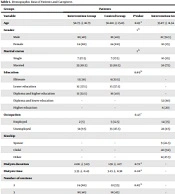
The results showed that there were no significant differences in demographic and other characteristics of the patients and caregivers between the intervention and control groups (P > 0.05; Table 1).
Table 1.
Demographic Data of Patients and Caregivers
| Groups | Patients | Caregivers | ||||
|---|---|---|---|---|---|---|
| Variable | Intervention Group | Control Group | P-Value | Intervention Group | Control Group | P-Value |
| Age | 50.75 ± 16.75 | 50.00 ± 15.85 | 0.83 a | 35.87 ± 11.34 | 34.67 ± 11.21 | 0.63 a |
| Gender | 1 b | 0.82 b | ||||
| Male | 24 (60) | 24 (60) | 19 (47.5) | 18 (45) | ||
| Female | 16 (40) | 16 (40) | 21 (52.5) | 22 (55) | ||
| Marital status | 1 b | 0.32 b | ||||
| Single | 7 (17.5) | 7 (17.5) | 10 (25) | 14 (35) | ||
| Married | 33 (82.5) | 33 (82.5) | 30 (75) | 26 (65) | ||
| Education | 0.69 b | 0.42 d | ||||
| Illiterate | 13 (30) | 9 (22.5) | - | - | ||
| Lower education | 15 (37.5) | 15 (37.5) | - | - | ||
| Diploma and higher education | 13 (32.5) | 16 (40) | - | - | ||
| Diploma and lower education | - | - | 32 (80) | 25 (62.5) | ||
| Higher education | - | - | 8 (20) | 15 (37.5) | ||
| Occupation | 0.43 c | 0.1 b | ||||
| Employed | 2 (5) | 5 (12.5) | 14 (35) | 14 (35) | ||
| Unemployed | 38 (95) | 35 (87.5) | 26 (65) | 26 (65) | ||
| Kinship | 0.90 b | |||||
| Spouse | - | - | 9 (22.5) | 8 (20) | ||
| Child | - | - | 20 (50) | 22 (55) | ||
| Other | - | - | 11 (27.5) | 10 (25) | ||
| Dialysis duration | 2.08 ± 3.03 | 1.91 ± 2.17 | 0.72 a | - | - | |
| Dialysis time | 3.33 ± 0.43 | 3.23 ± 0.36 | 0.26 a | - | - | |
| Number of sessions | ||||||
| 2 | 24 (60) | 22 (55) | 0.65 b | - | - | |
| 3 | 16 (40) | 18 (45) | - | - | ||
a Independent samples t-test
b Chi-square test
c Fisher’s exact test;
d Monte Carlo test
The results of the paired t-test indicated that the mean scores of the care knowledge of the caregivers in the intervention group increased significantly after the intervention (P = 0.001), compared to that of the control group (P = 0.12). The results of the independent samples t-test showed that the mean scores of the knowledge of the caregivers in the intervention and control groups before the family-centered care training intervention were not significantly different (P = 0.29). However, the results of the independent samples t-test demonstrated that the mean scores of care knowledge of the participants in the intervention group improved significantly after the intervention, compared to those of the control group (P = 0.001; Table 2). The results of the analysis of variance by the establishment of the assumptions of this test to control the significant effect of pretest scores showed that the mean scores of care knowledge of caregivers in the two groups were significantly different after the intervention (P = 0.001; Table 3).
Table 2.
Comparison of Care Knowledge of Caregivers in Two Study Groups
| Care Knowledge | Pre-intervention Scores (0 - 30), Mean ± SD | Post-intervention Scores (0 - 30), Mean ± SD | Paired Samples t-test |
|---|---|---|---|
| Intervention group | 10.42 ± 2.23 | 21.47 ± 3.21 | 0.001 |
| Control group | 11.27 ± 3.90 | 12.45 ± 3.40 | 0.12 |
| Independent samples t-test | 0.29 | 0.001 |
Table 3.
Results of Analysis of Variance for the Effect of Intervention on Care Knowledge of Caregivers in Groups
| Source of Change | Sum of Squares | df | Mean Square | F | P-Value | Effect Size | Power |
|---|---|---|---|---|---|---|---|
| Pretest | 229.51 | 1 | 229.51 | 28.21 | 0.001 | 0.26 | 0.99 |
| Group | 1753.79 | 1 | 1753.79 | 215.59 | 0.001 | 0.73 | 1 |
| Error | 626.36 | 77 | 8.13 | ||||
| Total | 25503 | 90 |
5. Discussion
This study examined the effectiveness of family-centered care education in the care knowledge of caregivers of hemodialysis patients. The results indicated a significant difference in the care knowledge between the intervention and control groups after the intervention. In other words, the care knowledge of the caregivers who attended the training intervention programs improved significantly, compared to that of the caregivers who did not receive any training. The aforementioned findings are in line with the results of previous studies. For instance, Khatiban et al. examined the effect of family-centered care education on the knowledge and self-esteem of caregivers of stroke patients (24), and Faraji et al. assessed the effect of a health education program on the knowledge, attitude, and practice of patients’ families (25). Moreover, Khorami Markani et al. evaluated the effect of family-centered care educational programs on home care knowledge among caregivers of patients with chronic renal failure under hemodialysis and showed that family-centered care education is effective in improving the knowledge of caregivers of hemodialysis patients, and this care can contribute to the enhancement of the physical and mental health of patients with chronic renal failure (22).
Amini et al. also showed that patient care training for caregivers of burn patients leads to an increase in their care knowledge (12). To increase the care knowledge of family members, especially caregivers, the reviewed studies have used strategies, such as family-centered education, to engage family members in caring for patients and provide instructions on crisis management for family members, especially main caregivers. Therefore, the reviewed studies are methodologically different from the present study regarding the type of intervention. Nevertheless, all the interventions led to increased care knowledge of caregivers and patients’ family members.
Keykha et al. examined the impact of self-care training on the psychological reactions of caregivers of cancer patients. The results showed that an increase in the caregivers’ care knowledge could contribute to better preparation of caregivers in providing care, and managing critical situations can help significantly reduce the care burden of clients (26). Following the results of the present study, Fathima examined the effect of the information booklet provided to caregivers of patients undergoing hemodialysis on the knowledge of home care management, and the results showed that educating caregivers increases their information significantly (27).
Previous studies on patients have also shown the positive effects of education on various aspects of patients’ lives. For instance, Fadlalmola and Elkareem examined the effect of an educational program on knowledge and quality of life among hemodialysis patients at Khartoum Medical Center in Sudan and demonstrated that the training program was effective in improving the knowledge of hemodialysis and quality of life of patients undergoing hemodialysis. The results indicated that the implementation of the educational program had a positive effect on the general knowledge of hemodialysis patients about the concept of hemodialysis, vascular access care, complications, dietary restrictions, fluid restriction, various medications, and routine activities (28).
Bañobre González et al. suggested that nurses’ training program significantly increases the level of caregivers’ awareness after educational interventions (29). However, in some cases, raising caregivers’ knowledge can have the opposite effect and be highly stressful for caregivers. For example, contrary to the results of the present study, Golaghaie et al. showed that the transfer of knowledge and information to family members can increase their anxiety (30) because the patient’s condition in intensive care units (ICUs) is very critical. Increasing the knowledge of caregivers can be stressful as their understanding of the clinical condition and deterioration of their patient’s condition increases. However, increasing knowledge, awareness, understanding, and application of knowledge in caregivers of patients with chronic diseases, including hemodialysis patients, increases the effectiveness of diets, medications, and routine activities and reduces complications, the need for frequent visits to the physician, and substantial medical costs (31). Nevertheless, education can be provided in different ways, including audio-visual, online, oral, written, or a combination of them.
The training instructions in the present study were provided orally (face to face) and in writing (an educational booklet). The results of the present study showed an increase in the knowledge of caregivers of hemodialysis patients upon receiving training, as confirmed in other studies (32-35). Following the findings of this study, it can be argued that family members play a vital role in care, support, and practical assistance when needed. In other words, family support is critical in the improvement of the quality of patient care (36).
5.1. Conclusions
The results of the present study showed that family-centered education could have a significant impact on the improvement of the knowledge of caregivers of patients and enhance the health of patients. Therefore, educational programs for patients should focus on the improvement of the knowledge of caregivers to provide better care.
5.2. Limitations
This study was performed on the caregivers of patients undergoing hemodialysis; therefore, the results cannot be generalized to all patients with chronic diseases.