
1. Background
In general, hospitals are not as safe as we assume (1). From every 150 patients, one patient dies because of the incidents occurring during medical cares. Two-thirds of the hospital incidents are related to surgeries (2). One patient in every 25 people undergoes surgery every year (3) and its estimate that 312.9 millions of surgeries are annually performed all the world (4, 5). The most complicated medical care is surgery and patients have the right to have a safe surgery (6). Although surgeries are done to save the patients and improve the quality of their life's (7), the probable complications of surgeries are considered as one of the major causes of death and disability in the world (8). Estimations in industrial countries suggest that the death risk for the hospitalized patients who having surgery is 0.4 - 0.8% and the risk of the probable complications is 3 - 17% for them (9-11). In summary, at least one million patients annually die during the surgeries and 7 millions of patients injure by surgery complications. Several studies have reported that about 50% of the surgery complications can be prevented by proper performance (12). Checklists and protocols are common tools for prevention of human error in challenging work environments (12). In these recent years, professional organizations have increasingly suggested using of instructions for evaluation of preoperative processes (8). In 2008, WHO proposed the surgical safety checklist to improve the surgical safety and decrease the death rates and surgery-related deaths (13-15). One of the key elements of risk management approach to create a safer environment in hospitals is using surgical safety checklist (16). Safe surgery can save the patients 'life and facilitate the achievement of public health productivity (17). According to the WHO estimation, application of this checklist can annually prevent 500000 deaths in the world (12, 18). In spite of the mentioned advantages, the observance of surgical safety checklist has been reported at a low level (19). Studies have suggested some instance of ignorance of these standards (20). Stehaie Russ et al studied 5 hospitals in England, they reported that about one-thirds of the surgical safety checklist items hadn't been observed by surgical teams (21). Observational studies have shown that surgical teams that accept this checklist are significantly different in terms of the observance of that and they don’t apply all of its items (22).
2. Objectives
Regarding the importance of recognition of the deficiencies in applying the surgical safety standards, the present study aimed to investigate the application of surgical safety checklist in the selected hospital of Kermanshah University of Medical Sciences (KUMS) in 2018.
3. Methods
This cross-sectional study was performed in operating rooms of selected educational hospital of KUMS. Study population includes all the surgical teams of neurosurgery, gynecology and general surgery operating rooms from January to May 2018 in selected hospital of KUMS. The minimum sample size that calculated based on Cochran’s formula was obtained as 150 surgeries. The inclusion criteria included: performing the operation in the main operating rooms of that hospital, scheduled as elective surgeries, the surgeries performed in neurosurgery, gynecology and general surgery operating rooms, and the presence of all the surgical team members in that mentioned surgeries. The exclusion criteria included: absence of members of the surgical team. The researcher randomly selected surgeries and filled the checklist by observation. Data's were collected by a checklist of surgical safety checklist. This checklist includes 33 items classified in three phases: (1) 20 items in phase one (before anesthesia), (2) 8 items in phase two (after anesthesia and before incision), and (3) 5 items in phase three (during or after suturing the surgical wound until getting the patient out of the operating room). Each of the items is scored based on a 3-point Likert scale as following: (1) properly applied as 2 score, (2) not properly applied as 1 score, and (3) not applied as 0 score. Reliability and validity of the checklist had been approved by Hashemi (8). For filling the checklists, the researcher observed the operation from the start to the end and checked items. Data analysis was done by SPSS version 18 and significance level was considered as 0.05.
4. Results
According to the findings, it was concluded that 77.11% of the surgical safety checklist items were observed in operating rooms of the selected hospital (Table 1).
Table 1.
The Scores of the Dimensions of the Total Items of the Surgical Safety Checklist in the Operating Rooms of the Selected Hospital of KUMS
| Phase | Score | SD | Percentage | The Total Standard Score |
|---|---|---|---|---|
| Phase one | 30.99 | 2.30 | 77.48 | 40 |
| Phase two | 11.98 | 1.38 | 74.80 | 16 |
| Phase three | 7.93 | 1.04 | 79.33 | 10 |
| Total | 50.89 | 3.05 | 77.11 | 66 |
Based on the analyses of the first phase, item that getting the highest score of adherence was approval of the patient’s name (98.7%) and item that getting the least score was the approval of the planned surgery (31.3%).
In the second phase, approval of the surgical instruments sterilization by the scrub nurse (81.3%) was the highest scores of adherence. The item getting the lowest score was reinjection of prophylactic antibiotic (24.7%).
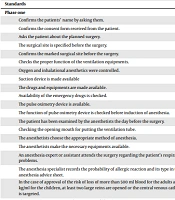
In the third phase, the item properly observed was labeling the samples that taken during the surgery (93.3%); whereas the approval of the planned surgery (16.7%) was the item getting the lowest score (Table 2).
Table 2.
Frequency and Percentage of Each Item in Three Phases of the Surgical Safety Checklist in the Selected Hospital of KUMS a
| Standards | Properly Observed | Not Properly Observed | Not Observed |
|---|---|---|---|
| Phase one | |||
| Confirms the patients’ name by asking them. | 148 (98.7) | 2 (1.3) | 0 (0) |
| Confirms the consent form received from the patient. | 100 (66.7) | 49 (33.3) | 1 (0.7) |
| Asks the patient about the planned surgery. | 47 (31.3) | 89 (59.3) | 14 (9.3) |
| The surgical site is specified before the surgery. | 59 (39.3) | 74 (49.3) | 17 (11.3) |
| Confirms the marked surgical site before the surgery. | 64 (42.7) | 53 (53.3) | 33 (22) |
| Checks the proper function of the ventilation equipments. | 112 (47.7) | 37 (24.7) | 1 (0.7) |
| Oxygen and inhalational anesthetics were controlled. | 116 (77.3) | 34 (22.7) | 0 (0) |
| Suction device is made available | 69 (46) | 78 (52) | 3 (2) |
| The drugs and equipments are made available. | 124 (82.7) | 25 (16.7) | 1 (0.7) |
| Availability of the emergency drugs is checked. | 56 (37.3) | 84 (56) | 10 (6.7) |
| The pulse oximetry device is available. | 130 (86.7) | 17 (11.3) | 3 (2) |
| The function of pulse oximetry device is checked before induction of anesthesia. | 94 (62.7) | 47 (31.3) | 9 (6) |
| The patient has been examined by the anesthetists the day before the surgery. | 72 (48) | 77 (51.3) | 1 (0.7) |
| Checking the opening mouth for putting the ventilation tube. | 53 (35.3) | 78 (52) | 19 (12.7) |
| The anesthetists choose the appropriate method of anesthesia. | 119 (79.3) | 31 (20.7) | 0 (0) |
| The anesthetists make the necessary equipments available. | 86 (57.3) | 60 (40) | 4 (2.7) |
| An anesthesia expert or assistant attends the surgery regarding the patient’s respiratory problems. | 112 (74.7) | 34 (22.7) | 4 (2.7) |
| The anesthesia specialist records the probability of allergic reaction and its type in the anesthesia advice sheet. | 64 (42.7) | 80 (53.3) | 6 (4) |
| In the case of approval of the risk of loss of more than 500 ml blood for the adults and 7 kg/ml for the children, at least two large veins are opened or the central venous catheter is targeted. | 101 (67.3) | 46 (30.7) | 3 (2) |
| The surgical team approves the existence of blood reservation. | 61 (40.7) | 78 (52) | 11 (7.3) |
| Phase two | |||
| Before incision, all the surgical team members confirm the planned surgery for the patients. | 82 (54.7) | 58 (38.7) | 10 (6.7) |
| Before incision, all the surgical team members confirm the planned surgery on the specified surgical site. | 85 (56.7) | 59 (39.3) | 5 (3.3) |
| The surgical specialist describes the cases causing rapid bleeding, damage, injury, or major disabilities. | 92 (61.3) | 57 (38) | 1 (0.7) |
| The surgical expert describes the cases of the necessity of special equipments, implants, and preparations for taking the necessary measures. | 66 (44) | 78 (52) | 6 (4) |
| The scrub nurse confirms the sterilization of the surgical instruments. | 122 (81.3) | 26 (17.3) | 2 (1.3) |
| In the case of necessity, the injection of prophylactic antibiotic minutes before the surgery is checked. | 89 (59.3) | 51 (34) | 10 (6.4) |
| In the case of necessity, reinjection of prophylactic antibiotic is done 60 minutes after injection of the antibiotic. | 37 (24.7) | 75 (50) | 38 (25.3) |
| In the case of necessity, negatoscope imaging is checked. | 96 (64) | 53 (35.3) | 1 (0.7) |
| Phase three | |||
| The surgical treatment performed for the patient is carefully checked and approved. | 25 (16.7) | 85 (56.7) | 40 (26.7) |
| The surgical instruments used during the surgery are counted by the scrub nurse. | 131 (87.3) | 19 (12.7) | 0 (0) |
| In the case of any ambiguity about the counted number of the surgical instruments, radiography imaging is done. | 110 (73.3) | 40 (26.7) | 0 (0) |
| The samples taken during the surgery are labeled by the circulator nurse. | 140 (93.3) | 10 (6.7) | 0 (0) |
| The written report of any failure in the surgical instruments and devices is submitted to the hospital authorities. | 75 (50) | 69 (46) | 6 (4) |
a Values are expressed as No. (%) unless otherwise indicated.
According to Table 3, there was a significant difference between the surgical fields in terms of adherence to the items of the first phase (P < 0.05). The safety standards were more observed in neurosurgery operations than other fields. In the second phase, adherences to the standards were higher in gynecological surgeries than the two other groups. In the third phase, there was no significant difference between the three groups in terms of adherence to the standards (Table 3).
Table 3.
Comparison of the Mean Scores of the Dimensions and the Total Surgical Safety Checklist in the Three Surgical Operations in the Selected Hospital of KUMS (Comparison of Adherence to the Standards in the First, Second, and Third Phases) a
| Phases | The Score of the Gynecological Operating Room | The Score of the General Operating Room | The Score of the Neurosurgical Operating Room | P-Value |
|---|---|---|---|---|
| Phase one | 30.62 ± 2.64 | 30.40 ± 2.27 | 31.96 ± 1.61 | 0.001 |
| Phase two | 12.38 ± 1.39 | 11.52 ± 1.23 | 12.04 ± 1.41 | 0.007 |
| Phase three | 8.100 ± 1.07 | 7.98 ± 1.07 | 7.72 ± 0.96 | 0.179 |
| Total | 51.10 ± 3.48 | 49.90 ± 2.97 | 51.68 ± 2.39 | 0.011 |
a Values are expressed as mean ± SD unless otherwise indicated.
5. Discussion
According to the results, 77.11% of the total standards of the surgical safety checklist are observed in the operating rooms of our study. Giles et al. investigated the application of surgical safety checklist in the operating rooms of Australian hospitals. The average level of adherence to the checklist items was 27% (20); this finding is significantly different from the results of the present research. However a systematic review performed by Borchard A. et al., as an inconsistent study, showed 75% adherence to the checklist standards (12). That is similar to the results of our study.
The findings show that 77.5% of the pre-anesthesia standards were observed. The two items with the highest adherence in the first phase were confirmation of the patients’ name and placing the pulse oximetry front of the surgical teams. Melekie and Getahun found that the first phase of standards was observed about 69.5%. The items getting the highest score were checking the anesthesia equipments and drugs before surgeries and connection of pulse oximetry (9). The mentioned items were also similarly observed in our study. Karlina reported that the items of detecting the patient’s wristband, surgical site and confirmation of the surgery and anesthesia consents were the items with the highest scores (14). However, adherence to the standards of this phase was reported lower than the previous studies. In the second phase of the checklist, 74.8% of the items had been observed. Giles et al. reported that adherence to the second phase was at the highest level (36.65%). Injection of prophylactic antibiotic was observed in 23% of the cases (20). Although this study has reported higher level of adherence to the standards than the other two phases, there is a significant difference between the findings of our study. According to the results, 79.3% of the third phase of surgical safety standards was observed; this rate was the highest adherence level. Bashford et al. reported a high level of observance of “counting the surgical tools, gauzes and suture needles” and “reporting the failure of the equipments” (about 94%). However, proper labeling of the samples was reported at a lower level (23). Melekie and Getahun reported the adherence to the standards of this stage as 54.3%. “Counting the surgical instruments before suturing the wound” was observed in 97.3% of the cases (as the highest score), and “reporting the major concerns and patient management in recovery room” was observed in 11.6% of the cases as the lowest score (9). The significant importance of counting the surgical tools before suturing the wound has been proved in all surgeries. This item has been performed at high level in these three studies.
The results of the present study suggest that the items of the surgical safety checklist have got a higher score in the neurosurgery operating rooms; i.e. it can be concluded that these items are more carefully observed in neurosurgery procedures. Seif Hashemi et al. reported a higher adherence to surgical safety standards in heart and plastic operating rooms (8). Russ et al. didn't report any difference between the emergency or elective surgeries in terms of observing the surgical safety standards (21).
5.1. Conclusion
According to the results, 77.11% of the surgical safety checklist items have been observed in the selected hospital of KUMS. Overall the adherence level is similar and even better than other studies results. It's suggested to perform further studies with larger populations and more samples in different operating rooms to investigate the effect of the surgical safety standards on postoperative consequences.