1. Background
One of the most important and common life-threatening conditions is end-stage renal disease where the ability of the body to maintain metabolic and electrolyte balance is impaired, causing elevated urea, creatinine, fluid retention, and electrolyte disorders in the body (1). Chronic kidney failure is a major medical, social, and economic problem for both patients and their families. Annually, it affects 3 - 5 million people, and part of these patients become candidates for hemodialysis (2, 3). When kidneys are unable to fulfill their functions due to any disorder, dialysis is used as a method to remove unessential and waste materials and to treat hyperkalemia, hypertension, and uremia (4).
The gold standard for venous access in hemodialysis patients is arteriovenous fistula (5). Patients with this fistula are constantly exposed to stress and pain resulting from 300 times of insertion into the fistula site every year. The considerable discomfort and stress of patients results from the perforation of fistula by a large needle. Mitigation of pain in these patients may be effective in easier acceptance of treatment and thus, improved quality of life (6). Meanwhile, nurses need to adopt different strategies to minimize this pain.
Generally, pain relief strategies are divided into pharmacological and non-pharmacological categories (7). Among these strategies are vapocoolant spray, lidocaine spray, prilocaine spray, tetracaine spray, eutectic mixture of local anesthetic (EMLA), and cryotherapy. Most of these strategies have some disadvantages including side effects, fairly late effectiveness, and staggering costs. Vapocoolant spray increases the risk of openness of the arteriovenous fistula in case of vasoconstriction. In response to lidocaine, various complications including allergic reaction, systemic toxicity, and altered cardiac rhythm patterns have been frequently reported. Further, EMLA topical mixture exerts its analgesic effect only after 60 minutes (8).
Another non-pharmacological strategy of pain mitigation is distraction. Different studies have shown that distraction is effective in managing the pain resulting from insertion of needles. The aim of distraction is to deviate the concentration from the painful stimulus, which can reduce fear, anxiety, and pain intensity (6, 9-12). Distraction using suitable and tolerable stimuli causes secretion of endorphins, and it is effective for short-term and transient pains (13). The results of a review study conducted by Malloy indicated that distraction is one of the oldest psychological interventions with considerable effects (12). Further, the results of the study by Borzou et al. showed that the intensity of pain resulting from venous needle insertion in patients undergoing hemodialysis was significantly lower compared to a control group when using distraction (10).
Another pain mitigation strategy is the use of Arnica ointment. Arnica, also called mountain tobacco, is a generic modification used to describe the herbal substances derived from the root, underground stalk, or dried flowers of Arnica montana. This plant is native to mountainous regions of Central Europe (Alp and Pirne mountains) and southern Scandinavia. Arnica can be used either as a dermal ointment or oral tablet (14). The anti-inflammatory and analgesic effects of this plant are associated with helenalin and dihydrrohelenalin. By inhibiting activation of NF-kB transcription factor, which is a central mediator in the inflammation process, it controls transcription of different genes including cytokine interleukins 1, 2, 6, and 8, as well as tumor necrosis factor alpha (TNFα) (15). Various studies have proven the anti-inflammatory, anti-hemorrhagic, and analgesic effects of Arnica montana in different conditions (postpartum hemorrhage, ecchymosis following rhinoplasty, and knee arthritis) (14, 16-18). Furthermore, the results of a review study by Iannitti et al. suggested the positive effect of Arnica montana on pain, function, edema, and ecchymosis of different organs compared to placebo (15).
Since no study has yet examined the effect of Arnica ointment on the pain caused by hemodialysis fistula placement, we sought to investigate the effect of Arnica ointment and distraction on the pain caused by fistula needle in hemodialysis patients.
2. Methods
This three-group, single-blind, clinical trial was conducted on 93 patients attending the dialysis wards of two hospitals affiliated to Zahedan University of Medical Sciences (Ali Ibn Abi Talib and Khatam-al Anbia hospitals) in 2017. The standard sample size was calculated at 22 for each group based on the formula for sample size determination of interventional studies considering confidence level of 95% and test power of 90%, and according to the values of similar studies on pain intensity reduction. Since this study consists of three groups, the sample size was multiplied by square root of 2; thus, 31 subjects were assigned to each group (Figure 1) (19).
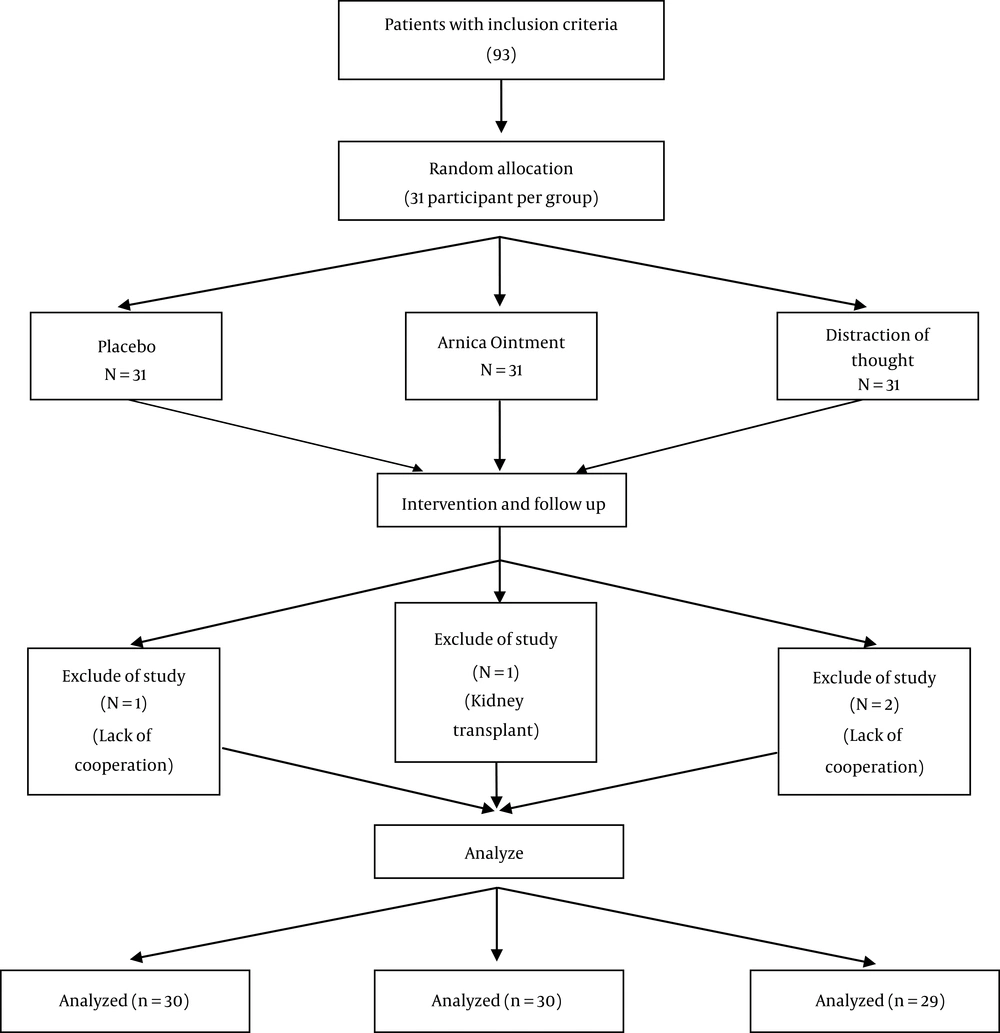
Figure 1.
Study flowchart
Once the proposal was approved by the Ethics Committee of the university (code of ethics: IR.ZAUMS.REC.1396.288) and after making the necessary coordination with the head of the hospitals and hemodialysis wards, the eligible patients were included in the study after receiving an explanation regarding the study objectives and signing an informed consent form. The participants were selected using the convenience sampling method. The inclusion criteria were age above 18 years, consciousness, ability to communicate, need for hemodialysis at least twice a week, not receiving any analgesics or drugs six hours before hemodialysis, absence of severe pain in other organs, and no skin problems or numbness at the site of access to the veins of diabetic patients. The exclusion criteria comprised lack of cooperation, kidney transplantation and termination of hemodialysis treatment, development of wound at the site of fistula at any stage of the disease, misplacement of the fistula needle at the first time, and death.
First, a demographic-clinical information form including items on age, gender, ethnicity, site of fistula, frequency of dialysis per week, and time of initiation of dialysis with fistula was completed by the patients. In case of inability to read and write, the form was completed through interview by the researcher.
In order to assign the patients to each of the intervention groups (distraction, Arnica ointment, and placebo), randomization method was used. For this purpose, 93 colored balls placed inside a vase were provided to the patients. Every patient randomly picked up a ball (red ball: Representing Arnica ointment group; white ball: Representing the distraction group; and green ball: Representing the placebo group), and the patients were assigned to three equal groups accordingly. In the distraction group, in order to distract the patients during insertion of fistula needle, images related to nature alongside music were presented using a laptop and headphone for 30 minutes. Specifically, the patients lied in a semi-seated position, the laptop was placed on the table ahead of the patients, and its monitor was opened towards them. Then, a headphone was provided to the patients, and music and images were presented to them. The music and images were presented for half an hour. Ten minutes after beginning the music, fistula needle insertion was performed and the pain score was assessed and recorded after needle insertion.
In the two groups of Arnica ointment and the group, identical materials were employed by the researcher for 60 minutes before fistula insertion by as large as around 5 cm2 on the needle insertion site. A bandage was then placed on it. Next, Arnica ointment or Vaseline cream was cleared off the skin surface, the needle placement site was disinfected with Betadine, and then arterial needle insertion was performed. Following arterial needle insertion and before venous needle insertion, pain intensity was assessed and recorded by the researcher without knowing the type of applied medication on the skin surface. Needle No. 16 (SUPA) was used for vascular access in all the patients. The arterial needle was inserted to the vessel at a distance of at least 5 cm off the fistula at 30 - 45°. Pain intensity was measured only the first time the patient’s skin was punctured by the nurse to insert the arterial needle. In case of misplacement of fistula needle and second attempt by the nurse to perform this procedure (re-perforation of the skin), the patient was excluded from the study in that session, and the pain resulting from subsequent times was not measured. Across all the three groups, arterial needle insertion was performed by the same nurse.
Visual analogue scale (VAS) was used for evaluating the patients’ pain. This scale is a horizontal line measuring the level of pain on a scale of 0 - 10. VAS was devised in 1975 by Mezlak, and it has been used in various studies ever since. In this method, using a questionnaire and through numerical gradation, among different factors ranked in association with pain, separation between the sensory part and cognitive, motivational, and emotional factors was done. This scale was used to measure the patients’ pain immediately after insertion of fistula needle. The scientific validity and reliability of this scale has been confirmed in various studies. In this regard, Wiliamson in a study entitled “reviewing three pain grading scales which are typically used”, he reported that this scale is valid, reliable, and suitable to be used in clinical practice (with correlation coefficient of 0.97 - 0.99) (20, 21). Pain assessment was performed by a trained nurse who was blind to the group allocations. Pain assessment in all the three groups was performed during two consecutive hemodialysis sessions (intervention with placebo, Arnica, or distraction). Eventually, the obtained data including demographic and clinical information and pain score were analyzed by using Chi-square, ANOVA, and Bonferroni post hoc tests at the significance level of less than 0.05 in SPSS, version 22.
3. Results
The findings indicated that out of all of the studied individuals, one patient from the Arnica ointment group was excluded due to kidney transplantation. Also, one patient from the placebo group and two from the distraction group were excluded due to unwillingness to cooperate. Eventually, analysis was performed in Arnica, distraction, and placebo groups with 30, 29, and 30 individuals, respectively.
Out of the 89 studied patients, 66% were male. The mean age of the studied patients was 48.84 ± 16.70 years. Investigation of internal consistency of the groups in terms of demographic variables including age, gender, race, fistula site, frequency of dialysis per week, and time of initiation of dialysis with fistula indicated that the groups were homogeneous and were not significantly different (Table 1).
Table 1.
Comparison of Demographic Characteristics of Hemodialysis Patients Between the Three Groups (Arnica Cream, Distraction and Placebo)a
| Variable | Group | Total | P Value | ||
|---|---|---|---|---|---|
| Placebo | Distraction of Thought | Arnica Ointment | |||
| Age, y | 49.50 ± 17.55 | 48.61 ± 16.43 | 47.50 ± 17.29 | 48.53 ± 18.39 | 0.906b |
| Sex | 0.199c | ||||
| Female | 11 (36.66) | 6 (21.42) | 13 (43.33) | 30 (34) | |
| Male | 19 (63.34) | 22 (78.58) | 17 (66.67) | 58 (66) | |
| Initiation of dialysis with fistula, mo | 39.27 ± 24.35 | 38.43 ± 37.79 | 47.87 ± 37.51 | 41.93 ± 46.74 | 0.569b |
| Frequency of dialysis per week | 2.73 ± 0.41 | 2.79 ± 0.45 | 2.83 ± 0.41 | 2.78 ± 0.37 | 0.650c |
| Nationality | 0.833c | ||||
| Fars | 14 (46.7) | 15 (53.6) | 14 (46.7) | 43 (49.5) | |
| Baluch | 16 (53.3) | 13 (46.4) | 16 (53.3) | 45 (50.5) | |
| Fistula location | 0.232c | ||||
| Radio cephalic | 9 (30) | 11 (39.3) | 8 (26.7) | 28 (31.8) | |
| Brachiocephalic | 14 (46.7) | 6 (21.4) | 9 (30) | 29 (33) | |
| Brachiobasilic | 7 (23.3) | 11 (39.3) | 13 (43.3) | 31 (35.2) | |
aValues are expressed as mean ± SD or No. (%).
bANOVA.
cChi-square.
The results of ANOVA test suggested a significant difference with regards to pain intensity among the groups. According to Bonferroni post hoc test, the mean pain score in the Arnica group was significantly lower than the placebo group in both hemodialysis sessions (P < 0.001). The mean pain scores in the distraction and placebo groups were not significantly different in the first dialysis session (P < 0.277). On the other hand, in the second session, the mean pain score was significantly lower in the distraction group (P < 0.002). Furthermore, comparison of pain intensity between the distraction and Arnica groups indicated a significant difference in both sessions between the distraction and Arnica groups, where the mean pain intensity was significantly lower in the Arnica group relative to the distraction group (P < 0.001; Tables 2 and 3).
Table 2.
Comparison of Mean Pain Intensity Before and After the Intervention in the Three Groups (Arnica Cream, Distraction and Placebo) in the First Dialysis Sessiona
| Group | No. (%) | Pain Score (First Time) | Follow-Up Test | |||
|---|---|---|---|---|---|---|
| Min | Max | Mean ± SD | ||||
| Arnica ointment | 30 (34.1) | 1 | 5 | 3.07 ± 1.36 | Arnica ointment < distraction of thought, P: 0.001b, Arnica ointment < placebo, P < 0.001b | |
| Distraction of thought | 29 (31.8) | 2 | 7 | 4.50 ± 1.23 | Distraction of thought > Arnica ointment, P: 0.001b, distraction of thought = placebo, P: 0.277b | |
| Placebo | 30 (34.1) | 2 | 8 | 5.13 ± 1.61 | Placebo > Arnica ointment, P < 0.001b, distraction of thought = placebo, P: 0.277b | |
aANOVA (P < 0.001).
bBonferroni.
Table 3.
Comparison of Mean Pain Intensity Before and After the Intervention Between the Three Groups (Arnica Cream, Distraction and Placebo) in the Second Dialysis Sessiona
| Group | No. (%) | Pain Score (Second Time) | Follow-Up Test | |||
|---|---|---|---|---|---|---|
| Min | Max | Mean ± SD | ||||
| Arnica ointment | 30 (34.1) | 1 | 7 | 2.83 ± 1.28 | Arnica ointment < distraction of thought, P < 0.001b, Arnica ointment < placebo, P < 0.001b | |
| Distraction of thought | 29 (31.8) | 2 | 7 | 4.29 ± 1.24 | Distraction of thought >, Arnica ointment, P < 0.001b, distraction of thought < placebo, P: 0.002b | |
| Placebo | 30 (34.1) | 3 | 9 | 5.50 ± 1.35 | Placebo > Arnica ointment, P < 0.001b, distraction of thought < placebo, P: 0.002b | |
aANOVA (P < 0.001).
bBonferroni.
4. Discussion
We found that the use of Arnica ointment can mitigate the pain resulting from fistula needle insersion. Furthermore, comparison of mean pain between the Arnica and distraction groups indicated that this ointment is significantly more effective than distraction for pain mitigation. The results of a study by Pumpa et al. investigating the effect of topical Arnica on pain, function, and muscular damage following vigorous exercise suggested a significant reduction in pain in Arnica group compared to controls, which is consistent with our findings (14). Further, the results of a study by Robertson et al. showed that Arnica tablet caused a significant reduction in pain resulting from tonsils removal, which was in line with our results, with the only difference that in our study, Arnica was not used topically (21). In a review investigating the effect of Arnica on pain and inflammation following surgery, Iannitti et al. concluded that Arnica montana, whether used topically or orally, is effective in the management of pain and inflammation and causes mitigation of pain intensity, which was in line with our results (15). Widrig et al. compared the effects of nonsteroidal anti-inflammatory drugs and Arnica on hand osteoarthritis and concluded that there were no significant differences in pain and function of hands between ibuprofen and Arnica groups, which was in line with our results, though it should be noted that the quality of pain in hemodialysis is different from that of osteoarthritis (22).
The results of our study suggested that distraction could assuage the pain resulting from fistula needle insertion. Similarly, Mollahosseini et al. reported that distraction technique caused pain mitigation in patients undergoing acute abdominal surgery (23). The results of the study by Alhani on teenagers undergoing hemodialysis showed that distraction mitigates the pain resulting from fistula placement. The results of both studies were in accordance with our findings (6). However, the results of a study by Aydin and Sahiner investigating the effect of music and distraction cards on pain during tonsils removal in children suggested insignificant differences across studied groups in terms of pain and stress. This incongruence can be attributed to the type of operation, because tonsils removal in children causes development of various limitations in the convalescence following surgery, which in turn, causes development of stress and pain in these children (24). Borzoi et al. employed a distraction technique such as rhythmic respiration, which caused pain mitigation following fistula needle insertion (10). Also, Borzoi et al. in another research investigated the effect of rhythmic respiration on the pain caused by orthopedic surgery. They indicated that distraction caused pain mitigation and less need to pain killers in these patients. The results of these studies were congruent with our findings (11).
One of the limitations of this study, which might have influenced the results, was the possible effect of culture and beliefs as well as routine problems about pain perception and pain intensity expression. Our findings might have also been affected by the patients’ unwillingness to disclose their real pain level or patients’ moods in different dialysis sessions.
4.1. Conclusion
Generally, the results of this study indicated that distraction and Arnica diminish pain intensity in patients undergoing intervention. These findings are of great importance in nursing care, since mitigation and improvement of this pain is considered an important care objective and causes better acceptance of treatment by the patient. Considering the high rates of painkiller use across all societies, training these inexpensive and convenient nursing methods to patients and healthcare providers is recommended, so that they can take steps to improve the quality of care.
This study was part of an M.Sc. thesis in Special Nursing Care approved by Zahedan University of Medical Sciences. The study has been registered in clinical trials registration database (IRCT20170806035520N3). We would like to thank the Deputy of Research of Zahedan University of Medical Sciences, head and academic deputy of Nursing and Midwifery Faculty, the staff in the dialysis wards of Ali Ibn Abi Talib and Khatam-al Anbia hospitals, and all the patients who cooperated with us in this study.