
1. Background
Cancer is the second leading cause of death in children aged 5 - 14 years (1). The World Health Organization estimates the incidence of childhood cancer to be 100 per 1000000 cases (2). In 2018, 10590 children under 15 years of age were diagnosed with cancer (3). Today, the prevalence of childhood cancer in developing countries is higher than 40 per 1000 people (4). The five-year survival rate has been reported for 80% of children with cancer, leading to an increase in childhood cancer (5). According to Mahak Charity, the rate of cancerous children in Iran is 9 per 10000 cases (6). According to the Iranian Ministry of Health and Medical Education, the incidence of cancer among Iranian children is annually between 1500 and 2000 (7). Today, due to therapeutic methods such as chemotherapy, the chance of survival has increased the number of cancer patients (4, 8).
Life-threatening illnesses such as cancer, due to their impact on the patient and his/her relatives, bring about countless changes in the structure and function of the family (8). Cancer diagnosis and its therapeutic process can trigger stress in the child and parents alike (1), because families with a child suffering from cancer undergo experiences such as frequent hospitalization of the child which often leads to psychosocial problems, isolation, and reduced recreational activities (9). Studies show that caregivers, especially mothers, of cancer patients usually carry huge burdens, which sometimes results in painful experiences such as excessive weeping, cheerlessness, avoidance of social interaction, reduced social relationships, unwillingness to talk, fatigue, decreased appetite, and decline in the quality of life (8, 10).
In Iran, it is mothers who often care for the sick child at the hospital (7). Therefore, mothers of cancer children are regarded as primary caregivers in the treatment process (8). Lacking adequate knowledge about treatment and care interventions, parents, especially mothers, often have to grapple with economic consequences of the child’s disease, the suffering imposed on the child during the illness, separation from the child, lack of awareness regarding the future of the disease, long-term care procedures, social reactions to the child’s illness, frequent hospitalization, unexpected turn of the illness, changes in the patient's physical condition, and the emergence of various complications associated with the illness and its treatment (11). Unfortunately, support services for caregivers are poorly provided in Iran (12).
Nursing care is effective when accompanied by attention both to the family and the patient (13) and when the world is viewed from their point of view as well (14). Given that the nature of suffering and burden is based on perceived experiences of individuals, various uncovered facts will emerge if seen through the perspective of others, but it cannot be identified and investigated by the conventional quantitative methods and tools. Therefore, it is crucial to understand the burden pattern of caregiving parents. Acquiring a deep and comprehensive recognition of the nature of burden borne by the family helps nurses to adopt effective interventions to alleviate parents’ suffering (15). Such tensions that affect a family member leave their impact on the entire family, especially mothers. Patient care drains the energy of the family and exposes it to physical, psychological, and emotional outcomes including isolation. This could give rise to frustration, despair, fear, and embarrassment in parents (16). Consequently, adaptability of parents, especially mothers, plays a decisive role in this regard (17). In fact, identifying and educating different methods of care and adaptation to new conditions can improve daily activities of these patients. For this reason, Roy adaptation model can be considered an effective method for patients’ adaptation (18).
Roy’s model of adaptation is one of the most widespread nursing models in coming to terms with diverse illnesses and problems (19, 20). The goal of this model is to encourage hope and trust in patients and their caregivers and to strengthen their physiological and cognitive adaptation to chronic diseases (21, 22). Healthcare programs that are based on Roy’s model can moderate maladaptive behaviors and boost compatibility (23). This model may be a useful guide for nurses in caring for patients and a pattern for adjustment and compliance programs for a host of patients (24).
In the context of providing nursing care, deploying interventions within the framework of Roy adaptation model reinforces physiological adaptability of patients (25) and reduces or even eliminates maladaptive behaviors (26). Bakan observed the positive effect of applying Roy adaptation model on the management of chronic diseases (27). This adjustment model integrates personal and external resources and provides the conditions for successful adaptation by helping the individual to achieve a higher level of equilibrium in threatening circumstances (28). Numerous researchers have proposed Roy’s model of adaptation as an effective guide to health education and research and believe that it assists medical teams to intervene effectively in addressing patients’ problems. Evidence also confirms its effects on physical and psychosocial adaptation of patients, improvement and control of adaptive responses to chronic diseases during nursing care, and finally applicability in all areas of nursing. In these studies, it is emphasized that educating patients may have a tremendous effect on the two basic concepts of Roy’s model: self-concept and self-management. Empowerment through this framework can turn patients’ self-concept to a positive managerial attitude and thus enable them to adjust to the illness (29).
Most studies on the application of Roy’s model have revealed its positive effects on controlling the disease and enhancing patients’ responses to chronic diseases such as heart failure, diabetes, and end stage renal disease (30). On the other hand, mothers of children with cancer play the chief role in caring for patients both during hospitalization and after discharge. However, few studies have been conducted on the efficacy of this model on caregivers, especially mothers, of children with cancer.
2. Objectives
Consequently, the authors of the present research have attempted to investigate the impact of Roy’s model on the care burden of mothers with children suffering from cancer and undergoing chemotherapy.
3. Methods
This quasi-experimental study was conducted among mothers of children with cancer and undergoing chemotherapy in 2018. It was carried out at the Chemotherapy Oncology Ward of Taleghani Hospital, Gorgan, Golestan province. Children whose condition had been approved by a specialist and who had undergone chemotherapy for at least one year were considered qualified. These children were hospitalized for chemotherapy at least once a week in the last 6 months. Also, children and their parents did not have any chronic mental illnesses. Besides, mothers who were absent for more than one session were excluded from the study.
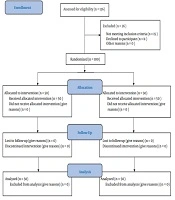
The sample size was determined at 18 for each of the two groups on the basis of the study by Mohammad Pour et al. and considering the effect size of 1.2, test power of 95%, and the significance level of 0.05 (30). Study samples were randomly divided into the control and experimental groups via coin flipping.
After acquiring the approval of the Research Council of the Faculty of Medical Sciences of Aliabad Katoul Islamic Azad University and obtaining the code of ethics (IR.IAU.CHALUS.REC.1395.35), the researchers referred to the Children Chemotherapy Center and sought the participation of hospital officials. Then, the research goals were explained to the mothers of children with cancer in order to ensure intervention safety as well as confidentiality of information and to obtain their informed consent form. Participants were allowed to withdraw at any stage from the study.
The intervention was conducted by a researcher with a Master's degree in Pediatric Nursing under the supervision of a Ph.D. in Nursing specializing in Psychiatric Nursing. The program was carried out during seven sessions (each lasting 45 min) for 4 consecutive weeks at the training room of the hospital.
The first session was devoted to getting acquainted with parents and their concerns; next, some general explanations were presented. Each subsequent session began with a review of the preceding session. Afterwards, a new topic was raised and parents were asked to participate. Each session ended with a recap, providing the pamphlet related to the session in question, and requesting parents to practice and implement the instructed materials. The sessions were held in the same place (hospital) yet on distinct days for each group. Topics elaborated in the experimental group included the following: physiological needs (sleep, nutrition, rest, control of vital signs, digestive complications such as nausea, vomiting, and constipation), self-concept (daily habits, constraints, despair, fear, empathy, and tranquility), roles (mother, helping others, adaptation to illness, enhancing the ideal self as well as the spiritual and moral self), and dependency (independence from nurse and health team, interest in the child and the family, sense of empathy, etc.) (Table 1).
Table 1.
Training Sessions
| Educational Sessions | Dimension | Educational Objectives | Training Duration |
|---|---|---|---|
| 1 | Physiology | Explaining about cancer, its causes, therapeutic methods, and other related issues | 45 min |
| 2 | Physiological needs related to nutrition | Elaborating on drug side effects and how to change one’s diet | 45 min |
| 3 | Physiological needs related to sleep | Elaborating on evolutionary needs and changing one’s sleeping hours | 45 min |
| 4 | Self-concept and teaching measures to the child to improve his/her self-concept | Explaining self-concept, the importance of child’s self-concept, and teaching measures for enhancing this self-concept | 45 min |
| 5 | Role | Narrative therapy of mother’s feelings about the child’s illness and consequent changes in the life of the mother | 45 min |
| 6 | Autonomy | Explaining lifestyle changes that occur in the family and training other family members to involve in caring for the sick child; teaching the caregiver about the importance of devoting some time for one’ own leisure | 45 min |
| 7 | Review | 45 min |
The control group was provided with the routine training, including several pamphlets containing brief information on the illness and chemotherapy care. In order to observe ethical issues, at the end of the study, the control group were provided with the materials of the test group along with the pamphlets.
The data collection tools consisted of a checklist related to parents' personal information including age, gender, educational level, occupation and economic status and demographic characteristics of children including gender, educational level, comorbidity, birth order, and place of residence. Moreover, the authors utilized the Caregiver Burden Scale developed by Elmstahl et al. (1996). The questionnaire comprises of 22 items scored based on a 4-point Likert scale (never: 1, rarely: 2, sometimes: 3, and often: 4). The overall score of the questionnaire varied from 22 to 88, with higher scores indicating lower care burden. The questionnaire also categorized parents’ care burden into three levels of low burden (22 - 44), moderate burden (44 - 46) and high burden (66 - 88) (31).
Ten professors of the Faculty of Medical Sciences of Aliabad Katul Islamic Azad University approved the face and content validity of the instrument. The reliability of this questionnaire was confirmed through Cronbach's alpha (0.87) and test-retest method (0.82) in the two studies by Mashayekhi et al. (32, 33). The results were analyzed in SPSS-21 by means of descriptive statistics (i.e., mean and standard deviation) and inferential tests (independent and paired t tests and covariance) at the significance level of 0.05. Finally, Shapiro's test was used to determine the normality of the data.
4. Results
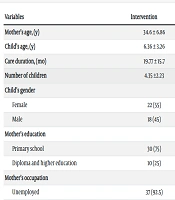
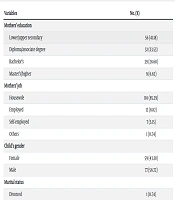
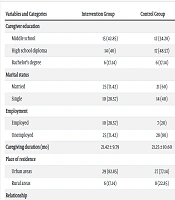
The descriptive statistics showed that 50% were female and 50% others were male, the majority of the subjects (38.9%) were under 5 years of age and the least frequent age group (5.6%) was aged between 10 and 15 years. Also, 47.2% of all the children had pre-school education. In terms of age, 72.2% of mothers were under 40 years, 37.8% were above 40 years, 47.3% of fathers were under 40 years, and 52.8% of the fathers were above 40 years old. Also, 22.2% lived as single parents and 77.8% live with their spouse. Of all the parents, 88.9% were mothers and 11.1% were fathers. With respect to educational level, most fathers (47.2%) had high school diploma and the least frequent educational status (2.8%) was literate. On the other hand, most mothers (47.2%) had high school diploma and the least frequent educational level (5.6%) was secondary education. Concerning occupation, the majority of the fathers (41.7%) were employees and most mothers (69.4%) were housewives. Furthermore, the majority of the parents (44.4%) had one child and the least frequent number of children (2.8%) was five children. From the economic point of view, 94.4% were in the average level, 69.4% of the total population benefited from support systems, and 61.1% of the subjects were living in the city.
The results showed that the mean score of burden before the intervention was 70.44 ± 7.04 in the experimental group and 67.11 ± 6.54 in the control group; in this regard, the independent t test did not reveal any significant difference between the two groups (P = 0.15). However, after the intervention, the same test reflected a significant difference in the mean of care burden between the experimental group and the control group (50.94 ± 4.58 vs. 70.88 ± 5.13; P < 0.01). Similarly, paired t test demonstrated a significant difference in the experimental group before and after the intervention (P < 0.01, t: 16.63), but there was no significant difference in the control group in this regard (P = 0.07; Table 2).
Table 2.
Comparison of Care Burden Before and After the Intervention in the Control and Experimental Groups in Mothers of Children Under Chemotherapy
| Stage | Group | P Value | |
|---|---|---|---|
| Experimental | Control | ||
| Before intervention | 70.44 + 7.04 | 67.11 ± 6.54 | < 0.01a |
| After intervention | 50.94 ± 4.58 | 70.88 ± 5.13 | |
at test.
Paired t test showed that the experimental group was significantly different before and after the intervention in terms of care burden score (P = 0.01). This test also revealed a significant difference in the control group before and after the intervention (P = 0.007). That is to say, care burden after the intervention increased in the control group and decreased in the experimental group. In addition, controlling for pre-test variables, covariance analysis suggested a significant difference in the mean of care burden (P < 0.01). Accordingly, 89% of post-test changes were attributed to the independent variable and the intervention (Table 3).
Table 3.
The Effect of Roy Adaptation Model on the Care Burden of Mothers of Children Under Chemotherapy in Gorgan in 2018
| Source of Variance | Sum of Squares | Degree of Freedom | Mean of Squares | F Value | Significance Level | Eta |
|---|---|---|---|---|---|---|
| Modified model | 5387.78 | 2 | 2693.89 | 95.67 | P < 0.01 | 0.85 |
| Post-test separator | 2998.24 | 1 | 2998.24 | 106.38 | P < 0.01 | 0.31 |
| Group | 5361.16 | 1 | 5381.61 | 191.11 | P < 0.01 | 0.85 |
| Error | 929.18 | 33 | 28.15 | |||
| Sum | 135779 | 36 | ||||
| Total | 4380.75 | 35 |
5. Discussion
The results of this study revealed that the level of care burden in the parents of cancer children was high before the intervention. However, this value declined in the experimental group after implementing Roy’s model of adaptation. This finding establishes the effectiveness of Roy’s model in the reduction of care burden.
The high severity of care burden among mothers of cancer children shown in this study is consistent with the study by Ahmadi et al. who came to a similar conclusion among the same population (31). Feghhi et al. explored the impact of Roy’s model of adaptation on psychosocial adjustment of type II diabetic patients. The results of their study indicated that patients’ knowledge and attitude toward the disease improved in their experimental group compared to their control group (34). Maleki et al. reported that the mean fatigue score significantly decreased after implementing a care program based on Roy’s model in their experimental group compared to their control group (23).
Also, the study by Yildiz et al. in Turkey pointed to a high level of care burden among caregivers of cancer patients (35). There is extensive evidence verifying that parents of cancer children undergoing chemotherapy experience emotional stress and many other care pressures (36). This is due to the fact that the family of cancer patients are exposed to many psychological stresses and tensions at the time of diagnosis and during treatment; in this regard, mothers of cancer children tolerate the most pain and burden (1, 37). When a patient suffers from pain, the caregiver gradually comes to develop a similar feeling. This sense of empathy is particularly huge in mothers of cancer children (38). These tensions and psychological stresses, in addition to intensifying care burden, reduce mothers’ quality of life (16, 39).
Mohammadi and Roshanzadeh showed that education based on standard nursing models reduces suffering and burden in patients and caregivers alike (40). Hassanzadeh and Hojjati reported that teaching resilience and increasing parents’ adaptation can mitigate suffering and the burden of care (39). It has been found that training adaptive behaviors and supporting families of patients suffering from chronic diseases could promote adaptability and the quality of life of in patients and their caregivers (30, 41). Hatami et al. reported that administering Roy’s model of adaptation for mothers of cancer children enhances their resilience and psychosocial well-being (42). According to Moradikia et al. training resilience and emotional regulation increases psychological adaptability of mothers of children with intellectual disability (43).
Mohammadi and Babaee carried out a study in Iran Alzheimer Association among 56 caregivers of Alzheimer’s patients. The study subjects participated in eight educational sessions on the nature of the Alzheimer's disease, its complications, and principles of self-care as well as home care management. The results exhibited a gradual decline in caregivers' suffering (44). McLennon et al. dealt with the burden of spouse caregivers of patients with dementia and argued that these caregivers endure a great amount of stress and tension; the author put forth measures such as training and developing support systems to alleviate this suffering (45). Mace and Rabins presented a care model for the family of patients with neurological problems such as dementia and forgetfulness. They emphasized dependency of these patients and focused on their caregivers. It was stated that any care program directed at supporting patients urgently needs to educate caregivers since many problems associated with health and patient care will be resolved if caregivers are empowered (46). In Nigeria, Adeosun concluded that individuals with the lowest educational level experienced the highest levels of care burden (47). In their review study, Stajduhar inferred that certain undeniable physical and psychological problems threaten home caregivers; in this regard, their empowerment through education and support systems will exert a positive impact on lowering the negative effects of care (48). This is consistent with the results of the present study.
Thus, educating and supporting family members of patients can be translated into upgrading the adaptation and quality of care and life in patients (30, 41). Given the effectiveness of Roy adaptation model, utilizing appropriate nursing patterns and theories becomes ever more important (22). Indeed, deploying conceptual frameworks of nursing to conduct research is essential for knowledge development in this field. Studies that are based on nursing models and patterns can lead to better understanding of human experiences and promotion of health and quality of health care in general (49).
Based on the results of this study, it can be posited that mothers of cancer children will be able to withstand many psychological pressures by practicing Roy’s model of adaptation. In fact, it may be inferred that education can be a factor in moderating care burden in stressful situations including children’s illness. Therefore, educational interventions based on Roy’s model of adaptation alleviate care burden in mothers and allow them to effectively deal with their problems and life difficulties.
The limitations of this study include its low sample size, reluctance of some mothers to participate in the research, and lack of regular attendance on the part of some participants due to occupational reasons. Since these restrictions may affect generalizability of the findings and constrain their applicability, it is suggested that future studies consider larger sample sizes. We also suggest further studies with more long-term follow-ups.
5.1. Conclusions
According to the results, it can be concluded that adjustment education is a useful intervention in relation to mothers of children under chemotherapy; furthermore, Roy’s model of adaptation may be employed as a non-invasive, non-pharmacological, and cost-effective method for controlling physical and psychological problems in chronic patients and their caregivers. As a practical nursing intervention, this model decreases care burden and enhances patient’s adaptability to his/her illness. Generally, it is argued that adopting effective nursing theories as frameworks for conducting research leads to the development of nursing knowledge and boosting the quality of nursing care.