The results of the current study revealed that
E. coli was the cause of UTI in the majority of the cases. Moreover, it was the most frequent etiologic agent in all four groups of patients. Most of the patients were female and had febrile UTI. We found a significantly higher frequency of non-
E. coli infections in cases with neurogenic bladder vs. those with apparently normal urinary tract and patients with urological anomalies (VUR and urinary obstruction). Shaikh et al. (
6) reported that Hispanic children and cases with moderate to severe VUR (VUR grade 3 - 5) are more prone to develop UTI caused by non-
E. coli organisms.
The present study was targeted toward the assessment of the rate of UTI caused by
E. coli and non-
E. coli pathogens among Iranian children. Our results revealed a higher prevalence of UTI among females than males. Nonetheless, this rate has been reported to be higher in males than in females in other studies (
3,
11). This discrepancy may be due to the use of various sampling methods. In this regard, in a study performed by Spahiu and Hasbahta (
3), 63.88% of the infections were reported to be caused by
E. coli pathogens. Furthermore, Halerstein (
11) and Shaikh et al. (
6) reported this rate as 75%. In the present study,
E. coli was the cause of UTI in 79.5 % of the infections. Friedman et al. (
12) found a higher association of non-
E. coli disease with urinary tract anomalies (77%), including VUR (50%) and UPJO (9%).
Despite different studies on pediatric UTIs, our knowledge about non-
E. coli pathogens is incomplete (
1). A better understanding of the non-
E. coli pathogens accounting for the development of UTI can contribute to the prevention and management of this disease. Based on the literature, a total of 10 -20% of UTI episodes are due to non-
E. coli pathogens.
Klebsiella,
Enterobacter,
Pseudomonas, and
Staphylococcus species are the most common non-
E. coli pathogens accounted for pediatric UTIs (
3). In the current study, approximately 20% of the infections were due to non-
E. coli pathogens, 29.24% of which were due to
Klebsiella.
Klebsiella accounted for 81/1348 (6%) of total UTI episodes. Compared to the study by Spahiu and Hasbahta (
3), the prevalence rate of UTIs developed by
Klebsiella was about four-fold of our series (23.06% Vs. 6%, respectively). They found
Proteus mirabilis,
Citrobacter, and
Staphylococcus saprophyticus as the second to fifth most common non-
E. coli uropathogens in their cases. In our series,
Proteus and
Citrobacter were responsible for 2.45% and 0.66% of total UTI episodes, respectively.
Staphylococcus species were accounted for 4.08% of total episodes of UTIs. In the current study, the second to fifth most common non-
E. coli uropathogens were
Staphylococcus,
Enterobacter, and
Proteus species, respectively.
In a study carried out by Friedman et al. (
12), in terms of clinical and laboratory characteristics of UTI, there was a significant difference between the infants and children. They reported that patients with non-
E. coli UTIs younger, have milder clinical signs, and need a longer hospital stay in comparison to those with
E. coli-related UTIs. Moreover, they showed a higher rate of urinary tract anomalies in patients with non-
E. coli UTIs compared to those affected by
E. coli species. In the current study,
E. coli and non-
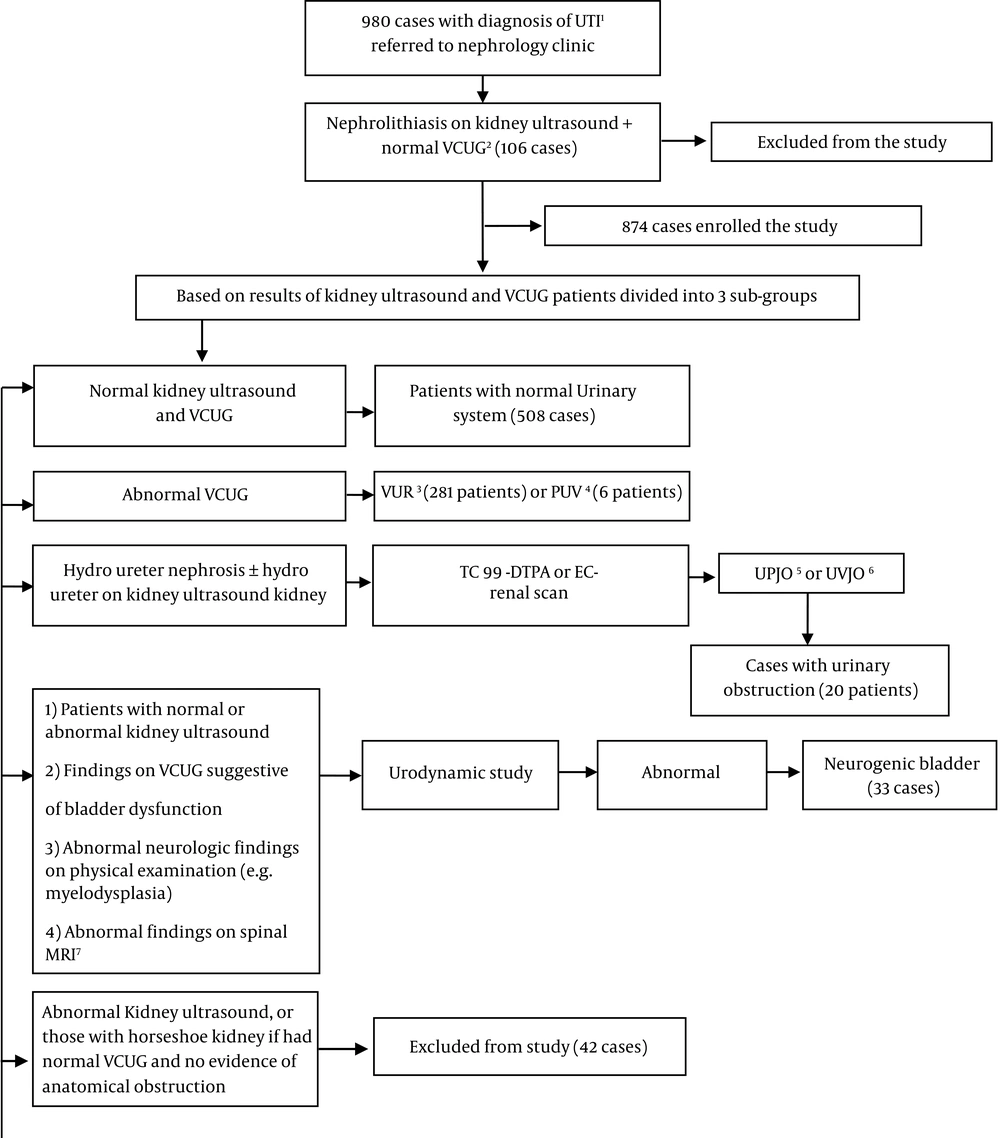
E. coli pathogens accounted for 77% and 23 % of infections in cases with VUR, and 82% and 18% of UTIs in a patient with urinary obstruction.
The results obtained by Honkinen et al. (
13) showed a stronger association between non-
E. coli UTIs (i.e.,
Klebsiella or
Enterococcus UTIs) and VUR than between
E. coli UTIs and VUR, in contrast to this study, we did not find a significant association between non-
E. coli infections and VUR. Based on a study carried out by Shaikh et al. (
6), the UTIs are caused by non-
E. coli pathogens are more observed among children with grade III or IV VUR and those without fever. They showed that the rate of high-grade VUR in children with non-
E. coli UTIs was twice the rate of the UTIs caused by
E. coli (
6). This result has also been confirmed in previous studies (
13,
14). Therefore, inconsistent with the findings of other studies, we found that non-
E. coli UTIs cannot be suggested as a predictive factor for the diagnosis of anatomic anomalies. Nonetheless, our results indicated a significantly higher prevalence of non-
E. coli UTIs in patients with neurogenic bladder dysfunction.
The value of non-
E. coli virulence factors in patients with neurogenic bladder has not been established yet. To the best of our knowledge, no sequence type or phylogenetic group of non-
E. coli has been observed in the urine culture of the patients suffering from the neurogenic bladder. In addition, there are no data demonstrating how they are genetically related to other pathogens (
6).
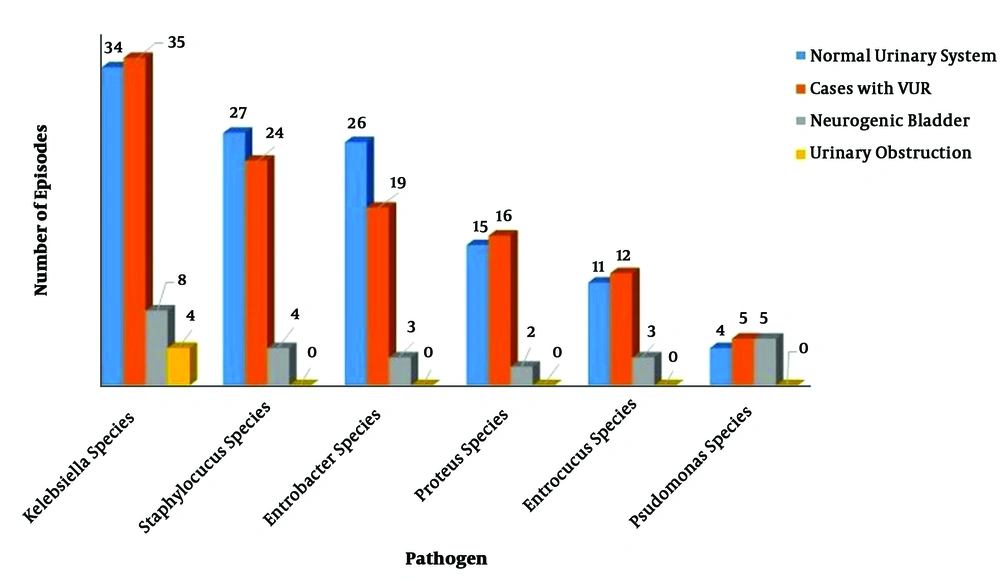
In a study, 25 children with neurogenic bladder receiving clean intermittent characterization were assessed for UTI. During 24 weeks, weekly urine samples were obtained through a urinary catheter. In 56% of cases, the urine culture was positive. The most prevalent organisms were E. coli, Klebsiella, Coagulase-negative staphylococci, Corynebacterium, and Enterococcus species, respectively. In our series, the most common organisms among patients with diagnosis of neurogenic bladder were E. coli, Klebsiella, Pseudomonas, Staphylococcus, Enterobacter, and Enterococcus species, respectively.
A relationship has been reported between the higher rate of
E. coli UTIs in patients with a normal urinary tract and higher virulence of
E. coli in comparison to non-
E. coli strains. Abnormal urinary tract is more susceptible to infection with the less virulent non-
E. coli bacteria (
15). Shaikh et al. (
6) found a high number of urinary tract anomalies in patients with non-
E. coli UTI necessitates the administration of prolonged antibiotic therapy and longer hospital stay. They found antibiotic treatment before hospitalization as a main risk factor for non-
E. coli UTIs. Non-
E. coli species are more likely to be resistant to the first-generation cephalosporins and nitrofurantoin (
16).
Honkinen et al. (
13) reported VUR in 1/3 of children affected by
E. coli UTIs. They also found a double rate of VUR in patients whose first episodes of UTIs were due to
Klebsiella or
Enterococcus (non
-E. coli pathogens). In our series,
E. coli was the pathogen responsible for first episodes of UTIs in 326/551 (59.16%) VUR
– and 233/281 (82.9%) VUR
+ patients.
Klebsiella accounted for 48/832(5.77%) of the first episodes of UTIs, including 25/281(8.9%) patients with VUR. In VUR
– cases, 23/551 (4.17%) episodes of the first UTIs were due to
Klebsiella. It indicated that
Klebsiella infections at the first UTIs were 2.13 times more common in patients with Vs. those without VUR. In the current study,
Enterococcus was responsible for 12/832 (1.44%) of the first episodes of UTI, including 7/281 (2.5%) episodes in patients with and 5/551(0.8%) episodes in those without VUR.
Enterococcus was not responsible for the first episodes of UTI in any patient with urinary obstruction or neurogenic bladder.
5.1. Conclusions
The findings of the present study indicate the patients with neurogenic bladder dysfunction are more prone to develop not only non-E. coli UTIs but also Pseudomonas infections than those with normal urinary tract or urological anomalies. We demonstrated that neither presence of VUR nor its severity (severe vs. mild to moderate VUR) are not significantly associate with non-E. coli UTIs. Doing similar studies in patients with voiding dysfunction ± VUR seems to be attractive. Voiding dysfunction or non-neurogenic bladder, an entity mimics clinical manifestation and radiologic findings of neurogenic bladder, is common among the pediatric population affected by UTI. Such evaluation can determine whether, similar to the patients with neurogenic bladder, those with voiding dysfunction are more prone to develop non-E. coli UTIs or not?