


1. Introduction
The vasculitides are a rare inflammatory disease of the blood vessel wall. Inflammation roots in the patients' autoimmune disease. Vasculitides can involve different parts of the body, and their presence in the bladder and urethra is highly rare. Establishing an appropriate diagnosis may be both difficult and long-lasting.
2. Case Presentation
Our case was a 56-year-old woman with a vesicovaginal fistula, due to vasculitis ANCA. She was complaining of pelvic pain and noted that difficulty in emptying the bladder was initiated in November 2016. In December 2016, she was admitted to a regional hospital due to urinary retention. Her disease was concomitant – mild hypertension and no previous surgery in medical history.
Initially, a biopsy from the bladder triangle was performed, and the Foley catheter was inserted. In histopathology examination, inflammatory changes were identified. Attempts to remove the catheter resulted in urine retention. According to the ultrasound of the abdomen tumor in the pelvis, it had a diameter of 5 cm and was located between bladder and vagina. The second biopsy was performed by a gynecologist, and in the pathology, no cancer cell was confirmed. In cytology from the cervix, no deviation from the normal range was found. Due to the presence of the tumor, despite lack of confirmation of cancer in pathology reports, the patient was referred for radiation therapy. However, as cancer was not confirmed, she was disqualified from XRT and referred to our department for further diagnostics.
In May 2017, she was admitted to our clinic. According to the abdominal CT-scan, the size of the tumor in the pelvis was 50x43x58 mm (Figure 1). The tumor surrounded the urethra and vagina, strengthening peripherally after contrast. The lesion caused mild bilateral dilatation of kidney pelvis – left 18 mm, right 25 mm. On 25.05, transurethral biopsy of pathologic tissue was performed. According to the specimen analysis, an abundant active inflammatory process was found with numerous plasmocytes, tissue fragments with severe necrosis with eosinophils infiltration, abundant plasmocytic infiltration CD 138+, and no restriction on kappa and lambda chains. No cancer cell was found in the material; hence, the pathologist suggested inappropriate biopsy (from inappropriate tumor unrepresentative sites).
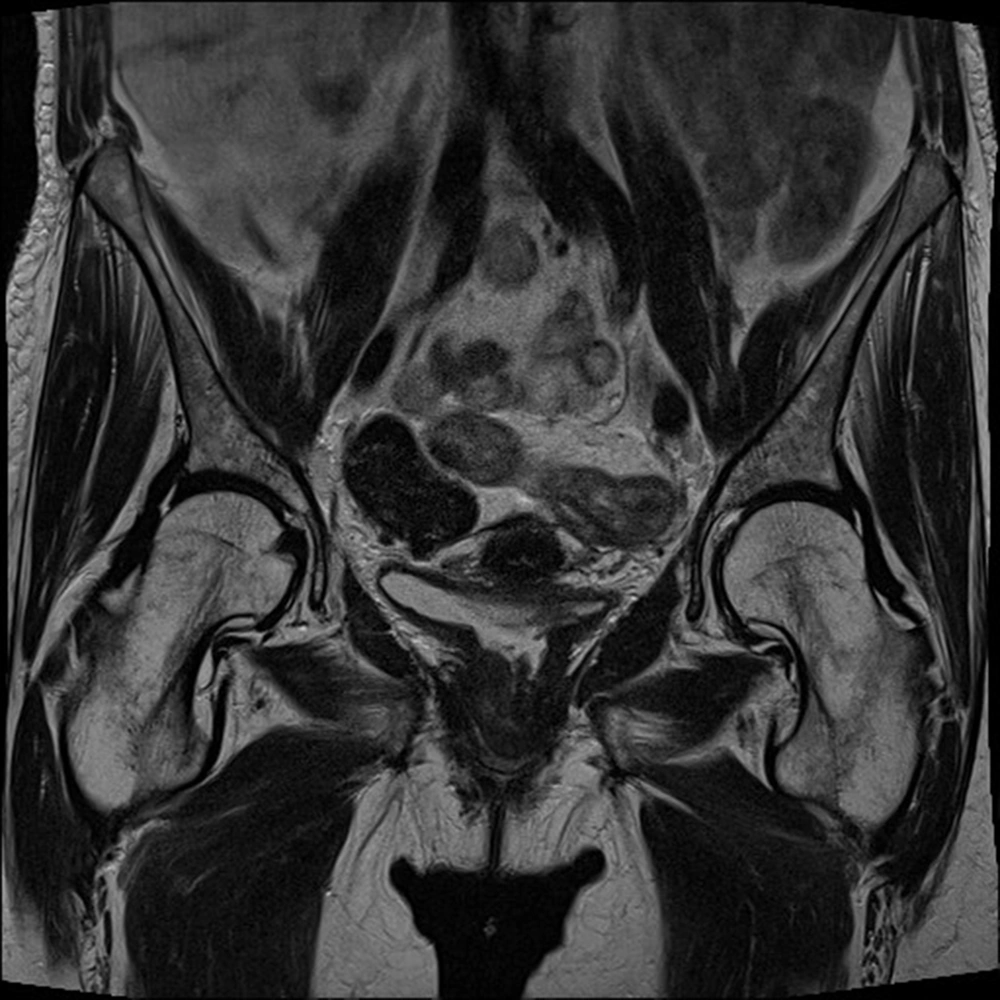
Figure 1.
MRI picture with inflammatory tumor surrounding urethra.
She was again hospitalized from 15 to Jun 19, 2017, and an open biopsy of the tumor was performed. In addition, histopathological staining of CD 20+, CD 3+, CD 138+, and CKAE 1/AE 3+ was specified. Granulomatous vasculitis was diagnosed after consultation. The urine leakage began about 2 weeks following the biopsy. She was fitted with a Foley catheter and received antibacterial treatment. In urine culture, Morganella morgani was presented. Also, creatinine was in its normal range.
On Jul 4 2017, she was admitted to the Nephrology Department in urgent mode due to fever, decreased urine output, creatinine elevation to 5,5 mg/dL, GFR 8 mL/min, and CRP 103. Hence, abdominal and pelvis MRI were performed and revealed a tumor with a size of 43 × 30 × 33 mm between the bladder and anterior wall of the vagina. Kidneys were without hydronephrosis, and urine excretion was symmetric and on time. Vesicovaginal fistula and kidneys with signs of oedema were present. Immunological tests were performed, which showed that anti-granulocyte proteinase antibodies cytoplasmatic type were very high [i.e. > 200 RU/mL (normal range < 20, 0)].
Antimyeloperoxidase antibodies were very also high. We performed CT of head, neck, and chest, which showed no abnormality. Urine culture (from 09.07.17) showed Enterococcus faecium 10/5 and Corynebacterium 10/3. Accordingly, antibiotic therapy was prescribed. In the control culture (Jul 25, 2017) Klebsiella pneumonia 10/6 and M. morgani 10/6 were found. After infection, she received metylprednisolon 3 × 500 mg, following by cyclofosfamid 3 × 650 mg iv, instead of 3 × 825 mg. Creatinine level decreased to 2,69 (from the peak of 7,41, which was observed before the introduction of steroids). In cystoscopy inflammatory infiltration, the severity of the bladder triangle is significant. In addition, an anterior vaginal wall defect (about 2 cm in diameter) was found in physical examination.
Prescribing endoxan (4.425 g) resulted in decreased levels of the following parameters: PR 3 = 1,8; cANCA 26 RU/mL; and Creatinine 1,03 mg/dL. Further doses of cyclofosfamid were administrated on an outpatient basis. The control MRI (28.06.18) did not reveal any pathological mass in the pelvis, and lymph nodes were not enlarged. However, the smooth contour fistula between the bladder neck and vagina with an empty bladder was present. On Sept 19, 2018, she was admitted to the urology department, and on Sept 21, the fistula was sutured with vaginal access. On Sept 24, she was discharged from the hospital with a Foley catheter for 2 weeks. After catheter removal, a small leakage of urine persisted, so that she needed 4 sanitary pads per day. In November 2018, cystography was performed and confirmed a persistent narrow fistula between the bladder neck and the middle part of the vagina.
The next step of surgery was done on Feb 7 2019, through vaginal access. We resected the fistula canal and sutured the bladder neck. Then, the fatty tissue was displaced -Martius flap technique- from the vulva into the area of the sutured hole in two layers. Foley catheter was left for 2 weeks. After removing the catheter, the patient was able to hold about 150 mL of urine. The next cystography confirmed bladder tightness, but in the course of the disease and subsequent operations, the urethral sphincter weakened (Figure 2).
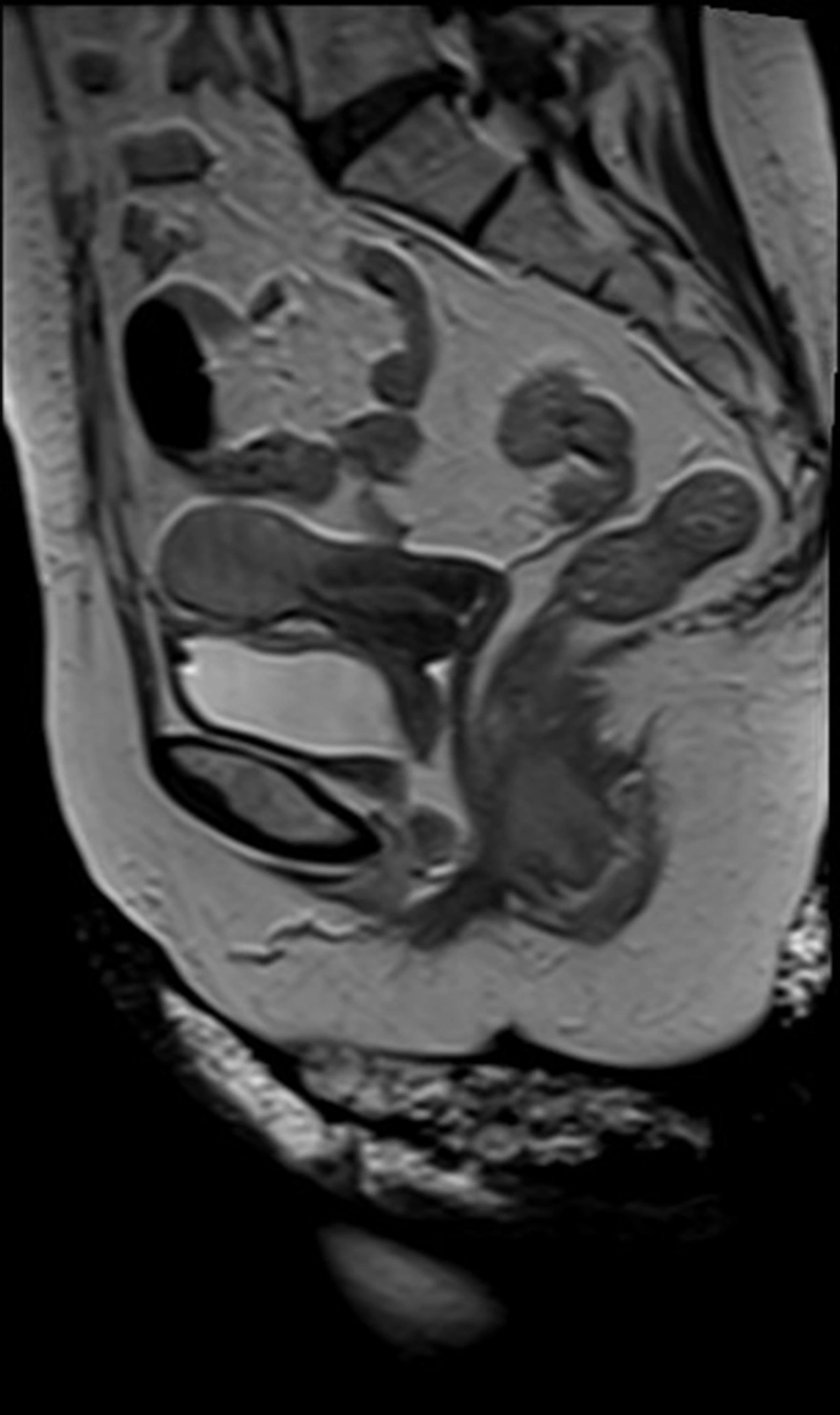
Figure 2.
Reduction of the infiltrate after treatment - saggital plane.
The patient underwent a pelvic rehabilitation course lasting for 6 months. In October 2019, during check-ups, she confirmed almost complete improvement in urine continence, a narrow stream of urine, and a slight difficulty in emptying the bladder during voiding. The improvement was so surprising that we decided to perform a cystoscopy. External orifice of the urethra was in large oedema, cystoscope was introduced with difficulties after calibration with single – catheters from 12 to 20 ch were used. In the bladder, neck, and triangle, oedema or infiltration was significant. The most likely cause was a relapse of vasculitis. Blood samples were examinated; therefore level of anti-granulocyte3 proteinase antibody was 34,85 RU /mL ( normal range < 20,0) and cANCA 1: 40. The previous result of antibodies from 09.2018 was 3.1 for RU/mL. She was referred for repharmacotherapy and received metylprednisolon 3 × 1 g. After 2 weeks, the patient reported the disappearance of symptoms of difficult voiding, but urinary incontinence was returned to a similar or lesser extent than that of after the last surgery with Martius flap. Now the patient was in continuing pelvic rehabilitation.
3. Discussion
Systemic inflammation of small and medium-sized blood vessels, previously called Wegener’s granulomatosis, is a rare disease mainly treated pharmacologically. Its annual incidence is reported as 7 - 22 cases per million (1). The disease mainly affects the upper and lower respiratory tracts and kidneys, where aggressive glomerulonephritis is induced. Rare cases with female genital organ involvement, such as the uterus, mainly cervix, ovaries, or fallopian tubes, are reported (2). Isolated bladder and urethra involvement are rarely reported (1, 3).
Our literature review revealed that few cases of lower urinary tract vasculitis have been described. Bladder vasculitis are extremely rare (1, 3). Vasculitis affecting the female genital tract has been reported more often. They appeared mainly as isolated forms in opposition to systemic types of the disease. A study performed in Cleveland reported that 70% of patients had isolated forms (2). A study on 163 patients with vasculitis reported that about 50% of them had vaginal bleeding as the first symptom of the disease. The mean age at the time of diagnosis was 56 y (2). Other symptoms were abdominal mass, pelvic pain, and atypical cervical smear. The majority of patients with isolated forms had no systemic symptoms, normal results of CRP, hemoglobin, and diagnosis of vasculitis was established incidentally after the surgery.
In a study by Ganesan et al., 46 cases of female genital vasculitis are analyzed, mainly referred for treatment due to vaginal bleeding. They reported that all patients had a history of surgery for reasons other than vasculitis. Therefore, the diagnosis was made after surgery. They only found the systemic disease in 4 cases (4). Involvement of the urethra in the urinary tract was described in 9 cases. Bladder involvement is also extremely rare (1). Obstructive symptoms have been reported in 2 cases, except for our patient (1). In our case, the patient additionally developed a fistula as a result of vasculities and widening ischemic necrosis. The correct diagnosis was established after a long process. The material for pathology examination was biopsied a few times before the cause was determined, which allowed starting the pharmacological treatment. Fistula reconstructive treatment was ultimately successful. The fistula was sutured, but the sphincter function is not satisfactory. The urethra is now a rigid tube with poor activity. A similar effect is described by Zielonka et al. (5). The remainder of the bladder was not damaged by vasculitis. Vagina was healed completely under systemic treatment and after surgery. The inflammatory tumor that was located between bladder and vagina disappeared completely without surgical intervention. The patient accepted the probable outcome of the treatment, even though the competent sphincter was not strong enough to hold more than 150 mL of urine. Her quality of life was decreased due to urine incontinency, but she did not want to accept the urinary diversion at the moment. Watchful monitoring of the patient allowed the detection of early relapse of vasculitis based only on one clinical symptom before periodic control of antibody level. The unexpected improvement of continence was a sign of the recurrence, which is new information that can be useful in practice.
Based on studies that investigated the impact of vasculite on female reproductive organs and urinary tract, it can be argued that in most cases, vasculitis has been diagnosed in the uterus, which ovary has been recognized after resection surgery (3, 4, 6, 7). In urinary tract, where resection of organ (bladder, urethra) is very mutilating or devastating, the diagnosis is based on a biopsy that can be further supported by imaging techniques such as tomography and resonance. The complete resection of involved organs is not well accepted by patients compared to hysterectomy. Pharmacology and surgery are useful to avoid the removal of the bladder.


