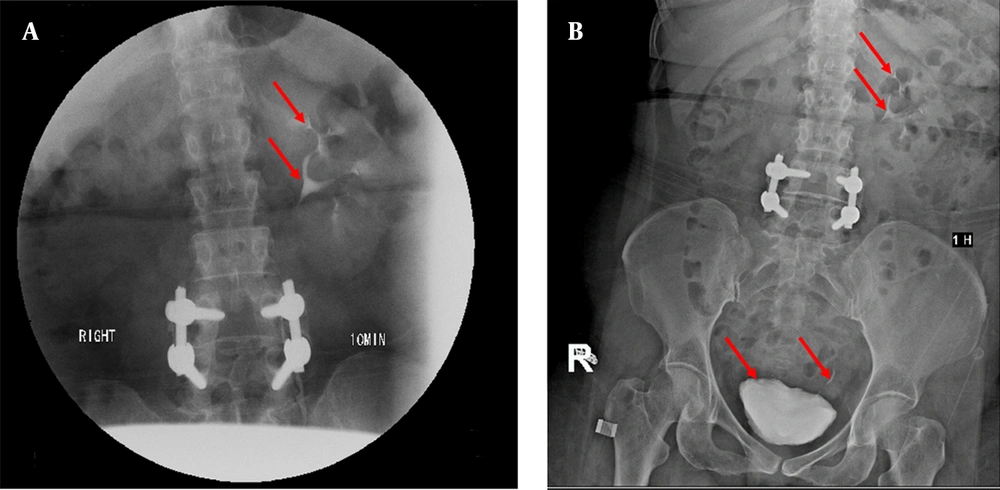
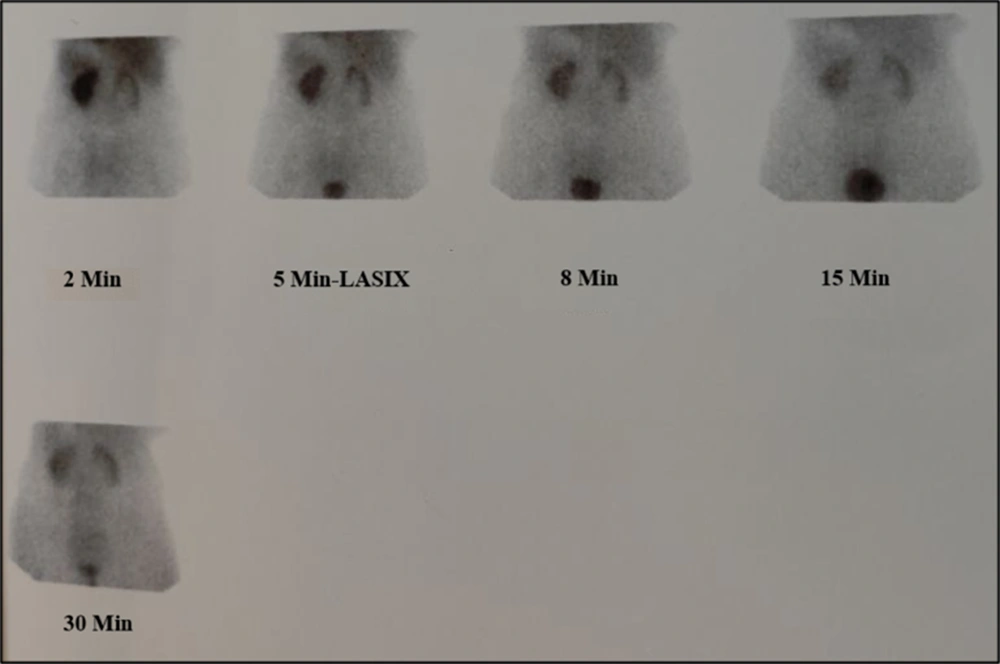
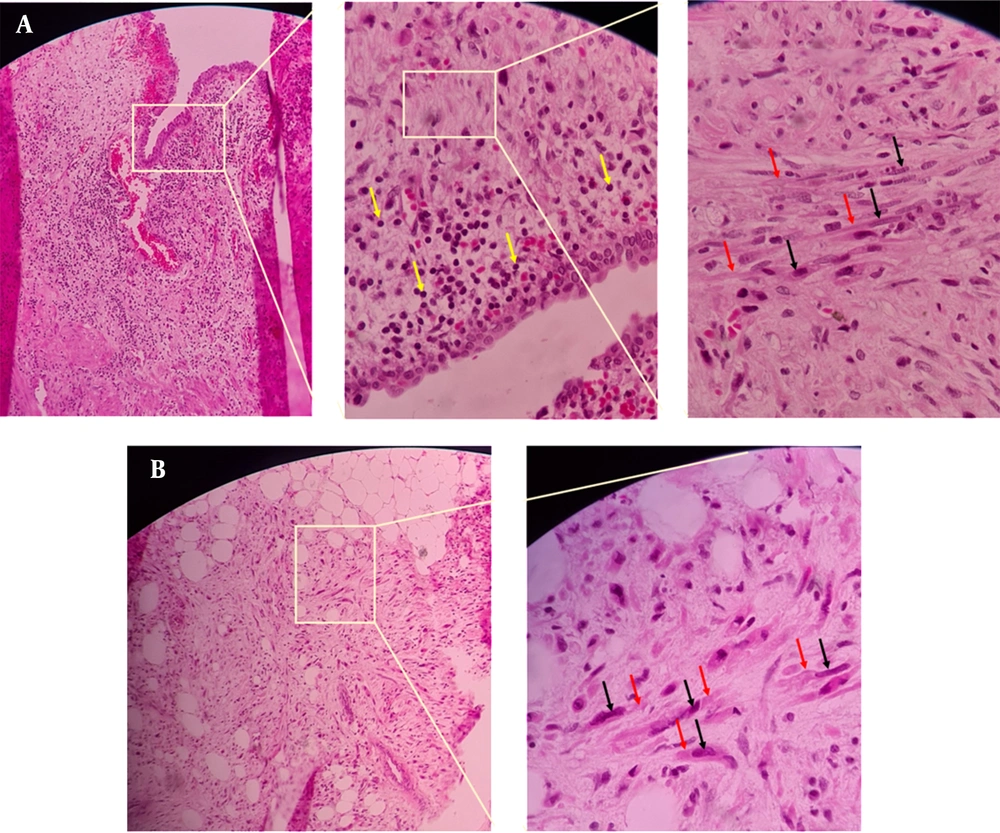
This report explained a rare case of ureteral obstruction caused by retroperitoneal fibrosis that has been created by an injury via PLIF surgery after five years. In this patient, the ureteral obstruction was successfully treated by end-to-end anastomosis of the ureteral and then covered with a flap of perinephric adipose tissue.
Although PLIF has been introduced as a minimally-invasive surgery, the ureter is surrounded by retroperitoneal fat and protects against injury, so there are a limited number of reports of ureteral injury (
2-
6). For example, its first case was described by McKay et al. in 1954 (
3). Moreover, Cho et al. in their study in 2008 have stated that posterior lumbar surgeries that involve the disk space such as discectomy and PLIF, have potential risks for ureteral injury (
4). In another study, Hajiha et al. in 2017 have documented a case of ureteral injury following posterior lumbar discectomy. They introduced the patient's lean with lack of retroperitoneal fat as an effective factor on increasing the risk of ureteral injury during posterior discectomy (
5). Additionally, Pillai et al. in 2013 have reported a case of ureteral injury after posterior lumbar discectomy with interbody screw fixation on postoperative day 10 (
6). The timing of the diagnosis in most of the reported cases ranged from 3 days to 6 weeks after surgery (
10,
11) while, in our case it has taken 5 years. In another research, Bjurlin et al. in 2009 have reported a case of iatrogenic ureteral injury after a thoracolumbar lateral fusion on postoperative day 14. In this regard, they have concluded that flank pain and urinoma after lateral thoracolumbar fusion should be considered as signs of ureteral injury (
12). de Quintana-Schmidt et al. in 2011 have revealed a case of ureteral injury after L4-L5 microdiscectomy. Accordingly, they have observed deep bleeding during surgery process that was controlled well. After 36 hours, the patient showed an abdominal distend and pain associated with anemia as well as an increase in WBC count, suggesting the ureteral injury (
2). Furthermore, Patel et al. in 2021 have presented a case of ureteral injury after transforaminal lumbar interbody fusion on day 8 post-operation (
13). In a systematic review, Turgut et al. in 2020 have concluded that ureteral injury is a complication of posterior lumbar spine surgery especially reported during discectomy (
14).
In lean people, the space between the vertebra and the ureter is very slender because the ureter anatomically and immediately places on the anterior longitudinal ligament of the spinal between the body of the vertebra and the psoas muscle (
15). Therefore, the ureter is vulnerable to be injured during PLIF surgery. While in obese people, retroperitoneal fat tissue maintains the ureter away from the intervertebral space, so it is protected against injury (
15). The patient in the present study lost 15 kg weight within five years after surgery, so the tips of the screws probably affected the connective tissue around the ureter and led to its fibrosis. Another possible explanation for the fibrosis may possibly be that at the time surgery, the fibrosis was caused by manipulations or surgical instruments simultaneously, and also by undiagnosed or delayed microvascular injury, which may have remained hidden in the retroperitoneal adipose tissue.
The patient’s clinical findings may appear either during and/or immediately after surgery or occur with a delay. As well, the signs and symptoms are nonspecific. The patient in this research showed flank and abdomen pain resulted from high-grade ureteral obstruction. Of note, signs of abdominal ileus developed with nausea, vomiting, anorexia, and fever. In addition, Hydronephrosis was created due to the ureter compression by retroperitoneal necrotized tissue. It is noteworthy that ureteral injuries should be diagnosed more quickly via performing accurate physical and radiological examinations, including nuclear scan and CT scan, in order to protect nephro-ureteral structures.