


1. Background
Erectile dysfunction is a major cause of men’s sexual dysfunction (1) and is defined as the inability to achieve and maintain a decent penile erection for sexual intercourse (2). This disorder can impact the health and well-being of men and their partners and their quality of life (QoL) (3). This disease is expected to impact an estimated 322 million men globally in 2025, an increase from 152 million men in 1995 (4). Although only 20% of men older than 40 are affected by erectile dysfunction, it may occur at any age, particularly when other risk factors such as diabetes, metabolic syndrome, and cardiovascular disease are present (5).
Erectile dysfunction can be treated by oral, intra-urethral, or intra-cavernosal medications, vacuum devices, or penile prostheses (2). Today, oral treatment with PDE5 inhibitor drugs is the most commonly used nonsurgical therapy for erectile dysfunction (ED) (6). Erectile dysfunction treatment made much progress in the past decade due to the introduction of PDE5i drugs, the first line for treating this disorder (7). Despite the effectiveness of PDE5Is, their highest dosage may not be effective in some people with ED (8), and approximately 40% to 50% of patients do not respond to them even after combination treatments (7).
Low-intensity extracorporeal shockwave therapy was initially introduced in 2010 by Vardi et al. (9). As a non-invasive therapy, Li-ESWT for patients with ED has recently emerged as a novel, effective, and safe intervention (10). Micro-trauma generated by Li-ESWT promotes angiogenic factors release, resulting in neovascularization in the treated tissues. Administration of Li-SWT to the penis can increase blood flow, enhancing erection (11). Recent studies have demonstrated that in individuals with ED of vascular origin who do not respond to PDE5Is, LI-ESWT can be an effective and safe intervention (7).
2. Objectives
In patients with ED resistance to PDE5I drugs, non-invasive treatments such as Li-ESWT can be safe and effective. This clinical trial study aimed to evaluate the effect of Li-ESWT on ED in non-responders to PDE5Is, investigate the durability of the effect, and identify predictors of success.
3. Methods
3.1. Study Design and Participants
This single-group clinical trial study was conducted on 128 erectile dysfunction patients who were unresponsive to PDE5i and referred to two urologic clinics in Rasht, Iran, from June 2016 to June 2017. According to two studies by Vardi et al. (9, 10), with 95% confidence and considering a 10% relative estimation error limit, a sample size of 128 people was calculated.Sampling was conducted by an easy and accessible method, and the participants were included in the study according to the inclusion criteria. Inclusion criteria included age of over 40 years, no stable relationship in the last three months, history of not responding to phosphodiesterase type 5 inhibitors, and no use of pharmacological or non-pharmacological treatments during the past month. The ineffectiveness of phosphodiesterase type 5 inhibitors was defined as insufficient erection for sexual satisfaction after at least ten times using the medication. Patients with a history of psychological disorders, neurological disease, depression, radical prostatectomy, pelvic radiation, malignancies, urethritis, LUTS, heart failure, and penile and urethral anomalies were excluded.
3.2. Data Collection
Before the intervention, details of the procedure were explained to participants, written informed consent was obtained, demographic characteristics were recorded, and the ED score was calculated using the international index of erectile function. This questionnaire comprises 15 questions with one to five scores. For the IIEF total score calculation, scores of all questions were pooled, and a greater score indicated better treatment (12). Erectile dysfunction severity was remeasured by the IIEF scale at the end of the intervention and three and six months later. An increase of at least five scores compared to before intervention was considered a successful treatment (13).
3.3. Intervention Protocol
Patients were treated once a week for six weeks by a single urologist using the ESWT device (Richard Wolf GmbH-Germany (Piezowave2). The energy density used was 0.16 millijoules per square millimeter (mJ/mm2). Its frequency was 6 - 8 hertz (Hz), and the total number of shocks per session was 6000, so each time, 2000 shock waves were applied to the corpus cavernosum on each side, and 1000 shock waves were applied to both sides of the corpora. This treatment protocol was effective in previous studies (8). Patients were re-evaluated after treatment, three months, and six months later, using the IIEF questionnaire. Other therapies, including PDE5Is, were prohibited during the study, and if used, the patient was excluded from the study. The treatment success threshold was based on the IIEF questionnaire as an increase of at least five points compared to the score before treatment (13). Initially, 145 patients were enrolled. After assessing for eligibility, 12 patients were excluded due to not meeting inclusion criteria or declining to participate in the study. Out of 133 included patients, five were excluded due to not completing the follow-up duration, and 128 were included ultimately (Figure 1).
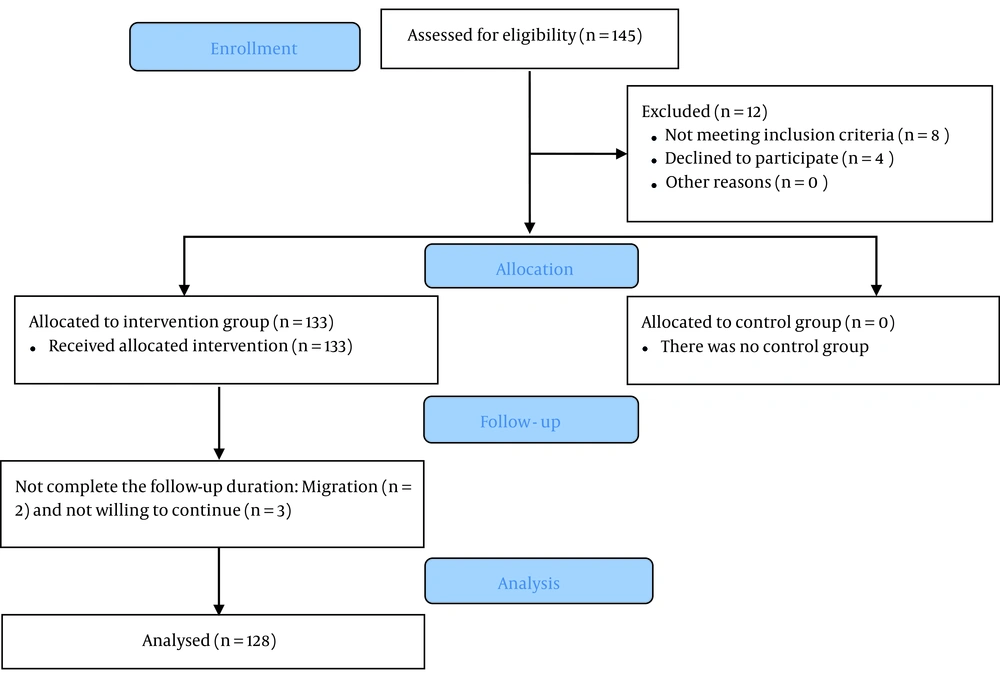
Figure 1.
CONSORT flow chat diagram
3.4. Statistical Analysis
Data were analyzed using the statistical package for social sciences (SPSS) software version 21. Statistical indices, including mean and standard deviation (SD), were used to describe the IIEF score. Repeated measure ANOVA test and Bonferroni post hoc test were used to compare IIEF scores before and after the intervention and three and six months later. Chi-square and binary logistic regression tests were conducted to explore the relationship between predicting factors and treatment outcomes. A P-value of less than 0.05 was considered significant.
4. Results
Results demonstrated that among 128 patients who participated in the study, non-responders to PDE5Is erectile dysfunction were included in the final analysis. The mean age was 58.35 ± 8.28, and the mean erectile dysfunction duration was 3.41 ± 1.78 years. Erectile dysfunction was treated in most patients (64.8%) following the Li-ESWT treatment intervention. Other demographic characteristics are summarized in Table 1.
Table 1.Baseline Characteristics of the Subjects
| Variables | Frequency (%) |
|---|---|
| Age | |
| More than 6o years | 48 (37.5) |
| Less than 60 years | 80 (62.5) |
| Erectile dysfunction duration | |
| Less than three years | 78 (60.9) |
| More than three years | 50 (39.1) |
| Diabetes | |
| Yes | 47 (36.7) |
| No | 81 (63.3) |
| Smoking | |
| Yes | 18 (14.1) |
| No | 110 (85.9) |
| Lower urinary tract symptoms | |
| Yes | 53 (41.4) |
| No | 75 (58.6) |
| Erectile dysfunction treatment | |
| Successful | 83 (64.8) |
| Not- successful | 45 (35.2) |
This study used the IIEF scale to determine ED severity at different times before and after Li-ESWT treatment. Results demonstrated that, at the end of the intervention, the IIEF score significantly increased. Moreover, the score was comparatively higher three months and six months after the intervention. As time passed, immediately after the intervention, compared to three months and six months later, and also three months compared to six months, the IIEF score decreased significantly. However, it was significantly higher all three times than before the intervention (Table 2).
Table 2.Comparison of IIEF Score Before the Intervention, After (at the End) It, and Three and Six Months Later
| Time | Before Intervention | At the End of the Intervention | 3 Months After the Intervention | Six Months After the Intervention | P-Value |
|---|---|---|---|---|---|
| IIEF score | 30.38 ± 8.37 | 37.92 ± 10.12 | 37.21 ± 9.7 | 35.9 ± 9.51 | < 0.001 a |
| First time | Second Time | Mean ± SD | P-Value | 95% CI | |
| Lower | Upper | ||||
| After | Before | 7.54 ± 0.56 | < 0.001 b | 6.03 | 9.05 |
| 3 Months | Before | 6.83 ± 0.52 | < 0.001 b | 5.43 | 8.23 |
| After | - 0.71 ± 0.18 | 0.001 b | - 1.19 | - 0.22 | |
| 6 Months | Before | 5.52 ± 0.52 | < 0.001 b | 4.11 | 6.93 |
| After | - 2.02 ± 0.35 | < 0.001 b | - 2.98 | - 1.06 | |
| 3 Months | - 1.31 ± 0.28 | < 0.001 b | - 2.08 | - 0.54 | |
Abbreviations: CI, confidence interval; SD, standard deviation.
a Repeated measurement ANOVA.
b Bonferroni post hoc test.
Figure 2 illustrates the decline in the IIEF score as time passed. Immediately after the intervention, the IIEF score increased, then decreased three months and six months after the intervention, but at all three-time points, it was greater than before the intervention (Figure 2).
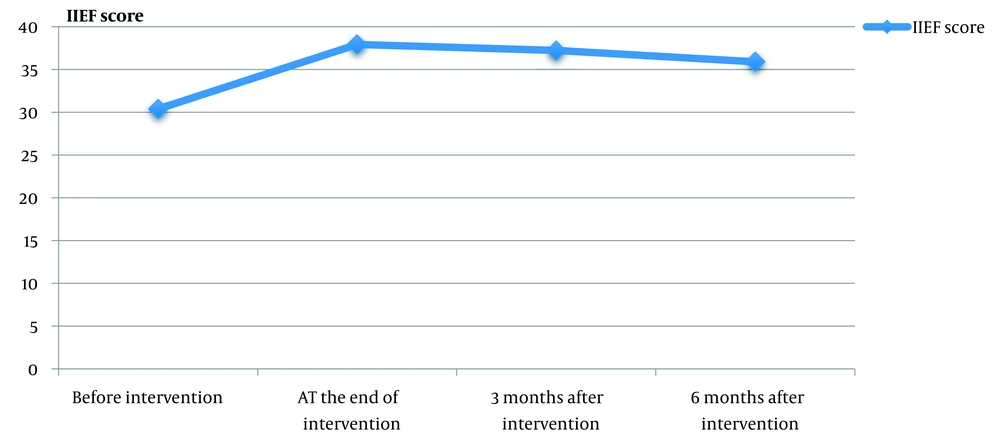
Figure 2.
Comparison of IIEF score at different time points
In this study, an increase of at least five scores on the IIEF scale compared to before the intervention was considered a successful treatment. Based on this protocol, patients were allocated into two groups: successful ED treatment (N = 83) and unsuccessful ED treatment (N = 45), and predictors that could influence this situation were evaluated. Results demonstrated that ED treatment in nondiabetic patients with an odds ratio of 4.72 times compared to people with diabetes was successful. Erectile dysfunction duration of fewer than three years compared to over three years predicted a successful treatment with an odds ratio of 2.92-fold. Treatment of ED in patients younger than 60 was 3.26-fold more successful compared to those older than 60. Not smoking and having no LUTS was related to successful ED treatment, with an odds ratio of 4.66 and 2.83 times compared to smokers and LUTS patients, respectively (Table 3).
Table 3.The Correlation Between ED Treatment Status and Their Predicting Factors Using Binary Logistic Regression
| Variables | ED Treatment, No (%) | P-Value | OR | 95% CI, Lower-Upper | |
|---|---|---|---|---|---|
| Successful | Non-success | ||||
| Age (y) | 0.002 a | 3.26 | 1.52 - 6.96 | ||
| < 6o (N = 80) | 60 (75) | 20 (25) | |||
| > 60 (N = 48) | 23 (47.9) | 25 (52.1) | |||
| Disease | 0.006 a | 2.92 | 1.36 - 6.15 | ||
| < 3 (N = 78) | 58 (74.4) | 20 (25.6) | |||
| duration (y) | |||||
| > 3 (N = 50) | 25 (50) | 25 (50) | |||
| Diabetes | < 0.001 a | 4.72 | 2.16 - 10.31 | ||
| No (N = 81) | 63 (77.8) | 18 (22.2) | |||
| Yes (N = 47) | 20 (42.6) | 27 (57.4) | |||
| Smoking | 0.003 a | 4.66 | 1.61 - 13.48 | ||
| No (N = 110) | 77 (70) | 33 (30) | |||
| Yes (N = 18) | 6 (33.3) | 123 (66.7) | |||
| LUTS | 0.006 a | 2.83 | 1.34 - 6.00 | ||
| No (N = 75) | 56 (74.7) | 19 (25.3) | |||
| Yes (N = 53) | 27 (50.9) | 26 (49.1) | |||
Abbreviations: OR, odds Ratio; CI, confidence interval.
a Chi-square.
5. Discussion
Throughout the last decade, patients have increasingly benefitted from Li-ESWT as a novel therapeutic approach to ED treatment. Natural and spontaneous ED may be treated by Li-ESWT, which is considered a non-invasive and safe therapy that improves penile hemodynamics and addresses underlying pathological alterations through angiogenesis (14). This treatment releases neo-angiogenic factors in the treated tissue, forming new blood vessels (15).
In this study, treatment with the Li-ESWT procedure was successful in 64.8% of the patients with ED who were resistant to PDE5Is. In line with our study, a recent meta-analysis by Sokolakis and Hatzichristodoulou demonstrated that Li-ESWT significantly improved ED (16). In 2016, in a study by Kitrey et al., a success rate of 51.4% was reported in the treatment of ED by Li-ESWT (17). Gruenwald et al. stated that LI-ESWT was effective in patients with severe ED who were resistant to PDE5Is (14). A study by Spivak et al. reported that LI-ESWT effectively treated patients with ED who were resistant and non-resistant to PDE5Is (18). The effectiveness of LI-ESWT on ED in different patients, particularly non-responders to PDE5Is, has been confirmed in other studies (13, 19, 20). However, in contrast with our results, Fojecki et al. stated that ESWT had no clinically significant effect on ED (21). These discrepancies may be attributed to the number of pulses and the shockwave penetration depth (Using 600 shockwaves per treatment session for ten weeks). Several explanations for the contradictory Li-ESWT findings, including differences in shockwave technology and the number of shockwaves, are proposed in the literature.
The longevity of the Li-ESWT’s effects is an essential inquiry. In our six months follow-up, although as time passed, the IIEF score decreased, the intervention maintained erectile function during the whole 6-month period of follow-up. Consistent with our study, a study by Tsai et al. on ED patients who were non-responders to PDE5Is demonstrated that Li-ESWT could maintain erectile function for three months after the intervention. Therefore, Li-ESWT can be considered safe and effective (8). The long-term effectiveness of Li-ESWT on ED patients who are resistant to PDE5Is was also demonstrated in a clinical trial study by Srini et al. (19). In a study by Bechara et al., the effectiveness of treatment by Li-SWT was maintained in 91.7% of the patients in a 12 months follow-up period (7). Kitrey et al. followed patients for two years after successful treatment; only in 53.5% of the participants the effect of Li-ESWT was maintained (17). In Li-SWT, the shockwaves interact with the organ and make a biological reaction that causes growth factor secretion; this causes neo-vascularisation of the organs and improves blood perfusion, thereby facilitating a long-term and more effective erection (22).
In our study, younger age, shorter ED duration, non-smoking, non-diabetic, and having no LUTS were the most important predictors of successful ED treatment. Similar to our results, Musa et al. observed that although Li-ESWT was successful in diabetic patients with ED, compared to nondiabetics, it was less effective (11). In line with our study, Musa et al. demonstrated that younger patients (< 45 years) with a shorter period of ED (< 2 years) and moderate ED responded better to Li-SWT in comparison with older patients with severe and long-term ED. On the other hand, contrary to our results, they reported that diabetes and smoking did not affect Li-ESWT outcomes (11). In a meta-analysis study, Lu et al. stated that Li-ESWT was more effective in patients without comorbidities than those with comorbidities (20). Adeldaeim et al. reported having diabetes, older age, and longer ED duration as the most common influential factors on Li-ESWT outcome (23). All of these factors (smoking, diabetes, older age, LUTS) share a common cause, which is the decreased blood flow in the targeted blood vessels, resulting in impaired erectile function. The chance of success decreases with an increase in the disease’s duration. On the other hand, identifying predictor factors may benefit urologists in selecting suitable candidates for Li-SWT and avoiding overtreatment for those who would not respond. Moreover, these predictors can help choose other interventions for patients unwilling to undergo Li-SWT with uncertain outcomes.
Greater sample size, the use of a novel and non-invasive treatment method, and taking clinical and demographic factors into account can be considered as strengths of our study. It should be noted that the data collection tool in this study was a self-reporting questionnaire, which could have distorted the results due to the patients’ individual and social differences. Moreover, the lack of a control group and short follow-up period can be considered weaknesses of this study.
5.1. Conclusions
Li-ESWT can be considered a safe and effective method for ED patients’ short- and long-term treatment. Although its effect wanes as time passes, it can maintain erectile function for almost all patients. Being nondiabetic, not smoking, having no LUTS, having less ED duration, and having a young age are the most common predictors of Li-ESWT success. Identifying predictor factors can assist urologists in selecting suitable candidates and avoiding the overtreatment of nonresponders.
5.2. Limitations of the Study
The non-compliance of the patients posed a large issue in this study. Addressing this issue through incentives and planning according to the patient’s preferred program can help overcome this shortcoming. Personal, social, psychological, and family differences were uncontrollable variables in the present study that may have influenced the results.

