Androgen Deprivation Therapy and Cardiovascular Risk

Author(s):
Panagiotis MourmourisPanagiotis Mourmouris1, Eleni EfstathiouEleni Efstathiou2, Athanasios PapatsorisAthanasios Papatsoris1,*
1Department of Urology, School of Medicine, University of Athens, Sismanoglio General Hospital, Athens, Greece
2Department of Clinical Therapeutics / Oncology, School of Medicine, University of Athens, Alexandra Hospital, Athens, Greece

Nephro-Urology Monthly:Vol. 5, issue 1; 653-654
Published online:Dec 15, 2012
Article type:Editorial
Received:Aug 04, 2012
Accepted:Aug 26, 2012
How to Cite:Mourmouris P, Efstathiou E, Papatsoris A. Androgen Deprivation Therapy and Cardiovascular Risk. Nephro-Urol Mon. 2012;5(1):653-654. doi: https://doi.org/10.5812/numonthly.7597

Androgen deprivation therapy (ADT) is an established therapy for metastatic prostate cancer (PC) and some cases of locally advanced and/or localized PC (1). However, concerns have been raised about the cardiovascular side effects of ADT and their impact on the survival of elderly patients with PC (1). Several studies have demonstrated an increased incidence of coronary heart disease, heart failure and acute myocardial infarction in patients on ADT. For instance, in a study on 1015 patients that received ADT (mean duration: 4.1 months), the use of ADT statistically significantly increased the risk of death from cardiovascular causes (HR = 2.6, P = 0.002) (2). In another study on 22816 patients with PC, multivariate analysis revealed that ADT significantly increased cardiovascular morbidity (3). Regardless of the studies that indicate the correlation of ADT with increased cardiovascular risk, surprisingly little is known on the potential mechanisms. ADT increases insulin concentration despite unchanged plasma glucose, which is suggestive of insulin resistance (4). Peripheral resistance to insulin can induce or precipitate type 2 diabetes mellitus (DM) and metabolic syndrome (4). Furthermore, ADT changes the body mass composition as it leads to muscular atrophy and an increase in subcutaneous fat, a situation characterized as “sarcopenic obesity” (5). A study in patients on ADT (mean duration: 3 months) has shown a 4.3% increase in fat mass and a 1.4% decrease in lean body mass (6). Moreover, studies have demonstrated that ADT is associated with dyslipidemias, lower levels of high density lipoprotein and higher levels of triglycerides, total cholesterol and low density lipoprotein concentrations (7). Furthermore, Chen et al. (8) revealed that long-term ADT (mean duration: 2.5 years) significantly decreased the levels of apolipoproteins I and II. Lastly, Nishiyama et al. (9) demonstrated that after 6 months of ADT, body weight, levels of fasting blood sugar, serum total cholesterol, blood urea nitrogen, compensated calcium, inorganic phosphorus, bone-specific alkaline phosphatase, and compensated urinary deoxypyridinoline increased significantly Arterial stiffness increase is another potential mechanism explaining the increased cardiovascular risk in patients on ADT. In a relevant study, arterial stiffness was assessed with pulse-wave analysis (10). After 3 months of ADT, the augmentation index increased from 24% to 29% (P = 0.003), while the timing of wave reflection was reduced from 137 to 129 msec (P = 0.003). Fat mass increased from 20.2 to 21.9 kg (P = 0.008), whereas lean body mass decreased from 63.2 to 61.5 kg (P = 0.016). In a subgroup of patients whose treatment was discontinued after 3 months, the augmentation index decreased from 31% at month to 29% at month 6, in contrast to patients receiving continuous ADT, where the augmentation index remained elevated at month 6 (P = 0.043). These results have been confirmed by other relevant studies (11). In the following diagram (Figure 1) we propose potential mechanisms contributing to the increased cardiovascular risk in patients on ADT. Relevant studies are ongoing and their results are warranted.
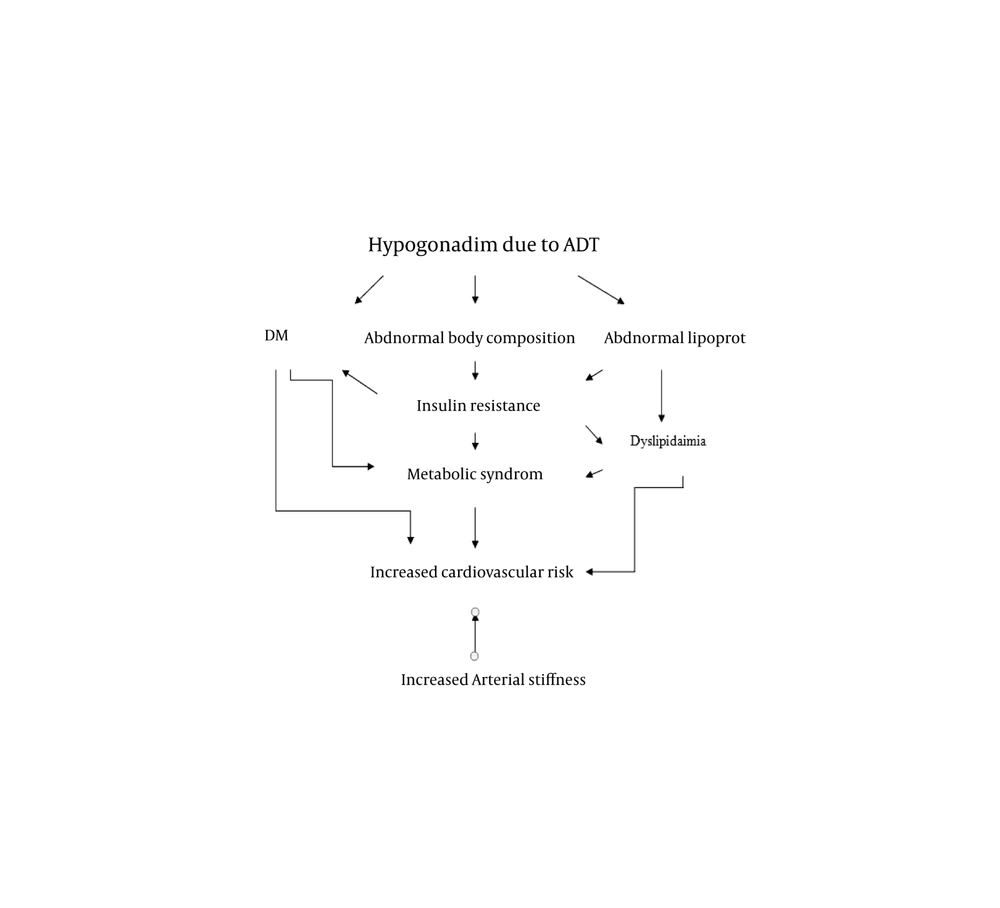
Mechanisms of Increased Cardiovascular Risk During ADT

Figure 1

Mechanisms of Increased Cardiovascular Risk During ADT

Footnotes

References

  • 1.
    Gruca D, Bacher P, Tunn U. Safety and tolerability of intermittent androgen deprivation therapy: a literature review. Int J Urol. 2012;19(7):614-25. [PubMed ID: 22435512]. https://doi.org/10.1111/j.1442-2042.2012.03001.x.
  • 2.
    Tsai HK, D'Amico AV, Sadetsky N, Chen MH, Carroll PR. Androgen deprivation therapy for localized prostate cancer and the risk of cardiovascular mortality. J Natl Cancer Inst. 2007;99(20):1516-24. [PubMed ID: 17925537]. https://doi.org/10.1093/jnci/djm168.
  • 3.
    Saigal CS, Gore JL, Krupski TL, Hanley J, Schonlau M, Litwin MS. Androgen deprivation therapy increases cardiovascular morbidity in men with prostate cancer. Cancer. 2007;110(7):1493-500. [PubMed ID: 17657815]. https://doi.org/10.1002/cncr.22933.
  • 4.
    Hsing AW, Gao YT, Chua S, Jr, Deng J, Stanczyk FZ. Insulin resistance and prostate cancer risk. J Natl Cancer Inst. 2003;95(1):67-71. [PubMed ID: 12509402]. https://doi.org/10.1093/jnci/95.1.67.
  • 5.
    Smith MR. Changes in fat and lean body mass during androgen-deprivation therapy for prostate cancer. Urology. 2004;63(4):742-5. [PubMed ID: 15072892]. https://doi.org/10.1016/j.urology.2003.10.063.
  • 6.
    Smith MR, Lee H, Fallon MA, Nathan DM. Adipocytokines, obesity, and insulin resistance during combined androgen blockade for prostate cancer. Urology. 2008;71(2):318-22. [PubMed ID: 18308111]. https://doi.org/10.1016/j.urology.2007.08.035.
  • 7.
    Braga-Basaria M, Muller DC, Carducci MA, Dobs AS, Basaria S. Lipoprotein profile in men with prostate cancer undergoing androgen deprivation therapy. Int J Impot Res. 2006;18(5):494-8. [PubMed ID: 16617314]. https://doi.org/10.1038/sj.ijir.3901471.
  • 8.
    Chen KC, Peng CC, Hsieh HM, Peng CH, Hsieh CL, Huang CN, et al. Antiandrogenic therapy can cause coronary arterial disease. Int J Urol. 2005;12(10):886-91. [PubMed ID: 16323982]. https://doi.org/10.1111/j.1442-2042.2005.01145.x.
  • 9.
    Nishiyama T, Ishizaki F, Anraku T, Shimura H, Takahashi K. The influence of androgen deprivation therapy on metabolism in patients with prostate cancer. J Clin Endocrinol Metab. 2005;90(2):657-60. [PubMed ID: 15562007]. https://doi.org/10.1210/jc.2004-1611.
  • 10.
    Smith JC, Bennett S, Evans LM, Kynaston HG, Parmar M, Mason MD, et al. The effects of induced hypogonadism on arterial stiffness, body composition, and metabolic parameters in males with prostate cancer. J Clin Endocrinol Metab. 2001;86(9):4261-7. [PubMed ID: 11549659]. https://doi.org/10.1210/jc.86.9.4261.
  • 11.
    Dockery F, Bulpitt CJ, Agarwal S, Donaldson M, Rajkumar C. Testosterone suppression in men with prostate cancer leads to an increase in arterial stiffness and hyperinsulinaemia. Clin Sci (Lond). 2003;104(2):195-201. [PubMed ID: 12546642]. https://doi.org/10.1042/CS20020209.

Similar Articles

20
Apr
2012

An Update on Plant Derived Anti-Androgens

Paul Grant,
Shamin Ramasamy

Grant P, Ramasamy S. An Update on Plant Derived Anti-Androgens. Int J Endocrinol Metab. 2012;10(2):. doi: https://doi.org/10.5812/ijem.3644

1
Oct
2013

Androgenic Anabolic Steroid, Cocaine and Amphetamine Abuse and Adverse Cardiovascular Effects

Efren Martinez-Quintana,
Beatriz Saiz-Udaeta,
Natalia Marrero-Negrin,
Xavier Lopez-Mérida,
Fayna Rodriguez-Gonzalez,
Vicente Nieto-Lago

Martinez-Quintana E, Saiz-Udaeta B, Marrero-Negrin N, Lopez-Mérida X, Rodriguez-Gonzalez F, et al. Androgenic Anabolic Steroid, Cocaine and Amphetamine Abuse and Adverse Cardiovascular Effects. Int J Endocrinol Metab. 2013;11(4):e8755. doi: https://doi.org/10.5812/ijem.8755

31
Mar
2018

A Systematic Review of Clinical Practice Guidelines for Castration-Resistant Prostate Cancer

Mohamad Javad Foroughi Moghadam,
Saeed Taheri,
Farzad Peiravian

Foroughi Moghadam MJ, Taheri S, Peiravian F. A Systematic Review of Clinical Practice Guidelines for Castration-Resistant Prostate Cancer. Iran J Pharm Res. 2018;17(Suppl):e124754. doi: https://doi.org/10.22037/ijpr.2018.2217

29
Jul
2013

Testosterone Replacement Therapy: Should It Be Performed in Erectile Dysfunction?

Orcun Celik,
Selcuk Yücel

Celik O, Yücel S. Testosterone Replacement Therapy: Should It Be Performed in Erectile Dysfunction?. Nephro-Urol Mon. 2013;5(4):858-861. doi: https://doi.org/10.5812/numonthly.11523

31
Jan
2010

Treatment of Advanced Prostate Carcinoma in Kyrgyzstan

Kubat Iyazaliev,
Michael Siegsmund,
Hans Leweling

Iyazaliev K, Siegsmund M, Leweling H. Treatment of Advanced Prostate Carcinoma in Kyrgyzstan. Nephro-Urol Mon. 2010;2(1):. doi:


Crossmark
Crossmark
Checking
Share on
Cited by
Metrics

Ordering Reprints

Articles are published under the Creative Commons license stated on each article. No permission or royalty fee is required for uses permitted by that license. CCC handles optional bulk and customized reprint orders. Any quotation covers production and delivery services only, not copyright permission. > Request Reprints from CCC 

Search Relations

Author(s):

Related Articles