


1. Background
Nocturnal Enuresis (NE) is a common childhood problem with a prevalence of 1.6% to 15%. This disorder may persist through adolescence and adulthood causing great distress (1-4). Nocturnal enuresis is the involuntary loss of urine during the night in children older than 5 years of age, and is distinguished to primary and secondary forms (1-4). In primary enuresis children have never gained control over urination (about 75% of cases), while in secondary enuresis children have developed incontinence after a period of at least 6 months of urinary control (25% of cases) (5, 6). Moreover, NE could be classified as monosymptomatic NE, in which there are no daytime urinary symptoms and nonmonosymptomatic NE, which is accompanied by daytime urinary symptoms (7).
Idiopathic Hypercalciuria (IHC) can be one of the causes of urinary problems in children (8, 9). Evidence has demonstrated that various symptoms of clinical urinary disorders such as hematuria, Urinary Tract Infections (UTIs), recurrent abdominal pain, dysuria, urgency and urinary incontinence are common in children with IHC (8-10).
According to a recent observation in 2010 by Raes et al. (11), there is a significant correlation between calcium excretion and nocturnal voiding volume (polyuria), low urinary osmolality and increased sodium and osmolar excretion of night time urine samples.
2. Objectives
Concerning this hypothesis, we decided to assess the effectiveness of HCT in the treatment of primary monosymptomatic nocturnal enuresis (PMNE) in children.
Since in practice, girls with NE often suffer from daytime voiding disorders, UTIs, constipation and congenital anomalies of kidney and urinary tract (CAKUT) and boys with isolated NE seldom have any genitourinary abnormalities, we restricted our research to boys with PMNE.
3. Patients and Methods
This was a randomized double-blind placebo-controlled clinical trial. Two hundred boys (age range, 6 - 12 years) with no underlying anatomical or functional abnormalities of the genitourinary tract, who were followed in the pediatric nephrology outpatient clinics in Amirkabir Hospital of Arak, Iran, with IHC and PMNE in 3 years, were included in the study between June 2011 and June 2014. The number of samples was calculated with regard to the prevalence of NE and IHC (α = 5%, β = 20%).
Primary monosymptomatic nocturnal enuresis was defined as follow: 1) NE: repeated involuntary voiding of urine in bed, at least twice a week for at least 3 consecutive months in a child of more than 5 years of age, 2) primary enuresis: children who have never gained control over urination, 3) monosymptomatic nocturnal enuresis: children without daytime urinary symptoms (1, 2, 15, 16). Idiopathic hypercalciuria is usually defined as urine calcium to creatinine ratio of more than 0.2 in random urine samples or urinary calcium of more than 4 mg/kg body weight in 24-hour urine samples (12, 13). In this study we used the random morning urine sample.
A meticulous history taking (especially with respect to fluid intake at night and pattern of nocturnal enuresis and daytime symptoms), clinical examination, necessary lab tests (blood and urinary chemistry tests and urine cultures), abdominal ultrasonography and voiding cystourethrograms were done.
our exclusion criteria were: boys with secondary nonidiopathic hypercalciuria, anatomical problems, history of diabetes insipidus, diabetes mellitus and chronic renal disease, impaired kidney function, UTIs and history of recurrent UTIs, abnormal Urinalysis (UA), history of unusual fluid intake especially at night, small bladder for age and urinary tract and renal abnormality.
After obtaining written consents, patients were divided into two equal groups (intervention and control groups) using simple random sampling and demographic, clinical and perinatal data (age, birth weight, mother’s age at birth, gestational age, maternal education, household incomes, marital status, siblings, type of delivery and history of jaundice at birth) were recorded.
The study coordination center at the Arak University Hospital (Amir Kabir Hospital) randomly assigned participating patients to one of the two groups. The random allocation sequence was generated by a computerized random number generator.
The intervention group received instructions regarding general conservative measures for PMNE (like parent-child education, charting with rewards for dry nights and voiding before bedtime) and 1 mg/kg/day HCT tablet as a morning dose for 4 months (13).
The control group in addition to general conservative measures received the placebo tablet for 4 months. Both drugs or both medications (HCT and placebo) were produced by the same company (Alhavi Company, Tehran, Iran) to ensure identical shape and color.
Average episodes of bed-wetting or wet-nights during the nights of each month were considered in order to evaluate the clinical response. To this end, parents were provided with tables with blanks for each night in order to tick the frequency of wet-night episodes during the night of each month.
We studied the potential side effects of HCT including dehydration, nausea and electrolytic disorders. Children were monthly visited by an authorized intern (who was not informed about the therapeutic intervention) to assess the wet-nights tables’ data and assure conservative measures and fluid intake as well as monitor any signs and symptoms indicative of HCT side-effect. Those with suspicious complaints were referred to a pediatrician. The calcium to cratinine ratio in urine was being measured for all children in the visits made at the end of each month (by pediatrician) and increasing thiazide’s dose to 2 mg/kg/day for the children who did not become normocalciuric (13).
Patients absent at follow-up visits, noncompliant in drug consumption, those with noncooperative parents, children on HCT who did not become normocalciuric despite 2 mg/kg/day of HCT, patients developing UTIs, those with side effects of HCT consumption were excluded from the study and replaced by similar cases. Figure 1 illustrates the study recruitment process.
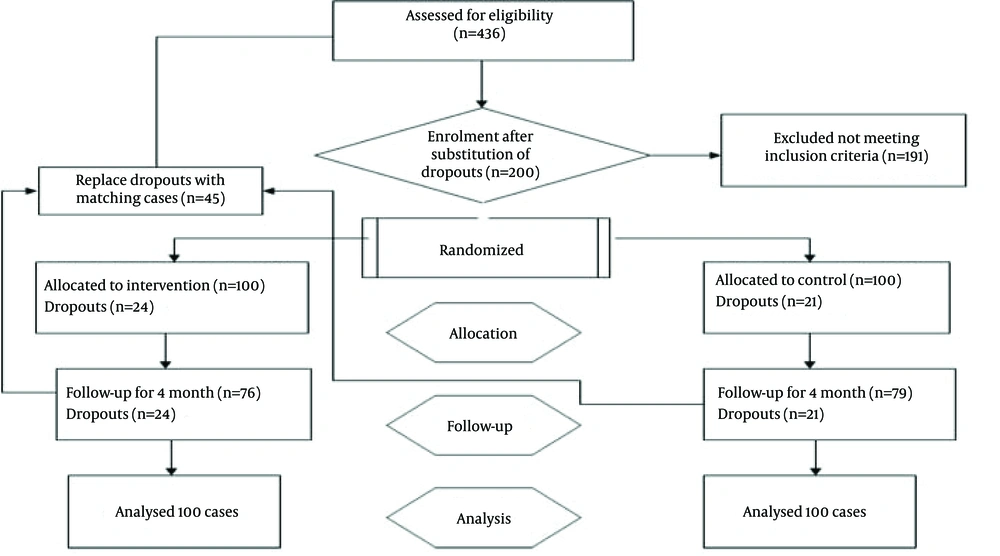
Figure 1.
The Study Recruitment Process
The collected data were analyzed using SPSS software (Statistical Package for the Social Sciences, version 18.0, SPSS Inc, Chicago, Illinois, USA) and descriptive statistics for frequency determination. Independent-samples t-test and chi-square test were used for data analysis. Moreover, Mann-Whitney and Wilcoxon tests (due to nonnormal distribution of the data) were used to compare the mean monthly wet-night episodes of the groups and assess clinical response to treatment in each group during the 4 months of treatment, respectively. P values less than 0.05 were considered significant. The ethics committee of Arak University of Medical Sciences observed ethics.
4. Results
In total, from a total of 436 patients with PMNE, 200 had IHC. Among the 45 children excluded during the 4-month follow-up, 42 ones (93.3%) were due to lack of consent and cooperation of their parents and 3 children (6.6%) were due to having calcium to creatinine ratios higher than 0.2, even after consuming 2 mg/kg/day HCT. All patients who were treated with HCT became normocalciuric. However, in 21 patients the dose was increased to 2 mg/kg/day.
The mean age of boys in the HCT group was 7.9 ± 2.09 and in the control group was 8.2 ± 1.23 years (P = 0.21). The youngest boy was 6 years old and the oldest one was 12 years old.
The results showed that type of delivery (P = 0.001), household incomes (P = 0.001), maternal education (P = 0.001) and gestational age (P = 0.001) were significant between the two groups. Other demographic, clinical and prenatal data of the intervention and control groups are listed in Table 1.
| Variables | PMNE Group | Control Group | P Value c |
|---|---|---|---|
| Gestational age | 0.001 | ||
| Full term | 62 (62) | 83 (83) | |
| Premature (< 37 wk) | 32 (32) | 12 (12) | |
| Post-term (> 40 wk) | 6 (6) | 5 (5) | |
| Maternal education | 0.001 | ||
| College | 29 (29) | 26 (26) | |
| High school | 23 (23) | 52 (52) | |
| Elementary school | 48 (48) | 22 (22) | |
| Household incomes d | 0.001 | ||
| Low | 59 (59) | 40 (40) | |
| Moderate | 39 (39) | 35 (35) | |
| High | 2 (2) | 25 (25) | |
| Marital status | 0.467 | ||
| Intact marriage | 79 (79) | 74 (74) | |
| Divorced | 21 (21) | 26 (26) | |
| Patient with siblings | > 0.05 | ||
| Yes | 5 (5) | 6 (6) | |
| No | 95 (95) | 94 (94) | |
| Type of delivery | 0.001 | ||
| Vaginal delivery | 66 (66) | 86 (86) | |
| Cesarean delivery | 34 (34) | 14 (14) | |
| Newborn jaundice | > 0.05 | ||
| Yes | 5 (5) | 6 (6) | |
| No | 95 (95) | 94 (94) |
a Abbreviation: PMNE, primary monosymptomatic nocturnal enuresis.
b The values are presented as No. (%).
c P values < 0.5 were considered statistically significant.
d Low, family monthly income < 5 million Rials, Moderate, family monthly income of 5 million to 10 million Rials, High, family monthly income > 10 million Rials.
As shown in Table 2, the mean numbers of wet-night episodes in the first (P = 0.3), second (P = 0.4), third (P = 0.1) and fourth (P = 0.3) months were not significantly different between the two groups.
Table 2. Comparison Between the Mean Numbers of Wet-Night Episodes at the End of Each Month in the Study Groups a
a The values are presented as Mean ± SD.
b P value based on the Mann-Whitney test.
c The group that received HCT and conservative treatment.
d The group that received conservative treatment alone.
The mean numbers of wet-night episodes in both groups were decreased during the 4 months of treatment; however, according to the Wilcoxon test, the decrease in the intervention group (P = 0.019) was significant unlike the control group. Not more significant compared to control group (P = 0.191) (Figure 2).
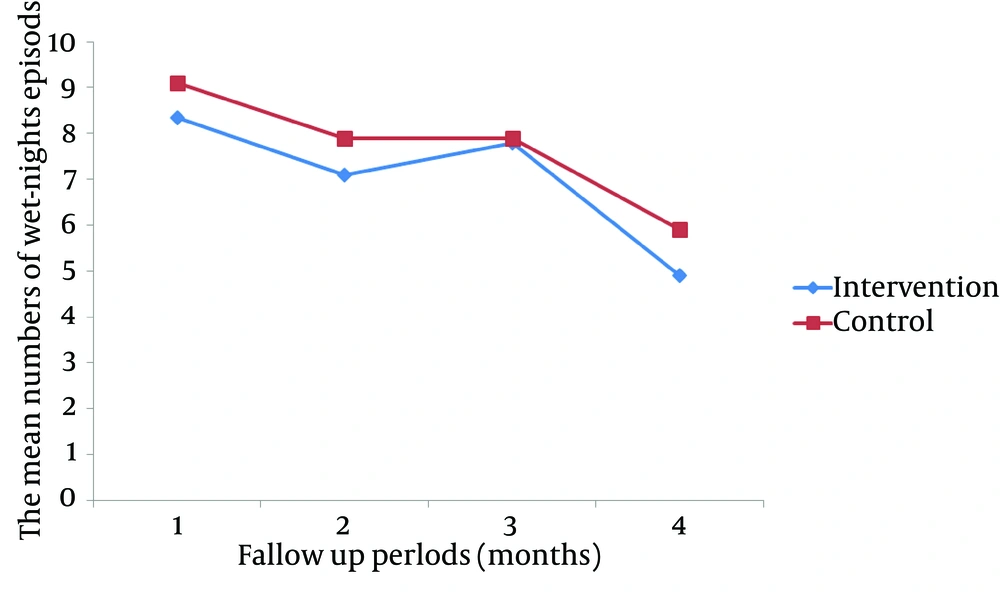
Figure 2.
The Mean Number of Wet-Night Episodes in the Fallow-up Periods in Each Group
No HCT-induced side effects were noticed among children during the study and no one was excluded due to intolerance to HCT.
5. Discussion
Our results showed that the improvement of PMNE in children receiving conservative treatment with HCT was more significant than the group receiving conservative treatment alone. Therapeutic efficacy of HCT on NE has been studied in only one study in 2010, by Alawwa et al. (17). In this study, 1 mg/kg/day oral HCT and placebo were used for treatment of 40 patients with NE and clinical responses of the patients were studied for 3 months. The results showed that both HCT and placebo were statistically effective in reducing the average percentage of wet-nights and HCT resulted in a significantly better reduction than placebo.
Park et al. (14), in a letter to the editor, in 2010, described two hypotheses concerning the relationship between hypercalciuria and NE and the possible effect of HCT on NE treatment: 1) Based on the evidence, transient receptor potential vanilloid 5 (TRPV5), which is in the distal convoluted tubule of the kidney, may have a significant role in the regulation of urinary calcium excretion (18). Also, the down-regulation of TRPV5 reduces reabsorption of calcium and becomes a factor for urinary calcium loss and causes hypercalciuria (19). Jang et al. (18) showed that in hypercalciuric rats, the hypocalciuric impact of HCT is associated with increased expression of TRPV5 protein. 2) HCT may have a role in the expression of aquaporin-2 (AQP2) and major renal Na+ transporters (14). Kim et al. (20) demonstrated that HCT reduces urinary output and increases urine osmolality by increasing the expression of AQP2, thiazide-sensitive NaCl cotransporter and α-epithelial sodium channel in lithium-induced nephrogenic diabetes insipidus in rats. Although these relationships have not been investigated in children with NE, it seems that the up-regulation of AQP2 and distal renal Na+ transporters in response to HCT may indicate a role of HCT in the treatment of NE (14).
Based on our findings, children who became normocalciuric after receiving HCT had significant PMNE clinical response. The findings of Alawwa et al. (17) and mechanisms explained by Park et al. (14) about the relationship between IHC and NE confirm our results. Due to the low cost, availability, ease of use and minor complications of HCT (13), it can be an effective drug in the treatment of PMNE in children. However, for the following reasons, further clinical and laboratory studies are needed before the recommendation of HCT as adjuvant or alternative therapy in NE: 1) Laboratory studies justifying the effect of HCT in the treatment of NE are few and molecular mechanisms involved in the paradoxical antidiuretic effect of HCT in NE are not completely identified, 2) Few clinical studies have been carried out regarding the impact of HCT in NE so far, 3) The dose-dependent effect of HCT on NE and the impact of HCT on various forms of NE (primary or secondary with and without monosymptomatic) require further studies.
The only limitation of our study was parental noncompliance because the follow-up lasted long and HCT is not a routine drug for the treatment of nocturnal enuresis. Some patients missed their follow-up visits during the study and were replaced with similar cases. Explaining the parents that HCT is a cheap and safe alternative to the more expensive drugs such as desmopressin improved compliance.
Since conservative treatment methods in children with PMNE are not convenient, according to our findings, it seems that HCT, as a safe and inexpensive drug can be effective in ameliorating PMNE is children with idiopathic hypercalciuria. However, due to the lack of clinical studies and also unknown mechanism of the association between IHC and NE, further studies with larger sample sizes and with the evaluation of dose-dependent effect of HCT on NE are recommended.


