


1. Introduction
Abnormalities in serum parathyroid hormone (PTH), phosphorus, and calcium levels are common in hemodialysis (HD) patients and have been associated with adverse clinical outcomes (1-9). According to previous observational studies, serum levels of calcium, phosphorus, and PTH outside the target range can lead to cardiovascular calcification, mortality, hospitalization, and fracture among patients (10-12). Among these abnormalities, hyperphosphatemia and secondary hyperparathyroidism are identified as more important targets for intervention (13).
With this background in mind, in the present study, we aimed to determine the trends of mineral metabolism markers among HD patients and specify calcium, phosphorus, and PTH ranges, associated with mortality risk and morbidity.
2. Methods
In this observational study, a cohort of 532 adult HD patients with high, intermediate, and low socioeconomic conditions was recruited from nine facilities in three regions of Tehran, Iran in September 2012. All the patients were on dialysis for at least two weeks and were older than 18 years.
A comprehensive questionnaire, comprised of demographic characteristics, comorbidities (Charlson comorbidity index; CCI) (14), and laboratory information, was completed, using administrative data and medical records. At least two or three laboratory findings were recorded in the questionnaire at baseline; the mean value was applied for the analyses. Six patients undergoing parathyroidectomy within 12 months before the study were excluded.
During the follow-up period (median: 28 months, minimum: 0.5 month, and maximum: 30 months), causes of hospitalization and exclusion from HD (e.g., death) were recorded. The final follow-up was the last visit or the time of HD cessation due to renal recovery, transfer for peritoneal dialysis (PD), or transplantation (one month after PD transfer). Patients who were transferred to a different facility were followed-up, as well. This study was approved by the specialized review board and the ethic committee. Informed patient consent forms were obtained from the participants.
2.1. Statistical Methods
Demographic characteristics and laboratory data of the patients were summarized by calculating the percentage, mean (± standard deviation; SD), or median (interquartile range) values, as appropriate. The mean value of two or three laboratory results obtained at baseline was used in the analysis of each patient. Categorical variables were compared, using Chi-square or Fisher’s exact test. Continuous variables were compared, using t-test, ANOVA, Mann-Whitney U test, or Kruskal-Wallis test, as appropriate. We used linear regression analysis for determining the correlates of PTH, both adjusted and unadjusted, for covariates of age, sex, body mass index (BMI), HD vintage, and diabetes.
Cox proportional hazards model was utilized to calculate the hazard ratios (HRs) of mortality, associated with calcium, phosphorus, and PTH levels. Covariates in all models consisted of age, sex, HD vintage, BMI, serum albumin level, and CCI. We used CCI (except renal disease), as it includes all comorbidities and has been validated in several studies as a good predictor of mortality in HD patients (14, 15).
We categorized calcium and phosphorus as 0.5 mg/dL increments and PTH as 50 pg/mL increments. Considering the range of mineral markers, reference categories were designated for calcium (8.51 - 9 mg/dL), phosphorus (4.51 - 5 mg/dL), and PTH (200.1 - 250 pg/mL). The range of serum variables was 5.9 - 11 mg/dL for calcium, 2.65 - 10.30 mg/dL for phosphorus, and 13 - 2100 pg/mL for PTH. According to the findings of the models, the probable greater risk and reference categories were recognized for each variable, and their relationship with all-cause mortality risk was analyzed in a second series of models, adjusted for case-mix, serum albumin level, and CCI.
The assumption of proportional hazard was evaluated by log-log plot and Schoenfeld residuals after fitting the models. Patient survival based on different ranges of iPTH was estimated by Kaplan-Meier method. The number of patients in different models varied slightly, owing to missing information. Data analysis was performed using SPSS version 19 (SPSS Inc., Chicago, IL). Significance level was considered to be less than 0.05.
3. Results
Based on the findings, the mean age of the patients was 56 ± 15.4 years. In total, 57% (n = 302) of the participants were men and 41% (n = 219) were diabetic. The mean duration of dialysis was 44.6 ± 49.1 months (median: 25, interquartile range: 55) (Table 1). During the follow-up period (948 patient-years of follow-up), a total of 161 (30%) patients died.
Table 1. Demographic, Clinical, and Laboratory Characteristics of 532 Hemodialysis Patientsa
| Characteristics | Patients (N = 532) |
|---|---|
| Sex (male) | 302 (57) |
| Age, y | 56 ± 15.4 |
| Diabetes | 219 (41) |
| Charlson comorbidity index (except renal disease) | 1.99 ± 1.8 |
| Body mass index, kg/m2 | 24.4 ± 4.6 |
| Hemodialysis KT/V | 1.31 ± 0.21 |
| Serum hemoglobin level, g/dL | 10.6 ± 1.5 |
| Serum albumin level, g/dL | 3.90 ± 0.35 |
| Serum creatinine level, mg/dL | 8.6 ± 2.8 |
| Serum calcium level, mg/dL | 8.9 ± 0.8 |
| Serum phosphorus level, mg/dL | 5.5 ± 1.3 |
| Serum alkaline phosphatase level, IU/L | 277 (IQR: 208 - 393) |
| Serum iPTH level, pg/mL | 320 (IQR: 158 - 572) |
| Serum vitamin D level, ng/mL | 25.1 (IQR: 18.5 - 31) |
| Annual parathyroidectomy | 0.76%/year |
| Serum iPTH (pg/mL) (N = 488) | |
| < 200 | 139 (28) |
| 200 - 600 | 238 (49) |
| ≥ 600 | 111 (23) |
| Serum phosphorus level, mg/dL (N = 520) | |
| < 4 | 50 (10) |
| 4 - 6 | 304 (58) |
| ≥ 6 | 166 (32) |
| Serum calcium level, mg/dL (N = 520) | |
| < 7.5 | 21 (4) |
| 7.5 - 8.5 | 129 (25) |
| 8.5 - 10 | 345 (66) |
| ≥ 10 | 25 (5) |
aValues are expressed as mean ± SD or No. (%).
3.1. PTH Determinants
We categorized iPTH into four groups: low (< 150 pg/mL), low-average (150 - 300 pg/mL), high-average (300 - 600 pg/mL), and high (≥ 600 pg/mL). As the findings revealed, patients with low PTH were older and had more comorbidities, compared to those with high PTH. Also, diabetes, lower serum albumin level, lower Kt/V, and higher serum calcium level were more frequently reported in these cases. In contrast, patients with high PTH were younger with longer HD vintage, lower serum hemoglobin level, higher serum phosphorus, and greater serum alkaline phosphatase level (Table 2).
Table 2. Comparison of Demographic, Clinical, and Laboratory Characteristics Regarding Different Levels of iPTH
| Characteristics | PTH < 150 (N = 106) (1) | PTH = 150 - 300 (N = 117) (2) | PTH= 300 - 600 (N = 154) (3) | PTH ≥ 600 (N = 111) (4) | P Value |
|---|---|---|---|---|---|
| Sex (male/female), % | 51 (48.1) | 67 (57.3) | 103 (66.9) | 54 (48.6) | 0.006 |
| Age, y | 60.1 ± 14.5 | 58.7 ± 15.2 | 56.4 ± 14.8 | 51.2 ± 15.9 | < 0.001 |
| (4) Vs (1), (2), (3) | |||||
| Diabetes (yes), % | 50 (24.4) | 63 (30.7) | 63 (30.7) | 29 (14.1) | < 0.001 |
| Hemodialysis vintage, mo | 33.8 ± 40.8 | 33.2 ± 46.9 | 47.3 ± 53.4 | 64.4 ± 46.3 | < 0.001 |
| (4) Vs (1), (2), (3) | |||||
| Body mass index, kg/m2 | 23.8 ± 4.1 | 25.4 ± 4.7 | 24.3 ± 3.7 | 24.2 ± 5.7 | 0.055 |
| Charlson comorbidity index (except renal disease) | 2.4 ± 1.8 | 2.2 ± 2.1 | 1.8± 1.6 | 1.7 ± 1.8 | 0.02 |
| Serum albumin level, g/dL | 3.77 ± 0.38 | 3.92 ± 0.35 | 3.94 ± 0.32 | 3.97 ± 0.33 | < 0.001 |
| (1) Vs (2), (3), (4) | |||||
| Serum hemoglobin level, g/dL | 10.8 ± 1.5 | 10.8 ± 1.4 | 10.5 ±1.4 | 10.2 ± 1.8 | 0.01 |
| (4) Vs (2) | |||||
| Serum creatinine level, mg/dL | 7.4 ± 2.3 | 8.2 ± 2.8 | 9.2 ± 2.9 | 9.6 ± 2.4 | < 0.001 |
| (4) Vs (1), (2) | |||||
| Pre-dialysis BUN, mg/dL | 54.5 ± 13.6 | 54.8 ± 14.1 | 57.5 ± 12.2 | 58.6 ± 14.2 | 0.065 |
| Single-pool, Kt/V | 1.28 ± 0.18 | 1.28 ± 0.19 | 1.32 ± 0.20 | 1.34 ± 0.23 | NS |
| Serum calcium level, mg/dL | 9.1 ± 0.6 | 8.9 ± 0.6 | 8.7 ± 0.7 | 8.6 ± 0.8 | < 0.001 |
| (1) Vs (2), (3), (4) | |||||
| Serum phosphorus level, mg/dL | 5.2 ± 1.2 | 5.3 ± 1.2 | 5.4 ± 1.3 | 6.1 ± 1.3 | < 0.001 |
| (4) Vs (1), (2), (3) | |||||
| Alkaline phosphatase level, IU/L | 242 ± 98 | 281 ± 143 | 331 ± 170 | 767 ± 826 | < 0.001 |
Based on the multiple regression analysis, after adjusting for demographic variables (i.e., age, gender, BMI, dialysis vintage, and diabetes), a significant direct correlation was found between PTH and serum alkaline phosphatase (r = 0.49, P < 0.001), serum phosphorus (r = 0.24, P < 0.001), and HD vintage (r = 0.21, P < 0.001). However, an inverse correlation was detected between PTH and age (r = -0.20, P < 0.001), diabetes (r = -0.16, P = 0.001), and serum calcium level (r = -0.13, P = 0.005). Also, we noticed a trend for lower hemoglobin level and higher PTH (r = -0.08, P = 0.09).
3.2. Identification of Risk Categories for Serum Phosphorus, Calcium, and PTH Levels
In Cox proportional hazards regression analysis, after obtaining the HR of mortality for different serum phosphorus levels in unadjusted and adjusted models, we concluded that the best reference range for serum phosphorus was 4 - 6 mg/dL. Also, the ranges for serum calcium and PTH were < 10 mg/dL and 200 - 600 pg/mL, respectively (Table 3, Figure 1). On the other hand, in the unadjusted model, HR of mortality was 1.61 (95% CI: 1 - 2.46) in association with serum phosphorus level < 4 mg/dL and 1.55 (95% CI: 1.06 - 2.27) for PTH < 200 pg/mL.
Table 3. Unadjusted and Adjusted Hazard Ratios (HRs) for Different Ranges of Bone Markers
| Characteristics | Unadjusted (95% CI) | Case-Mix Adjusteda (95% CI) | Case-Mix Adjusted + CCIb (95% CI) |
|---|---|---|---|
| Phosphorus level, mg/dL | |||
| 4 - 6 (reference) | |||
| < 4 | 1.61 (1 - 2.46; P = 0.05) | 1.29 (0.80 - 2.10; P = 0.29) | 0.83 (0.50 - 1.38; P = 0.47) |
| ≥ 6 | 1.09 (0.77 - 1.55; P = 0.61) | 1.35 (0.95-1.93; P = 0.09) | 1.56 (1.09-2.22; P = 0.01) |
| Calcium level, mg/dL | |||
| < 10 (reference) | |||
| ≥ 10 | 1.55 (0.82-2.95; P = 0.17) | 1.99(1.04 - 3.82; P = 0.03) | 2.34 (1.21 - 4.51; P = 0.01) |
| PTH level, pg/mL | |||
| 200 - 600 (reference) | |||
| < 200 | 1.55 (1.06 - 2.27; P = 0.02) | 1.38 (0.95 - 2.03; P = 0.09) | 0.99 (0.67 - 1.48; P = 0.97) |
| ≥ 600 | 1.37 (0.91 - 2.08; P = 0.13) | 1.75 (1.14 - 2.71; P = 0.01) | 1.59 (1.03 - 2.45; P = 0.03) |
aCase-mix adjustment (age, gender, BMI, and dialysis vintage).
bCase-mix adjustment plus serum albumin level and CCI.
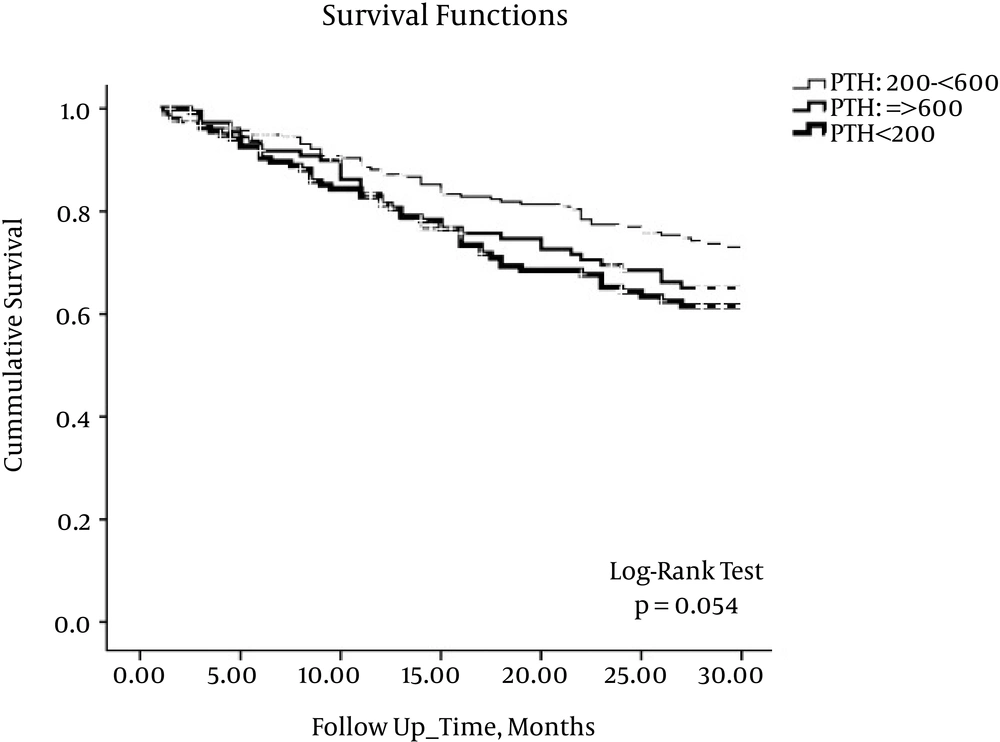
Figure 1.
Kaplan-Meier Survival Analysis of Different Ranges of Serum iPTH
In the adjusted models (in terms of age, gender, BMI, HD vintage, serum albumin level, and CCI), HR of mortality was 1.56 for serum phosphorus ≥ 6 mg/dL (95% CI: 1.09 - 2.22), 2.34 for calcium ≥ 10 mg/dL (95% CI: 1.21 - 4.51), and 1.59 for PTH ≥ 600 pg/mL (95% CI: 1.03 - 2.45). After adjustments for case-mix, serum albumin level, and comorbidities, values below the reference ranges were no longer associated with a higher mortality risk, which indicates that low levels of serum phosphorus and PTH in the context of malnutrition and comorbidities (perhaps with greater inflammation) were risk factors for greater mortality.
In addition, we categorized serum phosphorus and PTH into four groups: patients (n = 57%) with both phosphorus < 6 mg/dL and PTH < 600 pg/mL (reference group), patients (n = 22%) with only phosphorus ≥ 6 mg/dL, patients (n = 10%) with only PTH ≥ 600 pg/mL, and patients (n = 11%) with both phosphorus ≥ 6 mg/dL and PTH ≥ 600 pg/mL. In the adjusted model, HR of mortality was 2.69 for a combination of hyperphosphatemia and high PTH (95% CI: 1.55 - 4.68, P < 0.001), 1.44 for high serum phosphorus level (95% CI: 1.01 - 2.18, P = 0.045), and 1.30 for high PTH (95% CI: 0.86 - 2.20, P = 0.23) (reference: phosphorus < 6 mg/dL and PTH < 600 pg/mL). Meanwhile, 1.4% of the patients had concurrent hyperphosphatemia (≥ 6 mg/dL), hyperparathyroidism (≥ 600 pg/mL), and hypercalcemia (≥ 10 mg/dL).
Finally, after adjustments for all covariates including demographic (e.g., age, gender, and HD vintage), nutritional (BMI, serum hemoglobin, albumin level, creatinine level, pre-dialysis blood urea nitrogen or BUN, and total iron binding capacity), and vascular (Kt/V, CCI, and mineral markers) features, HR of mortality was 1.63 for serum phosphorus ≥ 6 mg/dL (95% CI: 1.10-2.92, P = 0.016), 1.79 for PTH ≥ 600 pg/mL (95% CI: 1.04 - 3.08, P = 0.035), and 2.01 for calcium ≥ 10 mg/dL (0.88-4.93, P = 0.096). Also, after incorporating serum phosphorus and PTH levels into the model, HR of mortality was 1.21 for serum phosphorus (mg/dl) (95% CI: 1.03 - 1.42, P = 0.02) and 1.10 for serum PTH (100 pg/mL) (95% CI: 1.05 - 1.20, P = 0.001).
Characteristics of patients with low serum phosphorus level (< 4 mg/dL) or low PTH (< 200 pg/mL)
In total, 10% (n = 50) of patients with the mean age of 61.5 ± 17.5 years and median HD vintage of 16 months had a serum phosphorus level < 4 mg/dL (range: 2.65 - 3.97 mg/dL). Non-surviving patients (42% of patients in a median of 28 months) were significantly older than surviving patients (68.2 ± 14.1 vs. 56.9 ± 18.6 years). Also, they experienced more comorbidities (CCI except renal disease: 4.5 ± 2.6 vs. 1.4 ± 1.1) and had a lower serum albumin level (3.66 ± 0.28 vs. 3.95 ± 0.35 g/dL), lower serum hemoglobin (10.2 ± 1.3 vs. 11.1 ± 1.7 g/dL), and lower serum creatinine level (5.8 ± 1.8 vs. 7.1 ± 2.6 mg/dL). Females accounted for 52.5% of non-surviving patients.
Overall, 28% (n = 139) of the patients with the mean age of 60.5 ± 14.3 years and median HD vintage of 16 months had a serum PTH level < 200 pg/mL (range: 13 - 193 pg/mL). Non-surviving patients (35% of patients in a median of 28 months) were significantly older than their surviving counterparts (64.1 ± 14.1 vs. 58.7 ± 14.3 years). Also, more comorbidities (CCI except renal disease: 4.1 ± 2.1 vs. 1.5 ± 1.2), lower serum albumin level (3.60 ± 0.37 vs. 3.93 ± 0.33 g/dL), lower serum hemoglobin level (10.4 ± 1.5 vs. 11.1 ± 1.4 g/dL), and lower serum creatinine (6.9 ± 2.1 vs. 7.9 ± 2.7 mg/dL) were observed in these patients. Additionally, BMI was lower in non-surviving patients (23.4 ± 4.1 vs. 24.7 ± 4.2 kg/m2). In total, females accounted for 61% of non-surviving patients (P = 0.03).
3.3. Incidence of Fracture
During a median of 28 months of follow-up (948 patient-years of follow-up), 26 fractures were reported among 532 patients. The approximate annual frequency of fractures was 2.1%. In other words, the incidence of fracture was 27.4 episodes per 1000 patient-years at risk (95% CI: 19.1 - 38.5). Patients with fractures were mostly female and had more comorbidities and longer dialysis duration; they also had a lower serum calcium level, compared to patients with no fracture events.
A trend was observed for older age and diabetes in patients with fractures (Table 4). Based on the logistic regression analysis, after adjustments for demographic variables (i.e., age, sex, and HD vintage), the relative risks (RRs) of fracture for the foregoing variables were as follows: 1.02 (95% CI: 0.99 - 1.05, P = 0.09) for age (years); 2.13 (95% CI: 0.93 - 4.88, P = 0.07) for female gender; 1.09 for HD vintage (years) (95% CI: 1.01 - 1.17, P = 0.03); 1.22 (95% CI: 1 - 1.50, P = 0.05) for CCI; 1.88 (95% CI: 0.84 - 4.52, P = 0.12) for diabetes; and 0.53 for serum calcium level (mg/dL) (95% CI: 0.31 - 0.89, P = 0.02).
Table 4. Characteristics of Hemodialysis Patients with and Without Fracture Episodesa
| Characteristics | Patients with Fractures (n = 26) | Patients without Fractures (n = 506) | P Value |
|---|---|---|---|
| Sex (female), % | 16 (61.5) | 214 (42.3) | 0.04 |
| Age, y | 60.5 ± 12.3 | 56.6 ± 15.4 | 0.13 |
| Diabetes (yes), % | 14 (54) | 205 (40.5) | 0.14 |
| Hemodialysis vintage, mo | 66.6 ± 58.1 | 43.4 ± 48.3 | 0.02 |
| Charlson comorbidity index (except renal disease) | 2.7 ± 1.6 | 1.9 ± 1.7 | 0.06 |
| Body mass index, kg/m2 | 24.9 ± 4.8 | 24.4 ± 4.5 | NS |
| Serum albumin level, g/dL | 3.90 ± 0.35 | 3.91 ± 0.35 | NS |
| Serum hemoglobin level, g/dL | 10.8 ± 1.1 | 10.6 ± 1.5 | NS |
| Serum creatinine level, mg/dL | 8.3 ± 1.9 | 8.6 ± 2.8 | NS |
| Serum pre-BUN level, mg/dL | 54.8 ± 10.5 | 56.5± 13.6 | NS |
| Serum calcium level, mg/dL | 8.57 ± 0.58 | 8.87 ± 0.73 | 0.04 |
| Serum phosphorus level, mg/dL | 5.4 ± 1.2 | 5.5 ± 1.3 | NS |
| Serum iPTH level, pg/mL | 394 ± 330 | 420 ± 348 | NS |
| Hemodialysis Kt/V | 1.32 ± 0.19 | 1.31 ± 0.21 | NS |
| Mortality (yes), % | 10 (38.5%) | 151 (29.8) | NS |
aValues are expressed as mean ± SD or No. (%).
4. Discussion
This observational, multi-center study provided detailed information on dispersion, trend, and mortality risk of different serum calcium, phosphorus, and PTH levels in a cohort of 532 maintenance HD patients. We found that ranges of 4 - 6 mg/dL for serum phosphorus and 200 - 600 pg/mL for iPTH were associated with the lowest risk of mortality. Nevertheless, after extensive adjustments for markers of malnutrition and comorbidities (CCI), bone markers below the range were no longer associated with mortality risk and they even became protective.
It should be noted that we used the average of two or three laboratory findings, obtained at baseline; the minimum average value of phosphorus was 2.65 mg/dL. This finding is feasible, as non-surviving patients with low serum phosphorus (< 4 mg/dL) or iPTH (< 200 pg/mL) level were older and had lower nutritional markers (BMI, serum albumin level, hemoglobin level, and creatinine level). They also experienced more comorbidities, compared to surviving subjects with the same level of bone markers.
In contrast, in the unadjusted Cox regression model, high levels of serum phosphorus (≥ 6 mg/dL), iPTH (≥ 600 pg/mL), and calcium (≥ 10 mg/dL) were not associated with the risk of mortality; however, they were found to be risk factors after adjustments for case-mix, nutritional, and comorbidity covariates. The findings showed that age, nutrition, and comorbidities (associated with more inflammation) play more important roles than bone minerals in determining the outcomes of HD patients.
After multivariate adjustment, a combination of high serum phosphorus (≥ 6 mg/dL) and PTH (≥ 600 pg/mL) levels showed the highest risk of mortality, compared to lower levels (HR: 2.69; 95% CI: 1.55 - 4.68), followed by high serum phosphorus level (HR: 1.44; 95% CI: 1.01 - 2.18) and high PTH level (not a major risk factor; HR: 1.30; 95% CI: 0.86 - 2.20). These results confirmed the findings of previous studies, which showed that high levels of bone minerals could lead to a greater risk of cardiovascular diseases and mortality through vascular calcification (12, 16, 17).
Overall, the present study showed that a lower PTH level is more desirable if the patients do not suffer from malnutrition or comorbidities. Furthermore, if PTH level is categorized into different ranges in order to consider various effects of covariate adjustment on mortality risk, PTH level ≥ 600 pg/mL (compared to 200 - 600 pg/mL) can be associated with significant mortality risk. It should be mentioned that the median of patients’ PTH level (320 pg/mL) was rather high in the present study.
Most of our observations were in agreement with previous reports. According to the literature, the cut-off serum phosphorus and PTH levels for the prediction of mortality differ in various observational studies, depending on the study design, incidence and/or prevalent dialysis population, baseline or time-dependent analysis, type of comorbidity adjustments, and demographic differences. Some reports have considered a cut-off value of ≥ 300 pg/mL for PTH as increased mortality risk (3), while Block et al. reported that moderate to severe hyperparathyroidism (PTH ≥ 600 pg/mL) and serum phosphorus concentration > 5.0 mg/dL were associated with the increased risk of mortality (1).
Most studies have shown that both decline and rise in serum phosphorus level outside the 3.5 - 5.5 mg/dl range are associated with a higher mortality rate (3, 5, 8). Floege et al. demonstrated that three metabolic bone disease markers, i.e., calcium, phosphorus, and PTH within the target range of kidney disease outcomes quality initiative (KDOQI), were associated with the lowest risk of mortality (8).
Streja et al. recently showed that balanced control of both serum phosphorus and PTH levels contributed to better outcomes in HD patients (13). A recent study by Danese et al. reported that at least two of three bone markers out of the target range can identify patients with more adverse clinical outcomes (18). Additionally, some reports have revealed a strong association between high calcium level and long-term mortality, whereas the results regarding low serum calcium level are inconsistent (1, 3-5).
Reports from Japan have revealed the highest survival rates in dialysis patients with PTH level < 150 pg/mL (19, 20). Likewise, a report by Nakai et al. showed better survival in non-dialysis chronic kidney disease (CKD) patients with lower PTH levels (21). In addition, Dukkipati et al. reported that PTH level in the range of 100 - 150 pg/mL was associated with the highest survival rate after adjustments for inflammation and nutritional markers (22).
Some evidence suggests that low-turnover bone disease might be a result of malnutrition (hypoalbuminemia) and inflammation (heightened oxidative stress markers or pro-inflammatory cytokines), leading to a higher risk of cardiovascular diseases and mortality in dialysis patients (22-25). Therefore, management of this situation relies on interventions to improve malnutrition and approaches to mitigate the inflammatory process.
Overall, both low and high levels of serum phosphorus seem to be risk factors for mortality. As low serum phosphorus level is observed in patients with a poor nutritional status and major comorbidities, observation of poor outcomes is justified in these cases and low phosphorus level can be a strong indicator of mortality. In fact, the association in these patients is even more obvious than cases with normal or high serum phosphorus level (26). However, some large-scale studies (1, 3) have shown that after adjustment for markers of malnutrition/inflammation, low serum phosphorus level (< 3 mg/dL) was still associated with a higher mortality rate in HD patients. After all, intake of proteins with a high biological value and appropriate use of phosphate binders are warranted in these patients (27, 28).
In the present study, there was a significant and direct correlation between serum phosphorus and serum PTH levels; also, an inverse significant correlation was found between serum calcium and serum PTH levels. Therefore, for the management of secondary hyperparathyroidism, we need to control hyperphosphatemia and hypocalcemia. As previously reported in other studies, since serum alkaline phosphatase has a strong positive correlation with serum PTH level, we might be able to predict high-turnover bone disease by the level of serum alkaline phosphatase (29).
Moreover, in the present study, we found that advanced age and diabetes had negative impacts on PTH level. Our findings are in line with previous studies, which have recognized diabetes, advanced age, inflammation, oxidative stress, high calcium content, and PD to be associated with adynamic bone disease (30). Indeed, it has been shown that high levels of pro-inflammatory cytokines contribute to low PTH status through suppression of PTH secretion (31, 32).
Additionally, it has been confirmed that hyperphosphatemia is a strong stimulator of secondary hyperparathyroidism. In fact, both of these conditions are predictors of higher morbidity and mortality rates in HD patients, even though evidence for hyperphosphatemia is much more powerful and consistent (33, 34). A meta-analysis by Palmer et al. on CKD patients revealed that only high serum phosphorus levels were strong predictors of mortality (35).
In the current study, the annual frequency of new fractures was almost 2.1% with the incidence of 27.4 episodes per 1000 patient-years at risk (95% CI: 19.1 - 38.5). This incidence rate was a bit higher than reports from the United States (24.8 per 1000 patient-years; 95% CI: 22.5 - 27.5) and European countries (25.6 per 1000 patient-years; 95% CI: 24.4 - 27.0) (36). Female gender, advanced age, longer HD vintage, comorbidities (including diabetes), and low serum calcium level were independent predictors of fracture. These results support previously identified risk factors for fracture in HD patients (36, 37). However, we did not observe an association between fracture risk and low BMI or high PTH. Furthermore, the present study identified hypocalcemia as an independent risk factor for fracture.
4.1. Strengths and Limitations
A point of strength in the present study is the selection of a reasonable representative sample of HD population. Also, we included detailed information on comorbidities, laboratory tests, dialysis adequacy, vascular access, and nutritional markers in our study. In addition, we calculated the average of at least two or three laboratory findings, obtained at baseline. On the other hand, limitations of the present study include the observational design, inattention to the residual renal function, and lack of adjustments for serum vitamin D level, fibroblast growth factor 23, use of calcimimetic and active vitamin D agents, and perhaps other residual confounders.
4.2. Conclusions
In conclusion, we found that hyperphosphatemia and hyperparathyroidism are associated with adverse outcomes in HD patients. We also found that patients with a low level of serum phosphorus or PTH (associated with poor clinical outcomes) have a poor nutritional status and high comorbidities. Also, combination of hyperphosphatemia and hyperparathyroidism was associated with the highest risk of mortality in patients with bone mineral disease. Additionally, a trend indicating a higher mortality rate in patients with hypercalcemia was observed. Based on the findings, we should control hyperparathyroidism through the management of hyperphosphatemia and hypocalcemia. Finally, as the findings revealed, hypocalcemia might contribute to fracture risk among patients.


