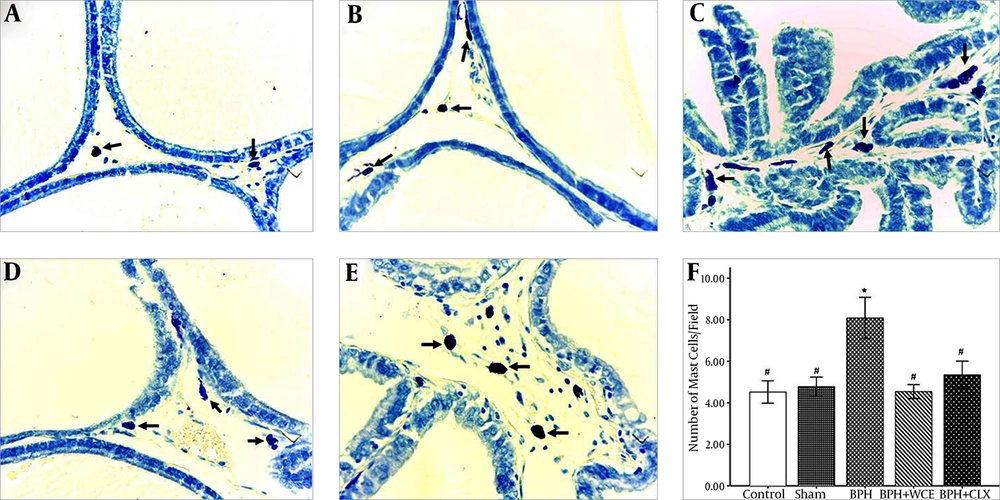
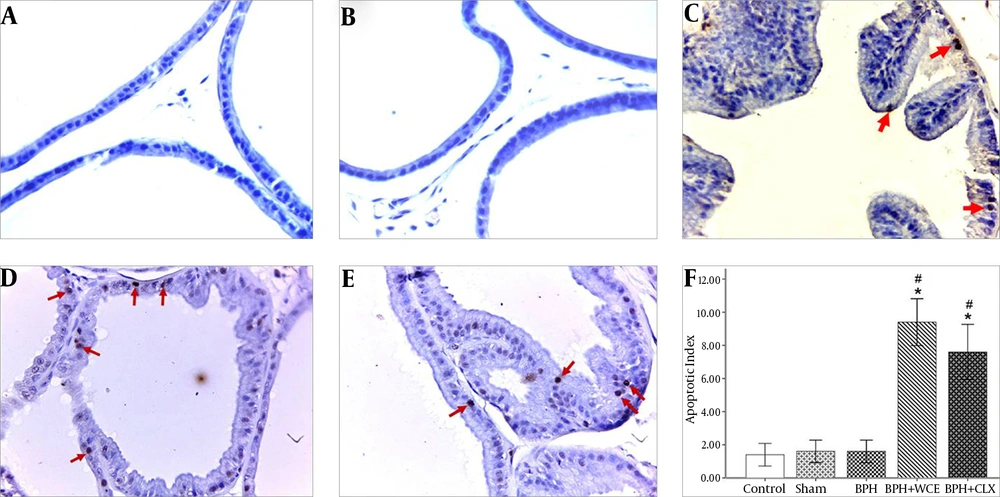
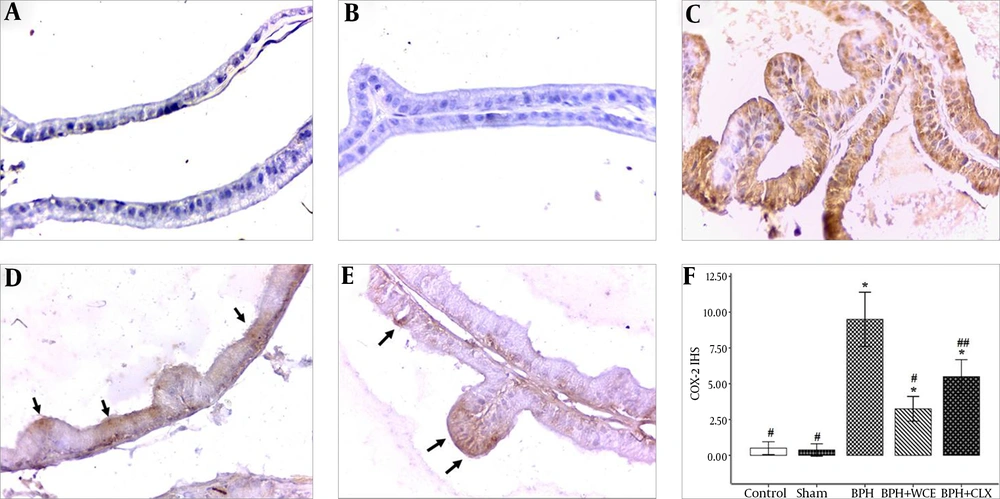
In the present study, we evaluated the effects of the W. coagulans extract on cell apoptosis and COX-2 inhibition in BPH induced by testosterone in rats. Treatment with WCE decreased the prostate weight, and COX-2 expression, as well as increasing cell apoptosis, in the prostate when compared to the BPH group. The histopathological study also revealed that WCE caused a decrease in the pro-inflammatory cells (mast cells) in the BPH model.
Although medical therapy is helpful in the treatment of BPH, plant extracts are known to be useful for the relief of BPH symptoms without resulting in side effects (
11).
WCE has anti-inflammatory, antiproliferative, and apoptotic effects that have been demonstrated by us and other researchers (
14,
25,
26). In our previous study, we demonstrated the antiproliferative and antioxidant effects of WCE in different doses on a BPH rat model (
14). A 1000 mg/kg WCE dose was found to be effective and therefore we applied that dose in the present study.
BPH is a pathologic disease and many factors are involved in the condition. In addition to aging, androgens play a principal role in the pathogenesis of BPH, with testosterone being the main androgen associated with prostate growth and the sustenance of its structural and functional integrity (
27). An alteration in the testosterone level is usually accompanied by changes in the growth and weight of the prostate (
28).
About 90% of testosterone (TE) is converted into dihydrotestosterone (DHT) by the prostate cells. The DHT then binds to the androgen receptors and stimulates protein synthesis, differentiation, and prostate cell growth (
29).
Researchers have reported that there is an increase in the serum testosterone and DHT in BPH patients, and these levels are directly related to the size of the prostate (
30). Some previous studies have reported that an increase in the prostatic weight is the main marker of the development of BPH (
31,
32).
In this study, we found an increase in the prostate weight in the BPH model. The animals treated with WCE showed a decrease in prostate weight when compared to the BPH group. This finding was more prominent in the WCE group than the CLX group. The two main active components of
Withania plants are Withaferin A and withanolides. Withanolides are also known as plant hormones; when there is an excess of a certain hormone, withanolides acting as cell membrane receptors are able to prevent animal hormones from attaching to these sites and can hence engage in their true activities (
16). In this study, the withanolides from WCE probably did not permit exogenous testosterone to bind to the testosterone receptors and prevent its effects, which caused proliferation and an increase in the weight of the prostate.
The pathogenesis of BPH remains obscure, although several studies have demonstrated the role of inflammatory infiltrates and their mediators in the development of BPH (
33). Increasing evidence indicates that mast cells play a main role in the pathogenesis of inflammatory diseases (
34). Mast cells also play an important role in the development of many tumors, including prostate cancer, and they are now discussed as the main regulators of inflammatory diseases (
35).
Huang and colleagues showed that mast cells blocked the apoptosis in tumor cells via the secretion of proinflammatory factors such as tumor necrosis factor-α (TNF-α) (
36).
Mast cells are a variety of inflammatory cells that release proteases, angiogenic factors, and cytokines. The enhancement of the cytokines induces cell survival, growth, differentiation, and cyclooxygenase-2 expression (
6).
Pittoni et al. confirmed that mast cells play an essential role in the initial and progression of prostate cancer, and also that mast cell inactivation may prove useful for antitumor therapy (
37). Papadoukakis et al. showed a remarkable enhancement in mast cell numbers in the stromal area of the ventral prostate in a BPH rat model with a significant number of intracytoplasmic granules and degranulation (
38).
The present work showed that BPH induction caused an increase in mast cell infiltration, which was in accordance with the findings reported by Bahey et al. (
22). Treatment with WCE decreased the number of mast cells significantly when compared to the BPH group. This might be attributed to the anti-inflammatory property of
Withania coagulans, which has been previously described by several researchers (
26,
39).
Various studies have shown that pro-inflammatory cytokines induce COX-2 expression, which leads to an increase in the proliferation rate in tissues (
5,
40). Via the conversion of arachidonic acid into prostaglandins, the COX-2 enzyme is responsible for inflammatory responses in the body (
41). The upregulation of COX-2 increases the cell proliferation and inhibits cell death (
42). Wang et al. indicated the over-expression of COX-2 in patients with BPH and prostatitis (
6).
Other studies have also indicated that COX-2 inhibition causes a decrease in proliferation in cases of prostate cancer and BPH (
43).
Altavilla et al. showed that Flavocoxid, a COX-2 inhibitor, reduced the prostate weight in a BPH model in mice via the induction of Bax expression and the decrease of Bcl-2 (anti-apoptotic) (
10).
Further, Jayaprakasam et al. reported that the withanolides isolated from the
Withania plant possess excellent selective COX-2 inhibitory activity (
25).
In another study, Min et al. demonstrated that Withaferin A, the main constitute of the
Withania plant, could regulate the inflammatory reactions in microglia by decreasing COX-2 expression and prostaglandin E2 (PGE2) production (
44).
Moreover, Withaferin A revealed that WCE inhibits TNF-α and nuclear factor-κB (NF-κB) activation (
45). TNF-α acts as a stimulator of COX-2 expression in normal and malignant prostate cells (
46). The study by Ichikawa et al. showed that withanolides downregulated the expression of COX-2 (
47).
COX-2 enzyme receptors have a high affinity for being occupied by plant steroid hormones (
48). In the present study, we found an enhancement in COX-2 activity in the prostate tissues in BPH rats, which was in agreement with the results obtained by Wang and colleagues, who found that COX-2 was upregulated in the prostate cells in both prostate cancer and BPH tissue samples (
40). The present study demonstrated that the COX 2 levels in the WCE treatment group significantly decreased when compared to those in the BPH group. This finding indicates that WCE restrains the development of BPH in rats, which is related to a decrease in COX 2 expression. However, the expression of this enzyme was better suppressed in the WCE treatment group’s prostate tissue than in the CLX treatment group, which indicates that the withanolides revealed themselves to be better inhibitors of COX-2 than NSAIDs. Therefore, withanolides could serve as substitutes for NSAIDs (
16).
Previous studies have shown that an increase in cell proliferation and a decrease in apoptosis causes pathologic prostate enlargement (
49). Apoptosis or programmed cell death is a protective mechanism against the accumulation and spread of defective cells (
50). In our previous study, we evaluated the anti-proliferative effects of WCE in a BPH rat model using PCNA immunohistochemistry staining. The results showed that WCE decreases the epithelial proliferation in prostate tissue. Withaferin A from
Withania showed an inhibition of the G1/S cell cycle and cell proliferation, as well as the induction of apoptosis, in prostate cancer cells. In addition, Withaferin A prevented the DNA binding activity of NF-κB, a main regulator of the cellular processes involved in the differentiation, cellular proliferation, and apoptosis (
17).
In the present investigation, we evaluated the effect of WCE on apoptosis in prostate epithelial cells using the TUNEL staining method. We found that WCE increases apoptosis in the epithelial prostate cells in a BPH model of rats, which might be attributed to the pro-apoptotic effects of WCE through the inhibition of both the G1/S cell cycle and NF-κB expression. This result is consistent with the findings reported by Roy et al. concerning prostate cancer cells (
17).
In conclusion, our results suggested that WCE might inhibit oxidative stress, inflammation, COX-2 expression, and the induction of apoptosis, which has a therapeutic effect in BPH. Therefore, this plant should be considered as a novel phytomedicine against BPH in patients. However, more studies are necessary to determine the potential therapeutic effects of Withania coagulans in BPH patients.