


1. Background
The importance of physical activity during pregnancy is well known as it positively affects the health of the mother and fetus. Studies have shown that, physical activity during pregnancy significantly reduces the risk of gestational diabetes (1, 2), depression (3), gestational hypertension (4), preeclampsia (5), and abnormal weight gain (6, 7).
The American College of Obstetricians and Gynecologists recommends that pregnant women who do not have medical and midwifery restrictions should undertake a moderate to severe physical activity for at least 30 minutes 5 days a week to have beneficial effects on their pregnancy (8). Nevertheless, research has shown that, many people are faced with complications of inactivity, which are caused mainly by the advancement of technology and its consequent tendency towards immobility (9). With regard to activity during pregnancy, we should note that the physical condition of the body during pregnancy increases the tendency towards immobility (9). In Iran, less than 40% of women have appropriate physical activity during pregnancy (10, 11). Another possible reason for women’s immobility during pregnancy is the traditional attitude of people, which encourages pregnant women to have more rest and reduce activity in this period (9). Therefore, in order to reduce the negative effects of this attitude, change the harmful behaviors of pregnant women, and ultimately, improve the health of women, appropriate education on physical activity should be provided to pregnant women.
The first pregnancy is a good time to provide health education because many pregnancies, especially in the developing countries, are unplanned, and in fact, women come in contact with the healthcare system for the first time during pregnancy. Despite training by health care providers on the benefits of physical activity during pregnancy, many studies have shown that the information received did not change the behavior of pregnant women to exercise properly during pregnancy (10, 11). Therefore, it seems that we need to use an educational intervention based on a valid health belief model that can create the motivation necessary to change the behavior of pregnant women towards physical activity. Health belief model (HBM) is one of the health promotion models that rely on the principle that says individuals should adopt health-related behavior when they perceive a threat from an agent such as inactivity in pregnancy and believes that undertaking physical activity protects them against those threats (12). This would be accompanied by an increase in physical activity with appropriate intensity and duration.
Shafieian and Kazemi (13) conducted a study on the physical activity of pregnant women, including nulliparous and multiparous women, using the HBM. However, in that study, the perceived sensitivity was not significantly enhanced in the target group. in this study, During the sampling, they found that the nulliparous women followed the training with greater accuracy and sensitivity and participated actively during the training by asking various questions. Therefore, considering the results of the study and efforts to eliminate the weaknesses of previous studies and to provide more accurate results, we decided to conduct this study only among nulliparous women. Among pregnant women, those who are experiencing their first pregnancy were considered an important group as they could be a platform for behavioral changes, especially in the field of physical activity. Furthermore, if the women achieve a favorable outcome in their first pregnancy by changing their behavior, they will naturally repeat their beneficial experience in later pregnancies
2. Objectives
This study aimed to investigate the effects of education based on the HBM on the physical activity of a group of nulliparous woman, which is the appropriate group for accepting new behaviors.
3. Methods
3.1. Study Procedure and Subjects
This triple-blinded randomized control trial was performed among 64 nulliparous women assigned to the intervention and control groups in health centers of Ilam, Iran, in 2018. The randomized cluster sampling method was used. At first, the city of Ilam was divided into four areas (north, south, east, and west) and named randomly. Then, a center was randomly selected from the health centers in each area. Therefore, a total of four centers were randomly assigned. In order to select the participants, the convenience sampling method was used; then, after the evaluation of physical activity and health belief constructs (first phase of the research), the random allocation was performed. Two trained midwives in each center were also selected to help us in the study. Three days of the week were selected randomly, and sampling was performed during these three days in consecutive weeks, and the samples were interviewed by the qualified midwife. After completing the questionnaire, the individuals were introduced to the educator. For the random allocation of research samples, the name of the group was recorded as A and B without specifying group nature so that the researcher, questioner, and statistical analyst did not know the grouping of the samples.
The inclusion criteria comprised of being 16 to 20 weeks pregnant, being 18 to 35 years old, not having any medical and midwifery restrictions for physical activity (moderate/severe), and not having any known psychological diseases such as depression and anxiety. Women who migrated to another city during the study period were excluded from the study. The number of samples was obtained by considering the test power factor of 80% (0.84), the reliability coefficient of 95% (1.96), and d as the minimum difference between the mean scores of each variable with 0.5 s. According to
3.2. Instruments
The evaluated variables in this study were demographic data, HBM constructs (perceived susceptibility, perceived severity, perceived benefits, and perceived barriers), and the duration of moderate/severe intensity physical activity in participants. In this research, demographic characteristics, including level of education, spouse’s education, occupation, spouse’s occupation, housing situation, and economic status, were recorded. The HBM questionnaire consisted of 20 items (4 items for each construct), which was developed on a Likert scale (1 - 5). In order to validate the content of the constructs questionnaire of HBM was extracted from valid sources and books, the questionnaire was reviewed by 7 related specialists, including two health promotion specialists, two reproductive health specialists, a senior midwifery expert, and two members of the community nursing group. Then, according to their comments, the necessary reforms were made. The test-retest method was used to determine the reliability of the HBM Constructs Questionnaire. The questionnaire was completed by 20 pregnant women who were not included in the study, and after one week, the questionnaire was completed again by the same individuals, and the interclass correlation coefficient (ICC) = 0.98 of all the construct showed the reliability of the data evaluation tool. Also, the internal reliability was confirmed after completing the HBM questionnaire with Cronbach’s alpha coefficient of 0.76 for all the constructs. Cronbach’s alpha was 0.74 for perceived sensitivity, 0.77 for the perceived severity of the threat, 0.76 for perceived benefits, and 0.79 for perceived barriers. Sample questions: (1) Perceived susceptibility: inactivity during pregnancy has negative effects on the health of the fetus. (2) Perceived severity: the consequences of an inactive lifestyle would endanger the health of pregnant women. (3) Perceived benefits: physical activity could help women to go through pregnancy without any complications. (4) Perceived barriers: physical activity during pregnancy would be tiring.
The evaluation of physical activity was performed using the pregnancy physical activity questionnaire, which assesses the minutes that were consumed for household activities, occupational activities, exercising, hiking and transportation, and the duration of inactivity based on the intensity of physical activity during the day and week. The reliability of the questionnaire was confirmed in a study entitled “validation of the physical activity questionnaire in pregnancy” with ICC = 0.73 (Chasan-Taber et al., 2004) (14). The validity of the Persian version of the questionnaire was confirmed by faculty members in the field of physical education and has been used in studies related to physical activity in Iran (15, 16). The reliability of the questionnaire was established with the participation of 20 eligible women with Cronbach’s alpha of .08, which indicates the high reliability of the questionnaire. Using the standard physical activity questionnaire in pregnancy, the duration of physical activity with moderate to severe intensity was measured in minutes per week. To measure the duration of moderate/severe physical activity during pregnancy, the physical activity questionnaire included the sum of the duration of home and work activities as work activity and the total duration of walking and physical exercise and commute as activity in leisure time. The intensity of each activity was determined in MET, such that the physical activity with 1.5 - 3 MET was considered low activity, the physical activity with 3 - 6 MET was considered moderate activity, and the activity with more than 6 MET was considered intensive or severe activity. The activity with the intensity of less than 1.5 MET was considered as inactive time. Sleep duration was not considered in the activity evaluation. The duration of leisure activities was calculated by mathematically adding it to the time of moderate to severe exercising and hiking in minutes per week. Besides the duration of leisure activities, the duration of moderate/severe intensity household and occupational activities were also considered as physical activity variables.
3.3. Intervention
After completing the demographic checklist in the physical activity and health belief questionnaires, the participants were introduced to the training midwife by the questioning midwife. The questioning midwife divided the subjects into the two groups of intervention and control by random allocation, and then, the training midwife taught physical activity to the women in intervention group based on the HBM, and the women in the control group were taught about routine nutrition in pregnancy (Figure 1).
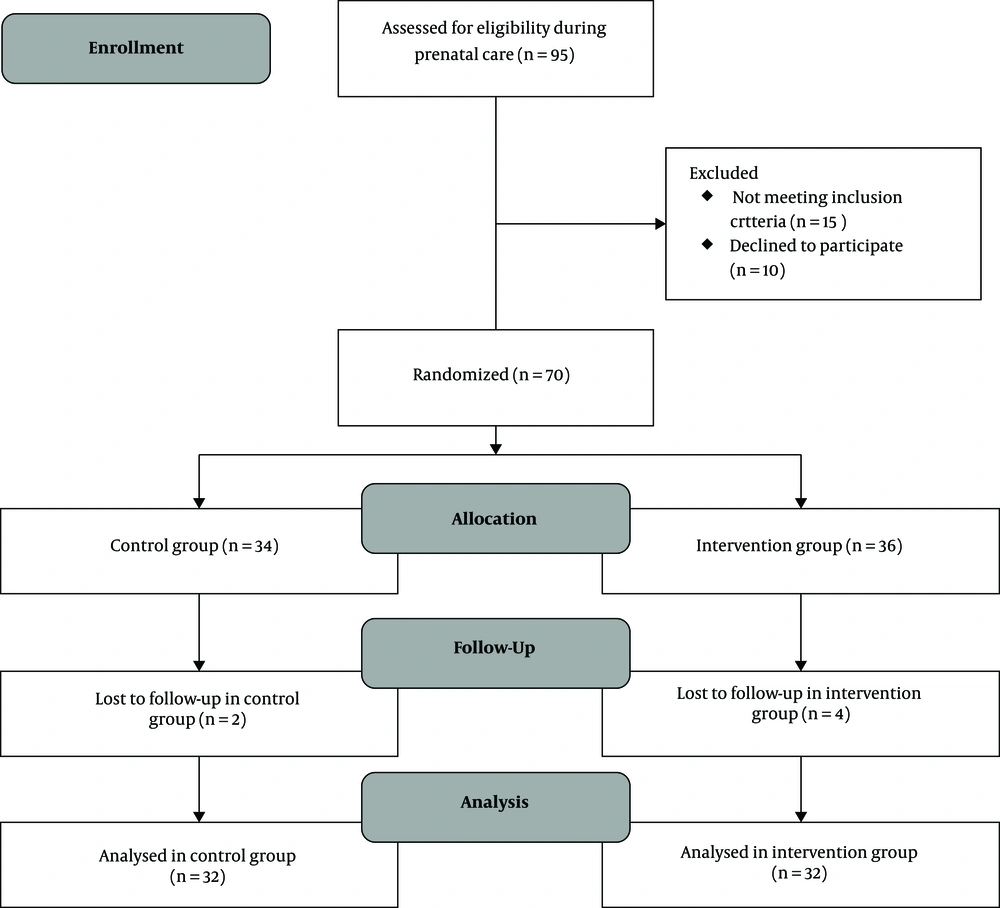
Figure 1.
CONSORT diagram shows the flow of participants through each group
During the research, the questioning midwife was unaware of the groups involved in the research. The educational package was designed by the researcher by reviewing the previous studies and based on experts’ opinions and presented to the participants face-to-face. The minimum time for theoretical training was 45 minutes, and if necessary, training continued until no questions were left. During and after theoretical training, practical training was performed through role-playing or face to face discussion, and if there was a problem, it was resolved. The educational package about appropriate exercises during pregnancy and recommended physical activities were provided for the intervention group. Routine trainings were also given to both groups. The physical activity questionnaire and the evaluation of health belief structures were completed by the questioning midwife after 4 to 6 weeks when the pregnant women attended their next three monthly visits. It should be noted, the instructor provided her contact number to the participants if they had any questions or requests for guidance. The participants were contacted on a weekly basis and asked them about the status of using training and educational packages in life.
3.4. Statistical Analysis
Data were analyzed using SPSS software, version 19, by chi-squared, paired t-test, and independent t-test at the significance level of P < 0.05.
3.5. Ethics Approval and Consent to Participate
The present study was approved by the Ethics Committee of Ilam University of Medical Sciences, Iran (ethics code: IR.medilam.REC.1394.35). From all the mothers who were willing to participate, written informed consent was obtained. Approval for the study was taken from each of the health centers (IRCT code: IRCT20150302021290N1, 2018-01-19).
4. Results
The results showed no statistically significant difference in the demographic variables between the two intervention and control groups (P > 0.05), and the two groups were considered homogeneous in terms of these variables (Table 1).
Table 1.Comparison of Demographic Characteristics Between the Control and Intervention Groups
| Groups | Control Group Frequency, No. (%) | Intervention Group Frequency, No. (%) | χ2 | P Value |
|---|---|---|---|---|
| Educational level | 0.439 | 0.979 | ||
| Illiterate | 2 (6.3) | 3 (9.4) | ||
| Primary | 10 (31.3) | 9 (28.1) | ||
| Secondary | 4 (12.5) | 3 (9.4) | ||
| High school | 5 (15.6) | 5 (15.6) | ||
| Graduate | 11 (34.4) | 12 (37.5) | ||
| Husband educational level | 1.477 | 0.831 | ||
| Illiterate | 2 (6.3) | 2 (6.3) | ||
| Primary | 7 (21.9) | 4 (12.5) | ||
| Secondary | 3 (9.4) | 2 (6.3) | ||
| High school | 5 (15.6) | 7 (21.9) | ||
| Graduate | 15 (46.9) | 17 (53.1) | ||
| Job status | 3.161 | 0.461 | ||
| Housewife | 25 (78.1) | 22 (68.8) | ||
| Employed | 7 (21.9) | 7 (21.9) | ||
| Other | 0 (0) | 3 (9.4) | ||
| Husband job status | 2.306 | 0.805 | ||
| Unemployed | 1 (3.1) | 1 (3) | ||
| Employed | 31 (96.9) | 31 (97) | ||
| Economic stats | 5.000 | 0.172 | ||
| Week | 0 (0) | 3 (9.4) | ||
| Medium | 15 (46.9) | 10 (31.3) | ||
| Good | 17 (53.1) | 19 (59.4) | ||
| Total | 32 (100) | 32 (100) |
Table 2 compares the mean scores of the HBM constructs pre- and post-test between the two groups. The results of paired t-test showed no significant differences in perceived sensitivity (P = 0.414), perceived severity of threat (P = 0.206), perceived benefits (P = 0.620), perceived barriers (P = 0.091), and self-efficacy (P = 0.147) in the control group. However, considering the fact that the control group received only routine training related to physical activity in pregnancy, no changes were expected in this group. However, in the intervention group, a paired t-test showed a significant difference in perceived sensitivity, perceived severity of the threat, perceived benefits, perceived barriers, and self-efficacy before and after the intervention (P < 0.001). This indicated the effect of educational intervention on the constructs of the HBM.
Table 2.Comparison of the Means of HBM Constructs Pre and Post-Test Between the Two Groups
| HBM Constructs/Groups | Mean Difference | Standard Deviation | Paired t Test | |
|---|---|---|---|---|
| t | P Value | |||
| Perceived sensitivity | ||||
| Intervention group | -4.750 | 2.199 | -12.215 | < 0.001 |
| Control group | 0.093 | 0.640 | 0.828 | 0.414 |
| Perceived severity of threat | ||||
| Intervention group | -5.312 | 1.874 | -16.036 | < 0.001 |
| Control group | 0.187 | 0.820 | 1.293 | 0.206 |
| Perceived benefits | ||||
| Intervention group | -2.750 | 1.502 | -10.352 | < 0.001 |
| Control group | 0.903 | 1.058 | -0.501 | 0.620 |
| Perceived barriers | ||||
| Intervention group | 4.093 | 1.444 | 16.027 | < 0.001 |
| Control group | -0.406 | 1.316 | -1.746 | 0.091 |
| Self-efficacy | ||||
| Intervention group | -3.656 | 1.405 | -14.708 | < 0.001 |
| Control group | 0.218 | 0.832 | 1.487 | 0.147 |
The status of HBM constructs (i.e., perceived sensitivity, perceived severity of the threat, perceived benefits, perceived barriers, and self-efficacy) and the duration of physical activity with moderate/severe intensity have been summarized in Table 3. The results showed the differences in physical activity pre and post-test between the two groups. The results of the paired t-test showed no significant differences in physical activity of the control group before and after the intervention (P = 0.503). Since this group received only routine training related to physical activity in pregnancy, no changes were expected in the control group. However, in the intervention group, the t-test showed a significant difference in physical activity before and after the intervention (P < 0.001). This indicated the effect of educational intervention based on the HBM on the physical activity of nulliparous women. The results showed that the mean duration of physical activity with moderate/severe intensity in terms of leisure activities and total activity was significantly different before and after the intervention (Table 4).
Table 3.Comparison of the Average Duration of Physical Activity Pre and Post-Test Between the Two Groups
| Groups | Mean Difference | Standard Deviation | Paired t Test | |
|---|---|---|---|---|
| t | P Value | |||
| Intervention group | -2049.000 | 963.342 | -12.032 | < 0.001 |
| Control group | 27.969 | 248.974 | 0.639 | 0.530 |
Table 4.Comparison of the Average Duration of Physical Activity in Terms of Intensity Between the Two Groups Before and After the Intervention
| Physical Activity (Moderate/Sever)/Group | Before the Intervention | After the Intervention | Statistical Test | |||
|---|---|---|---|---|---|---|
| Mean | Standard Deviation | Mean | Standard Deviation | t | P | |
| Leisure (min/w) | ||||||
| Intervention | 4 | 3.03 | 78.44 | 6.97 | 3.34 | < 0.001 |
| Control | 3.02 | 3.1 | 14.78 | 3.93 | 3.49 | < 0.001 |
| Task (min/w) | ||||||
| Intervention | 547.56 | 378.25 | 577 | 258.33 | 1.23 | 0.23 |
| Control | 453.42 | 430.26 | 487 | 380.17 | 1.62 | 0.11 |
| Walking (min/w) | ||||||
| Intervention | 2.16 | 2.12 | 2.18 | 1.99 | 0.09 | 0.9 |
| Control | 1.33 | 1.68 | 1.37 | 1.87 | 0.13 | 0.09 |
| Total activity (minutes/weeks) | ||||||
| Intervention | 553.72 | 383.4 | 657.56 | 267.29 | 2.13 | 0.02 |
| Control | 457.77 | 435.04 | 503.15 | 385.97 | 2.57 | 0.01 |
5. Discussion
The main purpose of this study was to assess the effects of physical activity education based on the HBM on nulliparous women. In this regard, the constructs of HBM and duration of physical activity with moderate/severe intensity were compared between the intervention and control groups.
The results indicated that the education of pregnant women was primarily associated with increased perceived sensitivity, perceived severity of the threat, and self-efficacy. Also, this educational approach was effective in the understanding of the benefits of an active lifestyle and reducing the perceived barriers to moderate/severe physical activity. Increase in perceived severity of the threat, perceived benefits, and self-efficacy and a decrease in the perceived barriers were also reported in the study of Shafieian and Kazemi (13), which was carried out on both nulliparous women and women with multiple pregnancies, but an increase in the perceived sensitivity was not observed in that study. Perhaps the reason for the difference in perceived sensitivity is the differences in the target groups, as the women surveyed in the present study were all nulliparous women who were more sensitive towards their pregnancy than women with multiple pregnancies, so they were prone to accepting the recommendations (16). Based on the results obtained from this study and those of similar studies, it can be concluded that the relationship between physical activity with moderate to severe intensity and the structures of the HBM could explain the pattern of activity in pregnant women. The HBM constructs explain the physical activity behavior during pregnancy. Therefore, the promotion of health beliefs is associated with the promotion of physical activity during pregnancy (17).
The results also showed that moderate/intense physical activity increased in the two groups after the intervention. The increase in physical activity during the second trimester has also been reported previously (9). Passing the stage of pregnancy where anxiety and the fear of pregnancy termination have improved (18) can explain the changes in the physical activity behavior during pregnancy. This change may also be the result of routine pregnancy training about physical activity during pregnancy. However, a significant increase in the moderate/intense physical activity in the intervention group compared to the control group indicated the effect of training given to this group. In the study of Shafiyan and Kazemi (13) on the nulliparous women and women with multiple pregnancies also showed an increase in physical activity during pregnancy using education based on the HBM, but the increased did not reach the desired level of 150 minutes per week. However, in the present study, the increase in physical activity in pregnant women reached the optimal level of 150 minutes per week. Considering that these two studies have been conducted in a completely similar manner, and the only difference was the studied groups, this difference could be the reason for the discrepant results. An increase in the physical activity of nulliparous women was also observed in the study of Shakeri (2012), with a difference that, in that study, education was not based on health models (19). It should be noted that, with regard to the physical activity training during pregnancy based on the HBM, no other study was found for comparison. Furthermore, the increase in all the HBM constructs with emphasis on perceived sensitivity, which was not significant in the previous study, was significant in this study. It seems that increased perceived sensitivity is an important factor in behavioral change. In fact, perceived sensibility refers to the mental perception of hazards that can compromise health. With regard to the known effect of inactivity during pregnancy, the personal identification and assessment of the risk should be included (20).
The results also showed that the use of the HBM in the training of an active lifestyle during pregnancy could be beneficial as it increases the level of perceived sensitivity, perceived severity of the threat, self-efficacy, and perceived benefits of physical activity and reduces perceived barriers to health promotion in nulliparous women. Regarding the average duration of moderate to intense physical activity in this study, it can be said that using this model as an individual model had the potential to promote an active lifestyle to the recommended range of 150 minutes per week in the studied women (21). On the other hand, although education based on the HBM model could enhance an active lifestyle as expected, this educational method could produce different results if it was carried out in a larger statistical society. Therefore, it is recommended to conduct similar studies in other provinces with larger sample sizes and to compare the results.
The present study showed that the HBM is a suitable model for nulliparous women training, and physical activity training through this model could enhance physical activity in nulliparous women. Therefore, this model should be used in routine pregnancy education to promote physical activity in pregnant women. Future studies are also required to investigate the use of this model for other educational topics in pregnant women.


