
1. Background
As the smallest and the most influential unit of society, the family plays a pivotal role in the development of individual, social, and human values (1). Marriage is identified as the most important subset of the family system (2, 3). In fact, as one of the most important bonds, marriage responds to sets of human needs of different dimensions, promotes physical well-being and mental health (4), reduces the risk of depression and substance abuse (5, 6), and increases both physical capabilities at mid to later life and household income (7). Married people enjoy happy and healthier lives than singles, divorced, and widowed peers, and are more satisfied with their lives (8). Mortality and morbidity are lower in married people than unmarried ones (9). Also, they have higher self-esteem due to a sustainable intimate relationship, increased support (10), and improved reproductive health (11). In different divine religions, marriage is also accepted as a means of evolving the flaws of couples, satisfying their sexual needs (1, 12), pursuing growth, attaining human perfection, and becoming close to the transcendence essence of God and human spiritual health (13). Nevertheless, such events as the low rate and rising age of marriage, changes in individuals’ attitudes towards mate selection, misunderstandings between couples, and subsequent increase in divorce are always observed (14).
Increase of age at marriage is one of the challenges in Iran, which can be attributed to the rising level of social awareness, public literacy, and expectations, rapid and significant changes in socioeconomic conditions due to development and modernization, the collapse of extended family systems, the substitution of the commercial and industrial economy for the traditional agriculture-based one, the complexity of the social division of labor, the expansion of public education, and women’s greater participation in the economic and social activities out of home (15). Although delays in marriage provide a good opportunity for an individual to continue his/her education, employment, and promotion of social identity, it also has negative consequences (16).
Increase of age at marriage leads to population imbalance, lower fertility rate, behavioral abnormality, lack of responsibility, increased social harm, loss of opportunity for a successful marriage and subsequently having children and the experience of parenthood (15), lower quality of family life (17), lower life satisfaction, and higher psychological distress compared with early marriage (18), and greater involvement in high-risk sexual behaviors (16, 19).
Marriage in the first period of youth is emphasized, which coincides with the completion of education, a transition from the stormy period of adolescence, and intellectual and emotional stability, since marriage in youth is associated with flexibility, forgiveness and lower vitality, lower expectations, less vulnerability, and more compatibility with the spouse (20).
Detailed results of the general population and housing census showed an annual reduction in the total growth population of Iran from 1.29 in 2006 to 1.24 in 2016 and an increase of the population over the age of 65 years. Continuation of this situation increases the elderly and inactive population and reduces the young and active force in the coming years (21).
2. Objectives
Therefore, the current study aimed at developing and psychometrically evaluating the successful marriage factors questionnaire (SMFQ) in youth after conducting a qualitative study entitled “exploring the concept and dimensions of successful marriage from the perspective of iranian experts and couples”.
3. Methods
The current methodological study was designed in two stages. The first stage was a qualitative study to determine tool items, and the second stage to assess tool validity and reliability. For the development of instruments, the items can be extracted by conducting a qualitative study, such as the grounded theory, literature review, using similar measurement tools, or a combined study (28). In the first section of the current study, the primary items were extracted by conducting a qualitative study using a conventional content analysis approach, literature review, and instruments of marital satisfaction and successful marriage.
3.1. A Qualitative Study
According to Namvaran Germi et al. (29), as quoted in Ganong and Coleman, qualitative research methods are excellent ways to investigate family dynamics and family relationships since they provide extremely rich data. For this purpose, the present study performed a qualitative study entitled “exploring the concept and dimensions of successful marriage” by using conventional content analysis on 10 successful couples screened as eligible and 14 experts in marriage-related fields (clergy, psychologist, sociologist, lawyer, sexologist, and family counselor) from different regions of Iran from 2016 to 2017.
Purposeful sampling was performed, and the study inclusion criteria were as follows: (1) Couples residing in Tehran; (2) couples with at least five years of marital life; (3) having a minimum literacy (reading and writing); (4) no history of psychological complications; (5) getting a 70% score in the 47-item EMS; and (6) providing oral and written consent to participate in the study. Couples participating in the study were selected based on the maximum diversity in terms of age at marriage, duration of the marriage, number of children, and occupation.
Living in Iran, Iranian nationality, and willingness to participate in the study were the inclusion criteria for experts, and in both groups of couples and experts, the reluctance to continue participating in the study was considered as the exclusion criterion. The data collection method included an unstructured in-depth interview, observation, and field notes. All interviews were separately conducted by the researcher and were continued until the saturation of data. The interviews started with the questions of “Do you feel happiness and fulfillment in your marriage?” and “What factors in your marriage make you feel happy or successful?” Based on the results, the mean age and mean age at marriage were 42.50 ± 8.51 and 28.59 ± 2.90 years in males, and 40.20 ± 7.67 and 26.25 ± 3.89 years in women, respectively. Also, the mean duration of marriage was 13.95 ± 7.73 and 13.95 ± 7.73 years for males and females, respectively (30).
After analyzing the data obtained from the qualitative study and using the results and reviewing the existing literature on marriage and divorce and instruments related to marital satisfaction and marriage, the initial pool of 210 items was developed, and 144 items were extracted by removing and integrating the similar ones. Finally, 144 items were assessed by the research team, reduced to 129, and the psychometric evaluation was performed, or the validity and reliability of the tool were assessed.
3.2. Psychometric Evaluation of an Instrument
In this phase, the validity of the primary items of the instrument was measured using qualitative and quantitative face validity, qualitative and quantitative content validity, convergent validity, and construct validity.
3.2.1. Face Validity
The face validity of the instrument was assessed in both qualitative and quantitative forms. For determining qualitative face validity, the primary instrument was provided to 10 people of the target group residing in Tehran and they were asked to comment on understandability, the relevance of items to questionnaire dimensions, and the existence of ambiguity- i.e., the possibility of misinterpretations of items or inaccuracies in the meanings of words, and then modifications were made accordingly.
Item reduction was used to eliminate inappropriate items, and the item impact method was applied to determine the importance of each quantitative item; the impact score was used to estimate the impact of each item. The item impact was determined with the help of 20 subjects from the target group (different from the prior group) in order to measure quantitative face validity. For this purpose, they were asked to score each item using a five-point Likert scale,5 = extremely important, 4 = very important, 3 = moderately important, 2 = slightly important, and 1=not at all important. The formula (item impact score = frequency × importance) is used to calculate the item impact score, where the frequency represents the percentage of participants that scored each item, and the importance denotes the participants’ mean response to the options following each item. Finally, the items were acceptable if they had an impact score of equal to or greater than 1.5 (31).
3.2.2. Content Validity
The qualitative and quantitative content validity of the tool was measured. For assessing the qualitative content validity, 17 experts in tool design, qualitative research, reproductive health, psychology, family counseling, and nursing were asked to comment on grammar, necessity, content, and scoring of the designed tool, and modifications were made accordingly. For assessing the quantitative content validity, content validity ratio (CVR), and content validity index (CVI) were measured. For estimating CVR, experts were asked to score each item using a three-point Likert scale (3 = an essential item, 2 = useful but not a necessary item, and 1 = the item is not necessary), 14 of whom completed the questionnaire. The following formula was then used to calculate the CVR.
Where nE is the number of experts selecting the necessary option and N the total number of experts. The numerical value of the CVR was obtained by the Lawshe table (32). Items with a CVR of more than 0.51 (the minimum acceptable value) based on the Lawshe table (number of experts = 14) were kept (31).
The CVI is the second most important criterion to measure the quantitative content validity, which determines the relevance and adequacy of each item (33). In the current study, to confirm the relevance of the designed items, 17 experts were asked to score each item using a four-point Likert scale (1 = not relevant, 2 = relatively relevant, 3 = relevant, and 4 = very relevant). The following formula was then used to calculate the CVI.
Items with a CVI greater than 0.79 were kept, those with 0.70 - 0.79 were modified, and items with less than 0.70 were removed (34). Accordingly, the researcher assured that the items of the instrument are designed in the best way, but with increasing the number of experts to more than 10, the likelihood of chance agreement might be reduced (35). At this stage, the modified kappa statistic (k*) was used to adjust each CVI for chance agreement, which is an index of agreement among experts that the item was relevant. The value of each k* was evaluated as poor (< 0.40), fair (0.40 - 0.59), good (0.60 - 0.74), or excellent (> 0.74) (34, 36, 37). Also, the average scale-CVI (S-CVI/Ave) was calculated by averaging CVIs for the entire instrument. The S-CVI/Ave ≥ 0.9 indicates excellent content validity (38).
3.2.3. Construct Validity
The present cross sectional study was conducted from May to July 2017 in Tehran in order to determine the construct validity of the primary items of SMFQ. Tehran was first divided into five regions (North, South, East, West, and Center), and one district was randomly selected from each. Parks and recreational places for families in each district were considered.
According to MacCallum et al. (39), as quoted in Comrey and Lee, a rough rating scale for adequate sample size in factor analysis as 100 = poor, 200 = fair, 300 = good, 500 = very good, 1000 or higher = excellent, was offered. They urged researchers to obtain samples of 500 or more observations whenever possible in factor analytic studies (39). Therefore, in the current study, the sample size was 900, but 11 of the respondents did not complete the questionnaire and were excluded from the study. In total, 889 subjects (546 females and 343 males) participated in the study.
The inclusion criteria were as follows: (1) Couples with at least one year of marriage; (2) being Iranian; (3) couples residing in Tehran; (4) having minimum literacy (reading and writing); (5) no history of psychiatric complications; and (6) no history of a previous marriage. After explaining the study objectives to individuals willing to participate in the study, they gave written informed consent, and then an 80-item instrument was provided to them. The collected data were transferred into SPSS version 22, and the exploratory factor analysis (EFA) was used to estimate construct validity. Therefore, the sampling adequacy was measured by the Kaiser-Meyer-Olkin (KMO) test, and correlation among samples was measured by the Bartlett test of sphericity. In general, KMO statistic varies 0 and 1, and a KMO greater than 0.7 or close to 1 indicates that it is possible to reduce the data to a series of hidden factors and that the factor analysis (FA) can be performed (40). Moreover, the KMO values between 1 and 0.9 indicate a very good FA (41). The orthogonal varimax rotation was also used to find the underlying factors of the scale.
3.2.4. Convergent Validity
At this stage, the convergent validity of the above-mentioned questionnaire, using the 47-item EMS, was measured and based on the results, the correlation between the total scores of the 47-item EMS and SMFQ and its items was evaluated and then, the questionnaire entered the final phase.
3.3. Reliability
Reliability refers to the internal consistency and stability of items within an instrument. In addition, reliability indicates the accuracy of a tool. An instrument is reliable if its measurements accurately represent the actual measurements of the character (42). In the current study, Cronbach’s alpha was used to measure the internal consistency of the dimensions of the instrument. If the Cronbach’s alpha value is between 0.7 and 0.95, it would be considered as a good internal consistency (43), factors with Cronbach alpha values of more than 0.7, representing the good internal consistency reliability, were kept (44). The internal consistency reliability of each factor and the entire instrument was calculated. In order to calculate the stability, test-retest reliability of the instrument factors, as well as the entire instrument, was calculated by the intra-class correlation coefficient (ICC). It should be noted that in addition to reporting the average measure ICC, confidence intervals were also reported for the instrument factors and the entire instrument. Moreover, the ICC levels 1 - 0.81 are considered as excellent, 0.8 - 0.61 good, 0.6 - 0.41 moderate, 0.4 - 0.21 poor, and 0 - 0.2 very poor (36).
Each item was scored based on a five-point Likert scale, ranging from 1 (strongly disagree) to 5 (strongly agree), for some items ranging from never to always scored 1 - 5 and for others, ranging from 1 (very low) to 5 (very high). The maximum and minimum scores of the factor of maturation were 150 and 30, respectively. The maximum and minimum scores of the factor of the ability to security provision were 70 and 14, respectively. The maximum and minimum scores of the factor of matching were 35 and 7, respectively. The maximum and minimum scores of the factor of problem-solving skills were 30 and 6, and for the factor of the ability to manage finances were 25 and 5, respectively. Concerning the variety of the studied areas, the standardization method was applied for the better understanding of the scoring and comparability of the different scales of the instrument.
4. Results
As mentioned before, 144 items extracted in the first phase of the study, assessed by the research team, were reduced to 129 and entered the psychometric evaluation phase. For the qualitative face validity, 10 subjects (five females and five males) participated in the study.
For the assessment of qualitative face validity, one item was difficult to be understood by the participants, which was modified. In the assessment of the quantitative face validity, two items, with an impact score of less than 1.5, were removed, and thus a 127-item instrument entered the content validity phase.
In the qualitative content validity, 18 items were modified. In the quantitative content validity, 44 items with a CVR less than 0.51 and three items with a CVI less than 0.79 were removed.
At this stage, the modified k* was used to adjust each CVI for chance agreement, which is an index of agreement among experts on the relevance of the item, and the k* value for all the items was greater than 0.74. Also, the content validity of the entire instrument content was 0. 90; thus, an 80-item instrument entered the construct validity phase (Figure 1).
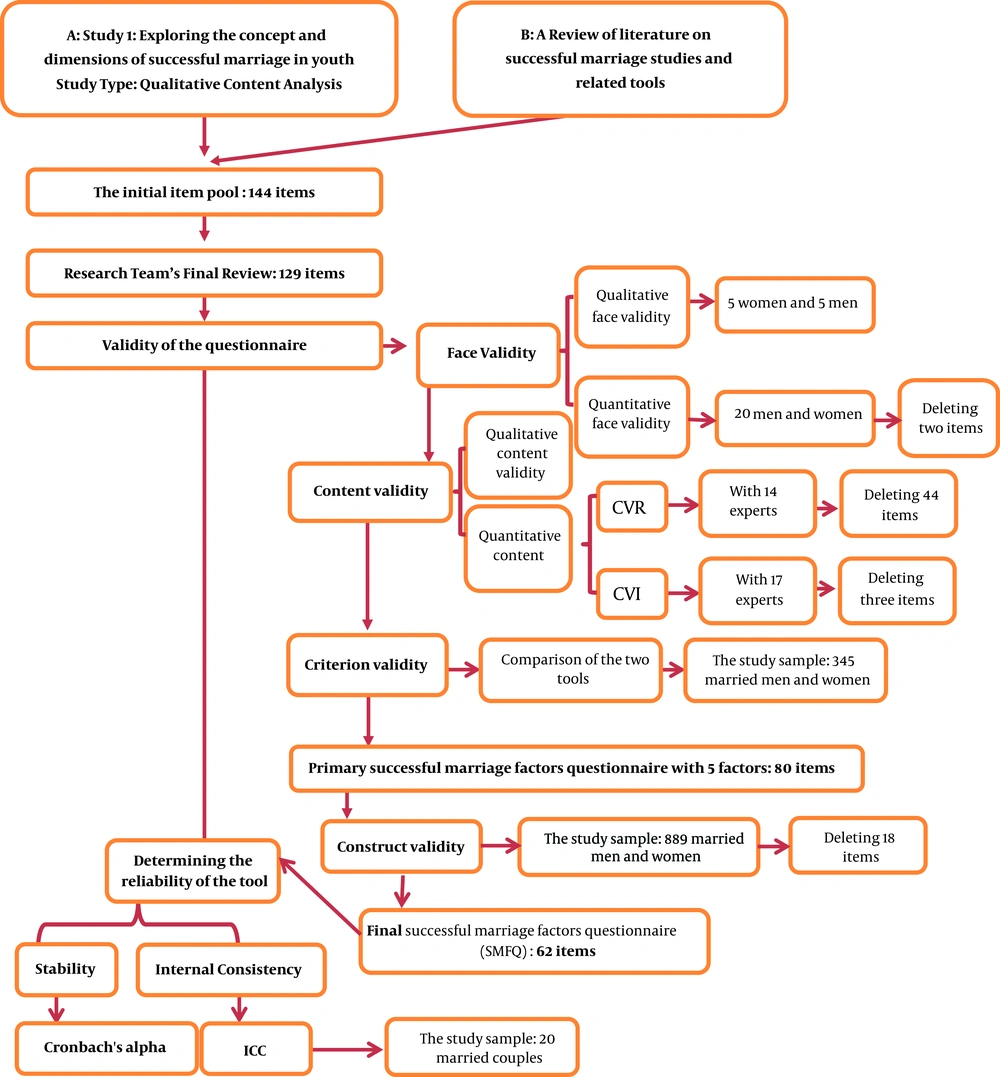
Figure 1.
Stages of development and psychometric evaluation of the questionnaire
A cross sectional study was performed to measure the construct validity, and the majority of the participants (61.4%) were females (Table 1).
Table 1.
Demographic Characteristics of the Study Participants by Gendera
| Variable | Gender | |
|---|---|---|
| Female (N = 546) | Male (N = 343) | |
| Educational level | ||
| Illiterate | 9 (1.6) | 5 (1.5) |
| Primary school | 33 (6) | 6 (1.7) |
| Middle school | 47 (8.6) | 37 (10.8) |
| The secondary school or high school diploma | 165 (30.2) | 105 (30.6) |
| College | 292 (53.5) | 190 (55.4) |
| Occupational status | ||
| Employed | 176 (32.2) | 319 (93) |
| Unemployed | 370 (67.8) | 24 (7) |
| Ethnicity | ||
| Fars | 374 (68.5) | 212 (610.8) |
| Kurd | 75 (13.7) | 46 (13.4) |
| Azeri | 60 (11) | 43 (12.5) |
| Turkmen | 24 (4.4) | 24 (7) |
| Lor | 5 (0.9) | 12 (3.5) |
| Sistani | 7 (1.3) | 5 (1.5) |
| Baloch | 1 (0.2) | 1 (0.3) |
| Relationship with spouse | ||
| Yes/close family | 103 (18.9) | 65 (19) |
| Yes/distant family | 118 (21.6) | 67 (19.5) |
| No | 325 (59.5) | 211 (61.5) |
| Having child | ||
| Yes | 396 (72.5) | 261 (76.1) |
| No | 150 (27.5) | 82 (23.9) |
| Kind of marrige | ||
| Traditional | 293 (72) | 242 (70.6) |
| Modern | 56 (10) | 42 (12.2) |
| Mixed | 97 (17) | 52 (17.2) |
| Living type | ||
| Living independently | 473 (86.6) | 308 (89.8) |
| Living with husband’s family | 67 (12.3) | 28 (82.2) |
| Living with wife’s family | 6 (1.1) | 7 (2) |
| Sum | 889 (100) | 889 (100) |
aValues are expressed as No. (%).
The adequacy of KMO was 0.973, while the Barlett Sphericity test was significant with 38670.948 chi-square at 3160 degrees of freedom that also showed the presence of correlations among samples for performing the EFA. Eigenvalues and the scree plot are used to assess the number of instrument items (Figure 2). The first analysis with an eigenvalue greater than 1 was performed, resulting in five-dimension loadings of 0.4, and indicated 45.850% variance with respect to the results. Accordingly, three items with the factor loadings smaller than 0.3 were removed. Based on the cross-loading law, items with multiple factor loadings of less than 0.2 difference between the factors should be deleted (22); thus, five items were removed (Table 2) (31, 32, 41).
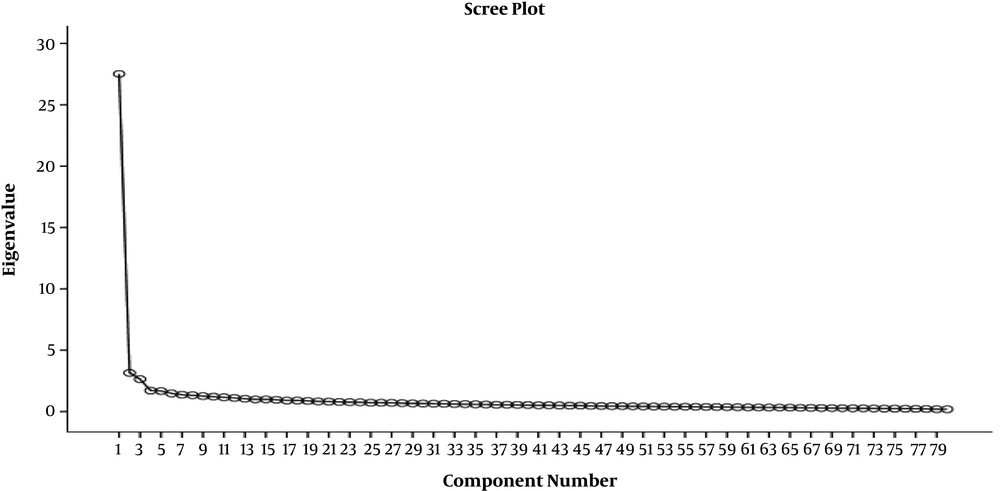
Figure 2.
The scree plot of the number of components of the successful marriage factors
Table 2.
Rotated Factor Matrix, Factor Loading, Eigenvalues, the Cumulative Percentage of Variance for Factor Loading After Rotation, ICC, Cronbach’s Alpha, and Final Number of Items per Factor
| Item | Factor Loading | ||||
|---|---|---|---|---|---|
| 1 | 2 | 3 | 4 | 5 | |
| Maturation | |||||
| 1. My spouse is my companion under all circumstances. | 0.736 | ||||
| 2. Being good-natured is one of my spouse’s positive attributes. | 0.729 | ||||
| 3. My spouse is a dedicated and forgiving person. | 0.721 | ||||
| 4. My spouse tries to bring happiness into the family. | 0.706 | ||||
| 5. My spouse is a flexible person in our married life. | 0.669 | ||||
| 6. My spouse and I are in love with each other. | 0.669 | ||||
| 7. My spouse is my trusted confidante. | 0.698 | ||||
| 8. Kindness is one of my spouse’s positive attributes. | 0.686 | ||||
| 9. My spouse sees my strengths more than my weaknesses. | 0.676 | ||||
| 10. My spouse is a good listener to me. | 0.654 | ||||
| 11. Patience is one of my spouse’s strengths. | 0.652 | ||||
| 12. My spouse keeps his/her promises. | 0.648 | ||||
| 13. My spouse and I can express our feelings to each other. | 0.626 | ||||
| 14. The relationship between my spouse and I is based on honesty. | 0.624 | ||||
| 15. My spouse is optimistic about our life in the future. | 0.623 | ||||
| 16. Low expectations are one of my spouse’s positive attributes. | 0.607 | ||||
| 17. Not being suspicious is one of my spouse’s positive attributes. | 0.598 | ||||
| 18. My spouse compliments me when I deserve it. | 0.594 | ||||
| 19. My spouse and I respect each other. | 0.593 | ||||
| 20. My spouse tells me about his/her activities. | 0.573 | ||||
| 21. My spouse is not a spiteful person. | 0.572 | ||||
| 22. My spouse is an organized person in affairs related to our married life. | 0.564 | ||||
| 23. I prepare the ground for our sexual relationship to be mutually desirable. | 0.533 | ||||
| 24. One of the effective factors in the success of our marriage is that we are both mentally healthy. | 0.530 | ||||
| 25. My spouse is a determined person. | 0.523 | ||||
| 26. My spouse is a sociable person. | 0.513 | ||||
| 27. I tell my spouse what I need. | 0.502 | ||||
| 28. My spouse is a neat and tidy person. | 0.479 | ||||
| 29. My spouse is an open-handed person. | 0.476 | ||||
| 30. We agree on how to raise our children. | 0.455 | ||||
| 31. I always show my appreciation for my spouse. | 0.431 | 0.416 | 0.407 | ||
| 32. My spouse has the ability to manage the financial affairs of our married life. | 0.427 | 0.412 | |||
| The Ability to Provide Security | |||||
| 33. In all stages of my life, I believe in God’s Wisdom in what He does. | 0.587 | ||||
| 34. I accept the responsibilities that I have in my married life. | 0.581 | ||||
| 35. I help my spouse to build his/her self-confidence in managing our married life. | 0.580 | ||||
| 36. I satisfy my spouse’s reasonable needs as much as I can. | 0.571 | ||||
| 37. I help my spouse in affairs related to our married life. | 0.570 | ||||
| 38. I spend my leisure time with my spouse and children. | 0.565 | ||||
| 39. My spouse is my priority. | 0.534 | ||||
| 40. I try to help my spouse’s parents on special occasions and in time of sickness. | 0.531 | ||||
| 41. I try to please my parents. | 0.529 | ||||
| 42. My spouse and I respect each other’s families. | 0.467 | 0.516 | |||
| 43. I know what to expect from my marriage. | 0.484 | ||||
| 44. My expectations of my spouse are in proportion to his/her capacity. | 0.491 | ||||
| 45. My spouse and I spend our income on the welfare and comfort of our married life. | 0.478 | ||||
| 46. I pay attention to the physical health of my spouse and children. | 0.474 | ||||
| 47. I try to help my spouse to get closer to God. | 0.422 | ||||
| Matching | |||||
| 48. I took into consideration whether the economic status of the person I wanted to marry matched mine. | 0.687 | ||||
| 49. I took into consideration whether the person I wanted to marry and I enjoyed similar recreational activities and had similar hobbies. | 0.641 | ||||
| 50. I took into consideration whether the level of education of the person I wanted to marry matched mine. | 0.628 | ||||
| 51. I took into consideration the decency of the family of the person I wanted to marry. | 0.597 | ||||
| 52. I took into consideration whether the goals in life that the person I wanted to marry had matched mine. | 0.583 | ||||
| 53. I took into consideration whether the religious beliefs and cultural values of the person I wanted to marry matched mine. | 0.582 | ||||
| 54. I took into consideration whether the person I wanted to marry and I differed in age. | 0.615 | ||||
| Problem-solving Skills | |||||
| 55. I behave judiciously when I am angry. | 0.617 | ||||
| 56. I learned as much as I could the skills necessary for married life | 0.615 | ||||
| 57. In cases of arguments with my spouse, I am the first to take steps for reconciling and for apologizing. | 0.604 | ||||
| 58. My spouse and I have set limits for our relationships with our families and for their influence in the decisions that we make in our married life. | 0.473 | ||||
| 59. In my married life, I use those experiences and advice of parents and acquaintances that I think are useful. | 0.454 | ||||
| 60. I adapt myself to the individual differences that I have with my spouse. | 0.424 | 0.432 | |||
| 61. We can cope with and manage life’s crises | 0.428 | ||||
| Financial Management Capability | |||||
| 62. I adapt myself to my spouse’s financial situation. | 0.556 | ||||
| 63. We are not financially dependent on our families. | 0.552 | ||||
| 64. Having our independent housing has preserved the respect of my spouse’s family and of my family for us. | 0.496 | ||||
| 65. Our appropriate economic status is an important factor in our marital success. | 0.454 | ||||
| 66. My spouse and I agree on how to manage the financial affairs of the family. | 0.438 | ||||
| 67. My spouse and I can manage the relationships between family members. | 0.420 | 0.424 | |||
| Eigenvalues | 27.518 | 3.148 | 2.634 | 1.711 | 1.670 |
| The cumulative percentage of variance for Factor loading after rotation | 18.832 | 29.645 | 36.236 | 41.509 | 45.850 |
| ICC | 0.963 | 0947 | 0.948 | 0.946 | 0.929 |
| Cronbach’s alpha | 0.964 | 0887 | 0.840 | 0.703 | 0.7 |
| Final number of items per factor | 30 | 14 | 7 | 6 | 5 |
Finally, the SMFQ with 62 items was ready. In this questionnaire, the minimum and maximum scores were 62 and 310, respectively. These scores were raw, and to express them as a percentage, the linear transformation method was used.
Where the actual raw score is the total raw score obtained from the questionnaire or even one dimension, the lowest possible raw score is the lowest raw score of the questionnaire or one dimension, and the possible raw score range is the difference between the highest and lowest raw scores of the instrument or a dimension (45).
The convergent validity of SMFQ was assessed by the 47-item EMS. The results showed a significant correlation between the scores of the 47-item EMS dimensions, such as marital communication (0.775), marital satisfaction (0.697), personality issues (0.410), marital relationship (0.530), conflict resolution (0.521), financial management (0.512), leisure activities (0.563), sexual relationships (0.578), marriage and children (0.429), relatives and friends (0.469), roles of gender equality (0.599) and religious orientation (0.425), and the total score of SMFQ. For the reliability of the instrument, the ICC values of the whole instrument and its constructs exceeded 0.9, which were excellent.
5. Discussion
SMFQwas designed based on the data obtained from a qualitative conventional content analysis study evaluating factors affecting successful marriage in the present cultural context of Iran. All the psychometric evaluations, including the qualitative and quantitative face validity, content qualitative and quantitative validity (by calculating CVR and CVI, modified k*, and content validity of the entire instrument), construct validity and convergent validity, as well as reliability (internal consistency and stability), were performed. Construct validity was assessed through EFA by using the varimax rotation. According to the results of EFA using the varimax rotation, five hidden factors were extracted, indicating the 45.850% variance of factors affecting the successful marriage. These factors included maturation, the ability of security provision, matching, problem-solving skills, and the ability to manage finances, which produced a questionnaire consisting of 62 items.
In terms of convergent validity, the 62-item SMFQ was compared with the short-form 47-item EMS (24, 27, 46, 47). Finally, the internal consistency of the entire instrument was 0.969, and the ICC of the constructs and the entire instrument was 0.929 - 0.963 and 0.982, respectively.
The results of the current study demonstrated that the factor of maturation consisting of 30 items accounted for maximum variance (18.832%), the items “My spouse is my companion under all circumstances” and “We agree on how to raise our children” had the highest and lowest factor loading, respectively. In line with these results, the findings of the qualitative section of several studies also emphasize the importance of “spouse as a companion”, confirming the necessity of this item in SMFQ (48-50). Different items of this factor indicated the importance of moral, personality, emotional, social, and sexual maturity in males and females for the successful management of marriage. Personality is defined as a combination of emotional characteristics, attitudes, and behavior of an individual, and personality traits are relatively stable and predictable over time (51). Traits mentioned in this factor, such as being a companion, good nature, dedication, forgiveness, flexibility, confidentiality and trustworthiness, kindness, patience, fulfillment of the obligation, optimism, honesty, having low expectations, not being skeptical, mutual respect, not being spiteful, being organized, being willing, being openhanded, being neat and tidy, reflect the personality maturity emphasized in most studies on marriage, in particular honesty and patience (48-50, 52, 53).
The factor of maturation used in SMFQ is investigated in more detail compared to that of the 115-item EMS (25), but the items of the short-form marital satisfaction scale designed by Afrooz are more similar to those in this factor (24), which may be due to the fact that the scale of Afrooz is developed and psychometrically evaluated according to Iranian culture. In general, the items of this factor emphasize the significance of the different dimensions of the maturity of couples, indicating that it plays a pivotal role in a successful marriage. The SMFQ designed in the present study also listed some important factors, such as mutual respect in married life and the importance of mental health, which were not mentioned in EMS. Instead, in the EMS, some of the items presented in the SMFQ are examined in more detail (25).
In the factor of “the ability to provide security” with 14 items, the items “In all stages of my life, I believe in the wisdom of God in what he does” and “I try to help my spouse to get closer to God” had the highest and lowest factor loading, respectively. Some items used in this factor, such as “I know what to expect from my marriage” and “Both my income and my spouse’s one are spent on prosperity and comfort in our married life”, were not observed in similar tools.
Another factor in the questionnaire of the present study is “the matching”. This factor consisting of seven items related to matching in the premarital stage and in the course of the married life. In this factor, the items “I considered whether the economic status of the person I wanted to marry matched mine” and “I considered whether the goals in life of the person I wanted to marry matched mine” had the highest and lowest factor loading, respectively. No items were found in marital satisfaction questionnaires and related tools about premarital matching and its effect on marriage success, but the marriage functioning assessment inventory (MFAI) contained the item “My spouse and I do not agree on our religious beliefs and lifestyles” and in the EMS of 115 and 125 items, the item “My spouse and I agree on our religious beliefs” was considered (26), which highlights the importance of religious matching in the marriage. A review of the relevant available tools showed that less attention is paid to matching in different dimensions, especially at the spouse selection stage; however, one of the most influential factors on marriage success is matching in different dimensions. Therefore, it seems that one of the strengths of SMFQ was the presence of the matching construct.
Another factor mentioned in the SMFQ was “the problem-solving skills” with five items, which assessed the skills used by the married couples to resolve their relationship conflicts. In this factor, the items “I am judicious when I am angry” and “We can cope with and manage life crises” had the highest and lowest factor loading, respectively. Much attention is paid to this factor in other related tools. In this regard, the short-form of the marital satisfaction scale designed by Afrooz had the factor of the problem-solving satisfaction with four items (24); no similarities were found between the items of the two factors.
The conflict resolution is also one of the factors considered in EMS. The factor of conflict resolution had 35 and 47 items in SMFQ and EMS, respectively, and the 66-item MFAI had no items similar to those in the problem-solving skills factor in the SMFQ (25, 26, 52). In the 10-item factor of the conflict resolution in EMS containing 115 and 125 items, there was only the item “In order to end an argument‚ I usually give up too quickly” that may have the same meaning as the item “I treat thoughtfully when I am angry”. In the index of marital satisfaction (IMS) designed by Walter W. Hudson consisting of 25 items, the item “We manage arguments and disagreements very well” (25), and in the marital satisfaction scale developed by Smadi (54) in Jordan, the item “When my husband and I disagree, we resort to dialogue” referred to one of the problem-solving skills, and in the SMFQ, the item “I learned as much as I could the skills necessary for married life” emphasized the importance of this factor.
It seems that in this factor from the SMFQ, most of the family problem-solving strategies are considered as the item, while in other tools, the factor of the conflict resolution contained items that not only offer some solutions but also provide the related materials in the form of an item. This factor seems to be more complete or comprehensive since it describes the conflict resolution skills in the married life.
The final factor considered in the SMFQ was “financial management capability” containing five items. In this factor, the items “We are not financially dependent on our families” and “My spouse and I agree on how to manage the financial affairs of the family” had the highest and lowest factor loading, respectively.
The Spanier dyadic adjustment scale and the 25-item Hudson marital satisfaction index each contained one item on financial issues. Also, the EMS consisting of 47, 115, and 125 items had a financial management factor, the 66-item MFAI contained the factor of money and finances (26), which the meaning of its items was similar to those of SMFQ, but there was independent housing as a success factor in the financial management capability construct of the SMFQ that was not mentioned in other tools.
SMFQ is the first tool developed in the field, and other instruments developed previously examine marital satisfaction, marriage, marital assessment, and marital adjustment. It can be concluded that the SMFQ constructs categorize the factors related to successful marriage comprehensively, thoroughly, and succinctly, and in some cases, there are items that are not observed in standard tools developed outside Iran’s cultural context. But there were some questionnaires similar to marital satisfaction and other related scales, such as the short-form marital satisfaction scale designed by Afrooz and the marital assessment scale designed by Sanai Zaker et al. (26), which might be due to the same cultural context, customs, and traditions, and shared experiences obtained from such a cultural context.
The questionnaire designed in the present study also took into account the factor of matching containing seven items that received a little attention to date in other instruments. Changes within cultures, beliefs, and attitudes of the unmarried young people that want to marry over time lead to changes in the needs and factors affecting the successful marriage and marital satisfaction; thus, there are some effective items in the SMFQ, indicating the factors affecting successful marriage not observed in previous instruments and can be considered as a confirmation of the fact that the SMFQ was developed and psychometrically evaluated based on the current human needs.
One of the limitations of the current study was that the respondents were not honest in completing some of the survey items, and the researcher tried to control this limitation by assuring that the obtained information is kept confidential and anonymous. Another limitation of the study was a lack of access to some similar and up-to-date non-Iranian studies, and researchers tried to fairly control this limitation by using the facilities of various university libraries. Therefore, it is recommended that a longitudinal study be conducted to evaluate the effectiveness of the SMFQ in predicting the marital success of different ethnic groups.
5.1. Conclusions
The results of the current study demonstrated that the SMFQ had acceptable reliability and validity. After psychometric evaluation, a questionnaire with five factors, including maturation, the ability to provide security, matching, problem-solving skills, and financial management capability, consisting of 62 items was developed, and its convergent validity was assessed by the 47-item EMS. According to results of current study, there was a significant correlation between dimensions of 47-item EMS and its total sore with total sore of SMFQ.