


1. Context
William Pinar believes that in the last century, the curriculum has shifted from formal and actual documents to all planned and unplanned experiences of educational institutions (1). John Dewey and some of his followers, such as Kilpatrick, have paid more attention to the hidden functions and experiences gained in the educational environment. But the publication of Philip Jackson’s book, living in the Classroom, can be considered the official beginning of extensive studies in the field of hidden curriculum (2). The hidden curriculum is beyond the formal curriculum scope and is learned from the behaviors and attitudes of others in the educational setting (3). From Michael Apple’s view, the hidden curriculum is those attitudes, values, and beliefs that exist in the education system but are not explicitly stated in written formal documents (4).
Also, Skeleton considers the hidden curriculum as a set of implications for knowledge, values, behavioral norms, and attitudes that the learner implicitly and empirically acquires during educational processes. These messages may be contradictory, non-linear, and affirmative, and each student will receive them in a specific way (5). Therefore, some researchers have investigated the relationship between hidden curriculum and educational content. They concluded that educational content always contains hidden messages (6). Today, information and communication technology is an integral part of the educational environment and has revolutionized the communication ways and teaching-learning process (7).
All of the following concepts are called e-learning: Computer-based education, computer-aided learning, web-based learning, web-based apprenticeships, web-based learning, online learning, virtual learning (8). In extensive definition, virtual learning involves any use of web and Internet technologies to create learning experiences (9). Hill (2004) believes that in today’s education, the key issue is not access to more information. Also, the primary factor in education is the student’s understanding of the content they receive continuously. In the future, the knowledge gained through the classroom, textbooks, and the internet is not the basis of education because it is quickly disappearing and is an obstacle to new ideas. Hence, today’s implicit knowledge is based on experience or case studies, and this type of knowledge forms the basis of learners’ ethics, values, and personality and prepares them for unexpected and difficult future decisions (10).
When learners are trained in the virtual environment, they acquired physical and psychological experience through technological tools (1). Learners’ virtual experiences help them learn new things and change their focus and understanding of the tasks they never had before. Virtual experiences also help learners develop their imagination and extend, extract, or add to their previous experiences (11). From Duncum's (1999) viewpoint, the importance of the hidden curriculum is not because it is hidden but because the learners learn it unconsciously (12). There are many theories to describe and organize the process and factors influencing the learning environment (13). From a constructivist perspective, the learning environment can shape students’ experiences and learning, but this success depends on how the student interacts with the environment (14). Understanding the hidden curriculum in online education helps design the correct curriculum, create the proper interactive environment, develop a curriculum based on learners’ needs, and manage a hidden curriculum. Although there was no common and clear definition for the hidden curriculum in online education, there was a research gap in this field.
2. Objectives
In this study, we have tried to present the hidden curriculum in online education, dimension, and promotion based on systematized review.
3. Study Design
To access the articles, a systematized review was conducted in electronic resources. The systematized review is similar to a systematic review, but it does not consider some of the systematic review components (15). First, the abstract and title of the article were reviewed. If it was relevant the full text was reviewed to expedite the screening was initially conducted in parallel by two experts until high levels of agreement. Two experts in the field of medical education and virtual education. Two authors initially performed selection with two options: “inclusion” and “exclusion”. The list of final documents for inclusion was reviewed by the authors following screening criteria.
4. Data Sources
The databases of WOS, Scopus, Ovid, PubMed, Google Scholar, ProQuest, ERIC, and Science Direct were searched. No restrictions were placed on the year of publication. Articles were searched using a comprehensive strategy, and Boolean operators 'AND' and 'OR' were also used to find out more relevant records. Keywords were; e-Learning, Virtual Education, Virtual Learning, Online learning, Distance Learning, and Hidden Curriculum (Table 1).
Table 1.Search Strategy for Different Databases
| Row | Database | Search strategy |
|---|---|---|
| 1 | WoS | TS = ("hidden curriculum" AND "e-learning" OR "online learning" OR "virtual learning" OR "distance learning") |
| 2 | Scopus | TITLE-ABS-KEY ("hidden curriculum" AND "e-learning" OR "online learning" OR "virtual learning" OR "distance learning") |
| 3 | Ovid | ("hidden curriculum" AND "e-learning" OR "online learning" OR "virtual learning" OR "distance learning") |
| 4 | PubMed | ("hidden curriculum" AND "e-learning" [Title/Abstract]) OR ("online learning"[Title/Abstract] OR "virtual learning"[Title/Abstract] OR "distance learning"[Title/Abstract]) |
| 5 | Google scholar | "hidden curriculum" AND ("e-learning" OR "online learning" OR "virtual learning" OR "distance learning") |
| 6 | ProQuest | "hidden curriculum" AND (e-learning OR "online learning" OR "virtual learning" OR "distance learning") |
| 7 | Science Direct | TITLE-ABSTR-KEY (hidden curriculum) AND (e-learning * OR online learning * OR virtual learning *) AND LIMIT-TO (topics, “medical, education, medical student”) |
| 8 | Eric | title: "hidden curriculum" AND "e-learning" OR "online learning" OR "virtual learning" OR "distance learning |
4.1. Inclusion and Exclusion Criteria
The studies were selected by inclusion and exclusion criteria. We included studies that reported on hidden curriculum in virtual education. We included studies written in the English language that document quantitative and qualitative findings. We excluded conference presentations that are not usually considered to be articles because they are not published. We also excluded articles without available full-text in English. We excluded studies that reported on hidden curriculum on traditional learning and studies that documented quasi-empirical.
5. Results
5.1. Summary of Articles Studied
Out of the 487 articles found in the first round of the search, 454 articles were reviewed, and 30 articles were selected for further review based on inclusion and exclusion criteria. After reviewing the full text and the agreement of the members, nine articles were included in the study. The articles reviewed were related to the hidden curriculum and online education (Figure 1). Finally, the results of this study are categorized into three sections that include elements that impact to shape of the hidden curriculum, the dimensions of the hidden curriculum in online education, and the development of the hidden curriculum in online education. The details of the articles are shown in Table 2.
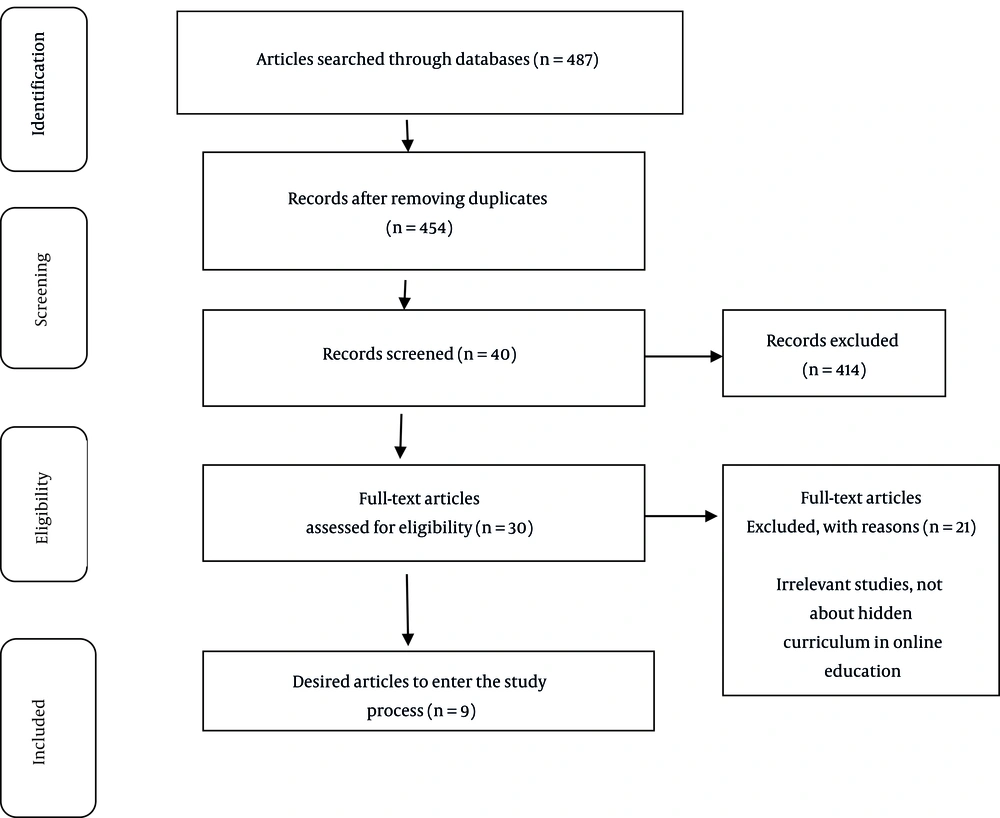
Figure 1.
Flow chart for including papers in the review
Table 2.Summary of Results
| Number | Author | Study Objectives | Population and Sample Size | Classification of Articles | Results |
|---|---|---|---|---|---|
| 1 | Anderson (16) | To begin a discussion about the unique “hidden curriculum" of distance education, focusing on both its positive and negative words. | - | The dimensions of the hidden curriculum in online education | Virtual education was often accompanied by pervasive restrictions on physical access that each created obstacles, and each had its own hidden curriculum. Therefore, good quality in virtual education provided the opportunity for discourse and knowledge sharing by learners and teachers and can be considered a democratic and benevolent response to personal and social needs. The hidden curriculum in virtual education like other forms of education must be clear so that those affected can make informed and intelligent choices. |
| 2 | Allan (17) | To explore e-learners’ experiences of time and to recognize factors that may be used by organizers in the design, development, and employment of VLCs. | 45 e-learners who participated in three networked learning communities hosted in the UK universities between November 2001 and July 2002. | Teaching time | The results showed that virtual education uses different ways to manage time. Although networked learning offered a flexible approach to professional development, this may be weakened if two factors were ignored in the curriculum: the time involved in networked learning; and the need for new virtual education to adapt their study methods to time. |
| 3 | Hubbard (18) | To improve understand the ways in which hidden curriculum shows in distance education learning environments from an ecological viewpoint. | The population to be studied is limited to an academic program at a large community college. | Learning environment, interaction, rules and regulations, organizational system | In this study, 14 main themes related to the formation of hidden curriculum through organizational and institutional systems, differences and similarities of learners, professors, and staff regarding hidden curriculum issues, and the formation of hidden curriculum in virtual education were presented. |
| 4 | An (19) | Analysis of the rewards of the high-definition video conferencing systems and telepresence in improving the hidden curriculum in distance education, on how to use technology to increase the hidden curriculum in distance education. | - | Promote hidden curriculum in e-learning | This study concluded by calling for the newest form of virtual education training and launching that we can use telepresence technology to enhance virtual education and refine existing university information technology |
| 5 | Han (20) | The key question addressed by this research is: What is the didactic character of imagery in the 3D animated virtual world of Second Life? | Revealing the didactic character of imagery in the virtual world is to reveal the hidden curriculum of the virtual world. | Learning environment, interaction | The five main findings in this study included: 1. Visual learning is important; 2. Cultural experience influenced visual perception; 3. Dual coding distinguished digital image; 4. Research disagreed with previous claims; and 5. There is a third of culture in the virtual world. |
| 6 | Oztok (21) | To show why and how inequality might exist in online learning environments and to produce cognizance of this perception for teachers, students, and scholars interested in online learning. | 12 participants | Learning environment | This study showed that when justice was identified as a more equitable learning environment, a hidden curriculum was a tool that created inaccurate learning experiences. |
| 7 | Dejagah Masouleh (10) | The role of e-learning in hidden curriculum of schools in the city of Tehran. | The statistical population included all secondary high schools in district 6 of Tehran. Using multi-stage cluster sampling, two schools were selected as the sample. | Individual characteristics | The results of the t-test in the hidden curriculum subscale study showed that there was a significant difference between social acceptance, vulnerability, stress, and self-esteem, and e-learning affected the hidden curriculum of schools. |
| 8 | Maghsoudi and Malekshahi (22) | To survey the impact of e-learning in the hidden curriculum. | 30 students of educational technology | Individual characteristics | The findings of the present study indicated that e-learning had enabled the students to differentiate their hidden curriculum functions if no change in the control group was observed. The components of self-esteem and socialization, stress, and paternal trauma were affected by the hidden curriculum. |
| 9 | Abdolahifard et al. (23) | To evaluate the parts of the hidden curriculum of virtual education in the form of a qualitative and quantitative study | In the quantitative part, all graduate students of virtual medical education were studied using census sampling. The questionnaire was sent to 150 entries from 2011 to 2014 via e-mail, and 74 filled ones finally returned. | Learning environment, interaction, rules and regulations, organizational structure, teaching and evaluation methods | Quantitative results showed that among the components of the hidden curriculum (teaching method, evaluation method, interactions between faculties and students, educational environment, rules and regulations, critical thinking) at Shiraz University of Medical Sciences, components of evaluation methodology, rules, and regulations of critical thinking was desirable. In addition, the components of teaching methods, the interaction between colleges and students, and the educational environment were less than desirable and perfectly desirable, and 177 codes of qualitative content analysis of data from the perspective of students in five areas including educational space, trust to Self-efficacy, inadequate evaluation, interaction, and surface training have been achieved in the qualitative section. |
Of the nine studies reviewed, the hidden curriculum in online education has been improved in one study. Individual value framework (self-esteem, vulnerability, social acceptance, stress) in two studies, learning environment in four studies, interaction in three studies, teaching and evaluation methods in one study, organizational structure and legal rules in two studies, and Teaching time in one study has also been identified as one of the factors behind the formation of a hidden curriculum in online education. Therefore, each of the factors has been assessed in several articles. Figure 2 reports the number of studies related to each of the factors behind the formation of the hidden curriculum in online education.
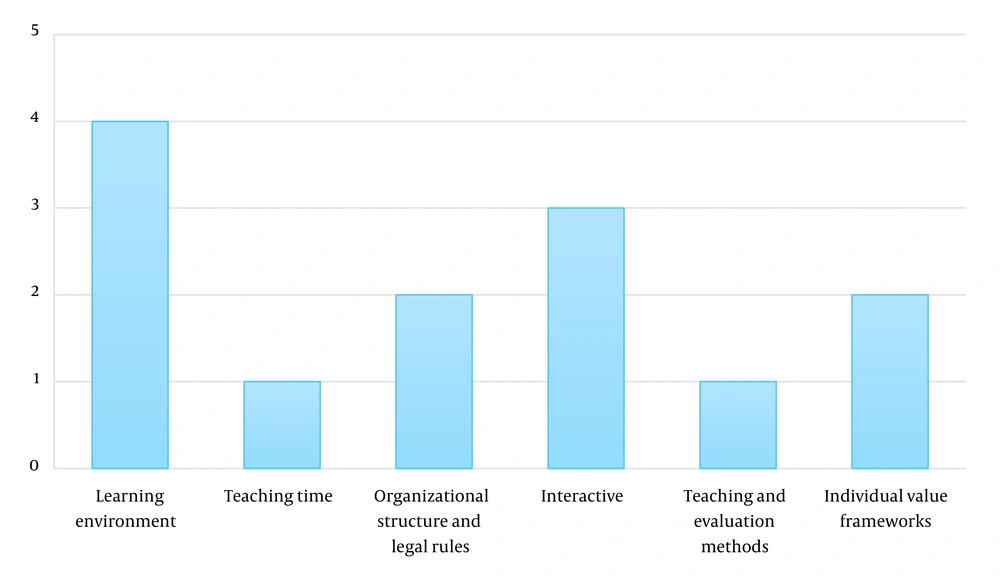
Figure 2.
Number of studies related to the factors behind hidden curriculum formation in online education
In general, the purpose of these studies was to discuss the distinctiveness of hidden curriculum in online education with an emphasis on their positive and negative aspects. These studies examined the impact of online education and its role on hidden curriculum, hidden curriculum issues in organizational programs and online learning environments, social justice and justice issues in online education, online learners’ experiences of engaging in online education environments, aspects hidden of online education curriculum addressed the benefits of using advanced online education technologies and mastery of improving hidden curriculum in online education.
6. Discussion
This study aimed to review and extract hidden curriculum components in online education. The results of this systematized review showed that three topics were discussed, factors affecting the formation of the hidden curriculum, dimensions of the hidden curriculum and improvement of the hidden curriculum in online education.
Academic virtual systems implicitly affect educational outcomes such as academic achievement, sustainability, and learner attitudes. Communication, interactions, learning content and issues, learning environments, organizational systems, and ultimately personal characteristics and learner’s cultural perceptions were seen as important elements related to the extent and impact of a hidden curriculum on an individual (24). These factors will be explained in detail.
6.1. Learning Environment
In the online education environment, the boundary among classroom, university, and larger online environment is unclear. Anywhere can become a learning environment in online education. Instructors can easily take classes anywhere, and learners can easily go outside the campus. The online environment is infinitely changeable, and its participants come from vastly different cultural backgrounds. Learners, teachers, and other participants have come from different cultures as learning environments (20).
Teaching is the process of forming and shaping individuals’ minds, consciously or unconsciously (25). In the field of online education, subjectivity is understood through the notion of social presence, individuals represent themselves and others when are connected with digital environments (26). Much research has proven that the concept of social presence plays an important role in the virtual learning community (27). While the recorded benefits of social presence may be true, such a view focuses solely on the positive aspects of society, but the implicit ways are ignored. A positive sense of community and the production of teamwork is not expected for every individual and depended on the situation. Indeed, researchers have noted that when teamwork is not implemented carefully, it influences issues of justice in team working (28).
6.2. Teaching Time
Time is a complex structure and may be examined from several different perspectives; for example, philosophy, sociology, education, and management. Online education is an effective tool for management development; so it is important for developers and facilitators of the time involved in this type of learning. Learners organize time-based activities. E-learners have used a variety of approaches, including planning, opportunism, or a combination of time management in their learning. Instructors and developers in online education need to make sure that timing issues are visible in the curriculum. Some learners are affected by a predominant cultural conception of time to whom the condition of online education seems to be an unpleasant process, similar to a cultural shock, and one that needs the support of peers and facilitators. Without this support, they may not actively intervene in their learning community and may eventually exit the community (17).
6.3. Organizational Structure and Legal Rules
Administrative bureaucracy is often an important element of the modern curriculum, with its extensive set of laws, regulations, procedures, and management systems. The organizational structure of the educational institution was effective in creating a hidden curriculum. In an educational institute to handle various tasks such as classifying, grouping learners, methods for evaluating all types of tests, scores, success in exams, disciplinary issues, methods of encouragement and punishment, individual and group activities of learners, participation or their non-participation, rules, and regulations affect student’s personality (29). In other words, the rules, regulations, methods are important factors in a hidden curriculum (30).
6.4. Interactive
Teacher behavior is one of the influential factors in the formation of students’ thinking, attitude, and behavior. The more the teacher interacts with the student with sincerity, guidance, and away from domination and obedience, the more the student’s participation in scientific activity. Therefore, the adaptability of the work environment is further developed in students. How they deal with the educational environment and how they treat students often shapes their attitudes and behaviors, and determines their lifestyle and management in the workplace. Interpersonal relationships were another factor in the formation of the hidden curriculum (30). Promoting student and teacher interaction through mediation or face-to-face means being more focused on teacher-tutor-learner- interaction. Other forms of interaction, such as the interaction between students and the institution and their staff, all affect students’ learning (31).
6.5. Teaching and Evaluation Methods
The hidden curriculum is an unpredictable dimension of learning, so instructional design regardless of this dimension has a great impact on learning. Often, explicit factors are seen in instructional structure and neglected by hidden factors. So factors related to the hidden curriculum need to be identified and partially controlled in instruction and implementation. Student involvement in education can help reduce the gap between the hidden and the explicit curriculum. If students participate in education learners will strive for educational goals and be interested in learning. Also, if the teachers are aware of the impact of their behavior during teaching and in class they will try to adjust their behavior to reinforce values and attitudes. The teacher should identify the factors influencing the hidden curriculum and make them more rational in educational settings (32). The teaching method of the teachers can create a spirit of passivity, frustration, rote memorization, and even cheating, on the other hand, it will stimulate learning, creativity and innovation, Evaluation system can also have tangible consequences and develop specific habits and attitudes for students (33).
6.6. Individual Value Frameworks
The hidden curriculum can also foster positive learning such as healthy habits, conscience, respect for humanity, fair and honest competition, healthy leisure, social perception, and global citizenship. It can also have negative consequences such as social isolation, disinterest, deprivation of multiple experiences, reduced self-esteem and overconfidence in evaluating the learning environment, acceptance of formal curriculum authority, suppressing teacher experiences and social status of learners and unwillingness to cooperate (10).
6.6.1. Dimensions of the Hidden Curriculum in E-Learning
Ahola believed that the hidden curriculum in the higher education environment could be classified into four dimensions: (1) learning how to learn, this dimension includes assumptions that prepare learners to apply for a university perspective in social and higher education. Although learners enter higher education institutions after many years of school education, the culture and expectations of higher education raise new challenges and demands that are quite different from their past experiences, and make them get new roles and strategies as learners; (2) learning a profession and job, this dimension is about specific expectations and subtleties that learners should understand and model it; (3) learning becomes professional. This kind of learning means how learners apply scientific think and follow academic traditions; (4)learning a game, this type of learning is the deepest dimension. Learners must learn multiple expectations and social rules that lead to their survival in the educational environment. Also, learners need to learn how to use these expectations and rules effectively (34). In the study of Anderson (2001) on hidden curriculum dimensions, they stated learning involved learning components of interaction and out-of-classroom, and learning consists of capacities with specific steps and structure. The learning dimension of the profession consists of the components, learning the inclusive profession, the importance of the role of teacher, lifelong learning. A third dimension, namely learning becomes professional, which was the most prominent in the online education of specialty both teachers and learners. They were forced to make their knowledge more publicly available. About the game learning dimension, advocated of online education had overwhelmed with the idea of re-teaching, learning, and testing in such training, and the formal rules of the game were often the same in virtual teaching and traditional teaching, given the growing number of learners. Tradition learners enrolled in virtual education courses did not seem to be strange since many virtual courses were designed for the same learners with a background traditional style (16).
6.6.2. Promote Hidden Curriculum in E-Learning
To interact, in online education learners need to learn how the virtual network community works how to communicate, how to understand the timing and content of the curriculum. The interaction of networked learning between participants was no longer limited to the classroom and learning environment but extended to the family and community. Therefore, the use of television (virtual reality technology) to promote the hidden curriculum in virtual education has been proposed and improved the effects of the hidden curriculum in all aspects such as the use of a human resources management system, the establishment of an online education complex, virtual libraries, virtual classrooms, and virtual centers. Learners, like the traditional complex, have full access to the university’s cultural environment to engage in extracurricular activities and cultural exchange. It has been argued that its use has the benefits of: (1) the use of transparent technology creates a comfortable learning environment; (2) communication with other movies makes it easy to get full compatibility; (3) displays an image without a slot; (4) everything is in the same environment (19).
6.7. Conclusions
The hidden curriculum is a reflection of what students receive in the learning environment; so we need to pay much attention to this environment. A review of studies in the hidden e-learning curriculum showed that the hidden curriculum is important because it has a strong influence on the learners in many ways. Virtual education, like traditional education, has latent learning that can affect education. Factors such as learning environment, interactions, time, rules and regulations, teaching and evaluation methods lead to the formation of a hidden curriculum in the form of positive and negative results. Therefore, by improving each of these factors, it is possible to enhance the quality of virtual education in the academic environment. More research examining hidden curriculum among students is needed, including in online classes, digital simulation, and virtual reality.

