
1. Background
Given the special status of the pharmaceutical industry in the world and the enormous costs of research and development (R&D) for health improvement in technology-oriented countries, drug production is continuously evolving. In this regard, public health is considered the backbone of community dynamics and development. Therefore, knowledge plays a clear role as a valuable competitive asset for the rapid emergence and evolution of technology. Given that the innovation process is heavily knowledge-dependent, a lack of organizational learning skills and overlooking management structures lead to a failure to implement essential knowledge management practices.
The concepts of knowledge management, innovation performance, and organizational resource management are critically important in knowledge-based organizations, which focus on producing modern products or utilizing superior technologies in the manufacture of their products. Therefore, paying attention to dynamic capabilities based on intelligent understanding and responding to available opportunities expands the changes that help adopt innovative actions. As a result, improving innovation performance is critical to maintaining this challenging situation. Medication plays a vital function in the proper performance of health services; thus, patients consider drug availability among the assessment criteria of the quality of health services.
The importance of health indicators in any country originates from the contribution of health to gross domestic product (GDP). The industry’s strong dependence on technology and industrial equipment and the uncertain nature of the R&D process has rendered the dominance of the supply chain of pharmaceuticals a controlling tool for third-world countries. Iran’s political position in the world necessitates strengthening the country’s pharmaceutical industry. Here, some questions are raised concerning the effectiveness of organizational units’ knowledge as the most prominent indicator of sustainability in a competitive environment to enhance innovation performance and the necessity of knowledge management as a strategic tool in advancing organizational goals. To answer these questions, we need to address the access and dissemination of international and national information and dynamic knowledge management capabilities.
The generic plan was implemented to provide the necessary drugs at a reasonable price and save foreign currency, which led to the creation of infrastructures. However, the transition from manufacturing engineering to design engineering was not achieved in this approach and was stopped at the level of generic drug production. Given the dependence of this industry on industrial technology and equipment and the uncertain nature of the R&D process, this research examines whether knowledge management and R&D have been influential in innovation performance when implementing a generic plan.
1.1. Knowledge Management
The specialty and sophistication of the manufacturing processes of pharmaceuticals have created a monopoly in its nature. Thus, its importance has been doubled since the pharmaceutical industry is interwoven with community health. The increasing complexity of technical knowledge is forcing firms to find channels to access foreign sources of knowledge. Resources in the world are limited,so the competitive arena is not homogeneous. Given today’s complex environment, one of the most critical elements in a successful economy is adaptability and the development of learning and new skills.
Asymmetry and dissemination of information may increase the cost of exchange (1). Therefore, access to information can reduce search costs and strengthen the link between organizations. However, it is of note that not every collaboration canbe considered as information dissemination, and the organization must have the capacity to accept it for the knowledge dissemination and transfer; otherwise, the knowledge source will not be effective for its recipient (2). Hence, targeted knowledge management practices lead to superior performance (3), and knowledge management process capabilities become essential for successful innovations (4, 5). Optimal performance is achieved when dynamic capabilities interact with changes in operational levels. These changes include management and practices, applied technology, and the target market (6). Knowledge of the organization can also be used to develop new products. The serious challenge in this regard emerges when searching for and defining proper intraorganizational understanding; however, knowledge is not quickly disseminated by determining the location where the knowledge is required (7).
Knowledge is considered to play an empowering role in the implementation of the modern pharmaceutical system. The revolutionary ideals influence the goals of such a system. Some of these ideals include moving toward industrial self-sufficiency, quantitative and qualitative organization of the pharmaceutical market, and drug prescription and consumption rationale. In this respect, the generic plan means producing and supplying medicines based on the original chemical formula at the same rate without considering the manufacturing company. Increasing trends from generic drugs to generic brands with gaining a good share of the drug market are observed in India and China by adopting appropriate policies for the pharmaceutical industry development. Considering the role of generic drugs in the growth and development of the drug industry, with the approval of the Revolutionary Council, the Iranian Ministry of Health has decided to implement a generic plan in Iran (8) to unify and reduce drug prices. Given that the generic program relies on domestic industries, one should ask whether the future can be visualized for the knowledge-based organizations active in the field of superior technology without knowledge management.
1.2. Research and Development
Pharmaceutical industry executives believe that R&D is the beating heart of the pharmaceutical industry. Organizations ranked at the top of the most important drug manufacturers confirm the direct relationship between the costs spent on R&D and leading pharmaceutical companies. The share of pharmaceutical R&D (ranked second after the military industry) amounted to 158$ billion in 2017 and is projected to rise to 181$ billion at a compound annual growth rate (CAGR) of 2.4% over the period 2016 - 2022 (9). The distinction between countries’ ability to continuously innovate across different political, cultural, and economic contexts leads to creating a gap, which will be widened by ignoring this issue (10). The situation of R&D in Iran needs much deliberation. In this regard, the high cost of R&D, the lack of mechanisms necessary to expand industry competitiveness, the absence of scientific planning to overcome export barriers, and drug pricing policy provide no opportunity for R&D, value creation, and innovation.
Given the budgetary constraints and the length of time spent on R&D, it is vital to have full information on the costs paid at each production stage. The high cost of R&D, the lack of mechanisms required to expand the competitiveness of industries, the absence of scientific planning to take action against export barriers, and drug pricing strategies do not allow for R&D, value creation, and innovation. In the modern pharmaceutical industry, 10.5% of sales are allocated to R&D, and this budget is on average less than 1% in low-level pharmaceutical industries (8). Domestically manufactured drugs are mainly controlled by focusing on reverse engineering of commercial drugs with passed patents.
Furthermore, the quality and formulation of medicines manufactured in other countries are minimal, compliant with good manufacturing practice (GMP) standards. Regarding the changing process of developing new drugs, it is not easy to determine the cost of production through annual reporting. Although the profit margins of active Iranian organizations in this industry are relatively low compared to many other industries, and the production and sales of medicines in terms of quantity and amount are beyond the specialization area of the health sector, these special leverages can also ensure a constant and growing profit margin. Therefore, manufacturing companies and drug distributors are recognized as the most reliable companies in terms of profitability and cash dividend, and their risk of investment is lower than that of other groups (11). The most important reason for this is the strategic importance of this product and the stability and security of the production and distribution of drugs in the country. The sales growth in critical conditions means that a drug is a highly demanded product rather than a manufactured product and supplied on demand. Hence, identifying market needs, on the one hand, and seeking and probing modern products (future R&D activities), on the other hand, are the 2 powerful arms in the industry. Now, a question is raised whether pharmaceutical organizations have greater profitability than the current status.
1.3. Innovation Performance
Companies are constantly seeking ways to eliminate uncertainty and achieve conditions that can predict the future to provide the necessary arrangements. In this regard, knowledge and resource management should be considered essential factors in any business. Innovation increases in organizations where there are high organizational learning experiences. This outcome is in line with the findings of several studies (5, 12-14). Innovation is the driving force behind the economic growth of society. In addition, the long-term success of organizations in their ability to create innovation has a positive impact on organizational performance (15). Hence, understanding the manifestation of innovation and its dissemination among individuals is considered as the starting point for understanding the strategy for increasing organizational performance. Moving on, the path of innovation requires the evolution of knowledge. Also, knowledge management has an influential impact on innovation performance (3), resulting in better utilization of knowledge resources in organizations (16). However, the conditions governing the activities of innovative companies are highly influential on the innovation outcome in organizations (17, 18).
2. Objectives
Therefore, if no effort is made to fill the existing gap between industry and academia, the former industry will not be as efficient when there is a need in society and require modern industry and creative production.
3. Methods
This descriptive survey with an applied objective was carried out using the single cross-sectional survey method during 2018. The census method was used to sample the study population consisting of 42 available Iranian managers with PhD in pharmacology working at R&D units of pharmaceutical industries, the personnel of which are in association with the present hypothesis. The related literature was extracted by the library method. Data were collected by the survey method using the standardized Innovation Performance Questionnaire (Camisón and Villar-López, 2014) (19), Organization for Economic Cooperation and Development (2005) (20), Alavi Knowledge Management (Alavi and Leidner, 2001) (21), Nonaka (1994) (22), and Dynamic Knowledge Management capabilities (Tidd et al., 1997) (23), (Jacobsson et al., 1996) (24). The questionnaire contained 51 questions scored as very weak to very strong. To comprehensively examine the conceptual model of research, data were analyzed with structural equation modeling (SEM) by the partial least squares (PLS) approach using the SmartPLS software package (SmartPLS GmbH). This method is the best tool for analyzing studies with complex relationships between variables and a small sample size because it is not sensitive to the normality of data (25).
After extracting the primary factors, relevant factors were surveyed by 5 experts in the pharmaceutical industry using a questionnaire, followed by selecting the most frequent elements. Afterward, an open-ended question, which was considered by the experts not included among the identified factors, was asked. Eventually, the main factors were finalized, and a conceptual model of research was formed based on them. The validity of the questionnaire was evaluated by content validity with the help of 5 drug experts, and the corrections were performed after preprocessing. The construct reliability of the questionnaire was verified through 3 tests of the Cronbach α (> 0.7), communality (> 0.5), and combination (0.95 > composite reliability (CR > 0.7), and the results indicated the reliability of this tool.
Data were analyzed using descriptive and inferential statistics using SmartPLS and SPSS version 24 (SPSS Inc, Chicago, Ill, USA) software packages. Data were first analyzed through an external model showing the relationships between questions and dimensions. After corrections and testing the external model to test the hypotheses, the causal relationship of latent variables was examined within an internal model. The structural model contains all the constructs considered in the primary research model that concentrates correlation levels between the constructs and their interrelationships in this section. General model tests were performed as the final step of the research analysis.
4. Results
The descriptive statistical analysis results about respondents’ education and work experiences showed that all the 42 R&D managers had PhDs with at least 4 years of experience.
In the measurement model, factor analysis was performed on questions only in terms of homogeneity, significance, and construct validity. Relationships, questions, and hypotheses were analyzed after confirmation of the study. Factor loadings below 0.7 were eliminated in the homogeneous test (Hair, 2009) (26). As a result, 18 out of 51 available indices with factor loadings less than 0.7 were removed from the model, and the analysis was performed using 33 indices.
Table 1.
Reliability and Validity Tests for the Variables
| Variables | Alpha | CR | Communality | CV COM | AVE | CR > AVE |
|---|---|---|---|---|---|---|
| Knowledge creation (CR) | 0.89 | 0.92 | 0.70 | 0.69 | 0.7 | OK |
| Knowledge application (DE) | 0.71 | 0.83 | 0.63 | 0.63 | 0.63 | OK |
| Knowledge dissemination (DI) | 0.81 | 0.87 | 0.63 | 0.63 | 0.63 | OK |
| External learning competence (EX) | 0.7 | 0.84 | 0.64 | 0.62 | 0.64 | OK |
| Internal learning competence (IN) | 0.72 | 0.77 | 0.5 | 0.48 | 0.5 | OK |
| Size (OR) | 0.73 | 0.93 | 0.57 | 0.54 | 0.57 | OK |
| Product innovation (PRO) | 0.71 | 0.89 | 0.73 | 0.73 | 0.73 | OK |
| Process innovation (PR) | 0.7 | 0.72 | 0.5 | 0.36 | 0.5 | OK |
| Research and development (R&D) | 0.8 | 0.87 | 0.62 | 0.61 | 0.62 | OK |
| Knowledge storage (SA) | 0.7 | 0.85 | 0.65 | 0.64 | 0.65 | OK |
Abbreviations: CR, composite reliability; AVE, average variance extracted; CV COM, convergent validity communality.
In the reliability tests of the reflective measurement model (Table 1), the Cronbach α is greater than 0.7, with 0.7 < CR < 0.95 in the maturity model according to Kline (27), while commonality is > 0.5 according to Tenenhaus et al (28). The above 3 tests validated the research model. The convergent validity and divergent validity were used in the construct validity test. A mean extracted variance of > 0.5 was considered for each variable, and CR > average variance extracted ( AVE in convergent validity, confirming the convergent validity.
Divergent validity was first examined by the cross-loading test. The factor loading of the primary variable is at least 0.1 higher than that of the question related to the other variables. According to the Fornell and Larcker test (29), the AVE root indicates the construct correlation coefficient with its indices in the main diameter (Table 2). If the model has divergent validity, the construct correlation coefficient with its indices is higher than those of that construct with other constructs.
Table 2.
The Results of the Fornell and Larcker Test
| CR | DE | DI | EX | IN | OR | PR | PRO | R &D | SA | |
|---|---|---|---|---|---|---|---|---|---|---|
| CR | 0.837 | |||||||||
| DE | 0.729 | 0.795 | ||||||||
| DI | 0.601 | 0.665 | 0.802 | |||||||
| EX | 0.594 | 0.458 | 0.319 | 0.803 | ||||||
| IN | 0.611 | 0.555 | 0.617 | 0.602 | 0.707 | |||||
| OR | 0.341 | 0.459 | 0.537 | 0.230 | 0.414 | 0.760 | ||||
| PR | 0.037 | 0.169 | 0.426 | 0.077 | 0.242 | 0.259 | 0.858 | |||
| PRO | 0.039 | 0.256 | 0.379 | 0.082 | 0.009 | 0.261 | 0.564 | 0.713 | ||
| R&D | 0.023 | 0.229 | 0.391 | 0.016 | 0.061 | 0.485 | 0.558 | 0.683 | 0.791 | |
| SA | 0.742 | 0.664 | 0.727 | 0.419 | 0.622 | 0.515 | 0.240 | 0.185 | 0.168 | 0.812 |
The divergent validity was confirmed based on the obtained results. An acceptable divergent validity in the model indicates that a construct in the model has greater interactions with its parameters than the other constructs. If convergent validity communality (cv com) is greater than 0.35, according to Henseler et al. test (2009) (30), the external model is strong, which we conclude according to Table 1. Overall, it can be inferred that the measurement model has a desirable validity.
First, the t test values greater than and equal to 1.96 for each dimension were presented, and their path coefficients were determined to analyze the structural model (Figure 1).
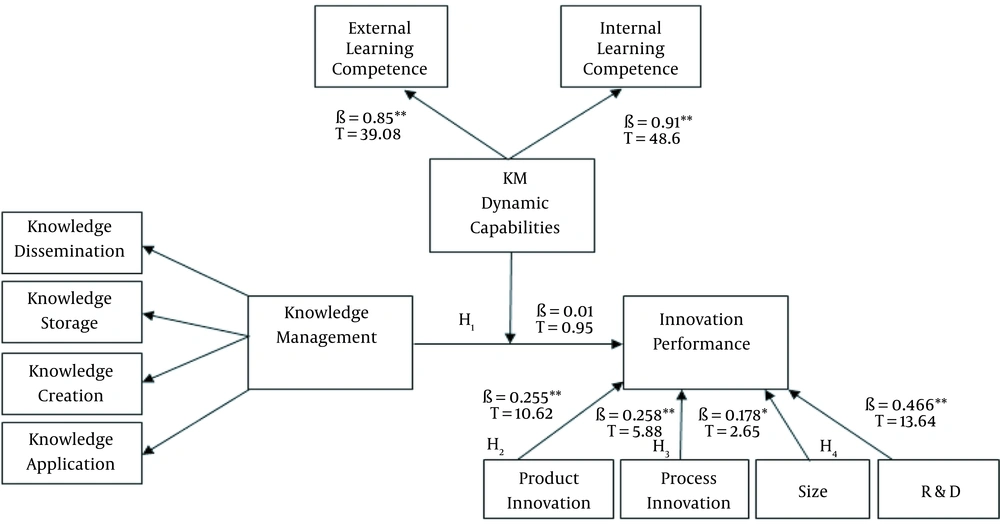
Figure 1.
The results of the structural equation model (P < 0.001***, P < 0. 01**, P < 0.05*)
Accordingly, the correlation of Hypothesis1 (H1 was not confirmed, while the correlations of the other 4 hypotheses were confirmed.
Table 3.
Structural Model Tests
| CR | DE | DI | EX | IN | IP | SA | |
|---|---|---|---|---|---|---|---|
| R2 | 0.829 | 0.794 | 0.700 | 0.721 | 0.827 | 0.985 | 0.787 |
| Q2 | 0.482 | 0.421 | 0.402 | 0.426 | 0.366 | 0.255 | 0.489 |
Abbreviations: CR, knowledge creation; DE, knowledge application; DI, knowledge dissemination; EX, external learning competence; IN, internal learning competence; IP, innovation performance; SA, knowledge’s storage.
Then, the behavior of the dependent variable was predicted using the R2 test, with R2 values exceeding 0.67 for all variables indicating a strong prediction of the variable behavior. According to Table 3, the quality of the Q2 structural model is at a strong level compared to the weak (0.02), moderate (0.15), and strong (0.35) criteria (30). A strong goodness of fit (GOF criterion (0.708), related to the general part of SEMs, was obtained in this study.
5. Discussion
The results of innovation performance in the generic plan implementation indicate that the innovation policy has not passed a proper course such that it simply focuses on disease recognition and diagnosis with an academic-based approach. However, the research process requires well-equipped knowledge-based centers that focus on a combination of economics and science. Various studies have focused on the role of knowledge management in the innovation process (31) and have widely acknowledged the importance of knowledge management and its relationship with innovation. Despite the results of existing studies, few and sometimes contradictory attitudes attempt to measure a company’s success through innovation derived from knowledge management (32).
In the model proposed in this research, there is no significant positive relationship between knowledge management and innovation performance with a path coefficient of 0.13. Innovation performance results from policymaking in various areas, and it cannot be promoted solely by science and technology policies. Technology and innovation are global in nature; so, R&D should not be confined to national and corporate bonds. Therefore, an important lesson learned from the successful experiences of countries in innovation development is to enhance the learning, utilization, and acceptance of innovation patterns from developed countries and adapt them to the country’s situation. Moreover, the creation of supporting and facilitating legal frameworks for the transfer and distribution of imported technologies, improving business conditions, financing mechanisms through risk-taking investments, and attracting top foreign talents have been the key pillars of the innovative approach in successful generic projects of China and India.
R&D [with the highest path coefficient (β = 0.466) and significant coefficients] plays an essential role in innovation performance compared to the other variables. This study showed that almost all organizations acted on generic production based on their mission to provide essential drugs at a reasonable price. As a result, it seems that no alignment exists in this plan between R&D, market demand, and supply of goods. Due to the absence of a competitive market, the role of R&D is intangible. In this regard, the government has allocated subsidies to support domestic production, which has turned it into an employer (government) and contractor (pharmaceutical factory) to meet basic needs. A typical example of strong R&D is manufacturing highly competitive products, in which the changes in shape and form are an inaccurate interpretation of the R&D system. As a result, the creation of new molecules is not achieved to enhance the quality of effective material. Although the use of imported resources and increased learning skills lead to high dynamic capabilities, the optimal use of such resources without proper R&D infrastructure in the production does not result in practical measures concerning external investigation, even in the light of supporting laws. The critical point to educate management is the technology transfer process in this area; hence, the import and trends of technologies should be monitored and facilitated at the national level. While large organizations with enormous resources are exposed to the technological situation, small organizations have advantages such as agility, flexibility, and rapid decision-making (33). Also, organizational size has shown a significant positive impact on innovation performance.
Technological innovations (i.e., product and process innovation) are essential and have a positive impact on firm performance (34). The generic design could principally lead to agility in providing essential medicines in critical situations, such as wartime, at low cost that stimulated the creation of a platform in the formulation area and increased the skills of the workforce in the formulation development; thus, innovation performance has often turned into a process. By implementing the generic plan, organizations made positive changes based on the new mission to improve the level of manufacturing and formulation knowledge and management approach.
As inferred from the results, product and process innovations significantly correlate with innovation performance with a path coefficient of β = 0.25. The generic plan approach was implemented to achieve independence in production and save foreign currency, a process that is in its infancy relative to technological developments in biopharmacy. Compared to India and China, where a theoretical and ideological background has been established for science and technology and has progressed toward the production of molecules, Iran with scant production of generic drugs has not yet aligned itself with global trends.
5.1. Conclusion
The invisible hand of the government is seen behind the activities of successful countries to reduce the distance from the pioneer group of science and technology leaders. Therefore, for the desired effect of government intervention policies and mechanisms, substantial arrangements should be provided for resource allocation and adaptation between socioeconomic activities. Moreover, regulations are necessary for creating a competitive business environment. Dissemination of innovation by improving conditions in the body of the pharmacy industry is feasible through protecting intellectual property rights, collaborating in the collection of international technology standards, supporting and building the infrastructure of fundamental laboratories, improving research management and public development by establishing an accurate performance appraisal system, and enhancing policy adaptability. Human resources should be developed by training talented people and scientific leaders. Also, higher education should be reformed to facilitate the attraction of academics and students to industrial units to lead individual and social advancement by utilizing their expertise and knowledge. Collaborating with universities or smaller companies can promote the pharmaceutical portfolio by reducing the advancement risk and costs and lead to the formulation and redesign of many previous policies and actions by adopting strategic decisions.