
1. Background
Conflict/quarrel is defined as the incompatibility of goals and values between two or more people or groups in a social relationship (1). Street quarrels, as a social violence indicator, occur in any society in different severity and frequency related to the economic, cultural, and social conditions of that society (2).
The importance of conflict resolution in any area is discussed as political philosophy (3). According to statistics, conflicts and quarrels taken by a number of victims every year, and their consequences have devastating effects on the socio-cultural situation of each country, so that sociologists and social pathologists have described it as one of the main trauma (4, 5). Quarrel is a multidimensional phenomenon and could be studied from different viewpoints. Different studies highlight the role of various factors in quarrel occurrence. This includes a wide variety of variables such as environmental conditions, level of exposure to pollutants, cultural values, and genetic correlates. According to reports, there is a significant association between violence and environmental heat and lead levels (6, 7). Separate studies conducted in Yazd and North-Khorasan provinces, Iran, reported a significant association between quarrel occurrence and age, life satisfaction, access to welfare services, marital status, lack of trust in the police enforcement, and the tendency to quarrel (8, 9). The heterogeneous distribution of these variables affects the distribution and severity of aggression and quarrels in different regions and countries. Also, trends of conflict are directly related to factors such as population, urban context, physical development, and other social factors (10).
The use of the standard morality/morbidity rate (SMR) or standardized incidence rate (SIR) on a map enables investigators to identify high- and low-risk areas. However, using SMR and SIR has certain methodological issues, including the violation of Poisson assumption and inability to account for heterogeneity in risk distribution. Hence, the results may be inaccurate and even misleading in some cases (11, 12).
Various space-time techniques and software have been developed to cluster high-low risk areas and assess risk trends. Disease mapping is among useful tools in the analysis of geographical changes in the occurrence of an event over space and time. It sums up spatial variations in the occurrence to identify areas with low or high rates and formulate or assess etiological hypotheses. This is done by preparing appropriate maps to reflect geographical diversity in the risk of an event in different regions. This method could also be used to assess the impact of variables in the risk or its trend over time (13, 14).
2. Objectives
There are a few reports on the quarrel incidence in Iran all of which are at province level (4, 8, 9, 15-18). No nationwide study on quarrel risk as well as trend assessment was available in Iran. Hence, in the current study, we sued modern spatiotemporal techniques to evaluate relative risk and trends of quarrels in Iran by using the official data published by the Iranian Legal Medicine Organization (ILMO) from 2013 - 2018 (lmo.ir).
3. Methods
The data used in this study were street quarrel, and conflict cases in different provinces of Iran referred to Iranian Legal Medicine Organization (ILMO) during 2013 - 2018. The data were retrieved in total population and for females and males, separately. First, the overall relative risk of the street quarrels and conflict was calculated by considering the six-year period as a single time point in Besag, York, and Mollie’s (BYM) spatial model (19, 20).
Here, the population of 2016 was considered the total population for the model. The BYM model has two parameters of structural (or correlated) and non-structural (or uncorrelated) heterogeneity to capture neighboring and internal variances, respectively. Correlated heterogeneity refers to the degree of dispersion of data in areas that are affected by adjacent areas, which is a major advantage for this model, where uncorrelated heterogeneity refers to the distribution of data in different areas due to area-specific random error.
Afterward, we used spatiotemporal model proposed by Bernardinelli et al. to assess the effect of time on the risk as well as to compare risk trends in different provinces (21). This model extends the BYM model by inclusion of a term for time. It assumes the Poisson distribution as
Oik ~ Poisson (Eik × RRik)
Log (RRik) = α + ui + νi + (β + δi) × tk
Oik is observed number of street quarrels/conflict cases in province i and year k.
In Bayesian framework, Bernardinelli et al. (21) considered a normal prior distribution for the ui random effects and CAR-Normal prior distribution for δi and νi. The relative importance of correlated heterogeneity is evaluated by
Higher values of K indicate the superiority of spatiotemporal models over simple SIRs and SMRs. In this relation
R-INLA package (r-inla.org) and shinyapp web application were used in R-3.6.2 (cran.r-project.org) to fit the models, calculate statistics, and plot the maps (22).
4. Results
There were a total number of 3,432,735 street quarrels and conflict cases referred to ILMO from March 2013 to February 2018 where almost 31% of these were for females. Tehran province had the highest proportion of quarrels with 609,629 records during this period.
To assess the geographical distribution of quarrels, first, we used BYM model by considering the whole period as a single time point. Figure 1 shows the map of RR in all provinces for females, males, and total population. Here, we used PX to refer to Province X on the maps. For females, as shown in Figure 1A, Alborz (P5) had the highest RR of 1.38 followed by Gilan (P3), Khorasan_Razavi (P19), Tehran (P6), Isfahan (P8), Qom (P7), North_Khorasan (P20), Zanjan (P4), and Kermanshah (P9) provinces all with RR in the range of 1.1 - 1.3. Sistan and Baluchestan (P17, RR = 0.30), Hormozgan (P16, RR = 0.49), Bushehr (P15, RR = 0.55) and Khuzestan (P14, RR = 0.57) provinces had the lowest RR for females.
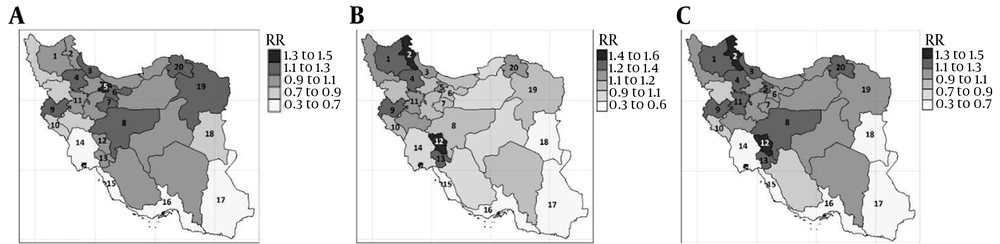
Figure 1.
Estimated relative risk of street quarrels in Iran 2013 - 2018 based on BYM model for females (A), males (B), and total population (C).
As suggested by Figure 1B, RR in males was the highest for Ardabil (P2) with RR = 1.45 followed by Chaharmahal and Bakhtiari (P12), Kohgiluyeh and Boyer-Ahmad (P13), East-Azerbaijan (P1) and Zanjan (P4) with RR between 1.2 - 1.4. The RR was the lowest for Hormozgan (P16), Sistan and Baluchestan (P17), South-Khorasan (P18) and Bushehr (P15) provinces with RR of 0.3 - 0.6. For total population, as shown in Figure 1C, Ardabil province (P2) with a RR = 1.32 has the highest risk of street quarrel followed by Chaharmahal and Bakhtiari (P12), Kohgiluyeh and Boyer-Ahmad (P12), East-Azerbaijan (P1), Zanjan (P4), Alborz (P5), Gilan (P3), Kermanshah (P9), Hamedan (P11), and North-Khorasan (P20) with RR of 1.1 - 1.3. For the total population, the RR was the lowest for Sistan and Baluchestan (P17), Hormozgan (P16), South-Khorasan (P18) and Khuzestan (P14) provinces with RR = 0.3 - 0.7.
Figure 2 shows the estimated differential trend (δ) parameter that compares trends of RR in each province to the overall RR trend in the whole country. For females, Qom (P7) and East-Azerbaijan (P1) had the steepest trend above the country overall trend where Hormozgan (P16) and Sistan and Baluchestan (P17) had the steepest decreasing trend. As shown in Figure 2B, Qom (P7) had the steepest increasing trend and Ilam (P10), Chaharmahal and Bakhtiari (P12) and Bushehr (P15) had the steepest decreasing trend for males. For total population in Figure 2C, Qom (P7) had the steepest increasing trend and Ilam (P10), Chaharmahal and Bakhtiari (P12), Bushehr (P15) and Hormozgan (P16) had the steepest decreasing trends of relative risk of street quarrel compared to the whole country.
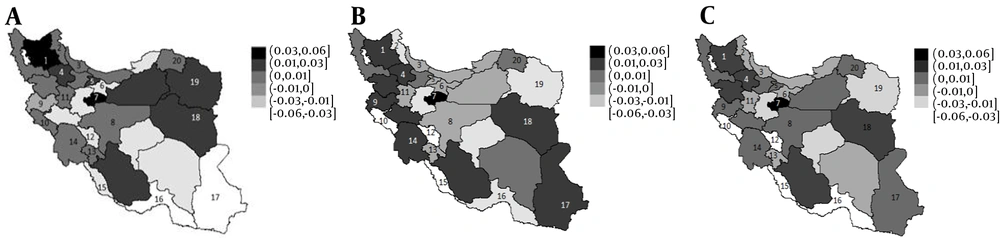
Figure 2.
Posterior estimates of differential trends (δ) for females (A), males (B), and total population (C).
Figure 3 plots the profiles of estimated provincial trends of street quarrels and conflict rates for 2013 - 2018 for four provinces with highest increasing patterns. Assessment of temporal trends indicated the estimated mean of overall time effect (β) by Bayesian spatiotemporal model -0.0019 [95% CI: -0.0034 to -0.0004] for females, 0.0000 [95% CI: -0.0011 to 0.001] for males, and -0.0005 [95% CI: -0.0004 to 0.0003] for total population. The trend of RR was decreasing for the total population and both sexes; however, it was statistically significant only for females.
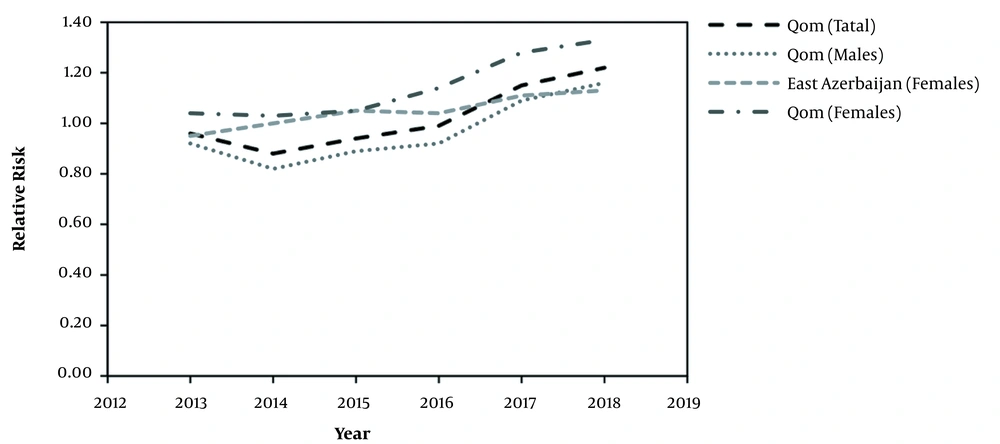
Figure 3.
Estimated trends of street fights/quarrels RR for four Provinces from 2013 to 2018.
For a detailed review of the changes in RRs, we plotted the estimated RR for different years based on spatiotemporal model in Figure 4. Here, increase/decrease in the RR could be inferred from gradual darkening/lightening in each province over time. As suggested by annual maps of RR, in general, the RR for males and total population does not represent a significant change over time. However, there is an apparent decreasing trend for females. The spatial fractional variance (variance ratio) for female 98.6%, for male 98.4%, and for total population 98.2%, indicates that a large part of the variability in RR is accounted by spatial heterogeneity and justifies the use of spatial models.
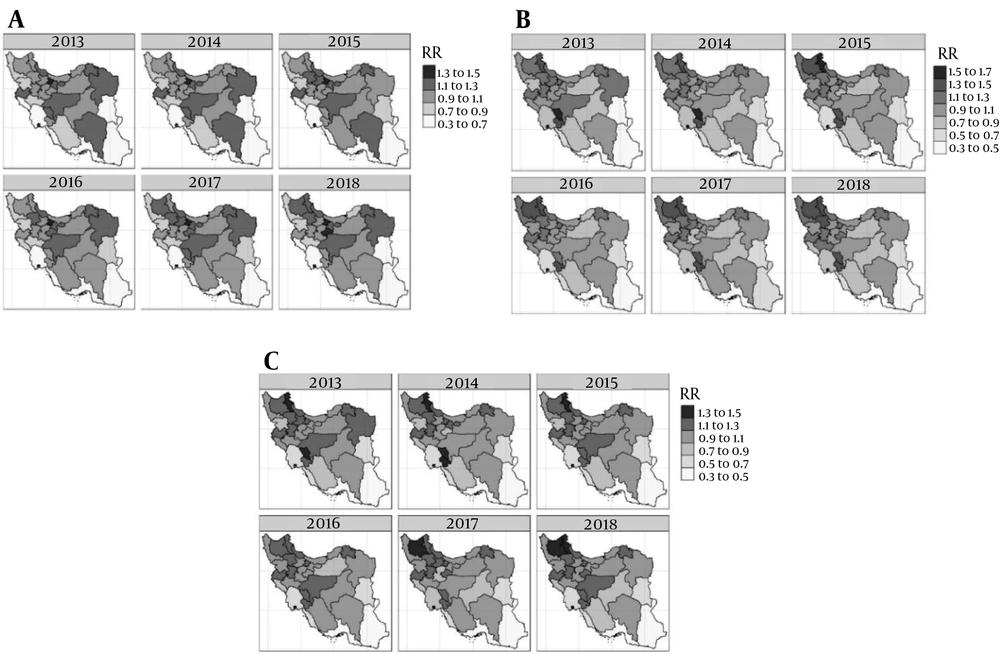
Figure 4.
Estimated RR of street quarrels and conflicts in Iran 2013 - 2018 based on Bayesian spatiotemporal model for females (A), males (B), and total population (C).
5. Discussion
In this study, the RR value of conflict for each province is estimated separately for women, men, and the total population of the province using the spatiotemporal model. In general, of 31 provinces under investigation, the slope of trend was significantly steeper than the national average trend in 18 provinces for women, 11 for men, and 16 for the total population.
It may be believed that people who are at higher levels of social-economic status are less prone to show aggressive behavior as stress and tension from economic, social, cultural, and political crises increase the risk of violence (23). In Iran, the economic factor is currently the main cause of violence and aggression in society. Experts point out that the social problems of unemployment or lack of suitable work are one of the most important social harms in the country, which is also the main cause of aggression. Detailed data were not available to assess their contribution to street quarrels and conflicts. Mohaqeqi Kamal et al. examined the relationship between the levels of social welfare with various components for each province earned (24). They showed Ardabil (P2), East-Azerbaijan (P1), Zanjan (P4), Gilan (P3), Kermanshah (P9), and Hamedan (P11), which have a low level of social welfare, were at high risk of conflict. Also, the provinces of Yazd, Bushehr (P15), and Khuzestan (P14), which had high social welfare, had a low risk of conflict. However, the relationship between social welfare and occurrence of conflict was unexpected in Chaharmahal and Bakhtiari (P12), Alborz (P5), Kohgiluyeh and Boyer-Ahmad (P12), Gilan (P3), and North-Khorasan (P20) where despite the high social welfare, the risk of conflict was also high. Surprisingly, South-Khorasan (P18), Hormozgan (P16), and Sistan and Baluchestan (P17), with the lowest level of social welfare, had the lowest risk of conflict. In the current study, we observed that the estimated RR of street conflict was the lowest for the southern provinces in the total population and both sexes. The following two could be justifications. It seems in less developed populations, people are usually calmer, more adapted to the environment, with lower standards of life. Hence, they are less likely to show aggressive behavior based on traditional context. But in developing populations, such as northern provinces of Iran, the level of expectation is increasing proportionately, and events are viewed from higher standards, and if they do not meet these criteria, people are forced to react. The other reason could be attributed to social characteristics in these provinces, where the conflicts and quarrels are usually solved through the intervention of the local elders. So it does not lead to complaints and the judiciary. It is also argued that when something illegal occurs, people do not blame themselves and solve the problem based on their sub-cultural indicators. Hence, our findings may not indicate that the conflict incidence is necessarily low in the southern provinces and other factors may be playing role.
In social control theory, Hirschi believes that violence occurs when one's attachments to society are weakened or completely broken. These attachments can be summarized under the four general concepts of Attachment, commitment, norms, and beliefs. According to Hirschi, those who have a weak belief and loyalty to moral and social norms may be more inclined to ignore them and engage in more street violence. According to Hirschi's theory, street violence, like other forms of delinquency, is the result of a reduction and lack of social control. When social control is weakened, reciprocally social cohesion is exposed to deterioration and depletion, which, in turn, reduces the power of integration, and due to this, the ability to effectively prevent delinquency and deviation is depleted, and eventually, the probability of violence Incidence increases (25). In our study, Ardabil (P2) province with RR = 1.32 had the highest risk of street quarrels. Javanmard et al. showed that collective conflict in Ardabil is affected by social capital, social control, social dissatisfaction, tribal attachment, and social differences variables. They also use social capital as an effective component in collective conflict and strife reduction, which instead of promoting violence, resolves group and individual disputes through negotiation, dialogue, mediation, and discussion. They also stated that this social capital function would be available with indicators such as social trust, social participation, and social cohesion (17).
According to the results of our study, Kohgiluyeh and Boyer-Ahmad (P13) and Chaharmahal and Bakhtiari (P12) Provinces were among the high-risk provinces of the country. The study by Nazari and Ghaffari (26) in Kohgiluyeh and Boyer-Ahmad (P13) showed that this province has many distinct social groups due to tribal context, each of which considers itself superior to the other tribal groups and humiliates the other tribal groups. This issue explains why the smallest local difference turns to widespread collective conflict. Tribal issues exist in all social stratum.
Tribal people say that strangers cannot be trusted, and people should be in touch with their relatives, and they get to one's rescue and scratch their relatives' back. So, this view which governs the culture of the province, encourages individuals, especially the youth, to unequivocally support the people of their tribe and relatives without any logical reason, which is a sign of cultural poverty (26). Besides, the results of Rezaei Kalvari and Bahraini in Chaharmahal and Bakhtiari (P12) showed that ethnicity and tribalism are some of the main causes of conflict and violence (27).
The results of estimating the differential trend (δ) parameter in this study showed that the steepest trend of street quarrels compared to the overall trend of the country is related to Qom (P7) province. One of the reasons for the increase in conflict in this province is the increase in urbanization (28). High migration of different ethnicities to this province increases the suburbanization of the city. The increase of such places automatically leads to the creation of social classes, cultural conflict, and the increase of conflict in this province.
5.1. Conclusions
Although the rates of street fights/quarrels do not show significant trends over recent years, its geographical distribution is significant. These discrepancies may have various cultural, social, and economic correlates that necessitate further research with explanatory variables in each province and the whole country.