
1. Background
Global statistics show that cardiovascular diseases are the leading cause of mortality worldwide. Approximately 18 million people die from these diseases annually, and 85% of these deaths are caused by heart attacks (1). One of the most common surgical procedures for coronary artery disease (CAD) is coronary artery bypass graft (CABG), which results in mortality reduction and patients' quality of life improvement (2). However, some postoperative complications, such as delayed wound healing in the leg and chest and incisional pain, lead to decreased patients' quality of life and increased hospital stay and treatment costs (3). Great saphenous veins (GSVs) are used in 95% of CABGs (4). Vein harvest sites in patients undergoing CABG are prone to edema and local complications, infection, and delayed wound healing because of the systematic inflammatory response following surgery, disturbed venous drainage, and extensive lymphatic and soft tissue damage (3, 4). In addition, pain after CABG can lead to stimulation of the sympathetic nervous system, disorder in muscle mobility, general mobility, and the patient's physical fitness (5).
Local care of vein harvest sites and control of pain in patients undergoing surgery are the important duties of nurses as a member of the treatment team (2, 6). Despite extensive improvements in wound dressings, care, and pharmacological and non-pharmacological agents controlling pain, more studies are still needed for pain control, accelerating surgical wound healing, and reducing complications. Added herbs to the dressings have led to the use of their antibacterial, anti-inflammatory, and antioxidant effects, which are helpful in wound contraction, angiogenesis, and epithelialization (7). Aloe vera is one of these medicinal plants found in various countries, including Iran. Laboratory studies have shown that aloe vera has various effects, such as inhibiting thromboxane (a repair inhibitor), inhibiting histamine production (reducing itching and skin irritation), strengthening the immune system, and producing cytokines, increasing and changing collagen composition, improving wound healing, and decreasing local pain (7-10).
Studies have shown that aloe vera gel has a better effect than 1% silver sulphadiazine cream for healing and controlling burn wound pain (11, 12). Another study reported the protective effect of aloe vera gel on preventing pressure ulcers in patients in orthopedic wards (13). Babaei et al. stated that until the fourth day of the study, the effect of aloe vera gel dressing on the healing of the sternal wound in diabetic patients undergoing CABG was not different from the control group. However, its positive effect on wound healing was observed from the seventh to the fourteenth day of the study (11). A study has reported a positive effect of topical application of aloe vera gel on the wound healing process in Skin Grafts, but no significant effect has been seen in controlling local pain (13). In another study, the moisturizing properties of aloe vera have been linked to reduced wound healing time. The study found no significant difference between aloe vera and placebo creams in reducing wound healing time (14). Rahmani et al. found that consumption of creams containing aloe vera extract significantly reduced chronic anal fissure pain (15). In addition, aloe vera gel, compared to routine care, had a significant effect on pain control after episiotomy (16).
Due to the widespread use of CABG surgery and its related complications, the control and treatment of these complications are of great importance. On the other hand, the effects of aloe vera gel have been widely studied due to its broad use in controlling inflammation and pain and accelerating the healing process of surgical wounds. However, there is a lack of studies in this group of patients, and there are contradictory results in the pain control of aloe vera gel; therefore, it seems that more studies are needed in this field.
2. Objectives
This study aimed to determine the effect of aloe vera gel on local pain intensity and healing of saphenous vein harvest wounds in non-diabetic patients undergoing open-heart surgery.
3. Methods
3.1. Study Design & Participants
A single-blinded randomized clinical trial was conducted over five months in 2020 in the subspecialty heart hospital affiliated with Isfahan University of Medical Sciences. Thirty-five patients who underwent CABG surgery with saphenous vein removal in both legs were included in the study. Other inclusion criteria include not having diabetes, skin disease, known vascular disease such as Raynaud's and Buerger's diseases, allergy to aloe vera (after 20 minutes of topical application of the gel on the patient's arm), and chronic renal failure in their medical history. They also did not have a history of previous surgery and venous removal. In the event that the patient refused to continue the study, as well as in the case of inflammation and purulent discharge from the wound, she was excluded from the study (11, 13).
3.2. Sampling & Sample Size
With the written permission of the surgeon, they underwent local care for the GSV site and were excluded from the study in case of inflammation, infection, purulent discharge, or death. The sample size (35 patients) was calculated using the following formula to compare the means with a 95% confidence level, 80% power, and a probability of 10% of patients' withdrawal.
Patients were selected by the convenience sampling method, and controls were the same patients to minimize the effect of interfering factors in the wound healing process and pain intensity, which are different in patients. Therefore, care was provided for both lower limbs of the patients. By random selection of even and odd numbers, one of the lower limbs was placed in the intervention group, and the other was placed in the control group. Numbers were placed in a package, and by taking a chance from the available numbers, if an odd number was selected, the limb was placed in the control group, and if the number was even, the limb was placed in the intervention group. The first choice was for the right limb, and the second choice was for the left limb. Patients' information was collected by a research colleague blinded to the type and method of intervention in the samples. Background and clinical information of the patients (age, gender, level of education, occupation, main reason for referral, underlying disease, weight, height, BMI, smoking history, and medications) were recorded the day before surgery, and the length of the surgical incision in the right and left lower limbs was recorded by the researcher after surgery.
3.3. Data Collection Tools
3.3.1. The Original Format of the Questionnaire
Patient pain intensity was assessed using the Visual Analog Scale (VAS) on the first, fourth, seventh, and fifteenth days after surgery. The VAS scale is a visual, widely used, easy-to-use, and standard instrument for measuring pain in the world that is rated from 0 (painless) to 10 (most severe pain) (15, 17). The REEDA scale was used to assess the healing of GSV wounds. The REEDA scale has five components: Redness, Edema, Ecchymosis, Discharge, and Approximation. For each component, a score from zero to 3 is assigned, and the maximum score (high level of tissue damage) is 15. The REEDA scale was first developed by Davidson and then reviewed by Carey (18, 19).
3.3.2. Translating and Adapting the Questionnaire to Persian
3.4. The Main Study
The day after surgery, after washing the venous harvest site with normal saline and drying with sterile gas (standard surgery wound nursing care), in the intervention group, a 2 mm layer of aloe vera gel (Reyhan Naghsh Jahan Pharmaceutical Co. based on U.S. Pharmacopoeia) was applied to the entire cutting area, and dry gauze was applied and then bandaged (14, 15, 17). All care provided to the harvest site was the same for the control group, except that aloe vera gel was applied to the limbs. The gel was applied four days after surgery. Wound healing and pain assessment were performed on the first and fourth postoperative days in the hospital ward and the seventh and fifteenth postoperative days in the hospital clinic.
3.5. Data Analysis
Data were analyzed using SPSS software version 26 to calculate paired and independent t-tests and repeated measures analysis of variance for evaluating and comparing the severity of pain and the mean score of limb wound healing. Significance level P was considered 0.05.
3.6. Ethics and Consent
The present study was approved by the Vice-Chancellor for Research and Technology of Isfahan University with the ethical code I.R.MUI.RESEARCH.REC.1397.452. All subjects were aware of the objectives and stages of the study, and attendance at the study and withdrawal at any time was optional. Written informed consent was obtained from the participants. All the collected information was kept confidential.
4. Results
In this study, 35 patients having CABG surgery participated. None were excluded from the study (Figure 1). The patient's demographic information and clinical variables are shown in Table 1. All the participants were married; most were male (77.2%), had a junior high school degree (54.2%), and were employed (65.7%). Participants had a minimum age of 44 and a maximum age of 79 years. Most patients (37.1%) had four to five grafts. Hypertension was the most common underlying disease in these people (28.7%), and 48.6% of the patients had no history of underlying disease. Most people (60%) had no history of smoking, and cigarettes were the most common type (25.7%).
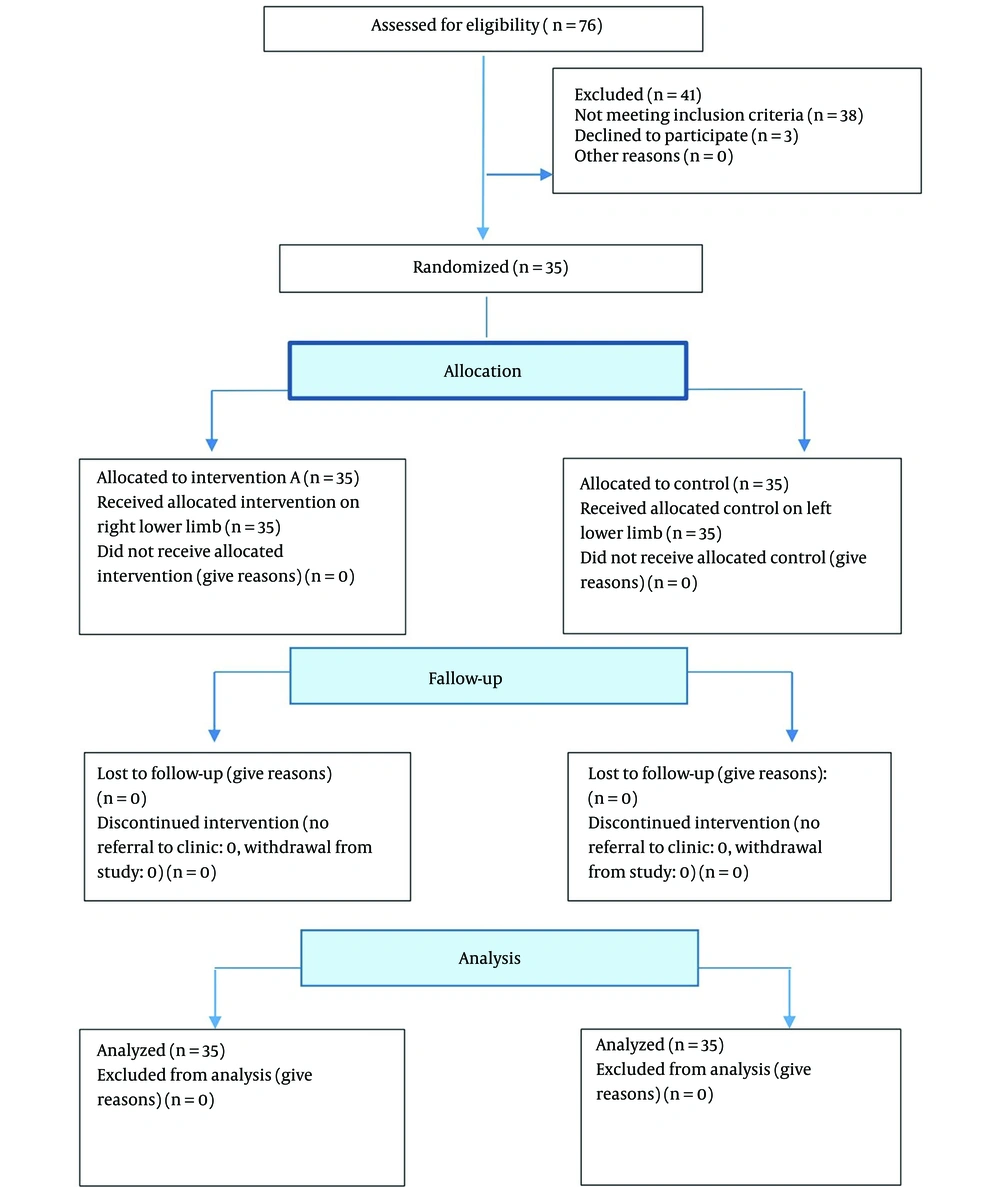
Figure 1.
Consort flow diagram
Table 1.
Frequency Distribution of Demographic and Clinical Data of Participants a
| Variables | Values |
|---|---|
| BMI, kg∕m2 (20.3 - 34) | 26.39 ± 3.49 |
| Age, y (44 - 79) | 60 ± 9.47 |
| The average length of the surgical incision | |
| Control limb | 32.70 ± 12.97 |
| Intervention limb | 35.43 ± 18.62 |
| Gender | |
| Female | 8 (22.8) |
| Male | 27 (77.2) |
| Underlying disease | |
| Asthma/COPD | 2 (5.7) |
| HBS + | 1 (2.8) |
| Heart failure | 1 (2.8) |
| HLP | 2 (5.7) |
| HTN | 10 (28.7) |
| Others | 2 (5.7) |
| Marital status | |
| Married | 35 (100) |
| Single | 0 |
| Job | |
| Employed | 23 (65.7) |
| Retired and unemployed | 4 (11.5) |
| Housewife | 8 (22.8) |
| Smoking | |
| Cigarettes | 9 (25.7) |
| Opium | 3 (8.6) |
| Both | 2 (5.7) |
| Education | |
| Illiterate | 13 (37.2) |
| High school | 19 (54.2) |
| Diploma and above | 3 (8.6) |
| Number of grafts | |
| Two grafts | 5 (14.3) |
| Three grafts | 13 (37.1) |
| Four grafts | 13 (37.1) |
| Five grafts | 4 (11.5) |
Abbreviations: HBS+, hepatitis B antigen positive; HLP, hyperlipidemia; HTN, hypertension.
a Values are expressed as mean ± SD and No. (%).
Table 2 shows the mean pain intensity and wound healing score in the control and intervention limbs on the first, fourth, seventh, and fourteenth days. According to the results, on the seventh day, the mean pain intensity in the intervention group was significantly lower (P = 0.01), and the wound healing score was not significantly different between the two groups at any time (Table 2).
Table 2.
Mean VAS Score (Pain Intensity) and Wound Healing in Control and Intervention Groups
| Variables | Time | Intervention Group, Mean ± SD | Control Group, Mean ± SD | Effect Size | P-Value |
|---|---|---|---|---|---|
| Pain intensity in surgical site | First day | 1.71 ± 1.23 | 1.73 ± 1.33 | -0.007 | 0.95 |
| Fourth day | 0.42 ± 0.49 | 0.78 ± 0.98 | 0.226 | 0.06 | |
| Seventh day | 0.13 ± 0.22 | 0.44 ± 0.67 | -0.296 | 0.01 | |
| Fourteenth day | 0.07 ± 0.17 | 0.15 ± 0.27 | -0.174 | 0.19 | |
| P-value | < 0.001 | < 0.001 | Effect size | 0.14 | |
| Wound healing score | First day | 5.54 ± 1.85 | 5.74 ± 1.75 | -0.055 | 0.64 |
| Fourth day | 3.11 ± 2.31 | 3.66 ± 1.92 | 0.128 | 0.29 | |
| Seventh day | 1.54 ± 1.31 | 1.97 ± 1.38 | -0.157 | 0.19 | |
| Fourteenth day | 0.63 ± 1.14 | 1.20 ± 1.49 | -0.210 | 0.07 | |
| P-value | < 0.001 | < 0.001 | 0.62 |
Based on repeated measures analysis of variance test, the changes in pain intensity and wound healing score during 14 days after surgery reduced significantly (P < 0.001) in both intervention and control groups, but these changes in pain intensity and wound healing were not significant between the two groups. (Figures 2 and 3). The Scheffe post hoc test results showed a significant decrease in the mean pain intensity in the intervention limbs compared to the control limbs on the seventh day (P = 0.010). In addition, based on the above test, in both control and intervention limbs, the mean changes in the total wound healing score on the first day compared with the fourth (P = 0.525), seventh (P = 0.639), and fourteenth (P = 0.477) were not statistically significant (Table 3). The results of the REEDA scale showed the severity of ecchymosis in the intervention limb compared to the control decreased significantly on the seventh and fourteenth days (P = 0.039).
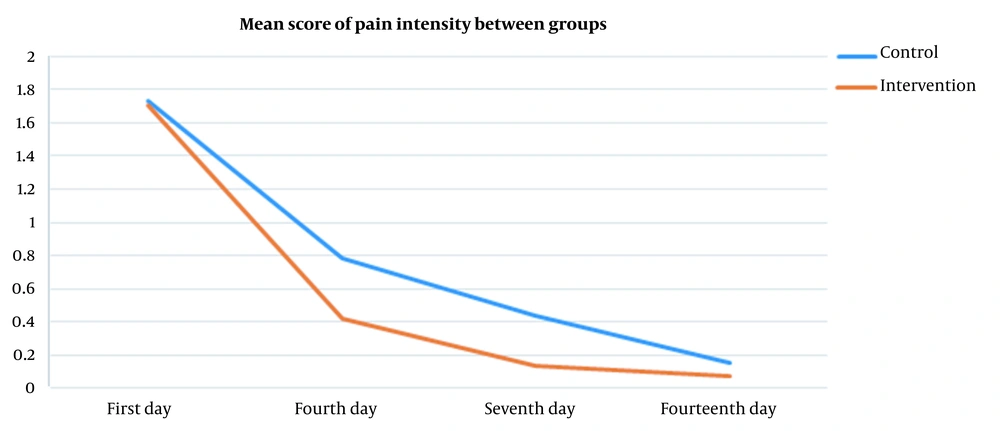
Figure 2.
Mean changes in pain intensity in control and intervention limbs
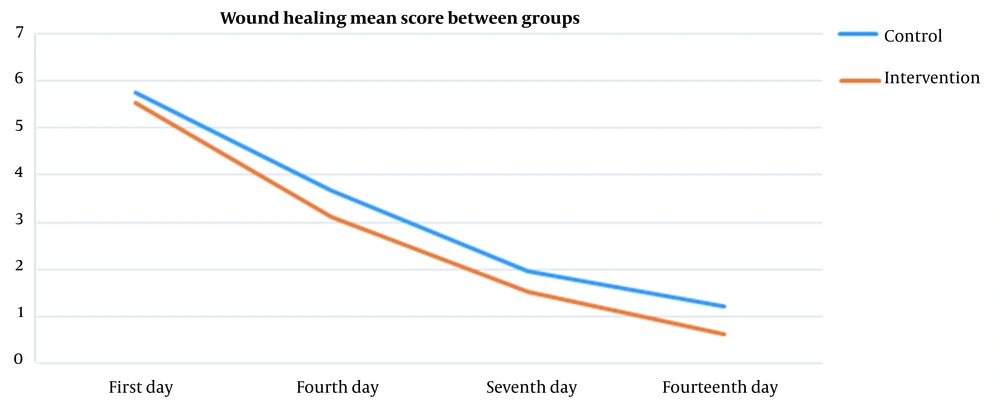
Figure 3.
Mean total wound healing score in control and intervention limbs
Table 3.
Comparison of Changes in the Mean Scores of Wound Healing and Pain Intensity of the First Day to the Fourth, Seventh, Fourteenth, Fourth to the Seventh Day, and Seventh to the Fourteenth Day a
| Variables | Time | ||||
|---|---|---|---|---|---|
| First Day to the Fourth Day | First Day to the Seventh Day | First Day to the Fourteenth Day | Fourth Day to the Seventh Day | Seventh-day to Fourteenth Day | |
| Pain intensity | |||||
| Control | 0.945 ± 1.44 | 1.282 ± 1.36 | 1.580 ± 1.18 | 0.337 ± 0.68 | 0.297 ± 0.50 |
| Intervention | 1.285 ± 1.21 | 1.577 ± 1.31 | 1.634 ± 1.28 | 0.291 ± 0.64 | 0.057 ± 0.17 |
| P-value | 0.290 | 0.30 | 0.855 | 0.744 | 0.010 |
| Effect size | 0.1267 | 0.1097 | 0.219 | -0.034 | -0.305 |
| Wound healing score | |||||
| Control | 2.085 ± 1.9 | 3.771 ± 2.04 | 4.542 ± 2.18 | 1.685 ± 1.76 | 0.771 ± 1.11 |
| Intervention | 2.428 ± 2.48 | 4.000 ± 2.01 | 4.914 ± 2.16 | 1.571 ± 1.68 | 0.914 ± 1.01 |
| P-value | 0.525 | 0.639 | 0.477 | 0.782 | 0.576 |
| Effect size | 0.077 | 0.056 | 0.085 | -0.033 | 0.067 |
a Values are expressed as mean ± SD.
5. Discussion
The results of our study show that the pain intensity at vein harvest sites before and after the intervention in patients undergoing CABG was mild, and patients reported mild pain that decreased over time. At the beginning of the study, pain intensity in the control and intervention limbs was not statistically significant. Major changes in pain intensity in the intervention limb occurred up to the fourth day, and although a decrease was observed until the seventh day, it was not significant between the two groups. In contrast, the changes in mean pain intensity on the seventh and fourteenth days were significantly lower in the intervention group than in the control group (P < 0.05). The results also show that the mean pain intensity in the intervention limb was less than in the control limb on the fourteenth day. In two studies that investigated the effect of aloe vera gel on perineal pain and wound healing in this area, no significant difference in the severity of perineal pain was found between the intervention and control groups at the beginning of the intervention, and on days 3, 7 and 10 after starting treatment in the intervention group had a significant difference (15, 17). The results of another study that investigated the effect of aloe vera cream on fissure recovery, bleeding, and chronic pain also showed a significant reduction in pain intensity and bleeding in the intervention group. This study used a topical cream containing 5% aloe vera extract powder three times a day for three weeks (15). The reason for the various degrees of aloe vera effectiveness in reducing pain intensity reported in different studies could be the difference in the number of times and days of aloe vera application in different areas.
Although our results showed no statistically significant difference between the decrease in the mean total wound healing score on the first, fourth, seventh, and fourteenth days in the control and intervention limbs, a further decrease in the mean total wound healing score (further healing) was seen in the intervention limb compared to the control limb. In addition, in investigating REEDA scale components, there was a significant decrease in the severity of ecchymosis in the intervention limbs compared to controls on the seventh and fourteenth days (P < 0.05). Babaei et al., in their study of the effect of aloe vera ointment on the healing of chest ulcers in diabetic patients undergoing CABG, found no significant difference between the two groups until the fourth day after the intervention, which confirms the findings of our study (11). In this study, it has been shown that aloe vera used for at least one week has a significant effect and improves wound healing. In addition, Schmidt and Greenspoon found that dermal aloe vera gel was associated with delayed wound healing. In this study performed on 21 women, who had complications in wound healing after cesarean section or laparotomy, the healing period of cesarean section and laparotomy wounds in patients receiving aloe vera gel was longer than the control group. The gel does not affect the healing of surgical wounds in this area (21). Another study investigated the effect of using aloe vera gel on split-thickness skin graft donor sites. They reported the area of the wound where aloe vera was used, and the speed of epithelialization was significantly more than where the placebo was applied (P < 0.05); however, no effect was seen on the severity of pain in these patients (13). In a similar study, no significant difference was observed between the placebo group and the group that used aloe vera to dress the donor site wound. However, the greater effect of aloe vera cream than the dry dressing group on wound healing speed was attributed to the moisturizing properties of aloe vera (14).
In a systematic study, Hekmatpou et al. concluded that aloe vera compounds have clinical benefits in preventing wounds and treating burn wounds, surgical sites, psoriasis, genital herpes, and nipple fissures (8). Two studies also reported that in the second-degree burn, wound healing use of aloe vera gel was associated with better and more significant results in epithelialization rate and burn wound healing compared to silver sulfadiazine cream. This effect is related to cell proliferation and the anti-inflammatory effects of this plant (9, 22). This finding has also been confirmed in a laboratory study by Najafi et al. They concluded that aloe vera gel could stimulate the expression of growth factor genes in the damaged skin of animals and thus could play a pivotal role in the wound healing process (23).
Based on the results of the present study and other studies in this field, topical application of aloe vera has different degrees of effect on pain intensity and wound healing speed. Differences in the number and frequency of herbal consumption, the type of wound, and sampling have influenced these results.
The present study has several strengths, including the selection of controls from the same patient to prevent confounding factors from interfering with the wound healing process and the severity of pain, the evaluation of the samples after discharge while the patient personally visited the clinic, and the same researcher extracted the information based on the scales and was blind to the grouping of limbs. One of the limitations of the present study was the prolonged length of the sampling process. Because the study was about pain and the wound healing process, several inclusion criteria were considered, and on the other hand, a few patients with non-diabetic heart problems required CABG. Further studies with more samples are required to obtain more detailed information on the effect of the topical application of aloe vera gel on surgical wound healing and pain control.
5.1. Conclusions
According to the results of this study, the mean score of pain intensity on the seventh day and the mean score of ecchymosis on the seventh and fourteenth days were significant in the intervention limb, which means that using aloe vera from the seventh day could be effective in reducing pain intensity and ecchymosis at the surgical site.
Although the mean score of healing and pain intensity was not statistically significant except for the seventh day, the mean pain intensity in the intervention limb had a greater decreasing trend than in the control limb. In addition, the mean total wound healing score in both control and intervention limbs had a decreasing trend, and this reduction in the intervention limb was greater at the same time interval, indicating that using aloe vera gel was effective in reducing pain and wound healing in the lower limb of non-diabetic patients undergoing heart surgery.