


1. Background
Team-based Learning (TBL) shifts the learning process from passive teacher-centered to active student-centered learning (1). It develops mature, confident class participation and interaction and enhances students' critical thinking, teamwork, and communication skills (2, 3). Thus, active learning methods like TBL have become popular and accepted in new educational programs (4). Active learning includes the direct participation of learners in the learning process (4, 5). According to previous studies, active learning activities are particularly effective in enhancing the amount of learning and increasing students' satisfaction, as well as their interest and engagement in the learning process (3). Collaborative learning is a type of active learning in which small groups of students work together on a specific topic. This method provides opportunities for developing social and communication skills and group processes (6). Collaborative learning instills more motivation in students and creates a positive attitude toward the learning experiences and the instructor (7). Dr. Larry Michelson, in 1998 developed TBL as a type of cooperative learning that aims to improve the quality of students' learning by enhancing their problem-solving skills, ensuring their presence in the classroom with prior preparation, and creating a class full of energy and active learning (8, 9). Also, TBL is an active learning method that enhances learning motivation (10).
On the other hand, anesthesia team members provide a wide range of services during the operation and use techniques that require advanced knowledge, critical thinking, and clinical expertise (11). Also, based on research findings, it has always been emphasized that the actions performed by nurse anesthetists should be based on technical and scientific knowledge and clinical reasoning (12). Since side effects related to health care and patients' health often originate from human error and inadequate teamwork (13), it can be argued that better communication and cooperation between medical teams may reduce the risk of surgery-related complications (14, 15). In addition, effective learning is often the result of pedagogically sound teaching methods implemented in a suitable environment that encourages creative techniques (16). In other words, when students are more actively engaged and participate in their learning, there will be an improvement that has a more lasting impact In other words, when students are more actively engaged and participate in their learning, there will be an improvement that has a more lasting impact (17).
One type of TBL which relies on student-centered techniques is Gallery Walk (GW). In this method, the student plays the main role in the learning process, and the instructor acts as a supervisor and facilitator (18). The way GW is implemented is similar to when a person visits an art gallery with a friend to admire works of art. They walk into the gallery, stop before a painting and carefully look at its components, discuss their understanding of the work, and share their opinions. If there is a problem in understanding the concept of the painting, they ask the creator artist to explain it to them. In this way, their knowledge about that painting increases. A similar process occurs in the GW educational method, where educational materials are treated like the painting in the above example. The educational contents in the form of posters are hung on the classroom wall, and the students assess them in small groups. This method directs and promotes learning in small groups while the entire class is being taught (19). In this technique, students' learning in groups provides them with the opportunity to discuss the desired topic freely, and thereby learning shifts from a passive activity (e.g., lectures in the classroom) to an active one (i.e., group discussion), improving their higher-order intellectual skills (20). On the other hand, the educational method employed in this technique not only familiarizes learners with the concept of time management in a practical way but also promotes peer evaluation, practice, and focus on a variety of tasks and challenges (18, 21).
Due to the dynamic nature of their profession, nurse anesthetists require excellent time management skills, fast decision-making abilities, critical thinking, impeccable clinical judgment, and a combination of knowledge and skills. As a result, most of their activities are based on teamwork. For this reason, nurse anesthesia students should learn how to use the knowledge and skills of anesthesia not only individually but also at a team level. The TBL methods can lend themselves to facilitating the achievement of this important goal.
2. Objectives
Considering the pressing need to implement innovative educational approaches that encourage active learning among students, this study aims to utilize the GW method to teach the topic of general anesthesia care during the induction phase. The study will compare the effectiveness of the GW method with the traditional lecture-based teaching method regarding its impact on students' scores.
3. Methods
3.1. Research Design
This was a quasi-experimental study that utilized a pretest, immediate posttest, and delayed posttest (one-month) design. The study was conducted on two groups: An intervention group taught with the GW method and a control group taught through lectures. The study took place at the Anesthesia Clinical Skill Lab of the School of Allied Medical Sciences at Ahvaz Jundishapur University of Medical Sciences in Ahvaz, Iran, from October 5 to November 22, 2022.
3.2. Participants
The participants were the second and third-year nurse anesthesia students who were selected by convenience sampling method. The initial number of students was 65, reaching 60 after five dropouts.
3.3. Data Collection and Instrument
The data of this study were collected by the test of general anesthesia cares knowledge during the induction phase. This tool included 30 four-choice questions about the knowledge of nurse anesthetists in the main stages of general anesthesia induction, including anesthesia induction drugs, pre-oxygenation with a face mask, laryngoscopy, intubation, and monitoring. All questions included four options with only one correct answer, scoring 1. Therefore, the minimum score was 0, and the maximum was 30. In order to achieve content validity, the necessity of each question was checked by the content validity ratio (CVR). After explaining the objectives of the tool to a group of experts consisting of anesthesiology faculty members, anesthesiologists, and medical education experts (N = 15), they were asked to rate each question using a three-point Likert scale: "necessary", "useful but not necessary", and "not necessary". Then, the CVR was calculated (22).
The content validity index (CVI) was used to ensure the relevance and clarity of the questions. To calculate the CVI, a panel of experts was asked to rate each question on a four-point Likert scale (irrelevant, need for fundamental revision, relevant but need for revision, and completely relevant). After collecting the views of the professors, using the formula, the CVR and CVI of each question were obtained (Table 1). The CVR and CVI for the total tool were 0.86 and 0.93, respectively. Also, after the content validity evaluation, the tool's face validity was checked by giving it to 20 students eligible to enter the study but not among the study participants. The research team sought the students' viewpoints regarding items' difficulty, relevance, the relationship between items and the main objective, item ambiguity and misinterpretations, and/or incomprehensibility of the meaning of words (23). The tool's reliability was measured using test-retest and Cronbach's alpha methods. The tool was filled out twice by the same 20 students with a one-week interval, and the obtained Pearson correlation coefficient and Cronbach's alpha were 0.84 and 0.81, respectively.
Table 1.Content Validity Ratio and Content Validity Index of Questions of General Anesthesia Cares Knowledge During the Induction Phase
| Item | CVR | CVI | |
|---|---|---|---|
| Relevance | Clarity | ||
| 1 | 1 | 0.93 | 1 |
| 2 | 1 | 0.86 | 1 |
| 3 | 0.73 | 0.8 | 0.93 |
| 4 | 0.6 | 0.86 | 1 |
| 5 | 1 | 0.86 | 1 |
| 6 | 1 | 0.93 | 0.86 |
| 7 | 0.73 | 0.8 | 1 |
| 8 | 1 | 0.93 | 1 |
| 9 | 1 | 1 | 0.93 |
| 10 | 0.6 | 0.93 | 0.8 |
| 11 | 1 | 1 | 1 |
| 12 | 1 | 1 | 0.86 |
| 13 | 1 | 1 | 1 |
| 14 | 1 | 0.93 | 0.8 |
| 15 | 0.86 | 0.86 | 1 |
| 16 | 1 | 0.93 | 1 |
| 17 | 0.73 | 1 | 1 |
| 18 | 1 | 0.86 | 0.93 |
| 19 | 1 | 0.8 | 1 |
| 20 | 0.6 | 1 | 1 |
| 21 | 1 | 0.8 | 0.93 |
| 22 | 1 | 1 | 0.86 |
| 23 | 1 | 0.8 | 0.93 |
| 24 | 1 | 0.93 | 1 |
| 25 | 0.73 | 1 | 0.93 |
| 26 | 0.6 | 0.8 | 0.86 |
| 27 | 0.73 | 0.86 | 0.8 |
| 28 | 0.6 | 1 | 1 |
| 29 | 0.6 | 0.93 | 1 |
| 30 | 0.73 | 1 | 1 |
3.4. Data Collection and Analysis
This study was conducted in five stages.
3.4.1. Sampling and Preparation
The participants were selected using convenience sampling. Following the study of Namaziandost et al. (24) and using the following formula, the sample size was calculated. Assuming 10% dropout for each (intervention and control) group, the sample size was 33 (
Students eligible to participate in the study were those in the second- or third-year nursing anesthesia who were willing to participate. Exclusion criteria were non-participation in class or withdrawal from the study. Then, the participants were briefed on the study objectives and details of the study methodology. They signed the informed consent form in this meeting. The final number of students who signed the consent form was 60 (dropout of 5). After block randomization of students based on the academic year, they were randomly divided into two homogenous intervention (GW) and control (lecture) groups. First, the students were divided into two blocks, second and third academic years. Using a random number table, 30 students were placed in the control group and 30 in the intervention group from each block.
In both intervention and control groups, half of the participants were second-year students (n = 15), and half were third-year students (n = 15). In the intervention group, 30 students were divided into five groups of 6 by block randomization based on their academic year, as explained above. To minimize the effect of the confounding variable of the year of study, in each hexad, half of the students were second-year (n = 3), and half were third-year (n=3). The educational content of the general anesthesia cares during the induction phase was approved by experts (anesthesiology faculty members, anesthesiologists, and medical education experts). One week before the implementation of GW, a guide sheet about the steps of the GW technique and the educational content of general anesthesia cares during the induction phase was given to the intervention group to be read before the class (Figure 1).
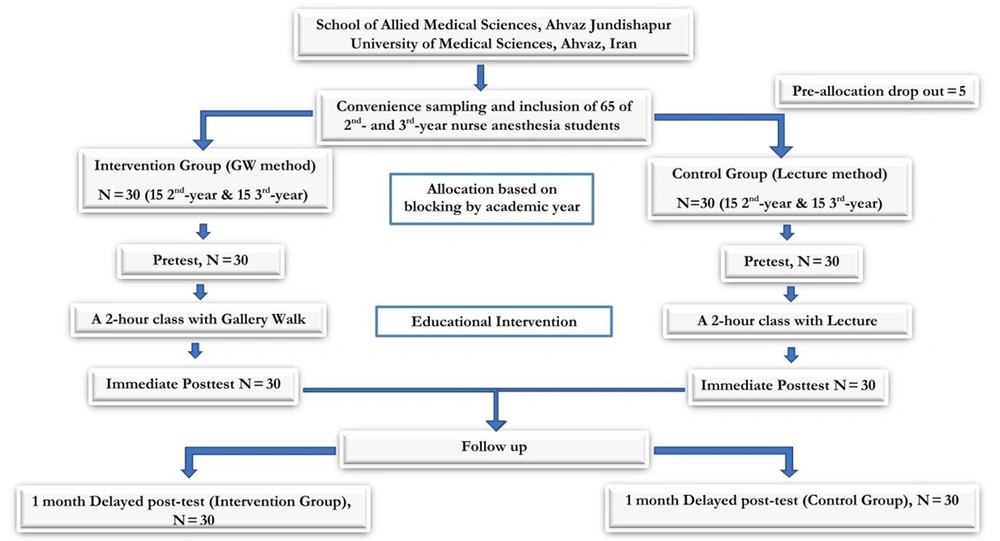
Figure 1.
Participants' flow diagram
3.4.2. Implementation of Gallery Walk for Intervention Group
This class was held in a two-hour session at the Anesthesia Clinical Skill Lab of the School of Allied Medical Sciences of Ahvaz Jundishapur University of Medical Sciences, Ahvaz, Iran. At the beginning of the intervention, a pretest was administered. Then, the names of each team members were announced. After that, each team was given a pack containing cardboard sheets, pens, colored pencils, colored markers, labels, rulers, and erasers, in addition to a group assignment sheet containing 12 questions from the educational content of general anesthesia care during the induction phase. Five questions were in the form of scenarios, four were about drug complications and care measures by the anesthesia team, and two were on airway management during general anesthesia induction. Various questions were used, including essay questions, four-choice questions, matching questions, short-answer questions, sorting questions, and drawing questions. Then, each team was placed in its predetermined station to answer the questions. The teams had 40 minutes to provide the answers on a poster as a conceptual map. The order and manner of answering the questions were left to the students. While the students were answering the questions and preparing the poster, the instructor was present in the class as a facilitator, answered the students' questions, and removed their doubts.
After 40 minutes, each team hung its poster on the classroom wall and chose one member to present the poster content. This volunteer member stayed by the poster and answered the questions of visitors from other teams who were supposed to observe the poster of their classmates for five minutes. While interacting with the presenter, each team member wrote their points and the possible mistakes of the poster on a sticky note and stuck it next to the poster. After five minutes, with the announcement of the facilitator, the teams changed their places. This continued until all teams had checked all the posters. After completing the rotations, the students sat on their chairs, and the debriefing technique was started. During the debriefing session, the students discussed their experiences with general anesthesia induction by answering questions such as "what new things did you learn today?", "do you think you can apply what you learned today in the operating room?". Students talked for 15 minutes about their experiences and what they had learned. After debriefing, the students took the immediate posttest (Figure 2).
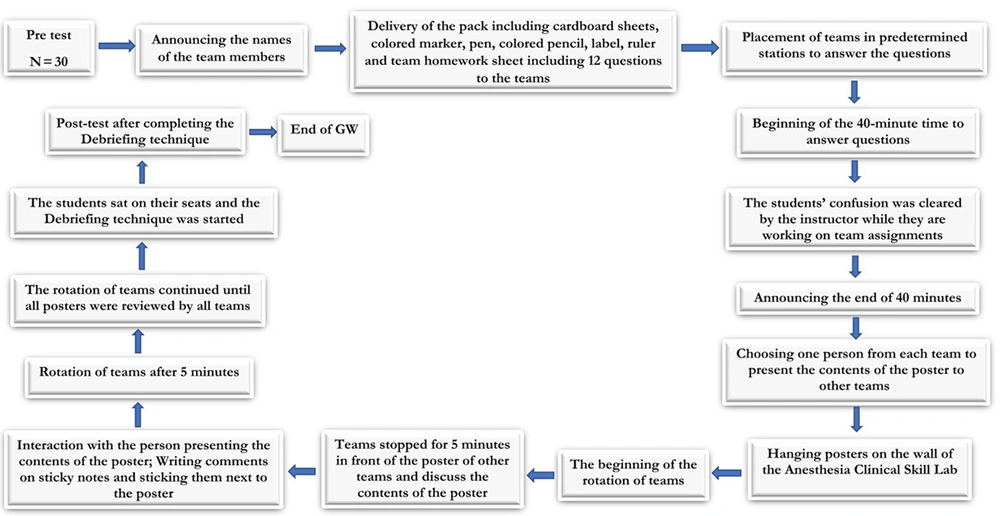
Figure 2.
Gallery walk educational method
3.4.3. Implementation of Lecture Method for the Control Group
Students of the control group attended a two-hour class presented using the lecture method. At the beginning of the class, a pretest was run. Then, the educational content about general anesthesia cares during the induction phase was presented using the lecture method along with PowerPoint slides. After the class, an immediate posttest was administered.
3.4.4. Delayed Posttest
One month after the interventions, the students took the same posttest to assess their retention of the material they had learned in both the control and intervention groups.
3.4.5. Data Analysis
After the educational interventions were completed, the data from the pretest and immediate and delayed posttests were collected and analyzed by independent sample t-test and repeated measures ANOVA, followed by the LSD post hoc test. The homogeneity of the intervention and control groups regarding GPA and age was checked by the independent sample t-test, while the chi-square test was used for gender. All data were analyzed using SPSS ver. 21.
3.5. Ethical Considerations
This study was approved by the Ethics Committee of Ahvaz Jundishapur University of Medical Sciences (Ref. ID: IR.AJUMS.REC.1401.283). Before the implementation of the research, a briefing session was held in which the students were assured that the scores of the research tests had nothing to do with their end-of-semester grades and that they could withdraw from the research at any stage without any consequences. Regardless of group allocation, all students in the intervention and control groups received the same routine education during and after the study. They were also assured that their personal information would remain completely confidential.
4. Results
The GW group included six men and 24 women, while three men and 27 women were in the lecture group. The mean age of the GW and lecture groups was 21.4 ± 4.2 and 20.8 ± 1.03 years, respectively. The mean grade point average (GPA) was 16.69 ± 1.69 and 16.62 ± 1.39 in the GW and lecture groups, respectively. The homogeneity of the intervention and control groups regarding GPA and age was checked by the independent sample t-test, while the chi-square test was used for gender. Both intervention and control groups were homogenous regarding age, gender, and GPA (P = 0.451, P = 0.472, and P = 0.873, respectively).
In order to reduce conflict of interest, the tests were scored by another educator who was out of the research team and blinded to the intervention and control groups. After the end of educational interventions, the mean scores of the pretest, immediate posttest, and delayed posttest were evaluated. The results of the independent sample t-test showed no significant difference between the GW (15.13 ± 0.87) and lecture (14.73 ± 1) groups in terms of their mean scores at the pretest (P = 0.765). Although the mean score of the GW group at the posttest (22.3 ± 0.47) was higher than that of the lecture group (20.8 ± 1.01), there was no significant difference between the two groups (P = 0.186). However, a significant difference was observed in the mean scores of the delayed posttest between the GW and lecture groups (P < 0.001), with the students in the GW group outperforming their counterparts in the lecture group (Table 2). An equal variance was assumed for the two groups in both the pretest and posttest.
Table 2.Results of Independent Sample t-test Comparing the Mean Scores of the Pretest, Posttest, and Delayed Posttest of Two Study Groups
aValues are expressed as Mean ± SD.
bSignificant
cRepeated measures
Based on the results of the repeated-measures ANOVA, there was a significant difference between the mean scores of the students in the posttest compared to the pretest (P < 0.001) in both GW and Lecture groups. In the GW group, there was no significant difference between the mean scores obtained from the immediate posttest (22.3 ± 0.47) and the delayed posttest (23.37 ± 0.61) (P = 0.16). On the contrary, in the lecture group, a significant difference was observed between the mean scores of the immediate posttest (20.8 ± 1.01) and the delayed posttest (17.33 ± 1.12) (P = 0.007) (Table 3).
Table 3.Results of Repeated Measures Test Comparing Pretest, Immediate Posttest, and Delayed Posttest in the Studied Groups (Post hoc Test: LSD)
| Group | P Value |
|---|---|
| Gallery walk | |
| Pretest compared with immediate posttest | < 0.001a |
| Pretest compared with delayed posttest | < 0.001a |
| Immediate post-test compared with delayed post-test | 0.16 |
| Lecture | |
| Pretest compared with immediate posttest | < 0.001a |
| Pretest compared with delayed posttest | 0.131 |
| Immediate post-test compared with delayed posttest | 0.007a |
aSignificant
5. Discussion
The present study aimed to compare the effectiveness of two educational methods, GW and lecture, on the learning outcomes and knowledge retention of nurse anesthesia students at Ahvaz Jundishapur University of Medical Sciences in Ahvaz. The results showed no significant difference in the mean scores of the pretest between the intervention and control groups, which was expected because no educational interventions had been implemented in the two groups before the pretest. In order to ensure the homogeneity of the intervention and control groups, the block randomization method was used based on the students' academic year. Also, the second- and third-year students were equally distributed in both groups. Therefore, the students in the two groups were homogeneous regarding their GPA and year of study. A comparison of the mean scores at the pretest and posttest in both intervention and control groups showed a significant difference, which was consistent with the results of Sharifdini et al. (18). However, no significant difference was observed between the two groups in terms of the mean scores at immediate posttest. This result was probably obtained due to the specialized subject matter studied, i.e., general anesthesia cares during the induction phase. In other words, we may have achieved more significant results in this area if we had chosen a broader and more complex topic, such as ethical dilemmas in the workplace. The reason for choosing the topic of general anesthesia care during the induction phase is that there is no specific lesson or course included in the educational curriculum for teaching this important topic to nurse anesthesia students in Iran. In other words, students learn about this topic through training in hospitals and classrooms where the subject is taught separately. Another reason for the insignificant result could be attributed to the fact that the training provided to both the intervention and control groups was limited to a single two-hour session. If the number and duration of the training sessions had been increased, it is possible that the difference between the mean scores of the GW and Lecture groups at the immediate posttest would have become statistically significant. Support for this claim can be provided by the results of Namaziandost et al. (24), who investigated the effect of GW on students' conversational skills in Iran. Their study included 60 students divided into two homogenous groups of 30 (GW and lecture), and the intervention involved 16 sessions held in eight weeks. Their results showed a significant difference between the intervention and control groups in terms of their mean scores at the posttest, which indicates the importance of the time period and its effect on the significance of the results.
Of course, it should be noted that unlike previous studies dealing with the GW method, the present study examined not only the outcome of learning but also the retention of students' learning using a one-month delayed posttest. In other words, due to the importance of retaining general anesthesia care knowledge during the induction phase, a delayed posttest was held one month after the interventions to ensure the students' recall of this knowledge. Comparing the mean scores of immediate and delayed posttests in the GW group showed no significant difference. That is, the students of the GW group retained the content one month after the intervention. On the other hand, comparing the same scores in the lecture group showed a significant difference, and the students received significantly lower scores in the delayed posttest. Our results showed that the mean scores of the GW group in the delayed posttest were significantly higher than those of the lecture group. In fact, until the posttest, the knowledge of both groups had improved to a similar extent. However, one month later, the students in the GW method outperformed their counterparts in the lecture group in retaining the content, which indicates the effectiveness of GW in teaching the topics that need to be remembered later. Therefore, according to the results, it can be argued that the GW teaching method is more effective than the lecture method in promoting learning retention.
In the lecture method, one of the most common methods of knowledge transfer at different levels, although a large amount of educational content is transferred from the teacher to the student, meaningful and deep learning does not occur (25, 26). Learning based on the lecture method may be the most appropriate teaching method in some situations, but in this method, the students are not allowed to think about and reflect on the content, which is essential in learning. Also, since students are passive and do not acquire problem-solving skills in this method, they will face serious problems in using their knowledge to solve problems in real situations (27). On the other hand, students in a class using the GW method focus on solving team assignments actively and flexibly. They can freely and easily express their opinions in class without worry or anxiety. Also, if they have any doubts, they can ask their teacher (facilitator) at any time those doubts are raised (20). In agreement with the results of Vale et al. (28), our results showed that thanks to the nature of this educational method, intra-group and inter-group interactions strengthen communication and play an important role in learning. Examining the posters of other teams, as described above, provides the opportunity for peer evaluation. In this method, not only is the educational process student-centered, but it is also possible that shy students, who are inactive in traditional classes, assume an active role. Also, due to the importance of timing in preparing and reviewing posters in this technique, students get to know the concept of time management (18).
The GW method is one of the team training methods. Several studies have investigated the effectiveness and efficiency of team-based compared to lecture methods. For example, the results of Lee and Park (29), Ulfa et al. (30), and Yan et al. (31) on TBL methods showed a significant difference between the intervention group (TBL) and the control group (lecture). Due to the activity and movement of the students in the class using the GW method, students will no longer feel bored, which may lead to better learning retention. However, it should be noted that the time limitation in the GW method, as a stressful factor, can affect the students' performance. Therefore, there should be a match between the time allocated to solve team assignments and the difficulty of the assignments and topics. It should also be noted that the selected topic must be flexible to design its poster or conceptual maps, making it difficult to use this method in specialized courses. Moreover, due to the active nature of the GW method, it is necessary to allocate a suitable educational space for the free movement of students. Also, due to students' team interactions, there is a possibility of chaos in the classroom. Therefore, teachers must be particularly prepared to manage classroom discipline. We suggest that a larger sample size be selected for future studies.
This study has important implications for anesthesia education because using new educational methods such as GW instead of the widely used traditional methods can lead to adopting appropriate educational techniques and thus improved learning. This will lead to better performance in anesthesia teams, which may improve the quality of patient care and outcome and bring about a considerable change in the education, care, and treatment system.
5.1. Conclusions
The results of this study showed that both GW and lecture methods effectively improve nurse anesthesia students' knowledge of general anesthesia care during the induction phase. However, the GW method led to significantly higher learning retention than the lecture method. In GW, students are actively involved in solving their assignments in a team. Besides, in their interaction with each other, they assume the main role in their learning. After graduation, nurse anesthesia students are expected to not only retain their knowledge, skills, and ability to communicate and work in a team but also to have sound clinical reasoning and the ability to make the right decisions at the moment, if needed. In order to achieve the mentioned goals, new educational methods are needed to provide the best teaching-learning opportunity for students and make them competent people who provide services in medical centers. In general, teaching based on TBL methods and, more specifically, the GW method has not been done comprehensively for nurse anesthesia students. Thus, it is imperative to conduct studies with both qualitative and quantitative designs to investigate students' communication skills, promotion of active learning and participation of students, and personal and professional satisfaction of teachers from using TBL methods. The results of such studies will provide important insights into improving the quality of nurse anesthesia courses based on these methods.

