


1. Background
As of 10 May 2023, the global statistics on COVID-19 revealed 765,903,278 confirmed cases and 6,927,378 deaths (1). The impact of COVID-19 varied among the member states of the World Health Organization (WHO) due to population-level immunity, vaccine availability, public confidence, and access to medicines (2). There have been numerous discussions regarding the success of countries in managing the pandemic and identifying indicators for such success. For instance, in March 2020, the WHO recognized Japan, China, Singapore, and South Korea as successful countries in controlling the crisis (3). However, subsequent crises experienced by some previously praised countries indicated that previous comparisons may have needed to be more comprehensive and accurate. Therefore, it is necessary to examine this question and provide a more informed answer critically.
Addressing this question requires answering another key question: "What criteria should be used to evaluate success in managing the COVID-19 crisis?" Defining these criteria is essential before considering any country's performance in combating this crisis. This article proposes four levels for evaluating and comparing the performance of countries.
1.1. Level One: Healthcare Services
At this level, indicators related to healthcare systems are assessed. These include metrics (e.g., the number and quality of conducted lab tests), case-finding strategies, management protocols for hospitalized patients and those receiving home care, the effectiveness of provided treatments, speediness accuracy, and quality considerations. Comparing these indicators can help assess different countries' crisis management capabilities.
1.2. Level Two: Crisis Management
Indicators relevant to crisis management are examined at this level. The conventional framework for crisis management includes mitigation/prevention, preparedness, response, and recovery stages. However, this cycle might need adaptations when explicitly applied to extensive and chronic disasters, such as COVID-19.
1.3. Level Three: Socio-economic Dimension
This level focuses on indicators related to societal impacts. Concerning the socio-economic wave, economic loss can be assessed through metrics such as gross domestic product (GDP), unemployment rates, and economic growth slowdowns. Social behavior change, collaboration among individuals and communities, and social cohesion can serve as indicators for assessing the social aspect of disease impact. Similarly, the political-security wave can be evaluated by examining indicators, such as the relative stress rate within society, destructive behaviors, and instances of social protests.
1.4. Level Four: Historical Analysis
The highest level for evaluating the success of countries lies in historical analysis. Previous studies have devoted little attention to this level, which calls for a more comprehensive exploration. At the historical level, it is crucial to examine what transpired in countries previously affected by SARS and MERS and how these experiences have left implicit or explicit impressions on individuals and organizations. These insights can shed light on their enhanced preparedness and response to COVID-19. In addition, at a global scale, there is an expectation for faster and more efficient responses to future viral epidemics based on lessons learned from past crises. Therefore, considering the element of time and the significance of knowledge acquisition becomes essential in evaluating success levels from this historical perspective (Table 1).
Table 1.Four Levels and Indicators for Each Level
| No. | Level | Example of indicators |
|---|---|---|
| 1 | Healthcare services | Number of laboratory tests, case-finding activities, number of positive cases detected |
| Percentage of hospitalization, ICU admission, death due to COVID-19 | ||
| Quality of service provision to outpatients, inpatients, and critically ill patients | ||
| 2 | Crisis management | Mitigation stage actions |
| General and specific preparedness stage actions | ||
| Response stage actions | ||
| Recovery stage actions | ||
| 3 | Socio-economic dimension | Country’s economic loss (GDP change percentage) |
| Slowdown of economic growth rate | ||
| Reduced income of businesses | ||
| Changes in social behavior and habits, social cohesion, political-security dimension | ||
| Relative community calm, deconstructive behavior, social protests | ||
| 4 | Historical analysis | Lessons from previous similar crises |
| Impact on the movement of people and entities | ||
| Formation of coping infrastructure |
Based on the suggested indicators, these levels are interconnected, each nested within a higher level. Figure 1 presents the relationship between these levels.
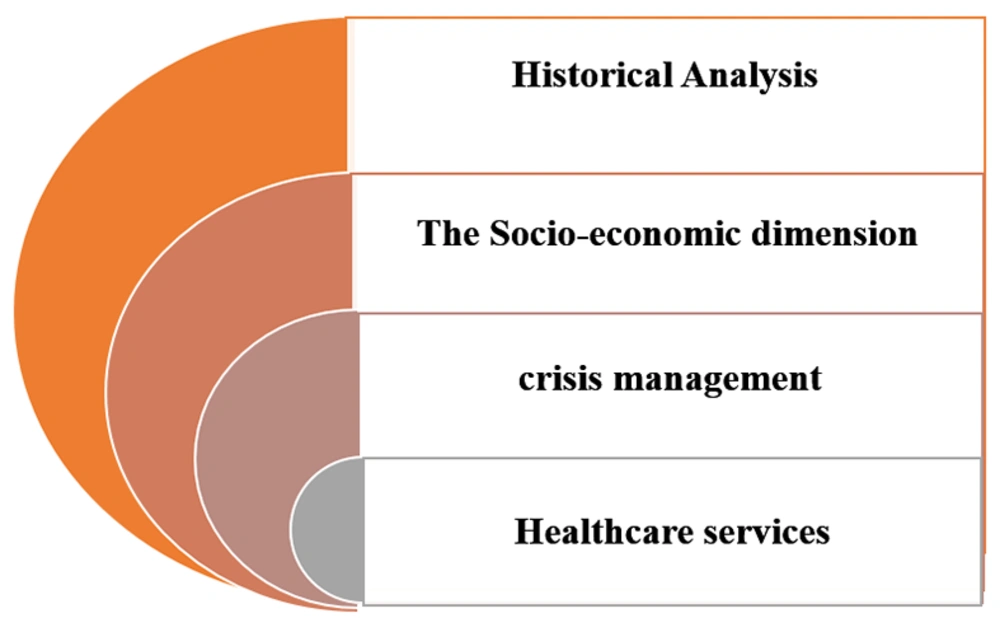
Figure 1.
Multilevel assessment of countries’ response in combatting COVID-19
2. Temporal Considerations in Evaluating Indicators
Unveiling the dynamics of assessment across different levels is a crucial consideration. While cross-sectional evaluations can be conducted for levels one to three, their value diminishes at higher levels where comprehensive assessments hold greater significance. For example, in level four, time enhances the ease and fruitfulness of judgment (e.g., examining the long-term effects of World War II on involved countries). However, cross-sectional evaluations can be performed in preceding levels during ongoing processes while recognizing that general and final evaluations carry more weight across all levels.
3. Polarity Between Solutions
The impact of a government's economic standing on COVID-19 morbidity and mortality rates emphasizes the need for supportive measures targeting households and occupations during the pandemic. Furthermore, social capital and trust play significant roles in controlling the pandemic through upholding social cohesion when implementing critical regulations (4). However, it is important to note that polarity exists between solutions proposed for different waves. This polarity implies no definitive or flawless solution; instead, an optimal balance must be sought between opposing perspectives. The following sections discuss polarities between health and economy as well as health and politics.
3.1. Polarity Between Health and the Economy
When analyzing variables related to the economic status of countries, one crucial determinant of macroeconomic resilience during crises is the government debt-to-GDP ratio (5). Consideration must be given to countries that have implemented extensive quarantine measures throughout most of the COVID-19 period. Although such actions are expected to result in fewer cases and deaths within those nations, they also severely disrupt retailers' operations as well as small- and large-scale industries. Conversely, some countries with shorter quarantine periods may experience higher morbidity and mortality rates but potentially maintain better economic conditions (6, 7). Consequently, a clear polarity emerges between health and the economy in the COVID-19 crisis, and neither should be disregarded entirely at the expense of the other. Instead, striking a balance between the two is crucial.
3.2. Polarity Between Health and Politics
A polarity exists between commonly accepted solutions for COVID-19 management in the health field and the political-security domain. For instance, specific countries, particularly those in Eastern regions, have implemented legal provisions accompanied by penalties, such as fines or imprisonment, to ensure strict compliance with quarantine measures (8). While this approach may lead to more accurate implementation of quarantine protocols, it can also generate public discontent due to perceived pressure and overuse of legal mechanisms. Conversely, some countries have relied solely on "recommendations" for implementing preventive policies, resulting in social tranquility while potentially compromising full adherence to health guidelines. Striking an optimal balance between these polarities is necessary for effective crisis management.
4. Conclusion
In order to assess the performance of countries in combatting COVID-19 and identify successful approaches, it is imperative to establish a framework for defining success. This study proposed four levels of evaluation: The health system level, crisis management level, society level, and historical level. These levels are structured as concentric circles, each encompassing a higher one. At each level, several indicators were suggested to gauge the success of different countries. Meaningful comparisons can be made by calculating and comparing these indicators across each country's respective levels.
Throughout the COVID-19 crisis, breaking the transmission chain emerged as the foremost priority due to the viral cause of the disease. Quarantine measures (later supplemented by vaccination) constituted fundamental solutions; however, they also brought about significant socio-economic repercussions. In crises stemming from communicable diseases, additional waves linked to socio-economic and political-security consequences are typically expected alongside public health implications. These consequences primarily arise from strategies employed for disease control rather than solely from the disease itself.
At the fourth-level assessment, some factors, such as time and learning, come into play alongside prior considerations, rendering this evaluation more comprehensive yet challenging compared to previous levels. Determining which of these four comparative levels holds greater significance depends on our perspective and analytical approach. Nevertheless, when assessing countries' crisis management performance objectively, all four levels must be taken into account. Given that higher levels encapsulate lower ones within their purview, evaluations conducted at higher echelons carry greater value.
Acknowledging that polarity exists between different elements involved in managing COVID-19 is crucial. Therefore, a definitive solution cannot be sought outright. Instead, a quest for an optimal balance between contrasting approaches becomes paramount. The determination of successful countries in combating COVID-19 ultimately hinges on striking this delicate equilibrium. As such, cross-sectional evaluations remain necessary during the ongoing pandemic. Moreover, a comprehensive and holistic assessment of all levels (particularly the perspective of history) becomes indispensable in identifying truly successful countries.

