




1. Context
2. Methods
2.1. Eligibility Criteria
2.2. Search Strategy
2.3. Screening and Selection
2.4. Data Extraction
2.5. Assessment of the Risk of Bias
2.6. Definitions
2.7. Meta-analysis
3. Results
3.1. Search Results
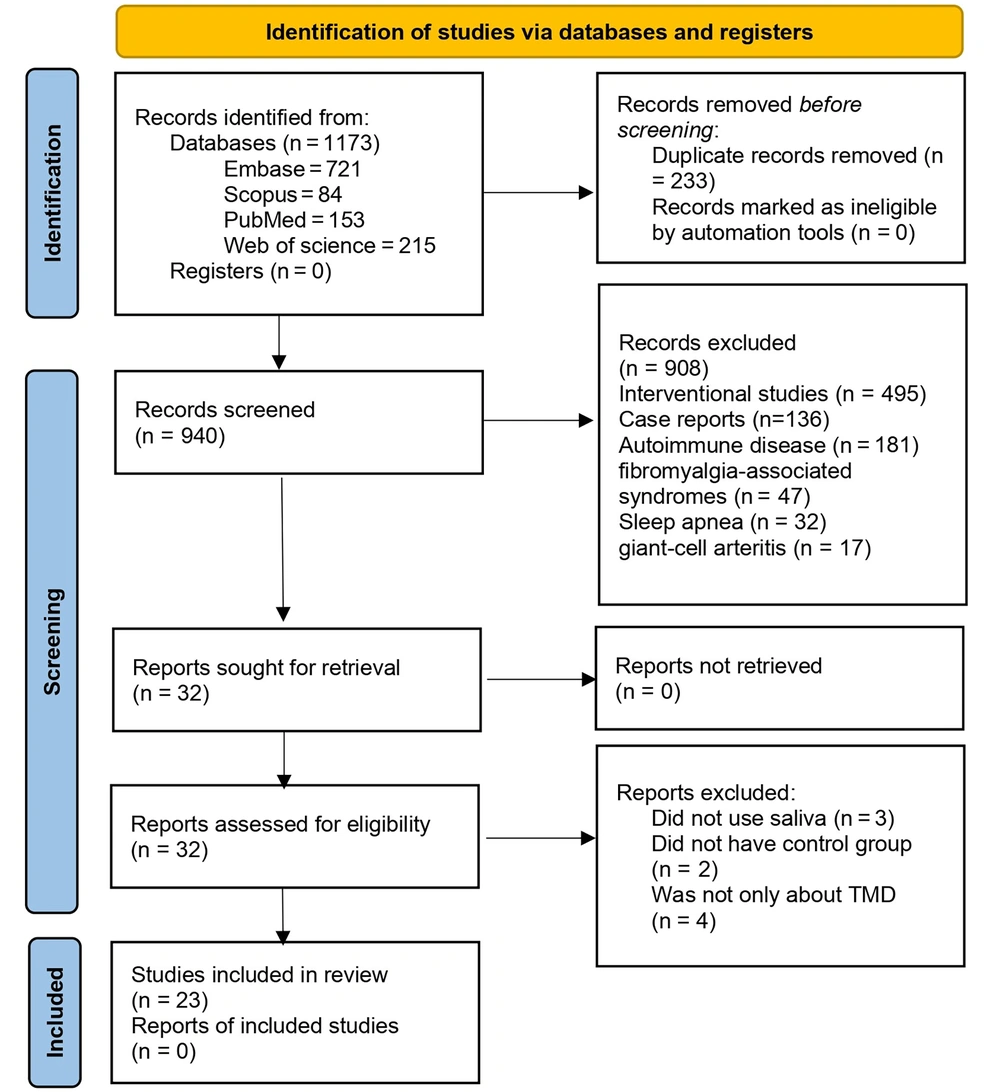
The PRISMA flow diagram shows the article selection process.
3.2. Assessing the Risk of Bias
| Author | Q1 | Q2 | Q3 | Q4 | Q5 | Q6 | Q7 | Q8 | Q9 | Q10 | Total | Risk of Bias |
|---|---|---|---|---|---|---|---|---|---|---|---|---|
| Da Silva Andrade et al.(43) | Y | Y | Y | Y | Y | Y | Y | Y | N | Y | 90 | Low |
| Nilsson and Dahlstrom (44) | Y | Y | Y | Y | Y | Y | Y | Y | U | Y | 90 | Low |
| Barabosa et al. (45) | Y | N | Y | Y | Y | Y | Y | Y | U | Y | 80 | Low |
| De Almeida et al. (46) | Y | N | Y | Y | Y | N | N | Y | N | Y | 60 | Moderate |
| Kobayashi et al. (20) | Y | Y | Y | Y | Y | N | N | Y | U | Y | 70 | Low |
| Venkatesh et al. (25) | Y | Y | Y | Y | Y | Y | U | Y | U | Y | 80 | Low |
| Jasim et al. (47) | Y | Y | Y | Y | Y | Y | Y | Y | Y | Y | 100 | Low |
| Nadendla et al. (21) | Y | Y | Y | Y | Y | Y | N | Y | U | Y | 80 | Low |
| Salameh et al. (24) | Y | Y | Y | Y | Y | Y | N | Y | U | Y | 80 | Low |
| Poorian et al. (22) | Y | U | Y | U | Y | N | N | Y | U | Y | 50 | Moderate |
| Galvão-Moreira et al. (48) | Y | N | Y | Y | Y | Y | Y | Y | Y | Y | 90 | Low |
| Vrbanovic et al. (49) | Y | Y | Y | Y | Y | N | N | Y | Y | Y | 80 | Low |
| Chinthakanan et al. (19) | Y | N | Y | Y | Y | N | N | Y | U | Y | 60 | Moderate |
| Staniszewski et al. (50) | Y | Y | Y | Y | Y | N | N | Y | U | Y | 70 | Low |
| Alresayes et al. (51) | Y | U | Y | Y | Y | Y | N | Y | U | Y | 70 | Low |
| Barakian et al. (52) | Y | U | Y | U | U | N | N | Y | Y | Y | 50 | Moderate |
| Goyal et al. (53) | Y | Y | Y | Y | Y | Y | Y | Y | U | Y | 90 | Low |
| Cheon et al. (23) | Y | N | Y | Y | Y | N | N | Y | U | Y | 60 | Moderate |
a Y, yes; N, no; U, unclear; NA, not applicable; Q, question. Q1: Were the groups comparable other than the presence of disease in cases or the absence of disease in control? Q2: Were cases and controls matched appropriately? Q3: Were the same criteria used to identify cases and controls? Q4: Was the exposure measured in a standard, valid, and reliable way? Q5: Was the exposure measured the same way for cases and controls? Q6: Were confounding factors identified? Q7: Were strategies to deal with confounding factors stated? Q8: Were outcomes assessed in a standard, valid, and reliable way for cases? Q9: Was the exposure period of interest long enough to be meaningful? Q10: Was appropriate statistical analysis used? Total = ΣY/applicable items (not applicable (NA) items were excluded from the sum). The risk of bias was classified as high when the study reached a "yes" score of up to 49%, moderate when the study reached a "yes" score of 50 to 69%, and low when the study reached a "yes" score of more than 70%.
3.3. Characteristics of the Studies
| Author | Country | Sex (Female %) | Participants’ Age (year) in the Case/ Control Group | Sample Size in the Case/ Control Group | Type of Saliva | Cortisol Levels (µg/dL) in the Case Group (Mean ± SD) | Cortisol Levels (µg/dL) in the Control Group (Mean ± SD) |
|---|---|---|---|---|---|---|---|
| Da Silva Andrade et al. (43) | Brazil | 50 | 22.5/22.8 | 20/20 | Stimulated | 0.27 ± 0.10 | 0.39 ± 0.33 |
| Nilsson and Dahlstrom (44) | Sweden | 100 | 19.7/21.2 | 30/30 | Stimulated | 0.41 ± 0.24 | 0.49 ± 0.36 |
| Barabosa (45) | Brazil | 66 | 11/11 | 86/59 | Stimulated | 0.21 ± 0.16 | 0.16 ± 0.12 |
| De Almeida et al. (46) | Brazil | 75 | 21.8/21.2 | 25/23 | Stimulated | 0.27 ± 0.2 | 0.39 ± 0.33 |
| Kobayashi et al. (20) | Brazil | 63 | 10.6/10.6 | 38/38 | Stimulated | 0.15 ± 0.09 | 0.15 ± 0.09 |
| Venkatesh et al. (25) | India | 53 | 20.5/20.5 | 107/241 | Stimulated | 1.10 ± 0.17 | 0.69 ± 0.16 |
| Jasim et al. (47) | Sweden | 100 | 42.3/45.7 | 27/27 | Unstimulated | 0.20 ± 0.26 | 0.21 ± 0.14 |
| Nadendla et al. (21) | India | 55 | 36.6/36.6 | 20/20 | Unstimulated | 1.7 ± 0.29 | 0.53 ± 0.13 |
| Salameh et al. (24) | Syria | 70 | 29.1/29.1 | 60/60 | Unstimulated | 0.21 ± 0.13 | 0.07 ± 0.04 |
| Poorian et al. (22) | Iran | 54 | 32.4/39.6 | 15/60 | Unstimulated | 2.90 ± 0.52 | 0.88 ± 0.95 |
| Galvão-Moreira et al. (48) | Brazil | 64 | 28.5/28.5 | 39/33 | Unstimulated | 0.10 ± 0.04 | 0.084 ± 0.04 |
| Vrbanovic et al. (49) | Croatia | 100 | 39.3/34.3 | 20/15 | Unstimulated | 0.41 ± 0.28 | 0.24 ± 0.16 |
| Chinthakanan et al. (19) | Thailand | 72 | 22/26.0 | 23/21 | Unstimulated | 0.29 ± 0.12 | 0.22 ± 0.06 |
| Staniszewski et al. (50) | Norway | 86 | 44/46 | 44/44 | Unstimulated | 0.26 ± 0.22 | 0.17 ± 0.13 |
| Alresayes et al. (51) | Saudi Arabia | 88 | 16.3/16.5 | 18/18 | Unstimulated | 0.31 ± 0.03 | 0.05 ± 0.00 |
| Barakian et al. (52) | Iran | NR | NR | 24/36 | Unstimulated | 0.49 ± 0.37 | 0.45 ± 0.20 |
| Goyal et al. (53) | India | 50 | 25.5/23.6 | 40/20 | Unstimulated | 0.36 ± 0.22 | 0.12 ± 0.42 |
| Cheon et al. (23) | Korea | 50 | 28.2/25.9 | 32/34 | Unstimulated | 0.2 ± 0.12 | 0.11 ± 0.03 |
aUnstimulated saliva: The saliva produced at rest, which is saliva secreted most of the day, can be collected by spitting and absorbent methods. Stimulated saliva: Stimulation of salivation typically occurs between 10% and 20% of the day, influenced by olfactory, gustatory, and mechanical stimuli. The sympathetic and parasympathetic subsystems of the autonomic nervous system control the secretion of salivary fluid and proteins. Upon stimulation, the saliva volume increases and becomes more hypotonic and less viscous.
3.4. Meta-analysis
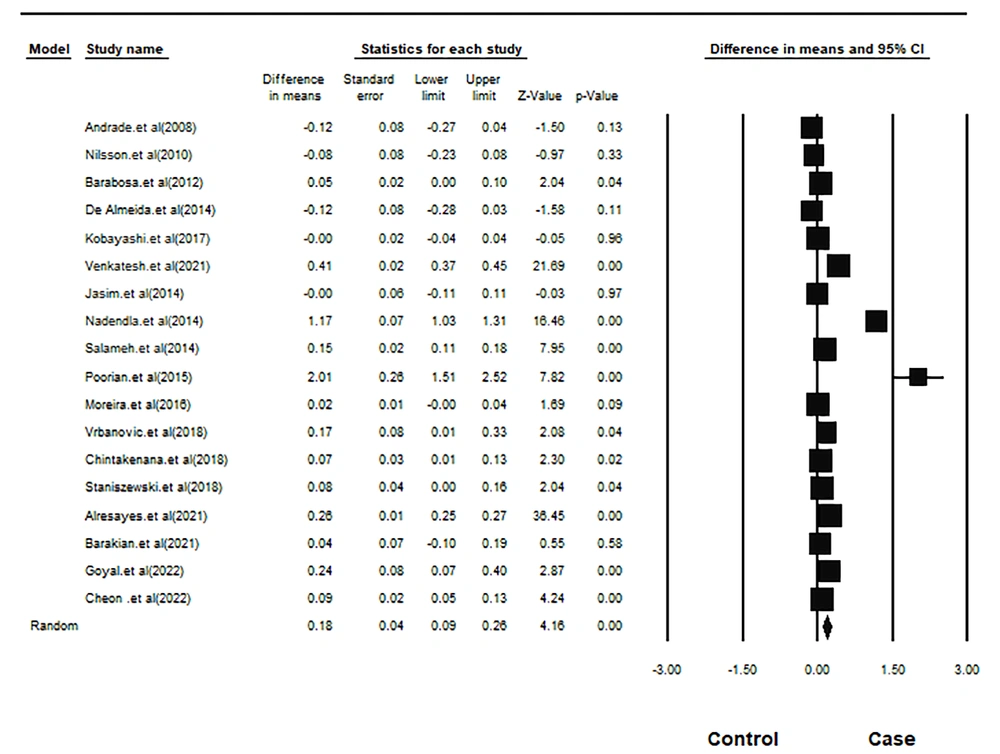
The forest plot depicting the included studies in the present meta-analysis.
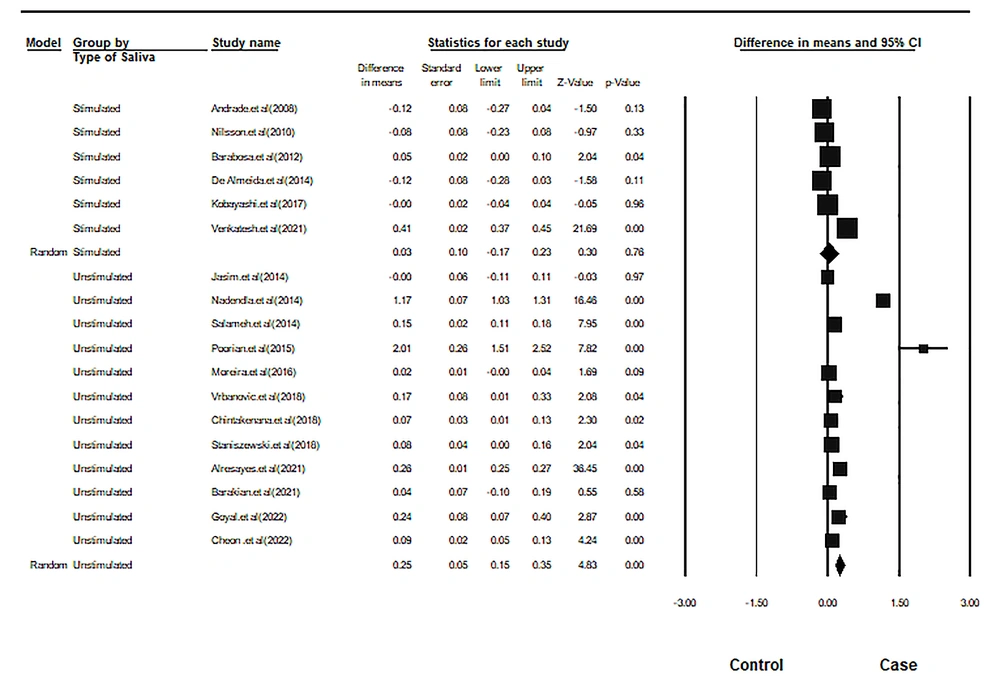
The forest plot of subgroups categorized according to the type of saliva collection method
| Groups | Effect Size and 95% Confidence Interval | Test of the Null Hypothesis (2-Tail) | Heterogeneity | ||||||||
|---|---|---|---|---|---|---|---|---|---|---|---|
| Number of Studies | Point Estimate | Standard Error | Lower Limit | Upper Limit | Z-Value | P-Value | Q-Value | df (Q) | P-Value | I-Squared | |
| Stimulated saliva | 6 | 0.03 | 0.10 | -0.17 | 0.23 | 0.30 | 0.76 | 291.13 | 5 | 0 | 98.28 |
| Unstimulated saliva | 12 | 0.25 | 0.05 | 0.15 | 0.35 | 4.83 | 0.00 | 687.96 | 11 | 0 | 98.40 |
3.5. Meta-regression Results Based on Age
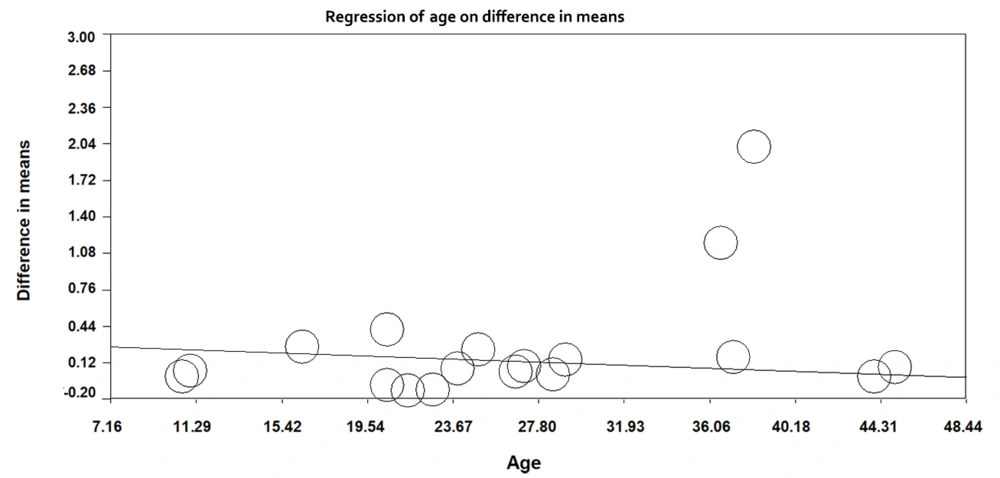
The meta-regression for age in the included articles.
3.6. Publication Bias
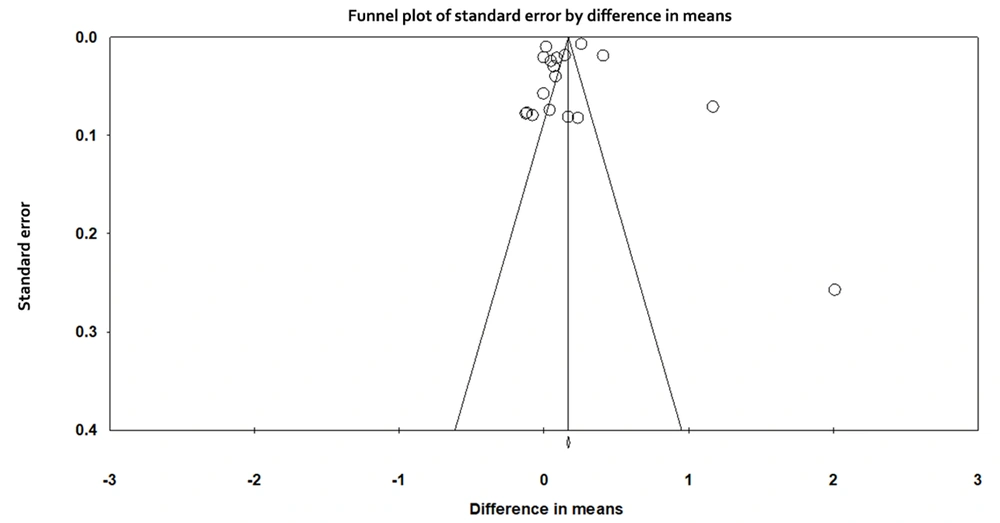
The Funnel plot of publication bias



