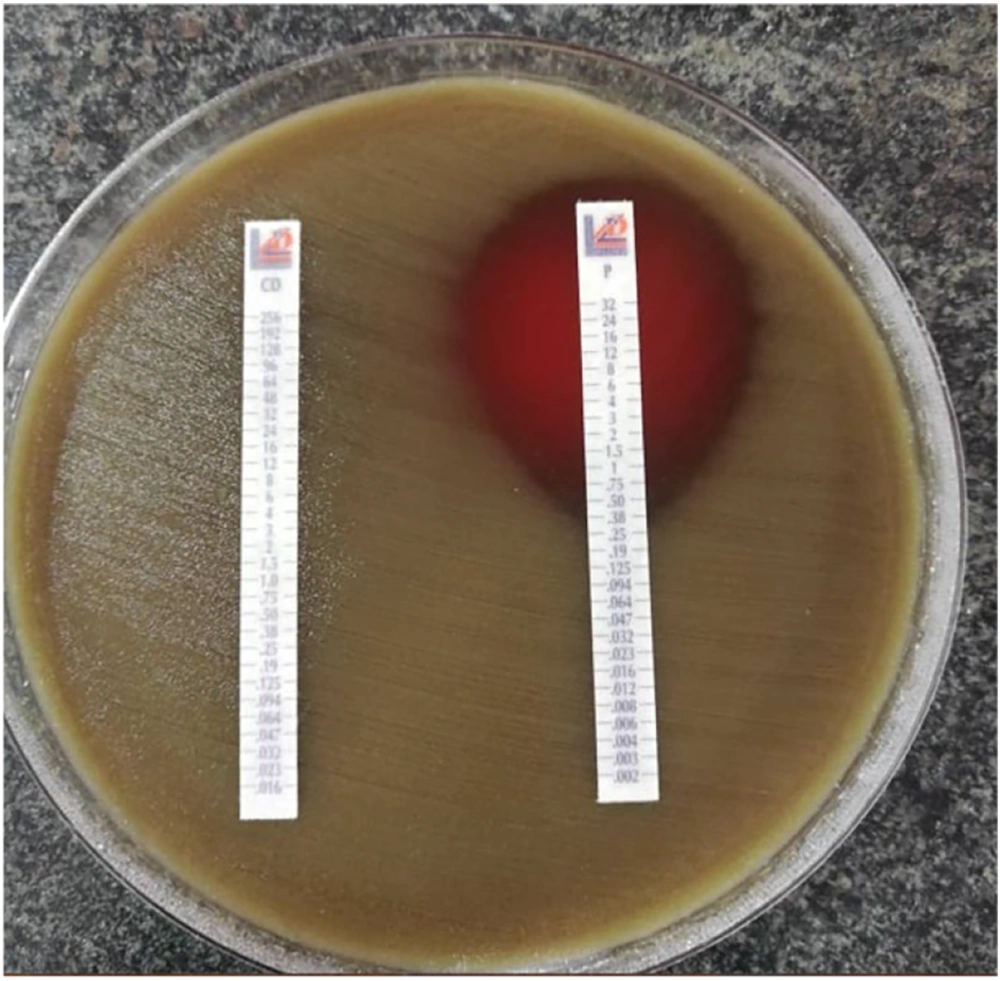
Antibiotic resistance has become a global public health crisis. Dentists are aware of the phenomenon of antibiotic resistance and play an important role in preventing the emergence of antibiotic resistance (
16). In the present study, the samples taken from the root surface extracted teeth were cultured for analyzing streptococci spp., which is due to the presence of this group of bacteria in the normal flora of the oral cavity, oral infections, periodontitis, and pericoronitis. The range of MIC of streptococcal spp. isolated from the root surface in the current study for penicillin was between 0.09 and 2 μg/mL, which, compared to older studies (
3,
17-
23), has increased, which indicates an increased ability of this type of bacteria to resist, compared to the past. Moreover, the maximum MIC level in the present study is still in the range that can be treated with this drug, and it seems that in cases where the immune system of individuals is competent, it can still be used as a first-line drug for the treatment of oral infections.
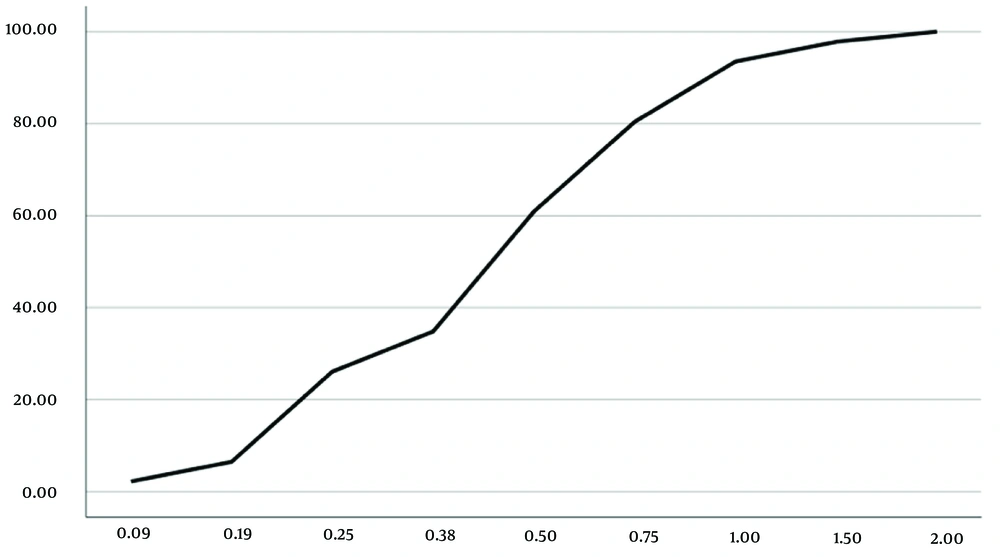
By training and increasing the skills of doctors in relation to the prescription of antibiotic agents and improving the knowledge of patients to use antibiotic drugs appropriately, it is possible to prevent the development of more resistance to this antibiotic and use penicillin for the treatment of oral infections, and it is still promising. The standard deviation observed in MIC for penicillin was 0.6, which is more than what was observed for clindamycin (0.12). The higher deviation of MIC against penicillin shows that despite the much longer duration of extraction and use of this antibiotic, there are still many sensitive cases with multiple MICs. According to
Figure 3, it can be concluded that the current average level of resistance to penicillin is more widespread, and the largest number of samples were inhibited at MIC equal to 0.5 μg/mL. Moreover, it is possible to increase the dose more for penicillin to inhibit more of these isolates; however, this dose adjustment is not possible for clindamycin because side effects and toxicity, along with increasing the dose, reduce the therapeutic window of this antibiotic.
The range of MIC of streptococci spp. isolated from the root surface in the present study for clindamycin was between 0.06 and 256 μg/mL, which has increased, compared to other studies (
3,
17-
23), which indicates an increase in resistance of this type of bacteria, compared to the past. In the present study, the maximum MIC did not inhibit some of the isolated streptococci spp., and it seems that in cases where there is resistance to this drug (21.8%), it is not effective either as a therapeutic antibiotic or as a prophylactic antibiotic. However, in cases where there was sensitivity to this drug, it was effective with a significantly lower MIC than penicillin. Therefore, in sensitive cases, this drug can reduce the duration of hospitalization and reduce related treatment costs.
The MIC 50 and MIC 90 of streptococcal spp. isolated from the root surface in the present study was reported to be 0.5 μg/mL and 1 μg/mL, respectively, for penicillin and 0.125 μg/mL and 0.19 μg/mL, respectively, for clindamycin, which is much higher than similar studies (
2,
3,
17,
19,
23) in developing countries. The diversity observed in the MICs reported in studies of aerobic streptococcal isolates for clindamycin can be considered to be related to the greater spectrum of activity of this antibiotic on obligate anaerobic microorganisms. However, this drug is among the alternatives to antibiotic prophylaxis, and further studies are needed in relation to assessing the effectiveness of this antibiotic in the common types of streptococci spp. that cause infective endocarditis and cases of prosthetic joint infection.
Most of the studies reported the resistance of aerobic isolates to penicillin within the range of 10 - 60% (
2,
13-
15,
24-
32). In the present study, only one sample was sensitive to penicillin, and the other samples (95.6%) did not show resistance to penicillin; however, they were in the MIC range of intermediate sensitivity. The range of resistance of facultative aerobic and anaerobic isolates to clindamycin has been reported between 0 - 65% in the reviewed articles. In the present study, 21.8% of the examined samples showed resistance to clindamycin. It can be concluded that in some cases, aerobic isolates were resistant to clindamycin; however, there was intermediate sensitivity to penicillin, which can lead to the conclusion that the effect of penicillin on aerobic types of polymicrobial infections of the oral cavity is more than clindamycin. In 78.2% of the samples, the sensitivity of the same type of bacteria to clindamycin was observed, and the same samples were intermediately sensitive to penicillin. Therefore, the elimination of clindamycin in the new antibiotic prophylaxis protocol published in 2021 by the American Heart Association makes sense.
5.1. Conclusions
According to the present study, penicillin can still be used as a first-line drug to prevent infections in the mouth, jaw, and face. Today, this drug has been forgotten for the treatment of oral infections in Iran, although penicillin is still the first line of treatment in most antibiotic treatment guidelines for oral infections. It seems that except in limited cases where there is resistance to clindamycin, this antibiotic is a more effective drug to control the bacteria in the mouth. However, in some cases, aerobic isolates showed intermediate sensitivity to penicillin V; instead, they were resistant to clindamycin.