The main purpose of this study was to evaluate the effects of CE on antioxidant enzyme gene expression, histopathology, and antioxidant parameters in the liver of diabetic rats. Reactive oxygen species (ROS), as by-products of aerobic metabolism, are continually produced and have numerous physiological functions as well as harmful effects. Under physiological conditions, ROS are detoxified by the antioxidant defense system, which consists of antioxidant substances such as GSH, as well as antioxidant enzymes like superoxide dismutase (SOD), glutathione peroxidase (GPx), GR, and CAT.
An imbalance between oxidant and antioxidant factors and the overproduction of ROS lead to oxidative stress, which can react with and modify cellular proteins, lipids, and DNA. Oxidative stress is related to the progression of diabetes complications (
27,
28). Because the liver is the most important organ involved in oxidative and detoxification processes, oxidative stress biomarkers were evaluated in the liver in this study. Additionally, experimental data show that the liver is subject to damage mediated by ROS in diabetes. Diminished body weight, polyphagia, and polydipsia are common disorders observed in diabetes (
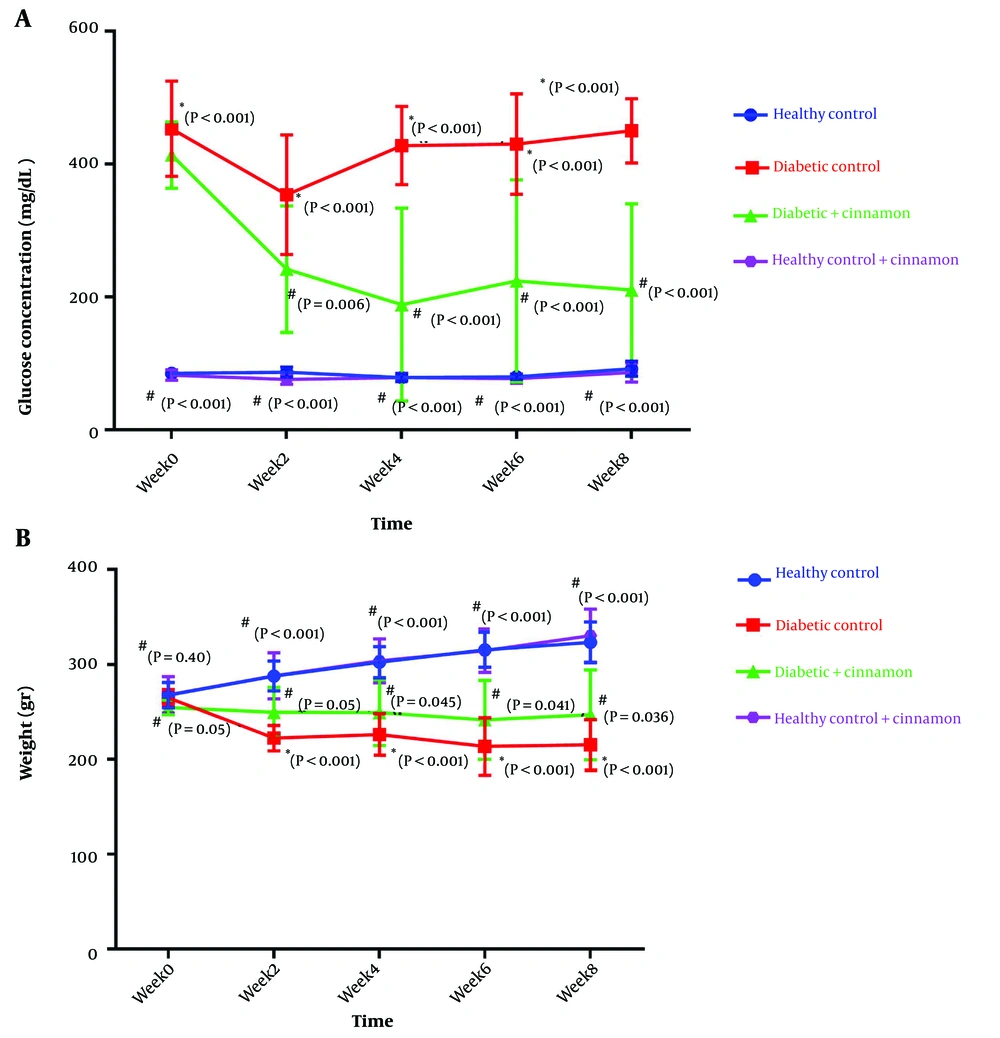
29). In this study, the induction of diabetes by STZ decreased the body weight of the rats starting from the second week compared to the rats in the healthy control group (P < 0.001). When compared to diabetic control rats, the body weight of the diabetic rats increased after receiving CE. Similar results were reported by some researchers (
29-
31). However, Ranasinghe et al. (
32) showed a decrease in body weight in diabetic rats, and CE treatment could not increase body weight. The experiment period, dosage, and CE preparation method could account for the discrepancy between our data and the results of Ranasinghe et al. The body weight reduction in diabetic rats is likely due to the catabolism of fats and protein, as insulin deficiency results in an elevation in proteolysis of protein content in muscular tissue (
33).
As demonstrated in the present study, Cinnamon was an effective agent for reducing glucose levels in serum. CE administration for diabetic rats decreased the plasma glucose level by 31% from the second week and by 53% by the end of the experiment. Our results align with those of Mahmood et al., who observed an increase in blood glucose levels in diabetic rats and a subsequent reduction after CE administration (
34). Similarly, Al-Qulaly et al., Nurinda et al., Celik et al., and Boudiaf et al. showed that gavaging diabetic rats with CE significantly reduced blood glucose levels, which could be attributed to pancreatic β-cells regeneration and an elevation in insulin secretion in diabetic rats (
21,
35-
37). Additionally, some researchers reported that Cinnamon contains various components such as phenolic acids, steroids, flavonoids, and terpenoids that have anti-diabetic effects (
38,
39). Prolonged hyperglycemia due to diabetes causes an increase in the production of free radicals, which alter cellular functions and induce lipid peroxidation. The lipid peroxides attack cell membranes, damaging proteins and DNA, leading to various diabetic complications. In the present study, the liver MDA level, a marker of lipid peroxidation, increased in diabetic rats, while administration of CE significantly diminished the MDA level close to the normal value (
40). Our results align with previous studies that reported Cinnamon reduced MDA concentrations in the serum, liver, and kidney of diabetic rats (
15,
16,
29). GSH is known as a critical free radical scavenger in the intracellular region, mainly maintaining the antioxidant status in plasma and cells (
40). In this study, the GSH level in the liver of rats was determined, and the results showed that this parameter was not significantly altered in all groups. Some studies have demonstrated that the induction of diabetes in rats results in the diminishing of GSH levels, and administration of CE for these rats significantly increased GSH levels. The discrepancy between our results and the results of Mohammed et al. is probably due to various factors, such as different study models, CE dose, Cinnamon preparation, rat species, and so forth. We used a water extract of Cinnamon at a dose of 40 mg/kg, B.W. in Sprague Dawley rats, but Mohammed et al. treated albino Wistar rats with nano-encapsulated Cinnamon oil at doses of 200 mg/kg and 400 mg/kg (
15).
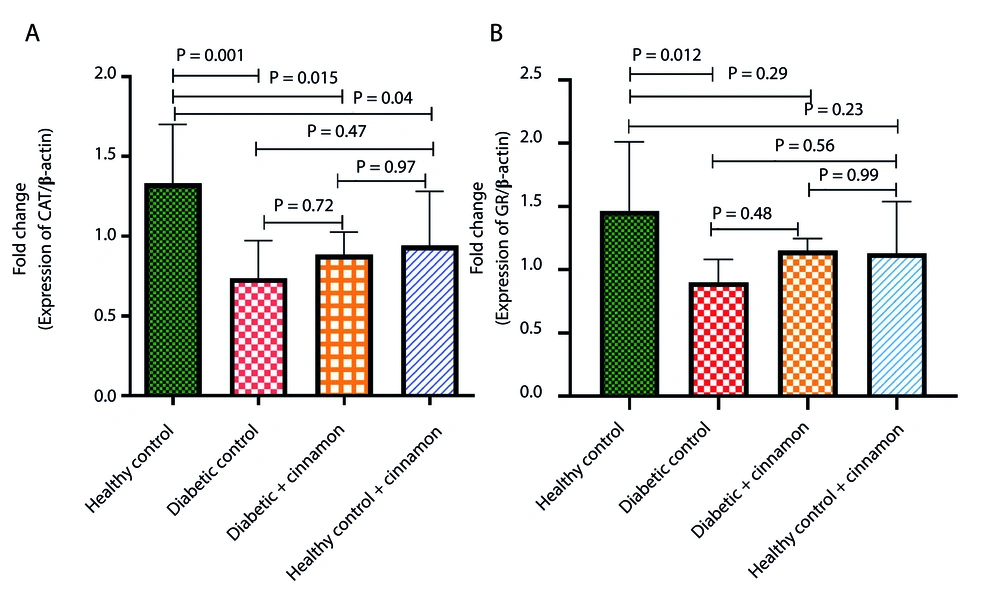
According to our results, the mRNA expression of the antioxidant enzymes CAT and GR in diabetic rats significantly decreased compared to the healthy control group. While administration of CE for diabetic rats could not significantly increase the mRNA expression of CAT and GR. Niazmand et al. reported that the activity of CAT in the liver homogenate of diabetic rats decreased and CE could increase this enzyme’s activity. In their study, the expression of the CAT gene was not investigated (
41). The difference between our results and the previous study is due to the study design. In general, CAT decomposes hydrogen peroxide (H
2O
2) derived from SOD activity into water and oxygen. In animals, H
2O
2 is detoxified by CAT and GPx, and H
2O
2 regulates CAT gene expression. Because catalase shares its substrate with glutathione peroxidase, no significant change in the expression of the catalase gene after CE administration may be due to H
2O
2 being involved in the reaction of glutathione peroxidase (
42). The GR enzyme converts oxidized glutathione to its reduced form (GSH) by oxidizing NADPH. Some studies have reported that the activities of CAT, GPx, and SOD in the liver of diabetic rats are diminished compared to control rats, and cinnamon can reverse these effects after 4 or 6 weeks (
40,
43). Our results align with these studies regarding the reduction of antioxidant enzyme activity following diabetes induction. However, the administration of CE couldn’t restore these enzymes at the gene expression level. Conversely, other researchers have demonstrated that the activity of SOD, CAT, and GR enzymes increased in diabetic rats after 5 - 6 weeks (
44,
45). However, none of these researchers studied these enzymes at the gene expression level. It has been shown that oxidative stress in a cell can stimulate the transmission of transcription factors that are sensitive to redox conditions into the nucleus. Therefore, changes in the gene expression of antioxidant enzymes in diabetes are likely due to the oxidation of transcription factors, which affects the initiation of transcription of these enzyme genes (
46). Liver histology in the healthy control group demonstrated normal structure and cellular construction, including the portal triad, numerous hepatocytes, and the central vein. The histopathology of the liver in STZ-diabetic animals showed mild hypertrophy in hepatocytes, consistent with the results of previous studies (
15,
30). Interestingly, the administration of CE (40 mg/kg B.W) had no protective effects on hepatocyte structure in diabetic rats. The hypertrophy of hepatocytes may be due to an increase in intracytoplasmic eosinophilic granules in hepatic cells and an elevated level of general oxidative stress in diabetic conditions (
15). Mohammed et al. reported that the administration of nano-encapsulated cinnamon oil (400 mg/kg B.W) improved the structure of hepatic cells in diabetic rats. The discrepancy between our results and those of Mohammed et al. is likely due to differences in CE dose, cinnamon extract preparation, and rat species (
15).
In conclusion, the findings of our study indicate that the administration of CE at 40 mg/kg for STZ-induced diabetic rats significantly normalized hyperglycemia and lipid peroxidation after 8 weeks. However, this herbal medicine could not normalize the histopathological changes that occurred in diabetic rats. Additionally, since this extract has adverse effects on hepatocytes, its prescription as an anti-diabetic agent should be done with caution and should include liver examination. Although this study showed that cinnamon had a significant positive impact on the antioxidant system in diabetes, further well-planned randomized clinical trials are required to confirm this regimen as a safe and useful remedy. Additionally, more research should be conducted to clarify the other molecular processes contributing to cinnamon's protective effects against diabetes, beyond its impact on the human liver.


-preview.webp "Representative histopathological profiles on the liver of healthy control rats (A1, A2); diabetic control rats (B1, B2); diabetic + Cinnamon treated rats (C1, C2); healthy control + Cinnamon treated rats (D). Scale bar is 100 μm (hematoxylin and eosin staining; magnification of A1, A2, and D are ×200; magnification of B1, B2, and C1 are ×400; magnification of C2 is ×100).")



