


1. Background
Health systems play a pivotal role in improving quality of life and increasing life expectancy in the new century (1). Health and treatment centers are tasked with providing comprehensive and accessible preventive care and treatment to address the most common health needs of society. These centers operate in coordination with other levels of the health system to ensure effective referrals (2, 3). In Iran, access to healthcare is recognized as a fundamental right. To deliver quality services within the health system, human resources play a critical role (4, 5). Human resources are among the most important strategic assets of any organization, and the success of organizations and workplaces is largely dependent on the efficient use of human resources guided by behavioral sciences (6-8). However, healthcare organizations face significant challenges, as human resources, their most valuable asset, are subjected to considerable work pressures and problems (9, 10).
Stressful factors can induce nervous strain and job-related stress for almost everyone (11). The consequences of stress among employees include cardiovascular diseases, hypertension, gastrointestinal disorders, mental health issues, communication difficulties, absenteeism, job turnover, increased accidents, and burnout (12, 13).
Resilience is an essential ability that enables individuals to adapt effectively to changes and stressors, helping them manage and overcome challenges (13-15). Newman defines resilience as the ability to adapt to difficulties (16). Through resilience, individuals can transform stressful situations into opportunities for learning and growth, addressing challenges by focusing on solutions (17). Resilience enhances well-being and job satisfaction among employees (18). It also positively influences job burnout, contributing to increased productivity in healthcare organizations (9).
Job burnout is a psychological condition characterized by emotional exhaustion, depersonalization, and a diminished sense of personal achievement among workers in social services (19, 20). This condition negatively affects service quality, fostering a negative self-image, adverse attitudes toward work, and disconnection from clients during care provision (21). A study by Elbarazi et al. highlighted the high prevalence of burnout among healthcare professionals, such as physicians and nurses, in Arab countries, including Lebanon (22). The repercussions of burnout extend beyond individuals to interpersonal relationships, families, and society, causing significant psychological and financial harm to systems and communities (23).
According to a study by Sherman burnout adversely impacts mental and physical health, reducing job satisfaction, service quality, and client satisfaction (24). Resilience has been identified as an effective strategy to prevent job burnout (25).
Examining human resource productivity is critical for the progress and sustainability of any organization (9, 26). Productivity encompasses the effectiveness, efficiency, and capability of employees, reflecting the optimal utilization of labor, power, talent, and skills (9). In the competitive modern world, productivity is essential for organizational survival and success. A culture of productivity promotes the efficient use of both material and intangible resources within an organization (27).
Research by Khazaei and SharifZadeh revealed that burnout is particularly pronounced among hospital employees, especially nurses (28). Conversely, Mansourian et al. demonstrated that resilience helps individuals manage stress and reduce the likelihood of burnout (29). Furthermore, improving the quality of work life enhances employee motivation, which subsequently increases resilience in the workplace (27). A study by Hatami et al. confirmed that a higher quality of work life correlates significantly with greater employee productivity (6).
2. Objectives
Given the importance of resilience and burnout in relation to healthcare worker productivity, this study aims to examine the correlation between resilience, burnout, and productivity among healthcare workers in southern Iran. The findings of this research can contribute to improving employee performance and identifying effective strategies for healthcare managers.
3. Methods
This cross-sectional study was conducted at Zahedan University of Medical Sciences (ZAUMS) in 2023 and included all employees working during that year. The inclusion criteria required participants to be employees of Zahedan health centers and hospitals, while the sole exclusion criterion was the employees' unwillingness to participate in the study.
Using the formula and considering a first-type error of 5% (30), a power of 80%, a correlation rate of 0.36 (31), and an anticipated 20% dropout rate, the estimated sample size was calculated to be 350 participants.
Confidence limits of correlation coefficient:
Two large public hospitals, Ali Ibne Abitaleb and Khatam Alanbia, were selected from the six hospitals affiliated with ZAUMS, and employees from these hospitals were included in the study. Participants from hospitals and health centers were chosen through systematic random sampling.
3.1. Data Collection Tools
(1) The Connor-Davidson Resilience Scale (CD-RISC) is a self-rated assessment designed to measure stress coping ability. Developed based on the concepts of hardiness, adaptation, and stress endurance, the scale has been validated in diverse populations. It includes 25 items rated on a five-point Likert scale ranging from completely false (0) to always true (4). The total score ranges from 0 to 100, with scores above 60 indicating high resilience. The resilience dimensions assessed are courage, optimism, and adaptability. This scale was standardized in Iran by Mohammadi and Jafarmahdian, who reported a reliability coefficient of 0.89 using Cronbach's alpha (32). Shafizadeh’s study further validated the questionnaire with a Cronbach's alpha of 0.91 (33).
(2) The Maslach Burnout Questionnaire was developed for teachers in 1981. This tool is designed to measure the level of burnout among personnel in various organizational roles and to compare burnout levels across different groups within an organization as well as between research cohorts (34). The scoring method for this 22-question questionnaire is structured such that questions 1, 2, 3, 6, 8, 13, 14, 16, and 20 represent the fatigue subscale , questions 5, 10, 11, 15, and 22 correspond to the depersonalization subscale , and questions 4, 7, 9, 12, 17, 18, 19, and 21 constitute the individual performance subscale .
Each question is scored on a scale from 0 to 6. The total score for each subscale reflects the individual's level of burnout in that area. The options on the scale— never , little , sometimes, medium, high, and always —are assigned scores of 1, 2, 3, 4, and 5, respectively. Higher scores indicate greater levels of burnout.
This scale was standardized in Iran by Khammarnia et al., who confirmed its validity and reliability. The internal reliability of the questionnaire was reported with a Cronbach's alpha coefficient ranging from 0.71 to 0.90, while the test-retest reliability coefficient ranged from 0.61 to 0.80 (34). In Rostami et al.'s study, the reliability coefficient of the questionnaire, as determined using Cronbach's alpha, was found to be 0.85 (35).
3. The human resource productivity questionnaire, based on the Achio model, was developed by Hersey and Goldsmith in 1980. This tool utilizes a five-point Likert scale (very low (1), low (2), medium (3), high (4), and very high (5)) and comprises 26 questions. It has been widely applied in both internal and external research studies. To calculate the total score of the questionnaire, the scores of all questions are summed. The total score ranges from 26 to 130, with higher scores indicating greater resilience in the respondent, and lower scores indicating less resilience.
The cut-off point for this questionnaire is 50 points. A score above 50 signifies that the individual possesses resilience. This questionnaire assesses resilience through three dimensions: Courage, optimism, and associate degree. The validity and reliability of this tool were verified by Bakhshi and Kalantari, who reported a reliability coefficient using Cronbach's alpha of 0.759 (36).
After obtaining the necessary permits from the university's research vice-chancellor to conduct the project, health and treatment centers were visited, and the questionnaires were distributed to the employees. The purpose of the study was explained to the participants. To encourage participation and ensure accurate completion of the questionnaires, the researcher remained available to address any questions from the participants. Once the participants completed the questionnaires, the forms were collected and entered into the software for analysis.
Data analysis was performed using SPSS software. The normality of the data was assessed using the Kolmogorov-Smirnov test (P > 0.05). To describe the data, descriptive statistics such as the mean and standard deviation were used. The mean provided a measure of central tendency, while the standard deviation indicated the dispersion of the data around the mean. Additionally, inferential statistical tests, including the t-test, one-way ANOVA, and Pearson's correlation, were applied to analyze differences between groups or conditions in the data and to examine correlations between the variables.
4. Results
Of the 350 participants, 235 were employed in hospitals, while 115 worked in health centers. The average age of employees at ZAUMS was 34.03 ± 7.6 years. Table 1 illustrates the correlation between employees' demographic variables and their resilience, job burnout, and productivity.
Table 1.The Frequency of Demographic Variables and the Mean of Productivity, Resilience, and Job Burnout with Demographic Variables Among the Employees of Zahedan University of Medical Sciences in 2023 a
| Variables | Values | Job Burnout | Productivity | Resilience |
|---|---|---|---|---|
| Gender | ||||
| Male | 152 (43.4) | 84.7 ± 15.7 | 74.8 ± 14 | 92.4 ± 13.8 |
| Female | 198 (56.6) | 85.7 ± 16.7 | 72.3 ± 14.3 | 88.3 ± 13.7 |
| P-value | - | 0.623 | 0.110 | 0.006 b |
| Marital status | ||||
| Single | 101 (28.9) | 81.7 ± 15.7 | 74.5 ± 14.4 | 89.4 ± 14.3 |
| Married | 249 (71.1) | 86.8 ± 16.3 | 73 ± 14.2 | 90.3 ± 13.7 |
| P-value | - | 0.007 b | 0.371 | 0.642 |
| Education | ||||
| Diploma | 10 (2.9) | 93.5 ± 18.0 | 66.2 ± 9 | 86.2 ± 12.6 |
| Associate degree | 24 (6.9) | 83.5 ± 18.0 | 65.9 ± 12.7 | 87.5 ± 14 |
| Bachelor's degree | 261 (74.6) | 85 ± 16.1 | 92.4 ± 13.8 | 89.3 ± 14 |
| Masters | 29 (8.3) | 86.6 ± 11.1 | 77.4 ± 11.3 | 93 ± 12 |
| PhD | 26 (7.4) | 85.1 ± 16.2 | 80.2 ± 16 | 97.6 ± 11.5 |
| P-value | - | 0.541 | 0.001 b | 0.011 b |
| Service location | ||||
| Hospital | 235 (67.1) | 86.7 ± 14.7 | 73.9 ± 14.6 | 89.1 ± 14.3 |
| Health Center | 115 (23.9) | 80.6 ± 18.3 | 74.1 ± 13.5 | 91.9 ± 12.8 |
| P-value | - | 0.001 b | 0.572 | 0.071 |
a Values are expressed as No. (%) or mean ± SD.
b P-value less than 0.05 was considered as statistically significant.
The average scores for productivity, resilience, and job burnout dimensions are presented in Table 2. According to the findings, the total scores for resilience, job burnout, and productivity were 90.0, 85.3, and 73.4, respectively. The highest resilience score was observed in the courage component (32.5), the highest score for job burnout was in the individual performance dimension (41.6), and for productivity, the highest score was related to feedback (12.5).
Table 2.The Average Scores of Resilience, Job Burnout, and Productivity Among Employees of Zahedan University of Medical Sciences in 2023
| Variables | Mean ± SD |
|---|---|
| Resilience | |
| Courage | 32.5 ± 5.7 |
| Optimism | 23.9 ± 4.1 |
| Associate degree | 26.1 ± 4.6 |
| Total | 90.0 ± 1.3 |
| Job burnout | |
| Emotional exhaustion | 30.5 ± 11.6 |
| Disfigurement | 13.2 ± 6.1 |
| Individual performance | 41.6 ± 9.8 |
| Total | 85.3 ± 16.3 |
| Productivity | |
| Ability | 10.1 ± 2.1 |
| Understanding | 12.4 ± 3.1 |
| Organizational support | 9.6 ± 3.1 |
| Motivation | 8.8 ± 3.3 |
| Feedback | 12.5 ± 3 |
| Validity | 10.5 ± 3.4 |
| Compatibility | 9.2 ± 2.9 |
| Total | 73.4 ± 14.2 |
The correlation between productivity, burnout, and resilience was analyzed using Pearson's correlation test, with results detailed in Table 3. The findings revealed a significant correlation between resilience and productivity, as well as between age variables and resilience and burnout (P < 0.05).
Table 3.Resilience Correlation with Job Burnout and Productivity Among Employees of Zahedan University of Medical Sciences in 2023
| Variables | Productivity | Resilience | Job burnout | Age |
|---|---|---|---|---|
| Productivity | 1 | - | - | - |
| Resilience | R = 0.313; P = 0.001 | 1 | - | - |
| Job burnout | R = -0.036; P = 0.476 | R = 0.034; P = 0.532 | 1 | - |
| Age | R = 0. 15; P = 0.032 | R = 0.123; P = 0.021 | R = 0.069; P = 0.196 | 1 |
Figure 1 visually represents the correlation between resilience, burnout, and productivity.
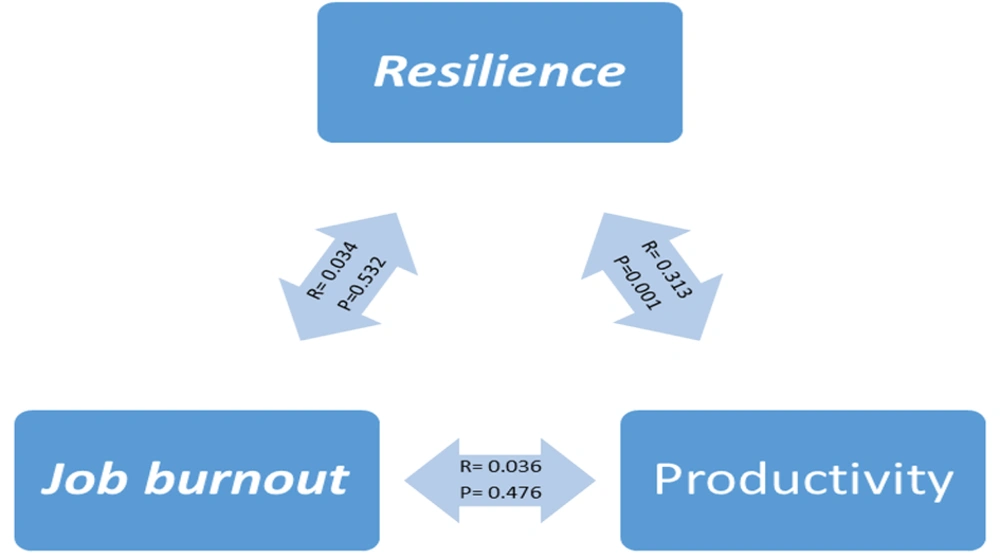
Figure 1.
The correlation between organizational resilience and job burnout and productivity among employees; P = P-value, R = correlation coefficient.
5. Discussion
Based on the results, the average resilience score was high, aligning with the findings of Sardarzadeh and Jian Bagheri (37). This score is more favorable and higher compared to the averages reported by Geraminejad et al. (38) and Rostami et al. (35). Higher resilience among employees reduces organizational tension and enhances service quality, ultimately increasing productivity and customer satisfaction.
The average job burnout in this study was higher than in the studies conducted by Mansourian (29), Shakrinia and Mohammadpour (30), and Rostami et al. (35). The findings also indicated that the highest level of job burnout is associated with the individual performance component. This result is consistent with the studies by Arsin et al. (39), Amini (40), and Khazai and SharifZadeh (28) but contradicts the findings of Khammarnia et al. (34) and Elbarazi et al. (22). A lack of success in one’s job appears to negatively influence attitude, reduce job satisfaction, and lead to depersonalization and emotional exhaustion.
The average productivity in this study exceeded the findings of Khammarnia et al. (9), indicating that high resilience contributed to increased productivity.
The research findings revealed a significant positive correlation between resilience and productivity, indicating that as resilience increases, productivity improves. Amini also found that resilience components are directly linked to productivity, with improved resilience characteristics fostering greater organizational interaction and higher employee productivity (40). Similarly, Khammarnia et al. concluded that while job burnout decreases productivity, factors such as extensive work experience (more than 20 years) and resilience enhance productivity (9). Therefore, healthcare center managers should prioritize boosting employee resilience to improve organizational productivity.
The study found no significant correlation between job burnout and resilience. In contrast, Sardarzadeh and Jian Bagheri reported that resilience negatively correlates with emotional exhaustion, depersonalization, and total job burnout scores in terms of both frequency and intensity (37). Furthermore, they identified a positive correlation between resilience and personal performance (35). Jamebozorgi et al. also noted a significant negative correlation between job burnout and resilience, highlighting the role of resilience in mitigating job burnout (41).
The findings indicated that as employees age, their ability to handle workplace challenges improves. This result contradicts the findings of Elbarazi et al. and Arsin et al. (22, 39). However, it aligns with Mansourian et al.'s observations, suggesting that younger employees exhibit lower resilience due to unmet high self-expectations, limited experience and skills early in their careers, and excessive expectations from their managers (29).
The present study's findings, consistent with those of Khammarnia et al. and Mansourian et al., suggest that men exhibit higher resilience and productivity than women, while women are more prone to job burnout (29, 34). In contrast, Mohammadi and Jafarmahdian reported that women demonstrate greater resilience than men. This discrepancy may stem from differences in work environments, as well as the generally higher age and work experience of men compared to women (32).
A significant correlation was observed between marital status and burnout in this study. Married employees were found to experience higher burnout levels than single employees, as supported by Gabbe et al., who noted increased burnout among individuals with limited support from their partners (19, 22). However, Khazaei and SharifZadeh's findings diverged, suggesting that single nurses reported a greater sense of personal failure compared to married nurses, who benefited from family support and experienced significantly less burnout (28).
The findings indicate that hospital employees experience greater exhaustion than those working in health centers. According to Elbarazi et al., 70% of physicians reported high levels of job burnout (22). Studies by Rasoulian et al. and Felton further revealed that nurses caring for terminally ill patients face significantly higher burnout levels (42, 43). These differences are likely attributable to the nature of duties and client interactions in hospitals versus health centers. The demanding and stressful hospital work environment appears to contribute substantially to the higher exhaustion levels among hospital staff.
An increase in education level correlates with higher resilience among employees. For instance, individuals with doctorate degrees demonstrate greater resilience, while those with lower educational levels experience higher burnout rates, as reported by Arsin et al. (39). Additionally, education level is associated with productivity, with employees holding bachelor’s degrees exhibiting higher productivity levels. The positive relationship between resilience and productivity aligns with findings from Jafari and Tehran et al., who noted that improving resilience enhances productivity (26, 44).
This study faced limitations, such as the extensive number of questions, which led to some employees declining participation. In these instances, the next eligible participant was selected.
5.1. Conclusions
To improve employee productivity, enhancing resilience is essential. This can be achieved by focusing on three key dimensions: Courage, optimism, and cooperation. One effective approach is providing resilience-building training to employees in hospitals and health centers. This training can include courses on communication skills, social relations, and workshops on resilience and coping with job burnout.
Additionally, supervisors must effectively manage their relationships with employees, foster a positive work environment, and enhance employee engagement to promote better interaction and reduce job-related stress. Furthermore, recruiting highly educated and efficient workers can also play a significant role in increasing both resilience and productivity.

