
1. Background
Diabetic foot ulcer (DFU) is one of the most common complications in patients with diabetes mellitus (DM), usually associated with poor glycemic control, peripheral neuropathy, peripheral arterial disease, and infection. The lifetime risk of developing a foot ulcer in patients with DM is around 15% to 25%. The duration of diabetes, along with Ankle Brachial Index (ABI) and Body Mass Index (BMI), are well-known risk factors for the prevalence of DFUs (1). Diabetic foot ulcers (DFU) represent a significant health burden, leading to substantial morbidity and, if not recognized and treated in a timely manner, can result in hospitalization and lower limb amputation (2-4). Diabetic foot ulcers can severely impact the health-related quality of life of patients and have considerable social, psychological, and financial consequences (4, 5).
Despite advances in conventional treatment, managing diabetes and its complications, including DFUs, remains a significant challenge in modern medicine (5, 6). Consequently, there is increasing interest in the use of complementary and alternative medicine (CAM) by diabetic patients (7). The combination of conventional treatment and traditional practices has shown promising results in treating certain diseases, including DFUs (6). For example, the use of olive oil in combination with routine care has been shown to improve healing outcomes (8). Overall, similar studies suggest that combination therapy is an effective approach for managing DFUs and other diabetic complications (7).
According to the World Health Organization (WHO), traditional medicine is a collection of knowledge, skills, and practices based on the theories, beliefs, and local experiences of various cultures. Whether explainable or not, these practices are used to maintain health, prevent, diagnose, promote, and treat physical and mental illnesses (WHO, 2022). Complementary and Alternative Medicine refers to remedies and practices that are not part of standard medical care. Specifically, complementary medicine is used alongside conventional medicine but is not considered standard treatment by itself, whereas alternative medicine is used instead of standard medical treatment (7, 9). Common types of CAM include mind–body therapies, biologically based practices, manipulative and body-based practices, energy healing, and whole medical systems (9). Traditional Persian medicine is a holistic medical system that is little known in the international community (10).
With the increasing prevalence of diseases like diabetes and the advancement of chemical drugs, CAM has gained popularity among diabetic patients in Iran as an alternative to conventional medications. Although the frequency and types of CAM treatments used by diabetic patients in Iran have been investigated in a previous study (7), to our knowledge, there is no published data on the use of CAM in patients with DFUs.
2. Objectives
Considering the importance of an effective treatment regimen for diabetic patients, this study aimed to assess the prevalence, types, and contributing factors of CAM therapy use alongside protocol treatments in patients with DFUs seeking care at the diabetes clinic in Shiraz.
3. Methods
3.1. Participants and Study Context
A descriptive-analytical cross-sectional study was conducted on diabetic patients with foot ulcers in Shiraz who visited the wound clinic within three months in 2021. The inclusion criteria were patients with diabetes and DFUs who were undergoing conventional treatment for diabetes. Patients under 18 years of age, those who did not agree to participate, or those with foot ulcers caused by conditions other than diabetes were excluded from the study. The ethics committee of Shiraz University of Medical Sciences reviewed and approved the study proposal with the code number (IR.SUMS.MED.REC.1400.172).
3.2. Informed Consent and Confidentiality
Participants provided informed consent by completing a consent form before responding to the questionnaire. They were assured that their information would remain confidential and that they had the right to withdraw from the study at any time. Acknowledgment was given to the analyst for handling the data.
3.3. Sampling
A total of 332 diabetic patients with foot ulcers who registered at the clinic were considered for participation in the study. After excluding 32 patients who either did not consent to participate, did not complete the questionnaire, or had foot ulcers caused by conditions other than diabetes, 300 patients who met the inclusion criteria and willingly agreed to participate were included in the study. All 300 patients completed the questionnaire under the supervision of a trained nurse.
3.4. Data Collection Method
For this study, a questionnaire was administered to the patients visiting the clinic for DFU treatment. The patients answered the questions carefully on their own, under the supervision and guidance of the author, in a quiet and stress-free environment after being provided with adequate information about CAM. This procedure was carried out by a fully trained nurse. A database management system (DBMS) and file systems were used to extract the necessary information, and the file systems were transcribed to facilitate further analysis.
This questionnaire was designed by Quant et al. It consists of four sections that contain information related to the use of complementary interventions, sources of CAM, the use of herbal medicines and dietary supplements, and self-care activities and measures. In each section, participants are asked whether they have used any of these methods in the past 12 months and, if the answer is affirmative, how many times they have used them in the last three months. Additionally, if they have used these methods, they are required to report the reason for use, its effectiveness or lack thereof, and whether their physician is aware of their use of these drugs and therapeutic methods. The patient's satisfaction with each of the traditional and complementary medicine methods is also assessed based on a question, which offers four possible responses: ‘Very’, ‘somewhat’, ‘not at all’, and ‘I don’t know’.
This questionnaire has been translated and psychometrically validated in several languages, with Rostami Chijan et al. preparing the Persian edition for its use in Iran. In a study, Rostami Chijan et al. assessed its face validity, content validity, and reliability (7).
Moreover, the results of the most recent laboratory data for each patient, including erythrocyte sedimentation rate (ESR), C-reactive protein (CRP), fast blood sugar (FBS), and hemoglobin A1C (HbA1c), were recorded from the patient files along with their demographic information. This study was conducted with the direct cooperation of human participants (visitors to the diabetic wound clinic) through the questionnaire. Patients were fully informed about the study and were allowed to participate voluntarily by signing an informed consent form.
3.5. Data Analysis
Descriptive statistical analysis was employed to present the characteristics of the participants. Quantitative variables were reported as mean ± standard deviation (SD), and qualitative variables were reported as numbers (percentages). A linear regression model was used to determine factors related to ESR, while an ordinal logistic regression model was used to determine factors related to Wagner's classification. Additionally, a logistic regression model was used to evaluate factors associated with CAM use and HbA1c (below 7 vs. above 7). The data were analyzed using GraphPad Prism version 9 and SPSS software version 20. The level of significance was set at P < 0.05.
4. Results
The study involved 300 patients with DM, with a mean age of 58.35 ± 9.39 years, among whom 186 (62.0%) were male. Based on Wagner's classification, most patients (54.0%) were categorized as grade 2. Among these patients, 175 (58.3%) had a history of hypertension, 83.0% had a history of neuropathy, and the most prevalent form of treatment was oral medication. Table 1 presents the demographic and clinical variables of the participants.
Table 1.
| Variables | CAM Negative | CAM Positive | Total |
|---|---|---|---|
| Age, y | 58.46 ± 9.38 | 57.76 ± 9.60 | 58.35 ± 9.39 |
| Gender | |||
| Male | 149 (58.7) | 37 (80.4) | 186 (62.0) |
| Education | |||
| Illiterate | 27 (10.6) | 10 (21.7) | 37 (12.3) |
| Under diploma | 102 (40.2) | 9 (19.6) | 111 (37) |
| Diploma & associate’s degree | 106 (41.7) | 27 (58.7) | 133 (44.3) |
| Bachelor’s & master’s degree | 19 (7.5) | 0 | 19 (6.3) |
| Doctorate and above | 0 | 0 | 0 |
| Residential place | |||
| City | 240 (94.5) | 32 (69.6) | 272 (90.7) |
| Village | 14 (5.5) | 14 (30.4) | 28 (9.3) |
| BMI, kg/m2 | 26.31 ± 0.50 | 27.23 ± 1.86 | 26.45 ± 2.43 |
| Measurements | |||
| ESR | 58.68 ± 49.27 | 46.52 ± 29.37 | 56.82 ± 46.94 |
| FBS | 191.57 ± 123.15 | 170.13 ± 58.30 | 186.12 ± 110.51 |
| CRP | |||
| Negative | 111 (43.7) | 5 (10.9) | 116 (40.3) |
| 1+ | 24 (9.4) | 0 | 172 (59.7) |
| 2+ | 55 (21.7) | 12 (26.1) | |
| 3+ | 32 (12.6) | 9 (19.6) | |
| > 3+ | 30 (11.8) | 10 (21.7) | |
| Missed | 2 (0.8) | 10 (21.7) | |
| HBAIC | 7.45 ± 1.81 | 7.77 ± 1.46 | 7.49 ± 1.76 |
| HBAIC | |||
| < 7 | 118 (46.5) | 14 (30.4) | 132 (44) |
| ≥ 7 | 136 (53.5) | 32 (69.6) | 168 (56) |
| Duration of the disease, y | |||
| < 5 | 48 (18.9) | 9 (19.6) | 57 (19) |
| 5 - 15 | 127 (50.0) | 19 (41.3) | 146 (48.7) |
| 15 - 25 | 58 (22.8) | 17 (37.0) | 75 (25) |
| > 25 | 21 (8.3) | 1 (2.2) | 22 (7.3) |
| History of other diseases | |||
| Hypertension | 149 (58.7) | 26 (56.5) | 175 (58.3) |
| Cardiovascular | 104 (40.9) | 22 (47.8) | 126 (42.0) |
| Hyperlipidemia | 148 (58.3) | 35 (76.1) | 183 (61.0) |
| Thyroid disease | 19 (7.5) | 13 (28.3) | 32 (10.7) |
| Liver disease | 89 (35.0) | 22 (47.8) | 111 (37) |
| Nephropathy | 85 (33.5) | 13 (28.3) | 98 (32.7) |
| Neuropathy | 212 (83.5) | 37 (80.4) | 249 (83) |
| Retinopathy | 65 (25.6) | 6 (13.0) | 71 (23.7) |
| Treatment | |||
| Oral medication | 108 (42.5) | 17 (37.0) | 125 (41.7) |
| Insulin | 9 (3.5) | 8 (17.4) | 17 (5.7) |
| Insulin + oral medication | 111 (43.7) | 5 (10.9) | 116 (38.7) |
| Insulin + herbal medicine c | 5 (2.0) | 5 (10.9) | 10 (3.3) |
| Oral medication + herbal medicine | 15 (5.9) | 6 (13.0) | 21 (7.0) |
| Insulin + oral medication + herbal medicine | 6 (2.4) | 5 (10.9) | 11 (3.7) |
| Wagner's classification | |||
| Grade 0 | 5 (2.0) | 0 | 5 (1.7) |
| Grade 1 | 93 (36.6) | 24 (52.2) | 117 (39) |
| Grade 2 | 140 (55.1) | 22 (47.8) | 162 (54) |
| Grade 3 | 14 (5.5) | 0 | 14 (4.7) |
| Grade 4 | 1 (0.4) | 0 | 1 (0.3) |
| Grade 5 | 1 (0.4) | 0 | 1 (0.3) |
Abbreviations: Cr, creatinine; HB, hemoglobin; CRP, C-reactive protein; HbA1C, hemoglobin A1C; BMI, Body Mass Index; ESR, erythrocyte sedimentation rate; CAM,
a Values are expressed as mean ± SD or No. (%).
b Wagner’s classification: Grade 0: Skin intact, but bony deformities lead to "foot at risk."; grade 1: Superficial ulcer; grade 2: Deeper, full-thickness extension; grade 3: Deep abscess formation or osteomyelitis; grade 4: Partial gangrene of the forefoot; grade 5: Extensive gangrene.
c Herbal medication in this study refers to any kind of plant-based medication intake, such as tablets or direct use of plants, according to grocer perception.
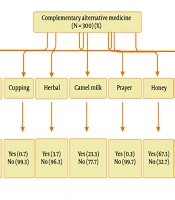
According to the results, 254 (84.7%) patients used at least one form of CAM (156 male, 98 female), 46 (15.3%) patients followed lifestyle management principles, and 238 (79.3%) patients had a history of using medicinal plants. Chamomile was the most frequently used medicinal plant (48.7%). Patients with nephropathy had a significantly higher history of using phlebotomy (P = 0.001), bitter apple (P = 0.002), and sumac (P = 0.001) compared to those without nephropathy. Conversely, patients without nephropathy had a significantly higher history of using chamomile (P = 0.001) and massage (P = 0.034). Patients without neuropathy had a significantly higher history of using lettuce seeds (P = 0.010) than those with neuropathy. Additionally, patients with retinopathy had a significantly higher history of using acupuncture (P = 0.001), while patients without retinopathy had a significantly higher history of using green tea (P = 0.005).
The results from Table 2 show the factors associated with the use of CAM. Age was not significantly associated with CAM use (OR = 0.99; CI: 0.96 - 1.03). Female participants were significantly less likely to use CAM compared to males (OR = 0.35; CI: 0.16 - 0.75). Similarly, residing in a city was associated with a significantly lower likelihood of CAM use compared to rural areas (OR = 0.13; CI: 0.06 - 0.31). No significant associations were found for education (P = 0.471), disease duration (P = 0.924), and income (P = 0.056).
Table 2.
Factors Associated with Complementary and Alternative Medicine Use
| Variables | OR | Confidence Interval for OR | P-Value |
|---|---|---|---|
| Age | 0.99 | 0.96 - 1.03 | 0.644 |
| Gender | |||
| Male | Ref | - | - |
| Female | 0.35 | 0.16 - 0.75 | 0.007 a |
| Residential place | |||
| Village | Ref | - | - |
| City | 0.13 | 0.06 - 0.31 | 0.001 a |
| Education | 0.86 | 0.58 - 1.29 | 0.471 |
| Duration of the disease, y | 1.02 | 0.70 - 1.49 | 0.924 |
| Income | 0.77 | 0.59 - 1.01 | 0.056 |
a Significant at 0.05.
The associations between the history of using various treatments and the grade on Wagner's classification are presented in Table 3. A history of using phlebotomy (β = -1.42), massage (β = -2.39), acupuncture (β = -2.41), spiritual treatments (β = -2.32), green tea (β = -0.51), and Urtica (β = -0.64) were significantly linked to a lower grade on Wagner's classification. However, the history of using Eryngo tincture (β = 0.82) and thyme (β = 0.62) was significantly associated with a higher grade on Wagner's classification.
Table 3.
Association Between Demographic Variables and Complementary and Alternative Medicine Use with Wagner's Classification a
| Variables | Estimate | Confidence Interval | SE | P-Value |
|---|---|---|---|---|
| Age | -0.001 | -0.02 to 0.02 | 0.01 | 0.935 |
| Gender | ||||
| Male | 0.22 | -0.23 to 0.68 | 0.23 | 0.335 |
| Female | Ref | - | - | - |
| Duration of the disease, y | 0.12 | -0.15 to 0.39 | 0.14 | 0.379 |
| Principles of lifestyle management | -0.57 | -1.18 to 0.04 | 0.31 | 0.070 |
| Leech therapy | -0.62 | -1.29 to 0.05 | 0.34 | 0.071 |
| Wet cupping | 0.07 | -0.54 to 0.67 | 0.31 | 0.826 |
| Phlebotomy | -1.42 | -2.20 to -0.64 | 0.39 | 0.001 b |
| Massage | -2.39 | -3.97 to -0.82 | 0.80 | 0.003 b |
| Acupuncture | -2.41 | -3.93 to -0.90 | 0.77 | 0.002 b |
| Spiritual treatments | -2.32 | -4.35 to -0.28 | 1.04 | 0.026 b |
| Fenugreek | 0.28 | -0.23 to 0.79 | 0.26 | 0.280 |
| Citrulluscolocynthis (bitter apple) | 0.39 | -0.37 to 1.15 | 0.39 | 0.319 |
| Silybummarianum (Mary thistle) | 0.35 | -0.42 to 1.12 | 0.39 | 0.375 |
| Green tea | -0.51 | -0.97 to -0.06 | 0.23 | 0.026 b |
| Urtica | -0.64 | -1.21 to -0.08 | 0.29 | 0.025 b |
| Chamomile | -0.09 | -0.53 to 0.35 | 0.22 | 0.697 |
| Dill | -0.03 | -0.53 to 0.49 | 0.26 | 0.914 |
| Poppy seeds | 1.31 | -0.09 to 2.71 | 0.71 | 0.068 |
| Lettuce seeds | 1.28 | -0.57 to 3.14 | 0.95 | 0.176 |
| Sumac | -0.47 | -0.99 to 0.05 | 0.26 | 0.080 |
| Walnut leaf | 1.31 | -0.09 to 2.71 | 0.71 | 0.068 |
| Eryngo tincture | 0.82 | 0.21 to 1.42 | 0.31 | 0.008 b |
| Thyme | 0.62 | 0.06 to 1.18 | 0.28 | 0.031 b |
a Wagner's classification was considered as the outcome variable; an ordinal regression model was used.
b Significant at 0.05.
Furthermore, following lifestyle management principles (OR = 1.98; CI: 1.01 - 3.89), as well as using leech therapy (OR = 2.33; CI: 1.08 - 5.02), wet cupping (OR = 2.13; CI: 1.09 - 4.17), fenugreek (OR = 2.37; CI: 1.36 - 4.11), green tea (OR = 1.67; CI: 1.04 - 2.68), Urtica (OR = 4.73; CI: 2.29 - 9.80), and dill (OR = 4.44; CI: 2.34 - 8.42) were significantly associated with A1C ≥ 7. Conversely, using sumac (OR = 0.39; CI: 0.23 - 0.68) and Eryngo tincture (OR = 0.51; CI: 0.28 - 0.93) were significantly associated with A1C < 7. Additionally, females were more likely to have A1C ≥ 7 than males (OR = 1.81; CI: 1.12 - 2.92). Age (OR = 1.04; CI: 1.01 - 1.06) and longer disease duration (OR = 1.47; CI: 1.11 - 1.96) were also significantly associated with A1C ≥ 7 (Table 4).
Table 4.
Association Between Demographic Variables and Complementary and Alternative Medicine Use with Hemoglobin A1C a
| Variables | OR | Confidence Interval for OR | P-Value |
|---|---|---|---|
| Age | 1.04 | 1.01 - 1.06 | 0.001 b |
| Gender | |||
| Male | Ref | - | - |
| Female | 1.81 | 1.12 - 2.92 | 0.015 b |
| Duration of the disease, y | 1.47 | 1.11 - 1.96 | 0.008 b |
| Principles of lifestyle management | 1.98 | 1.01 - 3.89 | 0.047 b |
| Leech therapy | 2.33 | 1.08 - 5.02 | 0.030 b |
| Wet cupping | 2.13 | 1.09 - 4.17 | 0.026 b |
| Phlebotomy | 0.95 | 0.44 - 2.01 | 0.891 |
| Massage | 0.98 | 0.26 - 3.73 | 0.978 |
| Fenugreek | 2.37 | 1.36 - 4.11 | 0.002 b |
| Citrulluscolocynthis (bitter apple) | 0.96 | 0.44 - 2.08 | 0.925 |
| Silybummarianum (Mary thistle) | 1.46 | 0.65 - 3.28 | 0.356 |
| Green Tea | 1.67 | 1.04 - 2.68 | 0.032 b |
| Urtica | 4.73 | 2.29 - 9.80 | 0.001 b |
| Chamomile | 0.81 | 0.51 - 1.28 | 0.382 |
| Dill | 4.44 | 2.34 - 8.42 | 0.001 b |
| Poppy seeds | 6.55 | 0.81 - 53.04 | 0.078 |
| Sumac | 0.39 | 0.23 - 0.68 | 0.001 b |
| Walnut leaf | 6.55 | 0.81 - 53.04 | 0.078 |
| Eryngo tincture | 0.51 | 0.28 - 0.93 | 0.030 b |
| Thyme | 0.71 | 0.44 - 1.31 | 0.326 |
a A1C ≥ 7 was considered as the outcome; a logistic regression model was used.
b Significant at the 0.05 level.
Lastly, a history of wet cupping (β = -25.91), as well as using fenugreek (β = -15.41), green tea (β = -12.27), and chamomile (β = -16.77), were significantly associated with a lower level of ESR (Table 5).
Table 5.
Association Between Demographic Variables and Complementary and Alternative Medicine Use with Erythrocyte Sedimentation Rate a
| Variables | B | SE | P-Value |
|---|---|---|---|
| Age | -0.55 | 0.29 | 0.056 |
| Gender | |||
| Male | - | - | - |
| Female | 0.01 | 5.59 | 0.998 |
| Duration of the disease, y | 3.25 | 3.26 | 0.320 |
| Principles of lifestyle management | -12.16 | 7.50 | 0.106 |
| Leech therapy | 10.53 | 8.23 | 0.202 |
| Wet cupping | -25.91 | 7.25 | 0.001 b |
| Phlebotomy | 15.27 | 8.87 | 0.086 |
| Massage | 7.28 | 15.91 | 0.647 |
| Principles of lifestyle management | -10.57 | 15.11 | 0.485 |
| Leech therapy | 30.69 | 21.13 | 0.147 |
| Fenugreek | -15.41 | 6.10 | 0.012 b |
| Citrulluscolocynthis (bitter apple) | 5.50 | 9.18 | 0.549 |
| Silybummarianum (Mary thistle) | -15.21 | 9.29 | 0.103 |
| Green tea | -12.27 | 5.47 | 0.026 b |
| Urtica | -12.80 | 6.88 | 0.064 |
| Chamomile | -16.77 | 5.34 | 0.002 b |
| Dill | 1.67 | 6.35 | 0.792 |
| Poppy seeds | -4.63 | 15.91 | 0.771 |
| Lettuce seeds | -9.99 | 21.20 | 0.638 |
| Sumac | -2.97 | 6.41 | 0.643 |
| Walnut leaf | -4.63 | 15.91 | 0.771 |
| Eryngo tincture | -9.27 | 7.04 | 0.189 |
| Thyme | 11.76 | 6.48 | 0.071 |
a Erythrocyte sedimentation rate was considered as the outcome variable; a linear regression model was used.
b Significant at 0.05.
5. Discussion
The results of the present study indicated a high prevalence of CAM use among diabetic patients (79.3%). Additionally, the consumption of medicinal plants, such as green tea and Urtica, showed an inverse relationship with Wagner's classification. Living in the city and having a high income were independent predictors of herbal medicine use.
Previous studies have reported an increasing prevalence of herbal medicine use among diabetic patients (11, 12). Based on our results, more than two-thirds of the participants were using herbal medicines, which is higher than in previous studies. The prevalence of herbal medicine use among individuals with DFUs observed in this study in Iran (79.3%) was significantly higher than what has been reported previously in Thailand, Turkey, and Saudi Arabia (37.5%, 61.8%, and 47.1%, respectively) (11, 13, 14). Evidence suggests that the high prevalence of CAM products may be attributed to patients' belief that these herbs are more effective than conventional drugs (14).
In the present study, CAM methods reported by diabetic patients included phlebotomy, bitter apple, sumac, acupuncture, lettuce seeds, and green tea. Additionally, chamomile was the most widely used medicinal herb. Bitter apple or Citrullus colocynthis was the most commonly used medicinal plant in a study conducted in Iran (15). Abdullah et al. showed in their study that bitter apple, cinnamon, and ginger were the most used medicinal herbs among Saudi diabetic patients (12). In another study, the most commonly used herbal medicines were lemon, honey, aloe vera, bitter gourd, green tea, and cinnamon (16). Herbal medicines such as bitter leaves, mangosteen peel, and bitter melon were used in Indonesia (17). The study by Gayathri and Saranya found acupuncture to be the most common treatment choice among diabetic patients, with 17.3% of participants receiving acupuncture treatment (18). Additionally, Adeniyi et al. provided evidence that CAM is an appropriate therapy for diabetics to prevent DFU (19).
In general, there is a wide variety of medicinal plants used for diabetes in different countries. Educating and guiding diabetic patients in this area can help correct the use of medicinal plants, enhance their beneficial effects, and prevent potential side effects.
The history of using phlebotomy, massage, spiritual treatments, green tea, and Urtica is associated with a decreased Wagner classification, while Eryngo tincture and thyme show a direct relationship. Evidence suggests that the effective use of these treatments in managing DFUs can reduce patient costs and antibiotic consumption. Therefore, these non-invasive treatment methods merit further investigation in conjunction with conventional and CAM principles (20). Several studies have demonstrated the positive effects of herbal medicines in treating DFUs (21, 22). Urtica extracts contain various herbal compounds, such as polyphenols, known for their medicinal properties, including antioxidant, anti-inflammatory, anti-ulcer, and antihyperglycemic effects (23). Clinical evidence also indicates that tea can protect individuals with diabetes by improving insulin resistance, acting similarly to insulin, safeguarding islet β-cells, scavenging free radicals, reducing oxidative stress, and alleviating the inflammatory response associated with diabetes complications (24). Sunarmi (25) have shown that massage is highly effective in healing diabetic ulcers and recommend applying massage to body parts prone to neuropathy to prevent complications, particularly diabetic ulcers. Further clinical trials should be conducted to investigate the protective effects of medicinal plants and CAM methods on diabetes and its complications, especially DFUs.
The present study showed that the use of sumac and Eryngo tincture significantly reduces the odds of A1C ≥ 7. The results of a review study indicated that the use of medicinal plants is effective in treating metabolic and endocrine disorders. Based on these findings, psyllium, ginseng, C. colocynthis, and fenugreek significantly reduced blood glucose (26). A clinical trial in Iran has shown that the consumption of sumac has a beneficial effect on reducing HbA1c levels in patients with type 2 diabetes (27). In addition, various studies have shown the anti-diabetic effects of different species of Eryngo (28, 29). Moreover, it was found that fenugreek, green tea, leech therapy, Urtica, and dill increased the odds of A1C ≥ 7. Contrary to these findings, several studies have shown that herbal plants such as fenugreek seeds, dill, and Urtica improve blood sugar control in diabetic patients (30-32). However, the general occurrence of hypoglycemia does not show an uptick in individuals using CAM; nevertheless, the use of crepe ginger correlates with a notable incidence of hypoglycemia, indicating a need for additional investigation (33). Based on this evidence, interventional studies and further evaluations are needed to investigate the effects of these medicinal plants on blood sugar control in Iran.
Increasing evidence supports several mechanisms of action of medicinal plants in treating chronic disorders, including diabetes. Herbal plants exert their protective and therapeutic effects on diabetes through several cellular mechanisms, including limiting glycogen degradation and gluconeogenesis, regenerating pancreatic β-cells, and reducing oxidative stress (34). For example, C. colocynthis stimulates insulin secretion through skin absorption and improves the function of pancreatic beta cells in diabetic patients (35). Additionally, fenugreek has an anti-diabetic effect, such as stimulating and/or regenerating β cells, along with an extrapancreatic effect that can reduce blood glucose levels in diabetic patients (36).
In the multivariable analysis of the present study, urban residence and high income were independent predictors of the use of herbal plants. The odds of using medicinal plants were significantly lower among urban residents and individuals with high incomes compared to the reference group. Similar findings have been reported in previous studies (37). In a study conducted in Sudan, it was found that rural people rely more on medicinal plants. They firmly believe in cultivating medicinal plants like garlic, fenugreek, and cinnamon in their fields, which provides them with knowledge about the usage of these plants. Furthermore, their limited income restricts their access to conventional medicines (38). Interestingly, our findings differ from those of Thorsen and Pouliot, who reported that higher income is crucial for using CAM (39).
Another finding of the present study was the effect of CAM methods on ESR, where these methods led to a reduction in ESR in patients. These inhibitory effects of CAM methods on inflammatory markers are consistent with the findings of other studies. Tawarah reported that Wet Cupping significantly reduced many inflammatory markers (40). Another study showed that short-term consumption of chamomile benefits inflammatory markers in patients with type 2 diabetes (41). Elevating patients' health literacy in utilizing CAM, with a focus on herbal medicine while undergoing conventional treatment, is an excellent strategy to reduce possible side effects and drug interactions (38, 39).
5.1. Limitations
Although this study provides updated information about the utilization of CAM among patients with type 2 diabetes who are receiving conventional treatment at a referral center for diabetes patients, it has some limitations. The study is based on data from a single center, and it would have been more beneficial to use a multi-center registry to improve its representativeness. Accessing such a data registry was not possible. Moreover, the data might be affected by recall bias, as patients were asked about their CAM usage over the past 12 months. Attempts were made to mitigate this bias by excluding incomplete questionnaires and ensuring good communication and sufficient participant time.
5.2. Conclusions
Based on the present study, the prevalence of CAM use among diabetic patients is very high (79.3%). Additionally, the consumption of medicinal plants, such as green tea and Urtica, was found to have an inverse relationship with Wagner's classification. Furthermore, living in an urban area and having a higher income were identified as independent predictors of using herbal medicines. Therefore, it is crucial to enhance patient education about CAM and emphasize the importance of consulting healthcare providers. Moreover, further interventional studies and evaluations are needed to investigate the cause-and-effect relationship between CAM utilization and diabetes management in Iran.