


1. Introduction
Healthcare settings are inherently complex, consisting of various dimensions that significantly impact patient experiences and outcomes (1). Color is a notable factor among the many elements that contribute to the atmosphere of healthcare environments, although it is often understudied (2). Colors can evoke emotions, influence behavior, and even affect physiological responses, making them a critical consideration in healthcare design and practice (3).
Healthcare environments extend beyond mere physical spaces; they are essential aspects of the patient journey and have a profound effect on health outcomes (2). Among the numerous factors shaping the atmosphere and effectiveness of healthcare settings, color is a powerful element that is often overlooked (4). The strategic use of color in healthcare design has the potential to impact patient well-being, staff satisfaction, and the overall quality of care delivery (5).
Research suggests that color can influence patient experiences, including perceptions of comfort, satisfaction, and recovery rates (6, 7). In addition, healthcare providers spend significant amounts of time in healthcare environments, and the colors surrounding them can impact their mood, stress levels, and job satisfaction (8). Beyond patient outcomes and staff well-being, color can shape the overall healthcare experience for patients, families, and visitors (9, 10). By creating aesthetically pleasing and psychologically supportive environments, healthcare facilities can enhance the overall quality of care delivery and promote positive interactions between patients and healthcare providers (11).
2. Objectives
This study aimed to provide evidence-based insights into the role of color in healthcare environments through a systematic review of the literature. By synthesizing existing research findings and identifying knowledge gaps, this review seeks to lay the groundwork for future research aimed at optimizing the use of color in healthcare design and practice. Ultimately, the goal is to improve patient outcomes, enhance staff well-being, and elevate the overall healthcare experience through thoughtful and evidence-based color design.
3. Methods
3.1. Literature Search
A systematic review of electronic databases, including PubMed, Scopus, and Web of Science, was conducted to gather relevant research on the impact of color in healthcare settings.
The PICO search framework was used to devise the search strategy (Table 1). This table defines each element of the PICO model and applies it to the topic of color in healthcare environments. The model helps structure the search strategy by clearly defining the population, intervention, comparison, and outcome of interest for systematic review (12).
Table 1.PICO Search Model
| PICO Element | Example of Color in Healthcare Environments |
|---|---|
| Population | Patients, healthcare providers, visitors, and staff in healthcare environments |
| Intervention | Exposure to specific colors or color schemes in healthcare settings |
| Comparison | Comparison between different colors or color schemes |
| Outcome | Effects on patient well-being, satisfaction, recovery rates, staff mood, productivity, and overall healthcare experience |
The present search strategy adhered to the preferred reporting items of the PRISMA model. Search terms were selected from the predefined keywords provided by each database, such as "MeSH" for MEDLINE, and included keywords like "color," "healthcare," "hospital," "patient outcomes," and "staff well-being." Only studies published in peer-reviewed journals up to 2024 were included in this review.
3.2. Inclusion Criteria
(1) Research articles published in peer-reviewed journals.
(2) Studies investigating the impact of color in healthcare environments, including hospitals, clinics, long-term care facilities, etc.
(3) Studies examining the effects of color on various aspects of healthcare, such as patient outcomes, staff well-being, patient experience, and stress levels.
(4) Studies using quantitative, qualitative, or mixed-methods approaches.
(5) Studies conducted in real healthcare settings or simulated environments.
3.3. Exclusion Criteria
(1) Studies that are not peer-reviewed (e.g., conference abstracts, dissertations, editorials).
(2) Studies focused solely on non-healthcare environments (e.g., residential, commercial).
(3) Studies not directly investigating the impact of color (e.g., studies on lighting, architecture, noise).
(4) Studies focused exclusively on animal models.
(5) Studies with inadequate methodological quality or lacking clear reporting.
(6) Studies published in languages other than English without available translations.
3.4. Study Objectives
(1) Systematically review existing literature on the impact of color in healthcare environments.
(2) Summarize and synthesize findings from empirical studies on the effects of color on various aspects of healthcare, including patient outcomes, staff well-being, patient experience, and stress levels.
(3) Identify gaps, inconsistencies, and methodological limitations in current research on color in healthcare environments.
(4) Elucidate mechanisms through which color influences psychological, physiological, and behavioral responses in healthcare settings.
(5) Explore the potential implications of color interventions in healthcare design and practice for improving patient care, enhancing staff satisfaction, and optimizing healthcare environments.
(6) Develop a research agenda for future studies to further investigate the role of color in healthcare environments.
(7) Provide evidence-based recommendations for healthcare designers, architects, policymakers, and healthcare professionals regarding the use of color in healthcare facility design and management.
(8) Highlight the importance of interdisciplinary collaboration among researchers in fields such as psychology, design, medicine, and public health to advance understanding of the impact of color in healthcare environments.
(9) Promote awareness and discussion among stakeholders about the significance of color as a modifiable factor in healthcare settings.
(10) Contribute to the development of evidence-based guidelines and best practices for incorporating color considerations into healthcare facility design, renovation, and maintenance processes.
These objectives aim to systematically evaluate the existing evidence base, identify research gaps, and propose future directions to advance knowledge in the field of color psychology within healthcare environments.
3.5. Model Evaluation
Evaluation can be approached as follows:
(1) Relevance of research questions: Assess whether the research questions addressed in the systematic review align with the objectives of understanding the impact of color in healthcare environments and with the aim of proposing a research agenda to address identified knowledge gaps.
(2) Search strategy: Examine the comprehensiveness and suitability of the search strategy used to identify relevant studies, including the databases searched, search terms applied, and any additional strategies employed to locate pertinent literature.
(3) Study selection process: Evaluate the transparency and reproducibility of the study selection process, including criteria for study inclusion and exclusion, methods for screening and selecting studies, and the resolution of any disagreements among reviewers.
(4) Quality assessment: Determine if the systematic review includes an assessment of the quality and risk of bias in the included studies, potentially using established tools or criteria to evaluate the methodological rigor of each study.
(5) Data synthesis and analysis: Evaluate how findings from individual studies are synthesized and analyzed, including the methods used for data extraction, result synthesis, and any statistical or qualitative analyses performed.
(6) Research agenda development: Assess the clarity, feasibility, and relevance of the proposed research agenda, evaluating identified literature gaps along with the suggested research questions, methods, and priorities for future studies.
(7) Implications and recommendations: Consider the implications and recommendations presented in the systematic review and research agenda, assessing their potential impact on healthcare practice, policy, and directions for future research.
(8) Transparency and reporting: Evaluate the transparency and thoroughness of reporting, including the documentation of methodology, results, limitations, and any potential conflicts of interest.
(9) Interdisciplinary perspective: Assess whether the systematic review and research agenda incorporate insights from relevant disciplines, such as psychology, design, medicine, and public health, to provide a comprehensive understanding of the topic.
(10) Overall contribution to knowledge: Evaluate the overall contribution of the systematic review and research agenda to advancing knowledge in color psychology in healthcare environments, including any novel insights, recommendations, or directions for future research.
4. Results
A flowchart illustrating the search outcomes and ongoing process of this systematic review is presented in Figure 1.
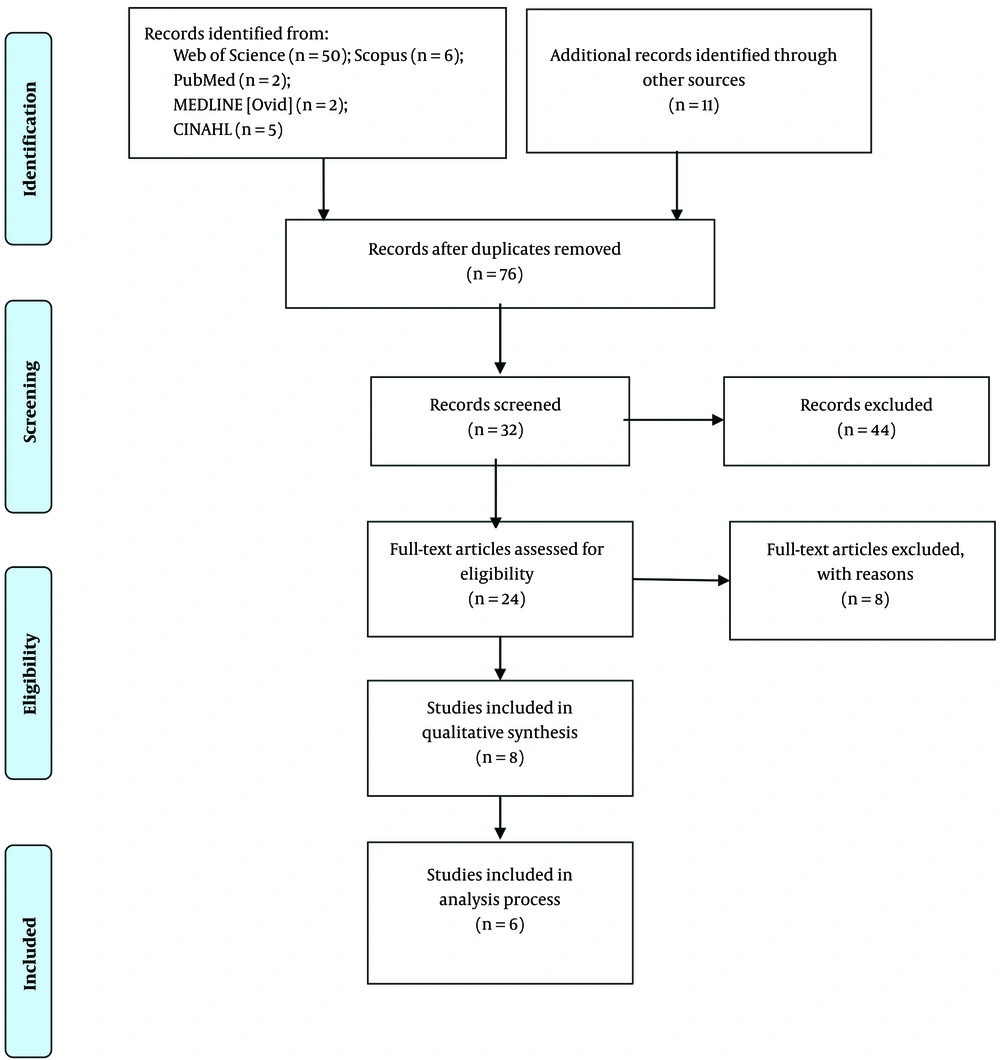
Figure 1.
The PRISMA flow diagram illustrates the literature search and selection process, indicating the number of studies identified, screened, extracted, and included in the review.
The systematic review identified six studies that met the inclusion criteria, providing valuable insights into the effects of color in healthcare environments. Key findings from these studies are categorized into several thematic areas:
4.1. Influence of Color on Patient Outcomes
The review indicates that specific colors in healthcare settings have a measurable impact on patient outcomes. Warm colors, such as shades of red, yellow, and orange, are associated with heightened feelings of comfort and warmth, though they may also increase anxiety in some patients. In contrast, cool colors like blue and green are linked to calming effects, helping to reduce stress, alleviate anxiety, and, in some cases, lower blood pressure. Neutral colors, especially soft whites and grays, provide a balanced environment; however, if overused, they can be perceived as sterile or uninviting.
4.2. Color and Healing Environments
Color significantly contributes to creating environments that support healing. Nature-inspired colors, particularly in patient rooms, have been shown to promote recovery. For example, green, which evokes a sense of nature, is often associated with restfulness and peace, positively affecting patients’ psychological states. Blue, symbolizing tranquility, is commonly used in areas where calmness is essential, such as waiting areas and mental health facilities.
4.3. Impact on Healthcare Staff
The review also underscores the importance of color in supporting the well-being and productivity of healthcare staff. Overly bright or harsh colors can lead to fatigue and eye strain, while balanced, muted tones can enhance focus and reduce stress levels. Additionally, the appropriate use of color in staff areas contributes to a more positive work environment, enhancing overall job satisfaction and performance.
4.4. Cultural and Individual Differences
The impact of color varies based on cultural background and personal preference. For instance, in some cultures, white symbolizes purity and cleanliness, making it a preferred color in healthcare settings, while in others, it may be associated with mourning and death. Individual experiences and associations with specific colors further influence perceptions, indicating that a one-size-fits-all approach to color in healthcare may not be effective.
A summary of these findings is presented in Table 2.
Table 2.Summary of the Literature Review and Recommendations for Clinical Practice
| Study/Citations | Study Aim | Method/Population | Key Findings | Recommendation for Clinical Practice |
|---|---|---|---|---|
| Dalke et al. (2006) (13) | To present evidence-based research findings on color and lighting. To develop a guidance document for utilizing color design and lighting. To produce a document intended for use by both staff and built environment professionals. | Conducting audits of the journey from entrance to ward. Reviewing existing research. Performing literature reviews. Conducting interviews with management, estates, and premises personnel. Engaging in discussions with staff and patients. Obtaining visual documentation of both exemplary and deficient practices. | Studies have shown that implementing staff relaxation rooms with varying color schemes and lighting levels can have beneficial effects on overall well-being, and substandard conditions in premises that have not undergone careful refurbishment have had a negative impact on both recovery rates and staff morale. Florence Nightingale keenly noted that "diverse forms and vivid colors in the objects provided to patients serve as a genuine method for promoting recovery". | Color and design have not conclusively been determined to serve as a remedy for illness and poor health, and further studies are suggested to understand that a balanced and aesthetically pleasing environment plays an important role in the health of patients. |
| Dijkstra et al. (2008) (3) | To explore whether a personality trait, specifically stimulus screening ability, can elucidate the conflicting effects of coloration on emotional states reported in the literature. | Clinical trial/male and females participants | t green color tended to have stress-reducing effects. Establishing a therapeutic environment through the utilization of wall colors, along with simple and cost-effective interventions, could prove to be remarkably efficient in terms of cost-effectiveness. | Future studies examining the impacts of environmental stimuli should incorporate a measure for stimulus screening ability to effectively control for an individual difference closely associated with environmental effects. |
| Park (2009) (14) | To explore the significance of color as a component contributing to a healing environment for pediatric patient rooms. | pilot study and simulation method/children | Assist healthcare providers and professionals in gaining a deeper understanding of suitable color choices tailored to pediatric populations. | A cross-cultural study with a larger sample size could offer valuable insights to validate the influence of culture on color preferences. |
| Nourmusavi Nasab et al. (2020) (15) | Incorporating children's perspectives to assess the significance and influence of effective environmental factors in generating guidelines for children's hospital design. | Descriptive/examine via drawings and interviews/children. | Children express a preference for hospital environments that offer entertainment facilities alongside design elements like abundant light, colorful decorations, the inclusion of green spaces, and conditions conducive to family presence. Additionally, they favor the use of cheerful light colors such as light blue, light green, and light yellow in hospital settings. | Quantitative studies should be considered in the future. Future research could explore and compare the influence of cultural, economic, and societal factors on the requirements of children in hospital environments across various geographical locations. |
| Lindahl et al. (2021) (9) | To evaluate how patients, family members, and staff perceive light and color as supportive elements in the physical care environment. | Pre-post study/patients, family members, staff | Light and color are distinct elements that significantly shape the perceived supportiveness of the physical environment. Color enables humans to interpret their surroundings, and through contrasts, individuals perceive information in the environment that aids orientation in unfamiliar settings. | This tool is valuable for architects, administrators, and researchers involved in healthcare environments as a baseline measure before refurbishments. It serves as an evidence-based reflection tool for facilitating critical discussions on environmental optimization and can also be utilized as a research tool to generate environmental variables for future studies. |
| Kalantari et al. (2022) (5) | To implement an innovative testing approach utilizing VR technology coupled with EEG data to assess the effects of three distinct interior designs. These designs will incorporate modified color patterns, graphics, and architectural features aimed at improving wayfinding in a hospital setting. | Interventional/selected hospital | Color and graphics to promote finding | The future directions of evidence-based pre-construction design testing. |
Abbreviations: VR, virtual reality; EEG, electroencephalogram.
5. Discussion
The findings from this systematic review emphasize the complex role of color in healthcare environments, underscoring its importance in fostering patient well-being, staff satisfaction, and quality of care delivery (16). By synthesizing existing literature and identifying key themes, several important insights emerge.
Firstly, the review reveals that color significantly influences patient outcomes, including mood, satisfaction, and recovery rates (17). Colors, such as soothing blues and greens may promote relaxation and healing; however, the effects of color can vary according to individual preferences, cultural factors, and environmental context (6). Therefore, healthcare designers should carefully consider these factors when selecting color schemes to create environments that are both aesthetically pleasing and psychologically supportive for patients (18).
Secondly, the review highlights the impact of color on staff well-being and productivity (19). Vibrant colors have been shown to enhance mood and cognitive function among healthcare providers, potentially boosting job satisfaction and performance (20). However, excessive stimulation or inappropriate color choices may contribute to fatigue and burnout. Striking a balance between creating stimulating work environments and providing spaces for relaxation and rejuvenation is thus essential for healthcare facilities.
In summary, this systematic review provides valuable insights into the influence of color within healthcare environments and outlines key directions for future research (21). By addressing methodological limitations, deepening our understanding of underlying mechanisms, and advancing evidence-based design practices, future studies can help optimize the use of color in healthcare settings, ultimately enhancing patient outcomes, staff well-being, and overall healthcare experiences (22).
Lighting plays a crucial role in how colors are perceived within healthcare settings. Natural light, artificial lighting systems, and their color temperatures can significantly influence the ambiance and mood of a space. Integrating lighting solutions that mimic natural daylight cycles or offer adjustable color temperatures may provide additional opportunities to enhance the impact of color in healthcare environments (9). Cultural considerations are also vital in color perception and preference, as colors that may be perceived as soothing or stimulating in one culture could have contrasting effects in another. Healthcare facilities serving diverse populations should take cultural nuances into account when selecting color schemes to ensure a positive resonance with patients and staff from various backgrounds (23).
Several studies indicate that the use of color in hospital settings can significantly affect patients' moods, anxiety levels, and overall experience. For example, warm colors such as yellows and oranges are often associated with feelings of comfort and warmth, potentially reducing anxiety in patients undergoing treatment (24, 25). Conversely, cooler colors like blue and green have been shown to promote calmness and relaxation, which is particularly beneficial in high-stress areas such as emergency departments or surgical units. A study by Kalantari et al. found that patients in rooms painted in calming colors reported lower anxiety levels and higher satisfaction with their care (5).
The impact of color extends beyond patient care and also affects healthcare staff. Another study found that healthcare professionals reported higher job satisfaction and lower stress levels in environments that utilized color strategically. Bright, vibrant colors in staff break rooms and work areas were associated with increased energy and motivation, while drab, uninspiring colors correlated with feelings of fatigue and dissatisfaction. These factors can potentially lead to higher turnover rates and decreased quality of care (26).
It has been stated that color can carry significant meaning and have a profound impact on people’s affect, cognition, and behavior. Furthermore, while this review primarily focuses on the visual aspects of color, it is essential to recognize that multisensory experiences within healthcare environments also contribute to overall well-being (16). Integrating other sensory elements, such as soundscapes, textures, and aromas, alongside color design can create holistic healing environments that engage patients on multiple levels and enhance their overall experience (8). Although existing research provides valuable insights into the effects of color in healthcare settings, further investigation is needed to address methodological limitations, explore underlying mechanisms, and develop evidence-based design guidelines. By prioritizing interdisciplinary collaboration, rigorous research methodologies, and stakeholder engagement, future studies can advance our understanding of the complex relationship between color and health in healthcare environments.
5.1. Limitations
Despite the growing interest in evidence-based design and the recognized importance of color in healthcare settings, several challenges and limitations persist in the existing literature. Methodological inconsistencies, small sample sizes, and a lack of standardized measures are common issues that hinder the generalizability and reproducibility of findings. Moreover, cultural differences, individual preferences, and situational factors can complicate the interpretation of study results and necessitate a nuanced approach to color design in diverse healthcare contexts.
5.2. Conclusions
Color plays a multifaceted role in shaping the healthcare environment and influencing patient outcomes, staff well-being, and overall care experiences. While existing research provides valuable insights into the effects of color in healthcare settings, further investigation is needed to address methodological limitations, explore underlying mechanisms, and develop evidence-based design guidelines. By prioritizing interdisciplinary collaboration, rigorous research methodologies, and stakeholder engagement, future studies can enhance our understanding of the complex relationship between color and health in healthcare environments.
Finally, the research agenda outlined in this review points toward several promising avenues for future investigation. Longitudinal studies examining the long-term effects of color interventions on patient outcomes, randomized controlled trials comparing the efficacy of different color schemes, and qualitative research exploring subjective experiences are all valuable areas for further inquiry.
5.3. Future Research Directions
Despite the promising findings regarding color's impact, there remains a significant gap in systematic research addressing the optimal application of color in healthcare settings. Future studies should focus on longitudinal designs that assess the long-term effects of color interventions on patient outcomes, staff satisfaction, and operational efficiency. Additionally, exploring how technological advancements, such as dynamic lighting that changes colors, can enhance patient experiences will provide valuable insights into modern healthcare design.

