


1. Background
The face is the most prominent body region psychologically associated with self-image and is an important component of self-confidence and self-esteem. Facial nerve palsy is among the most common conditions affecting facial appearance because it paralyzes the facial regions innervated by this nerve. This condition can cause partial or complete unilateral facial paralysis, disrupt facial movements, and impair interpersonal interactions and facial expressions. In addition to the negative psychosocial effects of facial nerve palsy, affected individuals may experience dysfunction in eating, drinking, and speaking, which affects daily activities (1).
Facial nerve paralysis may occur due to several etiologies, including congenital idiopathic causes, neoplasms, iatrogenic injury, infection, trauma, herpes zoster, tumors, diabetes mellitus, polyneuropathy, and other inflammatory causes (2). Bell's palsy is the most prevalent type of unilateral facial paralysis and occurs due to nonsuppurative inflammation of the facial nerve near the stylomastoid foramen (3). The acute nature of Bell's palsy, characterized by rapid onset over a few hours in the absence of a traumatic event, is a hallmark of its diagnosis. Epidemiological studies show that Bell's palsy, also known as idiopathic facial paralysis, accounts for 60% - 75% of acute unilateral facial nerve paralysis. Both sexes are equally affected, and the fourth to sixth decades of life represent the most common age range (4).
Various physical therapeutic approaches, including massage, facial exercises, electrotherapy, and biofeedback, with the greatest emphasis on facial exercises, have been proposed for the management of Bell's palsy (5). The main goal of these physical therapy modalities is to improve the function of the affected nerve. In addition, thermal therapy and massage have been recommended to reduce swelling and improve blood flow to injured tissues, thereby improving the oxygen supply to damaged hypoxic tissue (6).
Laser therapy is a noninvasive modality used for several peripheral neurosensory or neuromotor deficits, such as trigeminal neuralgia, neuropathy, lower back pain with sciatica, and herpes zoster (7, 8). Theoretically, laser therapy may induce local and systemic effects that enhance neural regeneration. Nevertheless, it has not been widely applied to Bell's palsy in the literature.
2. Objectives
This study aimed to investigate the use of high-power laser therapy in patients with Bell’s palsy.
3. Methods
3.1. Study Population
This randomized clinical trial (RCT) was conducted on 30 patients with Bell's palsy who were referred to the outpatient Rehabilitation and Physical Medicine Clinic of Amin Hospital, affiliated with Isfahan University of Medical Sciences, from November 2023 to May 2024.
The study was submitted to the Ethics Committee of Isfahan University of Medical Sciences and approved under code IR.MUI.MED.REC.1400.750. In addition, the protocol was registered in the Iranian Registry of Clinical Trials and accepted under code IRCT20190618043931N3. Patients were informed about the potential use of their medical data for scientific research, were reassured about the confidentiality of their personal information, and provided written informed consent to participate in the study.
Individuals older than 18 years with a recent history of Bell's palsy, at least 1 month and at most 1 year after the onset of nerve palsy, who had received standard therapeutic medications, including corticosteroids, acyclovir in the case of viral infection, and transcutaneous electrical nerve stimulation (TENS) (9), for at least 1 month were included. Patients with House-Brackmann Scale grades 5 - 6 (10), malignancy, hypertension, uncontrolled diabetes mellitus, neurologic disorders, concurrent palsy of other cranial nerves, pregnancy or lactation, any history of recurrent Bell's palsy, or facial deformity were not eligible. Patients who did not attend follow-up visits or had more than 20% missing data in their medical records were excluded.
The study population was enrolled through convenience sampling among individuals who met the study criteria. Participants were randomly allocated to the intervention or control group using a computer-based randomization table. This table contained numbers ranging from 1 to 30 and randomly assigned a number to each patient. The blinded random number was classified as odd or even; if it was odd, the patient was allocated to the intervention group; otherwise, the patient was allocated to the control group. Randomization was performed without replacement. The biostatistician was blinded to group assignment; therefore, assessments were presented to her as group A or group B without information about what A or B represented.
3.2. Sample Size Calculation
The sample size calculation resulted in 15 individuals in each group.
The sample size for this study was calculated based on data from the double-blind randomized clinical trial by Ton et al. (11), which examined the effect of laser acupuncture on patients with Bell's palsy. In that study, the mean ± standard deviation of the House-Brackmann score after intervention was reported as 3 ± 0.63 in the laser acupuncture therapy (LAT) group and 2.14 ± 0.69 in the sham laser acupuncture therapy (SLAT) group.
Using the sample size formula for comparing two independent means, the calculated minimum sample size was 10 participants per group. Considering an estimated dropout rate of approximately 20%, the final required sample size was determined to be 13 participants per group (26 in total). However, due to limitations in sample accessibility and to increase statistical power and ensure result stability, a sample size of 15 participants per group (30 in total) was adopted for this study.
z0.975=1.96
z0.80=.84
s2=0.69 s1=0.63
3.3. Intervention
All participants were taught to perform facial massage and facial expression exercises. The exercises included simple facial expression exercises; active, graduated strengthening exercises performed in front of a mirror, including active-assisted, free, and resisted exercises; proprioceptive neuromuscular facilitation exercises for facial muscles; and resisted exercises for the neck muscles (12). Massage and exercises were first performed in the presence of a physiotherapist for correction. Participants were then instructed to perform each task 5 times repetitively, 3 times a day, for 4 weeks. A family member was asked to monitor adherence to massage and exercise and to complete the study checklist.
In addition to the physical interventions performed in both groups, high-power laser therapy was administered in the intervention group using the Fisioline device (Lumix CPS model, Italy). The patient was placed in the supine position and wore special glasses for laser therapy. Twelve points along the pathway of the facial nerve were marked: 1 point before nerve division adjacent to the stylomastoid foramen, 3 points along the temporal branch, 2 points along the zygomatic branch, 4 points along the buccal branch, and 2 points along the mandibular branch. The device settings were as follows: energy, 180 J (15 J/point); wavelength, 1064 nm with pulsed emission; power, 1.2 W; frequency, 500 Hz; and duty cycle, 50%. Each patient received 3 sessions per week for 4 weeks.
3.4. Outcomes
The primary outcome of the study was response to treatment, evaluated using the HBS and electrodiagnostic studies.
3.4.1. House-Brackmann Scale
The HBS was first introduced by House and Brackmann in 1985 and has been frequently used to assess facial nerve palsy because of its ease of use and clinical sensitivity. The scale evaluates facial symmetry, synkinesis, stiffness, and global mobility in 6 categories: Normal, mild dysfunction, moderate dysfunction, moderately severe dysfunction, severe dysfunction, and total paralysis. Scores range from 0, corresponding to normal function, to 6, corresponding to the most severe condition, total paralysis. This assessment was performed at baseline and within 6 weeks after the interventions.
3.4.2. Electrodiagnostic Study
Electromyography and nerve conduction velocity studies were performed for all patients using a Natus device. Accordingly, a nerve conduction study was performed, and CMAP amplitude was measured for both facial nerves. The stimulator, active electrode (E1), and reference electrode (E2) were placed behind the ear, at the site of the nasalis muscle, and at the nasal bridge, respectively. The ground electrode was placed between the E1 and cathode electrodes, mostly close to the E1 electrode. The applied pulse width was 0.2 - 0.5 milliseconds, the device sensitivity was 200 - 1000 μV/division, and the sweep speed was 1 - 2 ms/division. The ratio of CMAP amplitude on the affected side to that on the healthy side was defined as the severity index. The electrodiagnostic study was performed at baseline and within 6 weeks after the interventions.
Although the basis of the study was to compare electrodiagnostic measures at baseline and within 6 months, normal values were derived from a clinical electrodiagnosis reference (13).
3.5. Statistical Analysis
The data were entered into the Statistical Package for Social Sciences (SPSS) version 20 (IBM Corporation, Armonk, NY). Descriptive data were presented as the mean, standard deviation, absolute number, and percentage. Data normality was assessed using the Kolmogorov-Smirnov test. The chi-square test was used to compare categorical variables. Continuous data were compared using the independent t-test. Given the nonnormal distribution of some variables, the nonparametric Mann-Whitney U and Wilcoxon tests were used for comparisons. P < 0.05 was considered statistically significant.
4. Results
In this RCT, 30 patients with Bell's palsy were evaluated in two groups: the intervention group, which received exercise therapy plus high-power laser therapy, and the control group, which received exercise therapy only. Figure 1 shows the CONSORT flow diagram of the study population. The study population comprised 18 males (60%) and had a mean age of 54.07 ± 7.45 years.
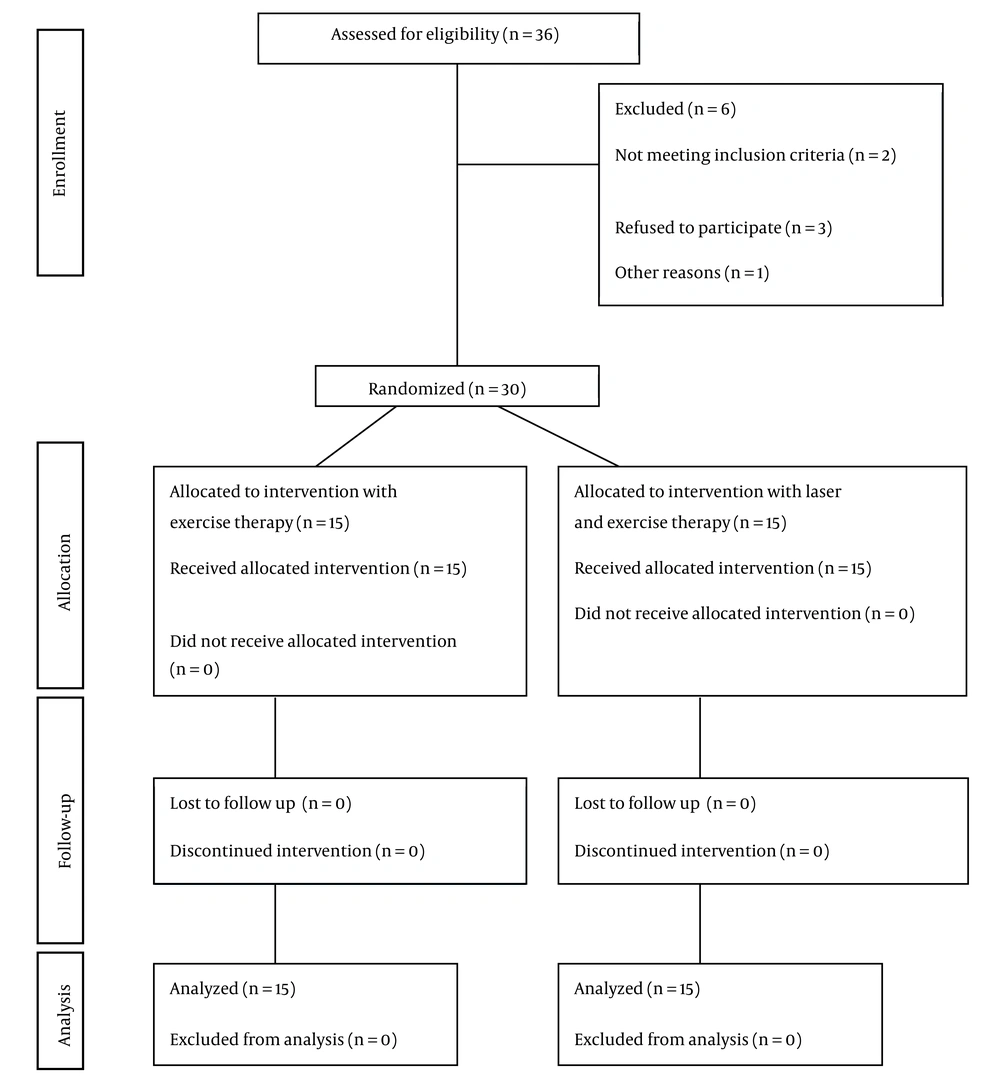
Figure 1.
CONSORT diagram of the study population
Table 1 presents the demographic characteristics of the study groups. The mean ages of patients in the intervention and control groups were 52.27 ± 7.87 and 55.87 ± 7.04 years, respectively (P = 0.456). Most individuals who received combination therapy were male (53.3%), compared with 66.7% of those who received exercise therapy only (P = 0.198).
Baseline assessments showed no difference in the severity index between the study groups (P = 0.345), whereas follow-up electrodiagnostic investigation showed a significantly higher index in those who underwent exercise therapy plus high-power laser therapy (P = 0.013). The severity index in the intervention group changed from 0.53 [0.20, 0.64] at baseline to 0.71 [0.46, 0.85] within 6 weeks (P < 0.001), and in the control group, it changed from 0.26 [0.16, 0.54] to 0.31 [0.20, 0.58] (P = 0.002). Similarly, the HBS score did not differ between the groups at study initiation (P = 0.486), whereas statistically significantly lower scores were observed in the intervention group within 6 weeks after high-power laser therapy (P = 0.013). In addition, the baseline-to-postintervention HBS score changed from 3 (2, 3) to 2 (2, 2) in the intervention group (P = 0.001) and from 3 (2, 3) to 3 (2, 3) in the control group (P = 0.014). Table 2 presents these data in detail.
Table 2.Impact of Therapeutic Approaches on Severity Index and the House-Brackmann Scale (N = 15)
| Variables and Group | Baseline | Within 6 Weeks (n = 15) | 95% CI of Differences | P-Value a | ||
|---|---|---|---|---|---|---|
| Median (Q1, Q3) | Mean ± SD | Median (Q1, Q3) | Mean ± SD | |||
| Severity Index | ||||||
| Intervention group | 0.53 (0.20, 0.64) | 0.43 ± 0.24 | 0.71 (0.46, 0.85) | 0.65 ± 0.24 | 0.17, 0.25 | < 0.001 |
| Control group | 0.26 (0.16, 0.54) | 0.34 ± 0.26 | 0.31 (0.20, 0.58) | 0.39 ± 0.26 | 0.02, 0.07 | 0.002 |
| P-value b | 0.345 | 0.345 | 0.013 | 0.013 | ||
| House-Brackmann Scale | ||||||
| Intervention group | 3 (2, 3) | 2.73 ± 0.59 | 2 (2, 2) | 1.93 ± 0.45 | -1.11, -0.48 | 0.001 |
| Control group | 3 (2, 3) | 2.93 ± 0.70 | 3 (2, 3) | 2.53 ± 0.51 | -0.68, -0.11 | 0.014 |
| P-value b | 0.486 | 0.486 | 0.013 | 0.013 | ||
a Wilcoxon test.
b Mann-Whitney test.
Table 3 shows the changes in the measured variables between the groups. The increase in the severity index was significantly greater in patients treated with exercise therapy plus high-power laser therapy than in those who underwent exercise therapy only (P < 0.001). However, the change in HBS score did not differ significantly between the groups (P = 0.098).
Table 3.House-Brackmann Scale and Severity Index Changes from Baseline to Postintervention (N = 15)
| Variables | Intervention Group | Control Group | P-Value (Mann-Whitney) | ||
|---|---|---|---|---|---|
| Median (Q1, Q3) | Mean ± SD | Median (Q1, Q3) | Mean ± SD | ||
| Severity Index | 0.23 (0.18, 0.26) | 0.22 ± 0.07 | 0.05 (0.01, 0.07) | 0.05 ± 0.04 | < 0.001 |
| House-Brackmann Scale | -1 (0, -1) | -0.80 ± 0.56 | 0 (-1, 0) | -0.40 ± 0.50 | 0.098 |
5. Discussion
This study investigated the utility of high-power laser therapy in addition to routine facial exercises and massage in patients with Bell's palsy. The findings showed that high-power laser therapy performed 3 times a week for 4 weeks, added to facial exercises and massage (7), could markedly improve facial nerve regeneration and yield a better treatment response than massage and exercises alone. These findings were observed within 6 weeks after the interventions, suggesting relative persistence of the treatment effect.
The major body of evidence supports laser therapy as a noninvasive, effective modality for rehabilitation of facial nerve function in Bell's palsy. This modality has also been successfully applied in patients with poorly controlled diabetes mellitus, although this condition was an exclusion criterion in the present study (14).
Various mechanisms have been proposed to explain the effects of laser therapy on neural injuries such as facial paralysis. Nonetheless, the biomodulative effect of laser therapy is not well elucidated. Theoretically, mitochondrial enzymes in the respiratory chain, such as cytochrome oxidase and adenosine triphosphatase (ATP), might be overactivated, leading to increased ATP production. In response, DNA synthesis is promoted and the production of collagen and procollagen is stimulated, all of which may contribute to the rehabilitation of injured tissue (7, 15).
Nevertheless, the anti-inflammatory properties of high-power laser therapy seem to play the most integral role in this modality. This effect reduces proinflammatory cytokines (16). In contrast, it promotes the production of anti-inflammatory cytokines and growth factors. The inhibitory effects of laser therapy on the release of prostaglandins, cytokine levels, and cyclooxygenase 2, as well as its effects on enhancing cell proliferation, collagen synthesis, and tissue repair, have been well studied in the literature. Overall, high-power laser therapy can mitigate the ongoing inflammatory process in the affected facial nerve and reverse this process. It is worth noting that, in addition to molecular effects, laser therapy can induce blood vessel dilation, thereby reducing swelling in the injured tissue caused by inflammatory components (17).
Another convincing point supporting the use of laser therapy for Bell's palsy is its probable direct effect on nerve recovery and regeneration through dilation of arterial and capillary blood supply to the nerves, leading to improved microcirculation, enhanced angiogenesis, reduced swelling, and stimulation of immunologic processes (18, 19).
Despite the scarcity of investigations on the use of high-power laser therapy for Bell's palsy, most studies in the literature have reported favorable outcomes. Ordahan et al. conducted a study on 46 patients using a wavelength of 830 nm, output power of 100 mW, and frequency of 1 KHz with a gallium-aluminum-arsenide (GaAIAs, infrared laser) diode laser. The mean energy density was 10 J/cm2, and laser therapy was performed 3 times a week for 6 weeks. They found a remarkable response to treatment in 2 follow-up assessments within 3 and 6 weeks after the intervention (20). Ton and colleagues were another group of researchers who applied laser therapy in Bell's palsy. Using a protocol similar to that in the Ordahan study (20), they reported promising outcomes, as HBS scores markedly improved (11). Aghamohamdi et al. assessed low-level laser therapy with a wavelength of 980 nm and frequency of 100 Hz, with an energy density of 5 J at each direct contact point with the facial skin at 9 points for 1 minute. They applied this modality in patients with poorly controlled diabetes and Bell's palsy and reported significant improvement in HBS scores after 12 treatment sessions (14). Alayat et al. administered low-level laser therapy with a wavelength of 830 nm, output power of 100 mW, average energy density of 10 J/cm2, frequency of 1 KHz, and duty cycle of 80% at 8 points. They performed this approach for 18 sessions and concluded that laser therapy plus massage and exercise could effectively rehabilitate facial palsy (19).
5.1. Strengths and Limitations
One novelty of this study was the use of high-power laser therapy for 4 weeks, with effects that remained stable within 6 weeks after the intervention. To the best of our knowledge, this is among the few instances in which laser therapy has been applied in high-power settings. However, a recent systematic review recommended 18 sessions of low-level laser therapy using an 830-nm wavelength laser with 100-mW power to achieve reasonable improvement in facial function (7). Nevertheless, this study had significant limitations. The small sample size and short follow-up period were the most important limitations. Furthermore, data regarding the interval between Bell's palsy onset and treatment initiation were not collected, although this is an important confounding variable that can affect the response to treatment. Earlier treatment initiation might lead to more successful outcomes. Therefore, further investigations considering this confounding factor are strongly recommended. In addition, patients were examined only twice, at baseline and within 6 weeks after the interventions, whereas the data could be more generalizable if patients were examined more frequently.
5.2. Conclusions
Based on the findings of this study, high-power laser therapy combined with facial massage and exercise could markedly promote facial nerve rehabilitation after Bell's palsy.
