


1. Background
Cancer and its treatment are currently among the most important challenges facing the health system. According to the World Health Organization (WHO), the diagnosis of cancer worldwide is increasing steadily (1). Depending on the type, location, and size of the cancerous tumor, chemotherapy and radiotherapy are used to treat cancer (2). Chemotherapy medications are used in the treatment of most malignant cancers as the main or adjuvant therapy. Chemotherapy medications have systemic effects. Therefore, they affect all cancerous and non-cancerous tissues in patients, which in turn leads to various complications in body organs, including inflammation and ulceration of the mouth, or oral mucositis (3). The prevalence of mucositis has been reported to be approximately 80% - 100% in high-dose chemotherapy, 40% in standard doses, and 10% - 15% in low doses (4). Mucositis leads to a decreased quality of life such that these painful lesions negatively affect the nutritional intake and oral hygiene of the patient, increase the risk of local and systemic infections, and result in the limitation or discontinuation of chemotherapy (5). The inflammatory response of the oral tissues usually appears within 5 to 14 days after receiving chemotherapy medications (6). Inflammation is caused by the release of free radicals immediately after body tissues are exposed to these medications, which in turn damages the mucosa (7). Numerous factors are involved in the occurrence of oral mucositis, including the type of treatment, patients’ sensitivity, compromised immune system, and increased inflammatory processes (8).
Since this complication affects patients’ quality of life, it is vital to apply a suitable modality to treat oral mucositis. Although no definitive modality has been found for treating oral mucositis yet, various solutions have been suggested, such as oral hygiene, various mouthwashes, and local anesthetics like lidocaine, magnesium-containing antacids, diphenhydramine, nystatin, sucralfate, and psychotherapy (9). Medicinal plants are another possible solution. Herbal remedies have been globally accepted for use in preventing or treating a variety of diseases and disorders. Recent approaches in medicine recommend these medications for the prevention and treatment of diseases due to their fewer side effects and lower costs (10). Aloe vera is one of the medicinal plants with various therapeutic applications. Aloe vera resembles a cactus, belongs to the Liliaceae family, and is native to tropical regions. It contains a gel-like substance, 99% of which is water. Aloe vera has shown in vitro bacteriostatic, bactericidal, and anti-inflammatory properties (11). Aloe vera exerts its anti-inflammatory effects through the inhibition of interleukin 6 and interleukin 8, decreasing leukocyte adhesion, increasing interleukin 10 levels, and decreasing levels of tumor necrosis factor-alpha (TNF-α) (12). Anuradha et al. reported that aloe vera gel has a significant effect on the treatment of oral submucous fibrosis (OSMF) (13). Peppermint is a strong antibacterial plant with a safe essential oil that causes a cooling sensation on the skin and mucous membranes (14). Research has shown the effectiveness of peppermint in relieving the pain of aphthous lesions and in preventing oral mucositis in patients undergoing chemotherapy (15).
If Veramint gel (aloe vera plus peppermint essential oils) proves effective in the treatment of oral mucositis, patients can tolerate more chemotherapy sessions, thereby increasing the effectiveness of chemotherapy, especially because this treatment does not cost much compared to conventional treatments for mucositis. A review of existing studies in this field shows that the most effective herbal medicine for the treatment of oral mucositis has not yet been identified. Furthermore, no research was found on the combined effect of these two plants on oral mucositis.
2. Objectives
The present study was designed to investigate the effect of an oral moisturizing gel containing aloe vera and peppermint essential oils on the treatment of oral mucositis in patients undergoing chemotherapy.
3. Methods
This two-arm clinical trial was approved by the Research Center of the School of Nursing and Midwifery, Isfahan University of Medical Sciences. The present study has been registered in the Research Ethics Committee with the code IR.MUI.REC.1396.2.145 and has the clinical trial registration code IRCT2019120331200N1. We used the CONSORT reporting guidelines (16). The sampling method used was simple random sampling with a 1:1 allocation ratio. A list of all patients referred to the chemotherapy center who met the inclusion criteria was compiled, and each participant was assigned a unique code. The random allocation sequence was then generated using Minitab software version 22.3, which provided a random list to assign participants to either the control or intervention group. To maintain allocation concealment, the randomization sequence was generated by an independent researcher who was not involved in participant recruitment or intervention administration. This randomization process ensured that no significant differences were observed between the characteristics of participants in the two groups, which helped maintain balance across the groups in terms of baseline characteristics.
The required sample size was estimated as 35 individuals in each group based on previous similar studies (17), considering a 95% confidence level, 80% power, and a standard deviation of 1.5. The sample size was increased to 40 individuals per group to account for possible sample loss (Figure 1). The inclusion criteria included having cancer, undergoing chemotherapy, grade 1 - 4 of the WHO checklist for Patient-Reported Oral Mucositis Symptom (PROMS) Scale (17, 18), being 18 - 65 years of age, having full consciousness, and no respiratory diseases, asthma, diabetes, or autoimmune diseases. Additionally, participants should have no history of radiotherapy and no allergy to medicinal plants. The exclusion criteria included receiving radiotherapy during the study, use of another solution or mouthwash during the study, withdrawal or unwillingness to continue the study, irregular use of the oral moisturizing gel, and use of systemic antibiotics or antifungals during the study.
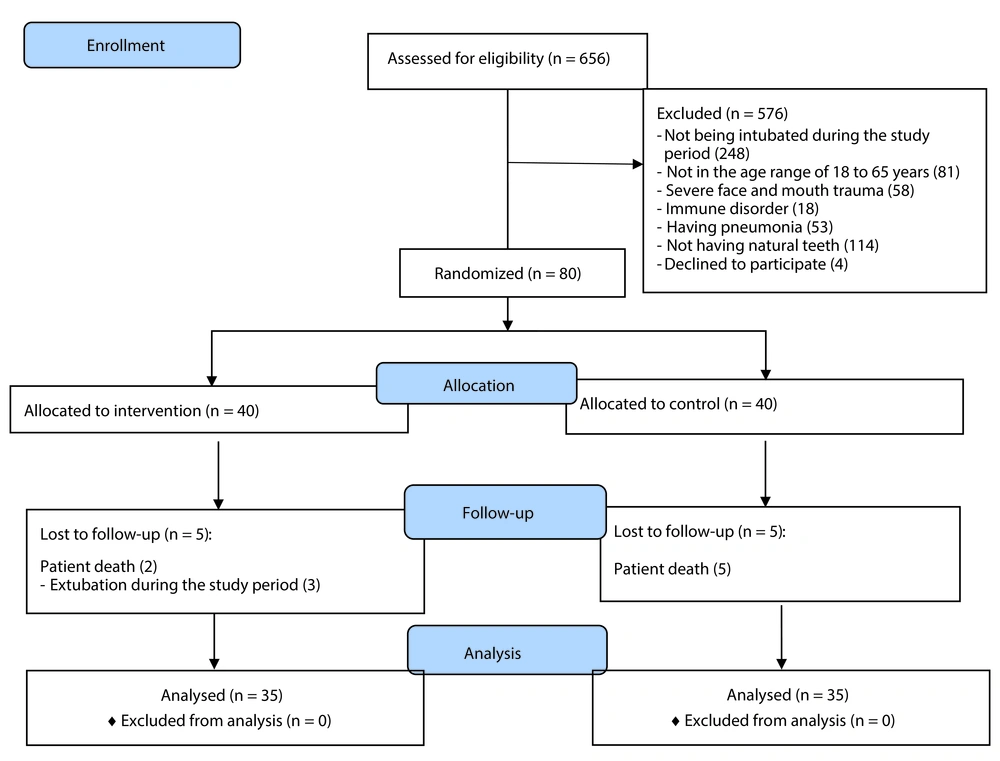
Figure 1.
CONSORT flow diagram
The researcher obtained the necessary permissions from Isfahan University of Medical Sciences, presented them to the head of the research setting, coordinated with the senior managers of the hospital, and explained the study objectives to them. The researcher then entered the intensive care unit, explained the research objectives to patients undergoing chemotherapy, obtained informed consent, and completed a demographic questionnaire, the Oral Mucositis Assessment Scale (OMAS), and the WHO checklist for PROMS Scale for both the intervention and control groups. The demographic information form included gender, history of smoking, oral diseases, frequency of brushing teeth, type of cancer, duration of chemotherapy, etc. The OMAS has two subscales for ulcer and erythema in 9 areas of the oral cavity (upper and lower lips, internal part of the right and left cheek, the floor of the mouth, the hard palate, the soft palate, and right and left sides of the tongue). The ulcer score ranges from 0 to 3, and the erythema score ranges from 0 to 2, with the ulcer and erythema scores summed. The final score in each area is between 0 (without mucositis) and 5 (the most severe type of mucositis) (19, 20). The PROMS divides oral mucosa into five distinct grades (0 - 4) (17). This tool was used to assess the condition of the oral mucosa and the incidence and degree of oral mucositis when patients entered the study (18).
After completing the questionnaires, the moisturizing gel containing 100% aloe vera gel, 3% peppermint essential oil, carboxymethylcellulose, 10% propylene glycol, and 0.1% potassium sorbate was used in the intervention group. For 14 days, a trained research assistant covered all surfaces of the tongue and mouth mucosa of the patients in the intervention group with 10 g of this gel every 6 hours (20) and did the same for the control group using a placebo gel. The placebo gel contained carboxymethylcellulose, 10% propylene glycol, 0.1% potassium sorbate, and 100% water, but no aloe vera or mint. The placebo gel smelled like the Veramint gel as a very small amount of edible mint essential oil with no therapeutic properties was added to it. Both gels were made by Barij Essence Co. (Kashan, Iran), and were identical in appearance, color, smell, and weight. It should be noted that both groups received conventional treatments as needed. The researcher completed OMAS for participants 7 and 14 days after the intervention. The test-retest method was used to determine the reliability of OMAS. For this purpose, 14 patients undergoing chemotherapy were evaluated separately by two observers, and a Pearson’s correlation coefficient of 0.94 was obtained for this scale. A similar study used simultaneous observation to determine the reliability of the PROMS and reported a correlation coefficient of 0.93 (21). It is worth noting that this study was triple-blind in that the manufacturer labeled Veramint and placebo gels with the letters A and B, and the researchers, patients, and data analyst were blinded to the content of the gels, and these codes were decoded after the study. After sampling, the data were entered into SPSS-22 software and analyzed. Independent t-test, chi-square, Mann-Whitney, paired t-test, and repeated measures ANOVA were used to analyze the data. Figure 1 shows the process of patient recruitment.
4. Results
Table 1 presents the demographic and clinical characteristics of the participants in the intervention and control groups. According to the results of the chi-square test (Table 1), there were no significant differences between the two groups in terms of demographic and clinical characteristics (P > 0.05).
Table 1.Demographic and Clinical Characteristics of Patients in Control and Experimental Groups a
| Variables | Experimental Group | Control Group | Chi-square Test | P-Value |
|---|---|---|---|---|
| Sex | 0.54 | 0.46 | ||
| Female | 23 (32.97) | 20 (28.62) | ||
| Male | 12 (17.19) | 15 (21.41) | ||
| Smoking | 1.21 | 0.14 | ||
| Yes | 5 (7.15) | 10 (14.35) | ||
| No | 30 (42.94) | 25 (35.76) | ||
| Oral and dental diseases | 0 | 0. 99 | ||
| Yes | 12 (17.13) | 12 (17.11) | ||
| No | 23 (32.97) | 23 (32.97) | ||
| Having dentures | 0.08 | 0.5 | ||
| Yes | 7 (10) | 8 (11.49) | ||
| No | 28 (40) | 27 (38.63) | ||
| Kind of cancer | 9.59 | 0.14 | ||
| Gastrointestinal | 8 (11.48) | 7 (10) | ||
| Blood | 4 (5.79) | 1 (1.46) | ||
| Bone | 6 (8.60) | 8 (11.40) | ||
| Breast | 7 (10) | 1 (1.48) | ||
| Lung | 3 (4.35) | 4 (5.77) | ||
| Kidney | 0 (0) | 1 (1.42) | ||
| Others | 7 (10) | 13 (18.64) | ||
| Duration of cancer (y) | 2.04 | 0.36 | ||
| Less than 1 | 17 (24.35) | 12 (17.16) | ||
| 1 - 5 | 13 (18.60) | 14 (20) | ||
| More than 5 | 5 (7.19) | 9 (12.98) | ||
| Consuming analgesics | 1.55 | 0.15 | ||
| Yes | 10 (14.33) | 15 (21.49) | ||
| No | 25 (35.79) | 20 (28.60) | ||
| Chemotherapy cycle | 3.64 | 0.30 | ||
| 1 - 5 | 11 (15.79) | 11 (15.76) | ||
| 6 - 10 | 16 (22.95) | 11 (15.75) | ||
| 11 - 15 | 4 (5.74) | 10 (14.34) | ||
| 16 - 20 | 4 (5.76) | 3 (4.37) | ||
| Frequency of brushing teeth | 0.42 | 0.80 | ||
| Never | 8 (11.48) | 8 (11.43) | ||
| Once a day | 20 (28.64) | 22 (31.49) | ||
| Twice a day | 7 (10) | 5 (7.10) |
a Values are expressed as No. (%).
Descriptive statistics of the oral mucositis scores for both groups at different time points are shown in Table 2. In the intervention group, the mean oral mucositis score before the intervention was 26.5 ± 3.56, and 14 days after the intervention, it significantly decreased to 0.14 ± 0.21. In the control group, the mean score before the intervention was 23.88 ± 4.31, and 14 days after the intervention, it remained relatively high at 22.22 ± 3.99. These descriptive statistics show that there was a substantial reduction in mucositis scores in the intervention group, while the control group showed a much smaller reduction.
Table 2.Comparison of Mean Oral Mucositis Scores Between Intervention and Control Groups Before, 7 Days, and 14 Days After the Intervention a
| Variables | Before Intervention | 7 Days After Intervention | 14 Days After Intervention | Within-Group Comparison P-Value |
|---|---|---|---|---|
| Group | ||||
| Intervention | 26.5 ± 8.0 | 10.3 ± 7.3 | 0.1 ± 0.6 | < 0.001 |
| Control | 23.9 ± 5.2 | 30.7 ± 15.9 | 35.7 ± 9.4 | 0.001 |
| Between-group comparison P-value | 0.112 | 0.001 | 0.001 | - |
a Values are expressed as mean ± SD.
Independent t-test results (Table 2) indicate no significant difference between the two groups prior to the intervention (P = 0.112), but significant differences were observed at 7 and 14 days post-intervention (P = 0.001).
Table 2 also shows that both groups experienced significant changes in their oral mucositis scores 7 and 14 days after the intervention, compared to before the intervention (F = 94.134, P = 0.001 and F = 476.33, P = 0.001, respectively). ANCOVA results further confirm that the intervention had a significant effect on oral mucositis scores, with the aloe vera and peppermint essential oil gel reducing mucositis by 58% and 88% in the intervention group, respectively, at 7 and 14 days post-intervention.
Descriptive statistics indicate that the intervention had a significant impact on reducing oral mucositis scores, and this effect remained stable at both 7 and 14 days post-intervention. Specifically, the mean oral mucositis score in the experimental group decreased from 147.36 ± 8.13 before the intervention to 0.55 ± 0.14 after 14 days. In contrast, the control group showed a less pronounced reduction, with scores decreasing from 26.55 ± 19.92 to 9.38 ± 35.68. ANOVA analysis revealed a statistically significant difference between the two groups at all-time points, with a P-value of 0.001, supporting the efficacy of the intervention in reducing oral mucositis.
5. Discussion
Oral mucositis is a side effect of chemotherapy and radiotherapy in patients with cancer (5). If patients with oral mucositis do not receive medical and nursing interventions, they will suffer many problems such as reduced quality of life, nutritional disorders, and decreased motivation and ability to pursue treatment, which in turn can disrupt the patient’s recovery process. Therefore, administering chemical or herbal medications for mucositis can prevent poor prognosis and increase their quality of life (22). Moreover, one of the principles of medical ethics is to alleviate patients’ pain and suffering during the course of the disease. Therefore, it is worthwhile to help remove this complication as quickly as possible. Unfortunately, oral care standards are not properly observed in many patients undergoing chemotherapy, and some treatment centers do not even use such methods (21). On the other hand, no study was found in the literature regarding the best herbal ingredient for eliminating inflammation in the oral cavity. Therefore, this study investigated the effect of an herbal gel (a combination of aloe vera and peppermint essential oils) on oral mucositis.
According to the results of the present study, the frequency of mucositis and the severity of inflammation of the oral mucosa were less in the intervention group than in the control group 7 and 14 days after using the herbal gel. In other words, this gel may be effective in the treatment of oral mucositis (P < 0.05). Also, based on the results of similar studies, these two plants may be effective in the prevention and treatment of oral mucositis. For instance, a controlled clinical trial recruited 64 patients (32 patients in each group) with chemotherapy-induced mucositis to evaluate the effect of aloe vera solution on oral mucositis. Patients in the intervention group gargled 5 cc of aloe vera solution for 2 minutes, 3 times a day for 14 days, while patients in the control group were given conventional mouthwashes. Patients’ oral inflammation status was assessed on days 1, 3, 5, 7, and 14 after the intervention. The severity of mucositis was measured using a checklist according to the WHO criteria, and the severity of pain caused by mucositis was measured using a Visual Analog Scale. Their results generally showed that the severity of oral mucositis and the resulting pain in the intervention group were significantly lower than those of the control group (P = 0.001) (21).
Another study compared the effect of aloe vera and benzydamine mouthwash on the treatment of radiotherapy-induced oral mucositis. In their study, 26 patients undergoing head and neck radiotherapy received either aloe vera mouthwash (in the intervention group) or benzydamine (in the control group). The severity of mucositis during the course of radiotherapy was assessed using a checklist based on the WHO criteria. According to their results, the interval between the start of radiotherapy and the onset of mucositis (aloe vera = 15.69 ± 7.77 days and benzydamine = 15.85 ± 12.96 days) and the interval between the start of radiotherapy and the maximum intensity of mucositis (aloe vera = 23.38 ± 10.75 days and benzydamine = 23.54 ± 15.45 days) were similar between the two groups. Furthermore, the mean changes in mucositis severity were statistically similar between the two groups, and the two methods were not significantly different (P = 0.09). According to their results, aloe vera and benzydamine mouthwash were equally effective in relieving the severity of radiotherapy-induced mucositis (23).
Another study was conducted to determine the effect of a mouthwash containing sage, thyme, and mint tea on the treatment of oral mucositis in patients undergoing chemotherapy. Sixty patients (30 patients in each group) participated in their study. Patients in the control group received basic oral care, while those in the intervention group received a mouthwash containing sage, thyme, and mint tea in addition to routine oral care. The WHO Oral Toxicity Scale was used on days 5 and 14. According to the results of the study, 70% of the patients in the intervention group and 40% of the patients in the control group did not have oral mucositis on day 5. In addition, the incidence of grade 1 oral mucositis in the intervention group (10%) was much lower than that in the control group (53.3%) on day 5 (P < 0.001). By day 14, most of the patients in the two groups had grade 0 mucositis, and the two groups were not significantly different (P > 0.05). Their results generally indicated that a mouthwash containing sage, thyme, and mint tea may have positive effects on relieving oral mucositis (24).
A clinical trial was conducted on 74 patients with OSMF to compare the effect of aloe vera syrup and aloe vera topical gel with intralesional injection of hydrocortisone and hyaluronidase. In their study, patients were divided into two groups. One group received topical aloe vera gel and syrup for 3 months, and the other received an intralesional injection of hydrocortisone and hyaluronidase for 6 weeks. Patients also received antioxidant supplements for 3 months. Patients were then evaluated 1, 2, and 3 months after the intervention. Their results suggested that OSMF improved in both groups (P < 0.001). Their results generally indicated that aloe vera can be a safe and effective alternative treatment for OSMF (13).
Nonetheless, according to another study, aloe vera solution may not be effective in preventing oral mucositis. This study compared the effect of oral aloe vera and placebo on the prevention of radiotherapy-induced mucositis in patients with head and neck malignancies. Fifty-eight patients (28 in the intervention group and 30 in the control group) participated in their study. Patients gargled 20 cc of 94.5% aloe vera solution in the intervention group, and 20 cc of placebo solution (with the same appearance but without aloe vera) in the control group, and then swallowed the solution. Patients completed a questionnaire about their general health status, ulcers, and the effect of ulcers on their daily activities (brushing, eating, etc.) during the course of the study. Based on their results, there was no significant difference between the two groups at the end of the treatment course in terms of the duration of grade 2 or higher mucositis, quality of life, weight loss, use of painkillers, oral infection, etc. In other words, their results indicated that aloe vera may not be effective in preventing oral mucositis (P > 0.05) (24).
A review of studies to date has shown that aloe vera and peppermint essential oils may have a positive effect on the treatment of chemotherapy and radiotherapy-induced mucositis. Few studies have investigated the effect of aloe vera or peppermint essential oils on the prevention of mucositis. The results of one of these studies suggest that aloe vera cannot effectively prevent mucositis and its pain, which is probably because a large amount of the basement membrane and mesenchymal tissue of the mouth is exposed to radiation and is destroyed in radiotherapy-induced mucositis (24). Therefore, it is possible to prevent the occurrence of radiotherapy-induced mucositis with substances that can regenerate the basement membrane collagens. However, aloe vera exerts its effects on the wound mostly by inhibiting inflammatory mediators and therefore may not be able to prevent oral mucositis effectively. Therefore, aloe vera is probably more effective in treating mucositis than preventing it. In general, further studies with larger sample sizes are needed to accurately determine the effect of medicinal plants such as aloe vera and peppermint on oral mucositis. One of the limitations of the present study was its small sample size. The inclusion of patients with different types of cancer may also be one of the limitations of this study because more specific and accurate results could have been obtained if only one type of cancer had been included.
Another limitation of this study is the broad exclusion of all patients who had received any form of radiotherapy. While this was initially intended to avoid confounding factors, we acknowledge that mucositis is primarily associated with head and neck radiotherapy. Future research should consider refining exclusion criteria by specifically excluding only those patients who have undergone radiotherapy in the head and neck region, to more accurately reflect the population at risk for treatment-induced oral mucositis.

