


1. Background
Digital technology has become a crucial element of contemporary education, allowing for the removal of temporal and spatial limitations and enhancing learning environments (1). This innovative approach effectively addresses many barriers associated with traditional education by offering greater flexibility and accessibility for learners, allowing them to engage with course materials at their own pace (2). Traditional face-to-face teaching methods often promote passive learning and frequently overlook the diverse needs of individual learners, thus failing to foster higher-order cognitive skills such as critical thinking, problem-solving, and creativity (3). Integrating the advantages of both traditional and modern teaching methods is a productive strategy for developing a comprehensive and engaging learning atmosphere that addresses the varied needs of students (4). Various studies have considered factors that affect online learning outcomes (5, 6). One of the important factors of online learning success is student motivation (7). Intrinsic motivation is a key determinant of active participation in learning activities, including both traditional and online formats (8). Research results suggest that the key factors influencing student learning satisfaction within a blended e-learning system (BELS) include computer self-efficacy, performance expectations, system functionality, content features, interaction, and the overall learning environment (9). Blended learning, which integrates face-to-face instruction with online components, offers flexibility, accessibility, and effectiveness in improving educational outcomes. It has been especially successful in medical education, where students report higher satisfaction compared to traditional lecture-based approaches (10, 11).
Although existing studies offer significant insights into the benefits of blended learning and the factors that influence its effectiveness, most emphasize student outcomes, such as satisfaction and performance. In contrast, there has been limited exploration of the motivational factors that inspire faculty members to adopt blended learning strategies, particularly within the context of medical education. Over the past twenty years, universities and higher education institutions have increasingly assumed a significant role within national innovation systems (NIS) (12). Faculty members are pivotal in enhancing the quality of higher education, serving as the foundational element of universities. Consequently, it is essential for higher education institutions to prioritize these critical and invaluable resources, ensuring that strategic plans are in place for their ongoing development (13). Faculty development encompasses a diverse array of initiatives that educational institutions implement to enhance or support faculty members in fulfilling their various responsibilities (14). Faculty and students faced challenges related to technology, workload, digital skills, and compatibility. They ultimately determined that education would evolve into a hybrid model, combining face-to-face and online instruction (15). The factors that motivate instructors to adopt blended learning include their interest in the approach, the opportunity for independent and personalized learning, confidence in using technology, social perceptions, external expectations, and the desire to enhance their skills (16). Over the past decade, there has been notable advancement in the use of e-learning resources in medical education (17). In addition, medical education is crucial for maintaining high standards in healthcare (18).
2. Objectives
Therefore, medical universities must prioritize motivating factors that encourage faculty to adopt blended learning strategies to improve educational outcomes and scalability. This study aims to identify key motivational components and design a comprehensive model that can effectively support faculty members in implementing blended learning within medical universities.
3. Methods
This research was conducted as a qualitative study, in which the grounded theory (GT) approach was used to examine the phenomenon of interest. Grounded theory is the most commonly conducted research method within qualitative methodologies (19). It is an inductive, systematic, qualitative research method concerned with the generation of theory, which is "grounded" in actual data, reflecting a modernist ontology (nature of reality). In GT research, data are systematically, iteratively, and rigorously collected and then analyzed to build theory (20). The participants in this research were faculty members of medical universities in region 4. This region includes the medical universities of Ahvaz, Lorestan, Dezful, and the medical schools located in the region. No specific limitations were placed on participant demographics such as age, gender, or academic discipline. Faculty members from various disciplines, including medicine, nursing, dentistry, and allied health sciences, were represented, reflecting the diversity of academic expertise within the region. Inclusion criteria were faculty members of region 4 of medical universities, interested in participating in the study, and having more than one semester of teaching experience using virtual education. Exclusion criteria were transfer to another region and research faculty members who do not have teaching experience in the virtual education system. Sampling was conducted purposefully, and the sample size continued until theoretical saturation was reached. The interviews began with general and simple questions and progressed towards more specialized and detailed questions. The data collection tool was a semi-structured interview. Data collection continued from November 2023 to March 2024. All interviews were transcribed, and some were also recorded. Participants were asked for permission to record the interviews, and the research objectives were explained to them at the outset, with written consent obtained. A three-stage coding method was used to analyze the data of the study. Coding is a process in which the researcher engages in separating, conceptualizing, merging, and integrating data. In this process, the fundamental unit is the "concept". Stages of grounded coding include open coding, axial coding, and selective coding. Open coding involves the process of breaking down, comparing, conceptualizing, and categorizing data. The method of open coding not only leads to the discovery of categories but also clarifies their characteristics and dimensions (21). Stages of open coding are analysis and coding, discovering categories, describing classes based on their characteristics and open coding table.
Motivational model for applying blended learning by faculty members was designed after coding. To ensure the validity and reliability of the extracted model, the qualitative method and Lincoln and Guba evaluation criteria were used. Based on this method, four criteria, credibility, transferability, dependability, and confirmability were considered for evaluation. To achieve each of these criteria, the following method was used:
(1) Credibility was established by meticulously recording all interview details and taking comprehensive notes throughout each step of the process. To ensure consistency, calculations between coders were performed, and for verifiability, reviews and peer feedback were utilized (22).
(2) Confirmability was achieved by thoroughly documenting and maintaining all steps and records throughout the research process. This study provided a complete description of the research stages, including data collection, analysis, and theme formation, to allow the audience to evaluate the research. Additionally, the research process was reviewed by several expert members to ensure methodological rigor, incorporating their suggestions and guidelines into the work stages.
(3) Transferability was ensured by obtaining the opinions and approval of four experts who were not involved in the research, thereby validating the research findings. The findings were shared with these experts to assess their applicability in different contexts.
(4) Dependability in the research was ensured through several measures: Sufficient time was allocated for the research, interview data were verified by the interviewees post-implementation, and the research process was reviewed by multiple specialists. To prevent bias in the coding process, two additional coders were employed to code several interview samples, ensuring consistency in perspective and avoiding the influence of personal bias. Notes were taken during interviews to further support dependability. The method of member checking was utilized, where analyzed texts were provided to several participants for confirmation. Dependability was quantified using the Holstein criterion method, with the formula
4. Results
The total number of faculty members in region 4 was 1,374. For this qualitative study, semi-structured interviews were conducted with 14 faculty members, comprising 9 men and 5 women. Participant details, including employment history, academic rank, and sex, are summarized in Table 1.
Table 1.Details of the Participants
| Variable | Academic Rank | Employment History (y) | |||
|---|---|---|---|---|---|
| Instructor | Assistant Professor | Associate Professor | 10 - 15 | > 15 | |
| Sex | |||||
| Men | 1 | 5 | 3 | 3 | 6 |
| Women | 0 | 4 | 1 | 3 | 2 |
After analyzing the qualitative data using open, axial, and selective coding methods, five main categories were identified as influential factors in designing a motivational model to support faculty in adopting blended learning. The details of the open coding outputs are presented in Table 2, and the motivational model is illustrated in Figure 1.
Table 2.Results of Interview Coding
| Primary Coding | Secondary Coding | Main Category | Example of Participant Quotes |
|---|---|---|---|
| Interaction with students | Learner centered | Learner-professor | “Blended learning helps me connect better with students, especially students who are not contribute easily in face-to-face classes”. (P5) |
| Student learning | |||
| Professional communication | |||
| Professional commitment | |||
| Receiving feedback from learners | |||
| Identification of students’ needs | |||
| Learners’ attitude to educational technology | |||
| Learners’ knowledge of educational technology | |||
| Personal professional development | Role of professors | “Using technology is a core part of teaching responsibilities of faculties”. (P8) | |
| Empowerment of professors | |||
| Professor's encouragement | |||
| Professor's attitude towards educational technology | |||
| Professor's knowledge regarding educational technology | |||
| Broadband development and increasing internet speed | Software | Infrastructures | “We need platforms that are not just functional but intuitive, so both students and professors can navigate them easily”. (P3) |
| Design of user-friendly environments | |||
| Strengthening offline and online sections | |||
| Increasing access level | |||
| Software development | |||
| Improving the quality of content | |||
| Easy access | |||
| Cost reduction | Hardware | ||
| Development of infrastructure networks | |||
| Application design | |||
| Providing suitable physical space | |||
| Provide support services | |||
| Financial assistance for content development | Financial incentive | Structural | “Funding for developing virtual tools is necessary, and it makes fully utilize blended learning methods”. (P7) |
| Allocation of grants and subsidies for the development of virtual education | |||
| Inclusion in the educational record | Educational score | ||
| Increase educational score | |||
| Determining the top professor | |||
| Maintain confidentiality | Building trust | ||
| Compliance with ethics | |||
| The importance of information security | |||
| Using educational design models and technology | Educational design | Environmental factors | “The flexibility in timing has made it easier for me to balance teaching and research”. (P10) |
| Various learning assignments | |||
| Using formative evaluation | |||
| Better classroom management | |||
| Curriculum flexibility in relation to virtual education methods | Curriculum | ||
| Flexibility in time and place | Flexibility | ||
| The speed of global changes and the acceptance of technology | Technology changes | ||
| Allocation of special points for students and professors to use blended learning | Ministry rules | Rules and regulations | “Having clear guidelines and standards for blended learning implementation are essential”. (P1) |
| Determine standards for blended learning | |||
| Change in curricula based on blended learning | |||
| Supporting research in the field of blended learning | Support | ||
| Compilation of educational packages to improve the knowledge and attitude of the professors and learners |
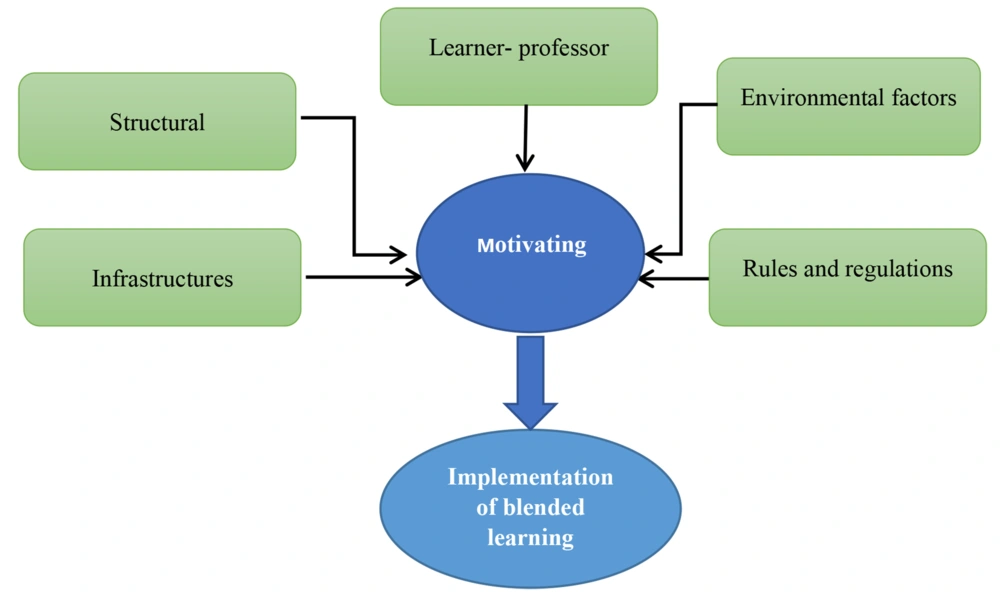
Figure 1.
Motivational model for applying blended learning by faculty members
The results of the validity and reliability evaluation demonstrated that after re-coding by four experts, the coefficient of consistency between coding, using Scott's (2012) approach, was 87.14, indicating an 87% agreement among evaluators in the coding process. Confirmability was established by experts after a comprehensive description of the research stages was presented. Subsequently, the research findings were approved by four experts for transferability. According to the Holstein criterion method, the dependability coefficient obtained during two stages of coding, with an approximate time interval of 3 months, was 85.4%.
5. Discussion
In this study, we identified five primary motivational factors influencing faculty members in medical universities of region 4 to adopt blended learning: Learner-centered approaches, the role of professors, infrastructure, financial incentives, and educational scores. The study emphasizes the importance of faculty professional development and empowerment, highlighting strategies that can enhance teaching practices. Additionally, various intrinsic and extrinsic motivational factors were included in the research, providing a nuanced understanding of faculty engagement. The study demonstrates a strong commitment to validity and reliability through thorough data collection and analysis methods. Our findings align with existing literature that underscores the pivotal role of intrinsic motivation in educational contexts (23). Notably, faculty perceptions, particularly regarding their teaching and learning satisfaction, are crucial in the context of blended learning (24). However, the present study extends this understanding by proposing a structured model that incorporates both intrinsic and extrinsic motivators, a perspective less frequently addressed in prior studies. In 2018, Zarabian conducted a study examining the impact of blended teaching-learning methods on learning, motivation, and interest in anatomy among medical students. The results indicated that blended learning significantly affected academic performance and motivation in anatomy at a significance level of 0.01. Among the motivational components, based on the mean differences between the pre-test and post-test in the experimental group, blended learning had the greatest impact on long-term resilience (3.83), while it had no significant effect on three components: Time perception (0.63), future orientation (0.77), and attention to competency criteria in friend selection (0.5) (25).
In 2015, Al-Harbi conducted a study to determine the attitudes and motivation of English faculty members in Saudi Arabia towards virtual learning environments and online course instruction. The findings revealed that faculty members have a positive perception of using e-learning technology, influenced by the demographics and experiences of students. The results also indicated that instructors generally enjoy and are interested in using tools in virtual learning environments for teaching. In countries like Saudi Arabia, where virtual educational resources are available and suitable technology is provided for instructors, they express satisfaction with virtual education (26).
In the same year, Schulz et al. conducted a study at Grimstad University in Norway to determine faculty motivation in using information and communication technology (ICT). The results showed that most participants believed the effective use of ICT tools depends on their integration into the learning and teaching process and their ease of use. Three categories of influential factors were identified: Human factors, such as faculty skills, attitudes, and beliefs about ICT tools; intrinsic values, including faculty satisfaction, interest, happiness, and enjoyment; and user requirements for ICT tools, such as usability, interaction level, compatibility, and learning needs. The study highlighted the need for faculty involvement in designing ICT tools for education, as well-designed tools can enhance intrinsic motivation in the teaching and learning process (27).
This study has several limitations that should be acknowledged. The regional focus on medical universities in region 4 may limit the generalizability of the findings to other geographical or institutional contexts, where differences in infrastructure and faculty composition might influence motivational factors. Additionally, the use of purposeful sampling and a relatively small sample size could introduce potential biases, as the findings reflect the perspectives of a subset of faculty members who were willing to participate. Although rigorous coding procedures were employed, the qualitative nature of the GT approach inherently involves some degree of subjectivity, and interpretation decisions may have been influenced by the researchers’ perspectives. Future research should address these limitations by including more diverse samples, expanding the geographical scope, and incorporating triangulation with quantitative or longitudinal methods to enhance the robustness and applicability of the findings.
To enhance faculty adoption of blended learning, institutions should invest in professional development programs that build technological and pedagogical skills, ensure robust infrastructure and technical support, and establish incentive structures such as financial rewards or recognition for innovative teaching practices. Facilitating cross-disciplinary collaboration and regularly evaluating blended learning initiatives can further refine strategies. Additionally, leveraging emerging technologies like AI and virtual reality can sustain engagement and adaptability. These steps provide a practical roadmap for policymakers and educators to create supportive environments that address motivational factors and improve educational outcomes.
5.1. Conclusions
This research presents a significant motivational model that addresses both intrinsic and extrinsic factors influencing faculty engagement in blended learning. Universities can implement this model by integrating it into professional development programs, enhancing infrastructure, and offering incentives to faculty. Future steps should include piloting the model in diverse settings, gathering feedback, and evaluating its impact on teaching quality and student outcomes to ensure its effectiveness and adaptability in fostering dynamic learning environments.

