The general characteristics of the infertile patients recorded in this study are presented in
Table 1. The mean age of all participating women was 32.55 ± 7.68 years, ranging from 19 to 51 years. The mean age of the PCOS group was significantly lower than that of the non-PCOS group, 28.67 ± 5.50 years versus 36.28 ± 7.64 years, respectively (P < 0.001). This finding is consistent with the studies conducted by Tannus et al., Louwers and Laven, van Keizerswaard et al., and Guo et al. (
10-
13).
The mean BMI of all enrolled women was 29.9 ± 5.43 kg/m
2, with a range of 17.1 - 42.8 kg/m
2. The mean BMI of the PCOS group was significantly higher than that of the non-PCOS group, 31.16 ± 5.55 kg/m
2 versus 28.69 ± 5.04 kg/m
2, respectively (P < 0.001). This result aligns with findings reported by Barber et al., Zeng et al., Barber and Franks, and Amiri et al. (
14-
17).
Primary infertility was observed in 264 women (50.6%), while secondary infertility was reported in 258 women (49.4%). No significant variation was found in the proportions of primary and secondary infertility between the PCOS and non-PCOS groups (P = 0.338). This finding contrasts with the results of Deshpande and Gupta (
18), who concluded that primary infertility was significantly more prevalent than secondary infertility in PCOS patients, and with the findings of Javadian et al. (
19).
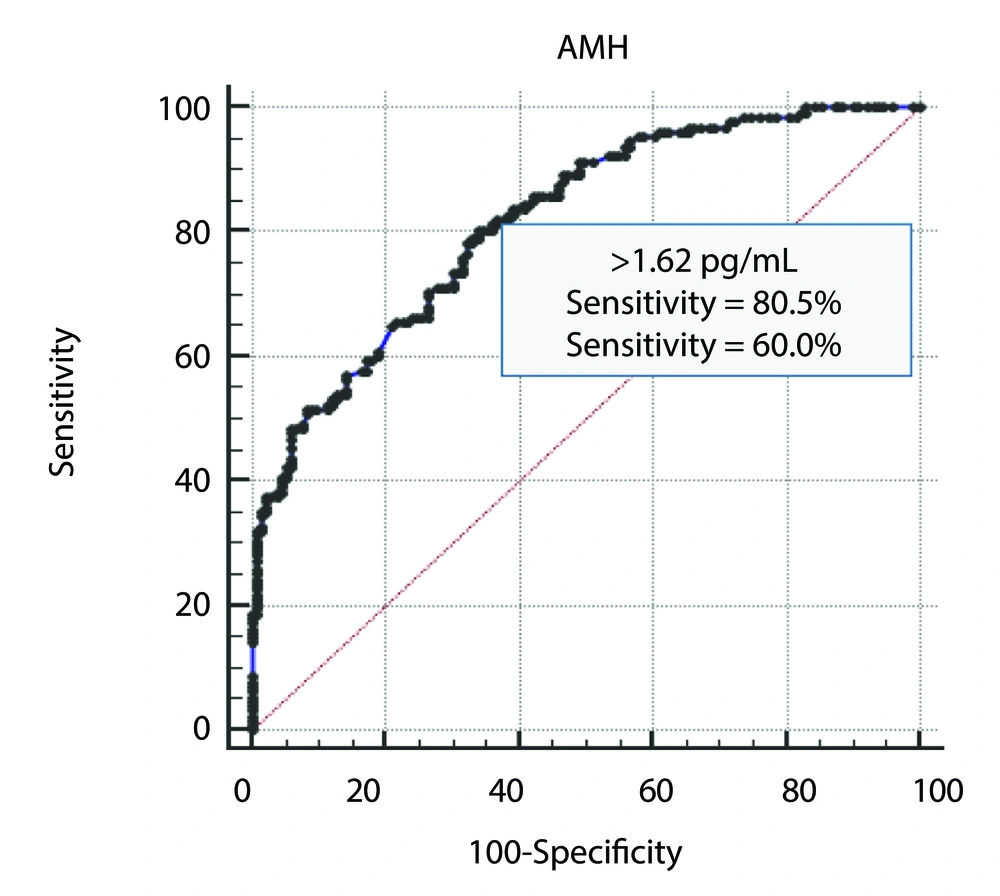
A comparison of the mean AMH values between women with and without PCOS is shown in
Table 2. The mean AMH value in all cases was 3.11 ± 2.96 ng/mL, with a range of 0 - 14 ng/mL. The AMH level was significantly higher in the PCOS group compared to the non-PCOS group, 4.70 ± 3.23 ng/mL versus 1.59 ± 1.57 ng/mL, respectively (P < 0.001). This finding is consistent with the study by Evliyaoglu et al. (
20), who suggested that AMH is the strongest diagnostic marker for PCOS, as well as with the study by Piltonen et al. (
21). However, van der Ham et al. (
22) disagreed, stating that AMH levels alone are insufficient for PCOS diagnosis.
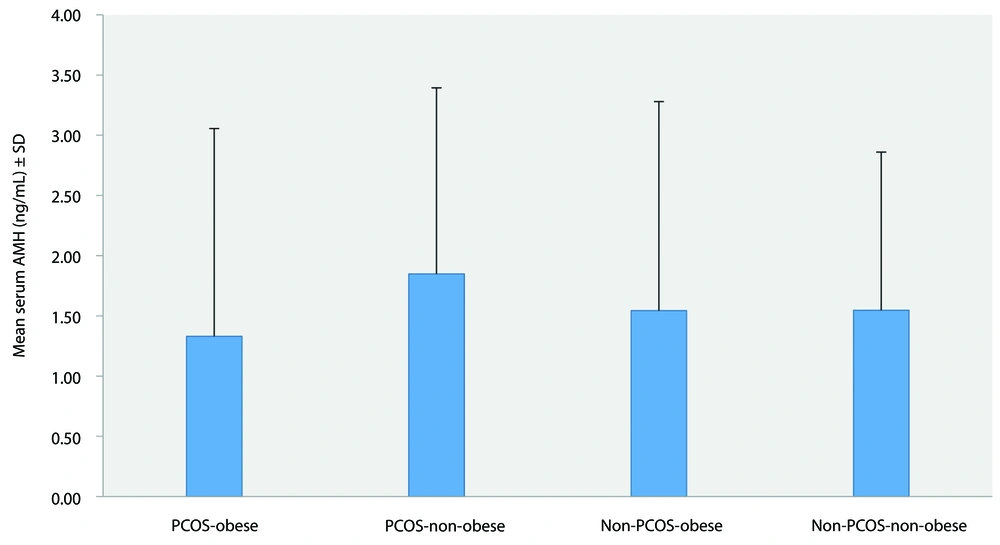
A comparison of mean serum AMH levels according to obesity status in both the PCOS and non-PCOS cohorts is shown in
Figure 4. The mean AMH levels were 1.33 ± 1.72 ng/mL, 1.85 ± 1.54 ng/mL, 1.54 ± 1.74 ng/mL, and 1.55 ± 1.31 ng/mL in the PCOS-obese, PCOS-non-obese, non-PCOS-obese, and non-PCOS-non-obese groups, respectively. The comparison revealed no significant difference (P = 0.302). This finding aligns with the study by Simoes-Pereira et al. (
23), which found that BMI does not significantly affect AMH levels. Additionally, other studies conducted on non-PCOS populations have also reported an absence of correlation, including those by Chiofalo et al., Hardy et al., and Zeng et al. (
24-
26). These studies questioned the reliability of AMH as a marker of ovarian reserve in women with obesity. However, others, such as Bernardi et al. (
27), reported a significant inverse relationship between obesity and AMH levels.
Conflicting outcomes have also been observed among PCOS populations, with some studies identifying a negative correlation (
28-
31), while others did not (
24). Furthermore, certain data suggest that a correlation may only be evident at extreme levels of obesity. Bhandari et al. found an association between AMH and BMI among individuals with BMIs exceeding 51 kg/m
2, while Bernardi et al. reported a similar trend in those with BMIs over 40 kg/m
2 (
27,
32,
33). They found that in the PCOS group, obese patients had the lowest AMH levels, while underweight patients had the highest AMH levels. Given these discrepancies, we aimed to clarify the existence of a link between BMI and AMH by ensuring that our study population accurately reflected a broad range of BMI categories.
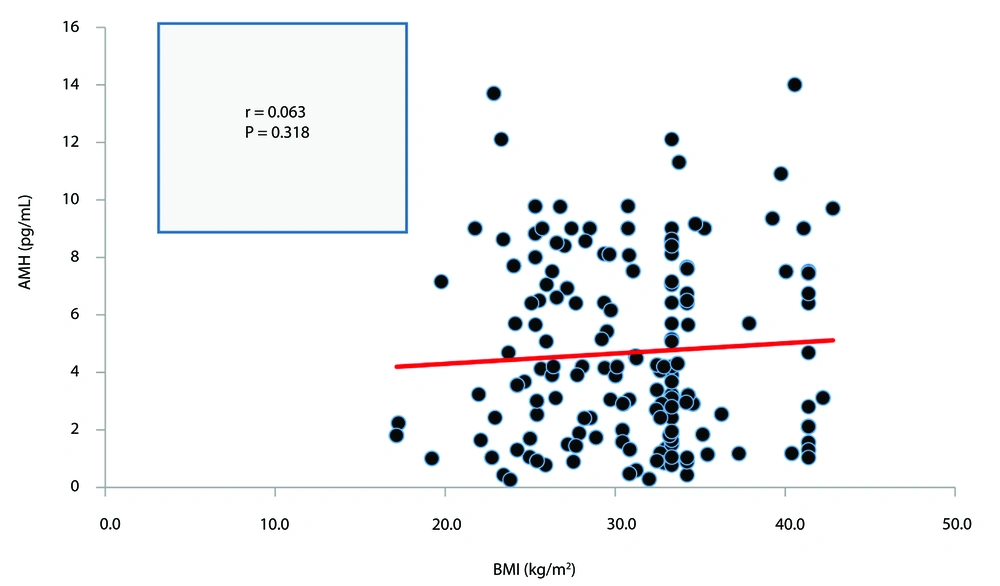
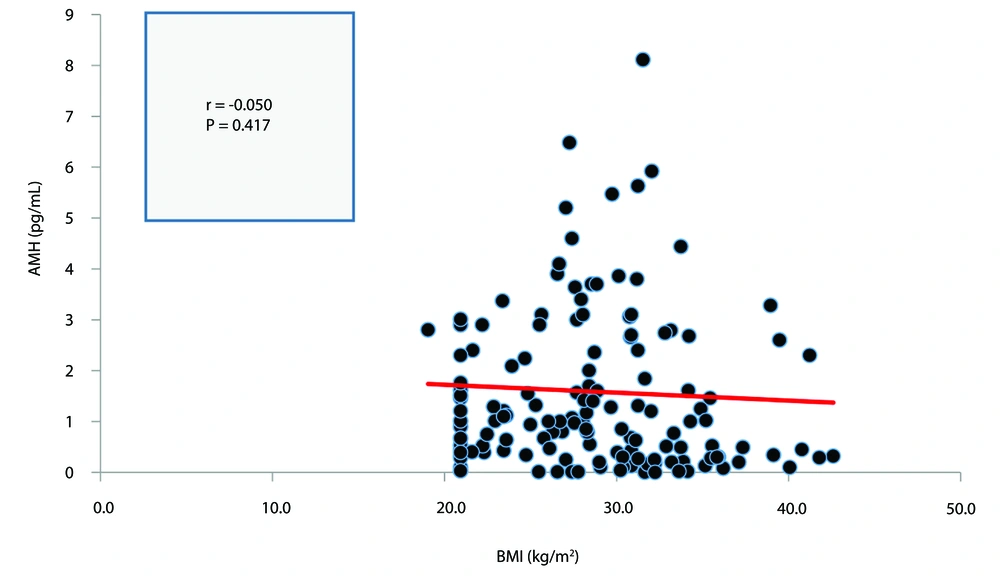
In conclusion, our analysis found no correlation between AMH and BMI across the entire study cohort, regardless of PCOS status. No significant changes were observed in serum AMH levels between patients with BMIs over 30 kg/m
2 and those with BMIs below 30 kg/m
2. This finding is comparable to the review by Oldfield et al. (
34).
5.1. Study Limitation
The primary limitation of this study is that it was conducted in a single clinic. Therefore, we recommend further studies with larger and more diverse populations to validate our findings.
5.2. Conclusions
Our analysis revealed no correlation between AMH and BMI in the entire study cohort, regardless of PCOS status. No significant differences were observed in serum AMH levels between patients with BMIs over 30 kg/m2 and those with BMIs below 30 kg/m2.