


1. Background
Organizational loyalty is a psychosocial condition that reflects employees’ commitment and dedication to their organization. It includes an ethical obligation (1) and serves as a key indicator of societal progress and the ability to contribute effectively to knowledge production, which in turn leads to increased staff efficiency (2). Theoretically, Meyer and Allen identified three components of commitment: (A) Affective commitment, reflecting a desire; (B) continuance commitment, reflecting a need; and (C) normative commitment, reflecting an obligation to maintain employment in an organization (3). A psychological contract is a set of perceptions regarding what managers and workers owe their organizations and vice versa (4). Loyalty, as a mediator, reduces employee turnover (5), which can be costly and time-consuming for organizations to manage. Loyal employees tend to be more engaged, motivated, and committed to their work (6). Organizational loyalty often leads to long-term employee tenure, enabling individuals to accumulate valuable knowledge and expertise. This accumulated knowledge benefits the organization by contributing to institutional memory and can be transferred to other employees, ultimately enhancing organizational effectiveness. Loyalty also fosters a positive organizational culture (7). A culture of loyalty promotes trust (8), collaboration, and strong relationships among employees. Finally, organizational loyalty is linked to employee engagement and satisfaction (9, 10). Loyal employees experience a sense of fulfillment and pride in their affiliation with the organization, contributing to increased job satisfaction and overall well-being.
The level of employee loyalty in an organization profoundly affects its core competitiveness, which is closely linked to company performance and organizational innovation (11). Additionally, leadership style impacts employee performance (12) and reduces turnover (13). It has been shown that there is an inverse relationship between organizational undermining and loyalty to the organization (14). In Egypt, a study showed that 67.7% of professors exhibit organizational loyalty, which is higher among university faculty members compared to researchers outside the university (15). Alshemari et al. found that ethical and calculation items indicated a high level of organizational loyalty (16). Another study showed a positive correlation between burnout, organizational commitment, organizational loyalty, and the tendency to leave the service (17). It was shown that nurses’ intention to leave their profession was significantly influenced by factors such as educational status, age, experience, job stress, job satisfaction, professional commitment, and organizational factors (18). Among the various components of the transformational leadership style, intellectual stimulation was found to have the strongest impact on the organizational identity of faculty members (19). Additionally, it has been shown that intelligent leadership increases organizational loyalty (20). Arqawi et al. demonstrated a statistically significant relationship between the levels of procedural and interactive justice among department heads at Palestine Technical University-Kadouri (21). Abdulrahman showed that the overall degree of organizational loyalty among faculty members in Jordanian universities was "moderate". "Emotional loyalty" ranked first, followed by "moral loyalty", while "continuing loyalty" ranked last (22). However, feelings regarding integration into academic life and the hope of finding more favorable research conditions elsewhere do exist (23).
Medical universities in Iran experienced a golden era during the last half of the century. However, these institutions now face several challenges. In the nursing domain, shortages and burnout are primary issues, along with management problems (24, 25). Over the last decade, additional problems have arisen, such as health sector reform, budget deficits, and issues with insurance institutions (26). The brain drain of faculty members in medical universities is another challenge (27). There is a shortage of faculty members in deprived regions and a lack of willingness to transfer to type I universities (28). A new challenge confronting the Iranian health system is the increasing reluctance to enroll in specialty residency programs (29).
2. Objectives
It can be proposed that there is a certain level of organizational loyalty among faculty members to the University of Medical Sciences. Although studies have focused on the determinants of loyalty and the managerial and organizational effects on loyalty, there has been no study on the nature and experience of loyalty among faculty members. The present study aimed to explore the reasons for this issue. Therefore, the question addressed in this study is: What are the reasons for organizational loyalty among faculty members in medical universities?
3. Methods
This qualitative study was conducted in 2022 in southern Iran. The field of study includes governmental medical universities in Shiraz, Yasuj, Jahrom, Bandar Abbas, Fasa, and Bushehr, collectively known as the 5th region of medical education in Iran. This region has its own policies regarding medical education and fulfills its mission in accordance with the Ministry of Health and Medical Education in Iran. Participants included clinical faculty members from these universities, encompassing all physicians in all departments and resident students. Therefore, all faculty members specializing in clinical fields, including subspecialties, were included as participants in the research. Inclusion criteria were being a faculty member with two or more years of work experience, not working in the private sector, not wanting to work there, and being interested in participating in research. Researchers aimed to include participants from a diverse range of specialties and groups. Purposeful and snowball sampling methods were used in this study. After identifying participants, the research objectives were discussed with them. If they were willing to participate, a time was scheduled for the interview. Based on saturation criteria, 23 clinical faculty members participated in this study (Table 1). Data were gathered through face-to-face and telephone interviews. Telephone interviews were mainly conducted for academic staff members who were difficult to reach or who did not have time for face-to-face interviews. The interview protocol was prepared based on the main question: What is organizational loyalty? Do you consider yourself a loyal faculty member? Why? Please explain your reasons for this loyalty. Based on the responses, additional questions were also asked. Content analysis was conducted in this study. Content analysis can be categorized into three approaches (30), and we used conventional content analysis. In this study, content analysis introduced by Lindgren et al. was used. A step-by-step approach was employed for data analysis, involving selecting meaning units (de-contextualization), condensing and coding, and creating categories and themes on different levels (re-contextualization) (31). Our analysis was conducted inductively. Abstract codes were used and interpreted in the process of analysis. Before coding, authors read the data several times to gain a comprehensive understanding of the subject. Finally, the authors attempted to explore a conceptual schema regarding organizational loyalty.
Table 1.Characteristics of Participants
| Department | Academic Ranking | Specialty | Participants’ Code |
|---|---|---|---|
| Shiraz University of Medical Sciences | Professor | Cardiologist | 1 |
| Shiraz University of Medical Sciences | Assistant professor | Emergency medicine | 2 |
| Shiraz University of Medical Sciences | Assistant professor | Rheumatologist | 3 |
| Shiraz University of Medical Sciences | Professor | Infectious disease specialist | 4 |
| Shiraz University of Medical Sciences | Assistant professor | Emergency medicine | 5 |
| Shiraz University of Medical Sciences | Professor | Pediatrician | 6 |
| Shiraz University of Medical Sciences | Assistant professor | Sargent | 7 |
| Shiraz University of Medical Sciences | Assistant professor | Sargent | 8 |
| Shiraz University of Medical Sciences | Assistant professor | Cardiologist | 9 |
| Shiraz University of Medical Sciences | Professor | Optometrist | 10 |
| Bandar Abbas | Associate professor | Sargent | 11 |
| Shiraz University of Medical Sciences | Associate professor | Psychiatrics | 12 |
| Shiraz University of Medical Sciences | Assistant professor | Dentist | 13 |
| Shiraz University of Medical Sciences | Professor | Cancer specialist | 14 |
| Shiraz University of Medical Sciences | Professor | Internist | 15 |
| Shiraz University of Medical Sciences | Assistant professor | Neurosurgeon | 16 |
| Shiraz University of Medical Sciences | Assistant professor | Optometrist | 17 |
| Shiraz University of Medical Sciences | Assistant professor | Gastroenterologist | 18 |
| Bandar Abbas University of Medical Sciences | Associate professor | Infectious disease specialist | 19 |
| Jahrom University of Medical Sciences | Assistant professor | Pediatrician | 20 |
| Yasuj University of Medical Sciences | Assistant professor | Pediatric cardio | 21 |
| Jahrom University of Medical Sciences | Assistant professor | Emergency medicine | 22 |
| Shiraz University of Medical Sciences | Associate professor | Cardiologist | 23 |
This schema was not introduced in the mentioned method, but the authors explored it to gain a better understanding of the subject. Trustworthiness and rigor standards were ensured in this study. Credibility, transferability, confirmability, authenticity, and dependability were considered during data collection and analysis (32). An appropriate methodology, research questions, and interview protocols were used throughout the study. The standards for qualitative research reporting (SRQR) guidelines (33) were used to enhance the reporting and methodological quality.
4. Results
Many participants complained about inefficiencies in medical universities. According to them, these universities face numerous defects and inefficiencies at the management level. Lack of attention to the needs of academic staff members, failure to pay fees on time, disproportionate promotion conditions, and organizational pressures weaken their overall experience. Participants reported encountering a weak and ineffective structure in medical science universities, causing some academic staff to leave the organization and seek opportunities in the private sector or abroad. Poor management at various levels, from macro to micro, has led to high levels of burnout, resignations, and retirements among academic staff members. Despite this, the participants in the research were individuals who remained in their organization and continued their activities. Organizational loyalty, as referred to in the current research, is the act of remaining employed in universities of medical sciences despite numerous challenges and deficiencies in management. Three main themes related to this type of organizational loyalty are organizational spirituality, social capital, and organizational affiliation (Table 2).
Table 2.The Implications of Organizational Loyalty Among Faculty Members of Medical Universities in Southern Iran
| Main Categories | Categories | Initial Codes | Meaning Units |
|---|---|---|---|
| Organizational spirituality | Supreme charity, organizational sacrifice, self-actualization | Sacrificing for vulnerable groups, attending to the needs of patients, being truly dedicated to education, embodying an educational spirit, embracing education, and providing expert instruction | I helped a disadvantaged child in this hospital, as well as many other individuals in need. Some patients pray for me. Attending university feels like perpetuating my existence. I prefer education over money. I have students whom I believe will become great physicians in the future. |
| Social capital | Interaction with reference groups, formal relationship networks, informal relationship networks | Being alongside reference groups and being part of them, engaging with influential individuals, earning people’s trust, and cultivating positive relationships with patients and faculty members. Having a strong network of friends, maintaining healthy family relationships | Here, I see the greatest professor every day. I enjoy conversations with my former teachers. I have many friends from different departments. Sometimes, we go on vacation with our families. |
| Organizational affiliation | Opportunistic view, emotional attachment | Self-sacrifice for the department, self-sacrifice for the next generation of students, the valuable role of faculty, scientific integrity, respect for individuals’ rights, professional accountability | If I were to leave the university, who would be there to teach the students? The department relies on my presence, this university holds a high position. I strive to perform my work well. |
4.1. Organizational Spirituality
Organizational spirituality refers to a positive sentiment and the overall experience of being present at the University of Medical Sciences. This can be attributed to the rewarding experience of treating patients and the uplifting feeling of working within the university environment. From this perspective, the organization is more than just its work contracts and job benefits. It provides opportunities for engaging in diverse activities that expose individuals to enriching and fulfilling life experiences. Initially, working in medical universities involves assisting impoverished and vulnerable groups in society. Because these groups cannot afford private sector healthcare, government clinics and hospitals provide healthcare for them. Therefore, being present in this sector presents an opportunity for humanitarian action.
Participant 9: "I truly feel sorry for these patients. I know that if I don’t come to this clinic, a family with a child would have to pay 300 to 400,000 Tomans (about $5) for a pediatric echocardiogram and a visit. So, I am here for these reasons".
Furthermore, these participants have a strong commitment to serving the organization. They believe that leaving the organization would cause serious damage and lead to the disintegration of various departments at the medical university. With their departure, questions arise such as who will train the students and in which direction the department will go. They consider themselves somewhat indebted to the organization that has brought them to this point. Despite numerous management inefficiencies, they strive to serve the organization and make sacrifices for it. When asked, "Why don't you consider working in the private sector?" a neurosurgeon responded by saying, participant 16: "If I leave the department, it will fall apart. It is unfortunate that it happened this way. Who will train neurosurgeon residents? They have the right to get a good education".
The third aspect of organizational spirituality relates to the education of medical students. Participants perceive a sense of self-actualization in this endeavor, encompassing both their current reality and metaphysical existence. The training of students and doctors in medical universities is of great significance and cannot be compared to financial contracts or organizational privileges.
Participant 9: "I believe that as a doctor, my responsibility goes beyond merely providing treatment and earning money. I also have the responsibility to foster a medical community that is well-suited for the country. Even when I grow old or pass away, what truly matters is the impact I have made by training exceptional students and doctors. It is not the amount of money I possess that will be remembered, but rather the quality of the individuals I have influenced".
4.2. Social Capital
A medical university is not merely a physical structure consisting of rooms and corridors; it is an existential structure that encompasses a vast network of human and social relationships. Being a faculty member, like being a member of any other organization, includes social capital. The membership of academic staff in the faculties of medical sciences carries higher social capital due to its special position. Participants emphasized the presence of social capital in medical science universities. The distinguishing factor is the presence of esteemed and highly regarded medical professors, who are respected not only within the organization but also in the community. Interaction with reference groups in medical universities is the most significant form of social capital. A member of the academic staff at the University of Medical Sciences engages in daily conversations and exchanges greetings with professors who possess high social capital and belong to scientific and social reference groups — professors whom they themselves were students of. They see themselves following in the footsteps of those professors, and the professors see their legacy continuing in the students who now serve as faculty members.
Participant 18: "I see many renowned professors here every day. Why? Because I am a faculty member at this medical university. If I leave this organization, will I encounter people like this? No. I had a conversation with those who were once my teachers, and I wished to be like them. I engage in scientific discussions, and this brings me the greatest satisfaction".
On the other hand, the University of Medical Sciences has a complex network of relationships that helps strengthen social capital. The existence of various medical departments, along with close and continuous communication among their members and the trust between them, has resulted in the development of a robust network of official relationships. In these official relationships, faculty members engage in scientific exchanges, have scientific discussions, and organize scientific meetings and workshops. Being a university professor entails a sense of identity and belonging to a broad community, which extends beyond the university and encompasses significant social capital within the institution. The concept of social capital includes all the tangible and intangible benefits that an individual gains from being part of the University of Medical Sciences. This includes a sense of identity and belonging, as well as the formal and informal connections formed through social interactions. Additionally, the university provides resources and opportunities that contribute to an individual's social capital beyond the campus. This tangible and intangible social network provides individuals with a feeling of effectiveness, efficiency, and usefulness.
Participant 20: "Yes, you are correct. We have a physical structure and a human force that we can communicate with at any time. The significance of this social capital lies in the trust that the members have in the system and its managers. In this system, the social capital consists of the faculty members, students, and employees. As a result, the performance of the system will improve".
On the other hand, some faculty members have informal friendships and family relationships that extend beyond formal connections. This informal social capital helps faculty members remain with the organization. These relationships lead to family visits and friendships outside the university environment, providing support for individuals within the university. Additionally, faculty members possess informal social capital through their conversations in the public sphere of society.
Participant 22: "On the other hand, the presence of some old friends and acquaintances prevents me from leaving the government system. Also, we talk and socialize with a lot of people here, which is valuable to us".
4.3. Organizational Affiliation
Organizational affiliation includes two contrasting categories: Opportunistic view and emotional dependence. The opportunistic view encompasses those who have only a university affiliation, but conduct most of their services in the private sector. Emotional attachment includes those who remain in the public sector or those who, even if they work in the private sector, spend most of their time and activity in the public sector. Generally, faculty members of medical universities have a strong sense of belonging and actively participate. Despite several organizational deficiencies, participants are proud of their affiliation with these universities. Being a faculty member of a medical university provides a significant sense of identity. Membership and belonging to such an organization is a source of pride for faculty members. Academic staff members introduce themselves in various formal and informal networks, both within scientific and non-scientific communities, while being affiliated with the University of Medical Sciences. In fact, the totality of social capital is rooted in the overall identity of the medical university. Therefore, despite its managerial deficiencies, a medical university offers multifaceted benefits for its members. This affiliation includes tangible benefits. For example, if a faculty member transitions to the private sector, they may face challenges in effectively engaging with scientific societies worldwide. Despite this affiliation, they can introduce themselves to all gatherings, give speeches, and publish articles in scientific publications and books.
Participant 8: "Academic staff members who have gone to the private sector also come to the public sector because of its scientific position at the world. If they break the relationship, they cannot participate in science".
The other category relates to the high status associated with attending a medical university. Even faculty members who work in the private sector benefit from this affiliation. This affiliation implies that clinicians work more scientifically than other doctors who work solely in the private sector. Therefore, affiliation is more valuable for faculty members.
Participant 23: "Even physicians who work in two sectors use the affiliation of a medical university because the affiliation serves a public function. So, they display this affiliation on their office sign".
Faculty members with an emotional attachment to the University of Medical Sciences find working there fulfilling and a source of pride, rather than boring. Therefore, despite several problems, they strive to fulfill their duties professionally. They fulfill their responsibilities despite work pressures, including hospital, clinic, and sometimes emergency room presence, as well as involvement in teaching and scientific research. Ultimately, they are professional physicians who fulfill their responsibilities to the best of their ability. This dedication is due to a strong affiliation with the organization. "University is a very good place. He gave us many opportunities. We can serve here for patients, people. What better place than this? I am satisfied here despite the many problems. I spend time for it for my department".
5. Discussion
The goal of this study was to explore the reasons for organizational loyalty among clinical faculty members of medical universities in southern Iran. We conducted a study among faculty members who have chosen to remain in governmental clinics and hospitals despite several challenges. We identified three reasons related to organizational loyalty: Organizational spirituality, social capital, and organizational affiliation. As shown in Egypt, loyalty is higher among university faculty members compared to researchers outside the university (15). Generally, being a faculty member is associated with higher loyalty to the organization, warranting further research. It appears that organizational loyalty at a personal level is related to how individuals interpret their responsibilities toward the organization and society. Our participants exhibited emotional loyalty, which is achieved by creating a strong emotional attachment to the medical universities. For faculty members, the medical university is a second home. They have spent several years working in the organization, sometimes even serving food, which forms an emotional connection to the organization. Other studies addressing topics such as justice management and leadership are not relevant to our findings.
Evidence shows that organizational justice, including distributive, procedural, and interpersonal justice, plays a role in the emotional exhaustion – organizational loyalty link (34). This is a main issue in the context of this study as well. However, our findings explored the dynamics of this matter at the micro-level of medical universities, which led to faculty member loyalties. These dynamics function despite the multifaceted challenges faced by medical universities. Nevertheless, our participants remained engaged in the context and continued their affiliation and work. Initially, spirituality is the main reason. Workplace spirituality has a direct effect on organizational commitment and an indirect effect on organizational commitment through the mediator variable, work engagement (35). Our participants view medical universities as a context that enriches their spiritual life. Helping the poor and vulnerable and feeling indebted to the organization that supported and nurtured them form the basis of this spirituality. It is clear that clinics and hospitals are not typically associated with spirituality, but their functions do include an understanding of spirituality. "I am a doctor who is dedicated to helping people, and this organization has provided me with the opportunity to do so". As noted, "an employee being loving, owning and owing to the organization" (36).
An organization is a field of belonging. It is clear that the satisfaction of faculty members is related to organizational leadership and management (37). However, our study showed that organizational loyalty is rooted in two fundamental elements: Spirituality and social capital. Many of our participants were faculty members who were welcomed by the private sector but remained in the governmental system. They had an emotional attachment to their organization and were unwilling to leave despite the problems and challenges. Such belonging was rooted in individual and organizational characteristics that provided them with a sense of satisfaction beyond material concerns and organizational obstacles. This is an organizational identity that emerges from its values, practices, and discourse. It is shaped by workplace and individual spirituality, guided by the leader and other members, and influenced by the environment, organizational culture, and knowledge management. This relates to a culture of gratitude towards the organization, as well as a commitment to improving its services and sacrificing for the people. We believe that spirituality, within the context of our culture, is deeply ingrained in the widespread social system that has significantly influenced our organization. On the other hand, social capital in this context is also a cultural issue. It has been shown that social capital significantly influences the planning of employee loyalty and retention (38). In the context of the study, there were formal relationships, as well as deep informal interpersonal relationships, trust, and cooperation between faculty members. This network sometimes extends to include their families, leading to satisfaction and enabling medical universities to function effectively. Despite all the studies that have highlighted deficiencies and challenges in the management of these organizations, medical groups and interpersonal relationships lead to a shared sense of identity, value, trust, and cooperation. Medical universities are considered the second home for faculty members. In the context of the study, it was shown that there is a dynamic relationship between the individual, interpersonal, and macro-levels of an organization that preserves social capital (39). Based on our findings, we can say that micro-level relationships include significant elements of social capital, as our participants have stated.
Let’s revisit the research question: Why do the participants still have a positive perception of the University of Medical Sciences, despite management problems? Why do they tend to stay despite financial problems and sometimes family pressures? They not only enjoy their roles but also strive to remain if given the chance. We base our answer on three themes. Considering the concepts of spirituality, capital, and dependence, it can be said that staying in these universities stems from a profound sense of affiliation. This dependence is primarily rooted in a person's prolonged presence at the university. Regarding the theme of spirituality, it can be argued that the university serves as a pathway for self-actualization. Faculty members are in contact with esteemed colleagues and, regardless of material concerns, are dedicated to the pursuit of knowledge. They study science beyond mere management or material matters, focusing on maintaining the department, educating students and future doctors, and ultimately assisting patients. What is better than this? Figure 1 shows the conceptual schema of organizational loyalty.
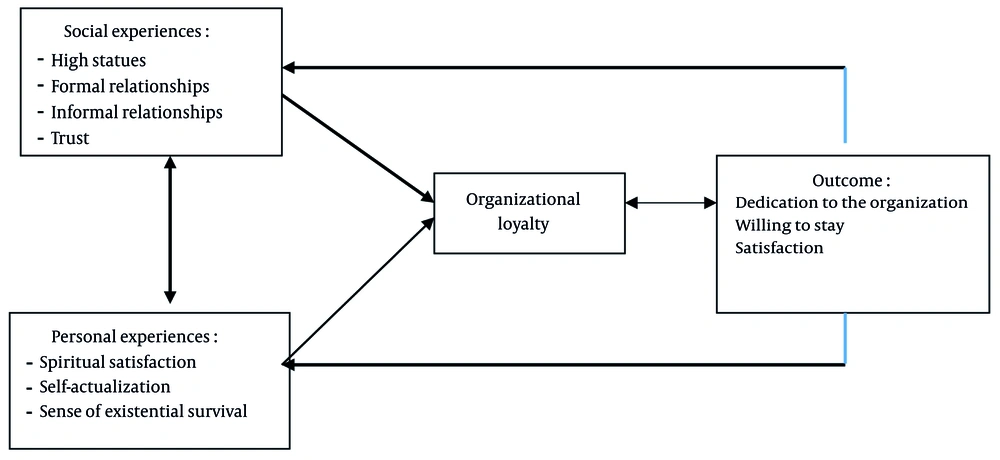
Figure 1.
Conceptual schema of the organizational loyalty
As shown in Figure 1, organizational loyalty in this study is related to two elements: Personal and social. On a personal level, faculty members experience spirituality that involves self-actualization and a sense of existential survival. These are intangible benefits of being a faculty member at medical universities. Faculty members who stay and work in medical universities generally enjoy these meaningful experiences. On the social level, individuals encounter beneficial aspects not related to management and leadership, but rather to the organizational atmosphere itself. Being enrolled in a medical university entails having high status, both informal and formal capital, and trust. These factors contribute to organizational loyalty, which, in turn, results in sacrifice, dedication to the organization, professionalism, and the preservation of affiliation.
It’s clear that modern organizations cannot survive solely on loyalty. Additionally, loyalty is related to macro-level conditions such as justice, payment systems, quality of management, and leadership in organizations. Therefore, despite this study’s emphasis on the micro-level of organizational loyalty, macro-level factors are also important. It has been shown that loyalty includes three main dimensions (36); however, we demonstrated that loyalty is rooted in the deep layers of physicians, such as spirituality and existence. We believe that our findings explain the formation of loyalty. Our findings confirm postmodern theories of loyalty. In this approach, loyalty is a personal interpretation rather than the result of formal organizational control (40), as other studies have referred to some personal and organizational conditions that affect organizational loyalty (12, 13, 18). We believe that these factors impact loyalty; however, each person has specific goals regarding their presence in the organization. Therefore, alongside personal and organizational factors, organizational affiliation, spirituality, and social capital in the organization are important too. Employees’ feelings towards the organization are more important than issues such as payment, management, justice, and leadership. However, the duration and survival of organizational loyalty are related to environmental conditions. Evidence-based conceptualization is suggested for future studies in this field. Modern organizations encompass various dimensions beyond those defined by the bureaucratic framework, necessitating specific management and leadership approaches. One of the most crucial aspects of an organization, particularly in today’s era, is understanding and familiarity with employees’ relationships with their organization. The present study demonstrates that clinical faculty members of medical universities have developed a strong connection with the organization, its functions, and its social capital. These factors contribute to organizational affiliation and loyalty. In fact, our participants emphasized the consequences of being present in medical universities. Despite facing numerous challenges, they were satisfied with being accepted into medical universities. Regardless of management and leadership patterns, an organization can be judged by its employees based on how well it functions for them. If these functions contribute to promoting and enhancing organizational spirituality and developing social capital, the likelihood of employees leaving the organization will be reduced. We believe that in the 21st century, these elements can contribute more to the growth, promotion, and maintenance of the organization and its workforce. The main finding of this study is that despite the importance of organizational leadership and management, several micro-level issues function as cohesive forces within the organization, fostering and enhancing organizational loyalty. In this regard, new theoretical approaches are needed.
5.1. Conclusions
The present study demonstrates that the retention of participants in medical universities is influenced by both organizational and individual factors, including spirituality. Within organizational discussions, elements such as organizational capital and affiliation play a significant role. Faculty members exist within a network of human and social relationships that foster social capital. Additionally, affiliation with a medical university contributes to the development of a unique organizational identity that is often intertwined with personal identity. At the individual level, the nature and quality of service within the organization are accompanied by a form of spirituality that enhances faculty retention. As illustrated in the conceptual model, a combination of social experiences within the organization and individual experiences forms the foundation for organizational loyalty, ultimately encouraging faculty members to remain with the institution. This loyalty persists even in the face of numerous structural and management challenges. However, it is important to note that medical universities in the country are grappling with the issue of elite faculty departure, which is generally linked to social, cultural, and management factors within the organization. Governments must give serious attention to this matter. To address this issue, it is recommended that efforts be made to strengthen organizational loyalty by enhancing managerial capacity and reforming bureaucratic mechanisms within medical universities.
5.2. Limitations
The main limitation of this study is the inability to measure the extent of organizational loyalty among faculty members. Additionally, some participants may have remained in medical universities for reasons such as fulfilling their mandatory duty and may have left the organization afterward due to challenges in management and leadership. Finally, there are several challenges at the macro level of medical universities in Iran that this study was unable to explore. Although all participants referred to these challenges, the relationship between these challenges and organizational loyalty was not explored or discussed.

