


1. Background
Schizophrenia is a serious mental health condition affecting approximately one percent of the world’s population (1). Schizophrenia, as defined by the American Psychiatric Association, is a mental health condition characterized by a range of symptoms, including delusions, hallucinations, disorganized speech, and negative symptoms, such as diminished emotional expression or lack of motivation and volition. By diagnostic criteria, these symptoms must persist for at least six months (2, 3). The onset of schizophrenia symptoms typically occurs between late adolescence and the middle of the third decade of life. In men, symptoms appear before the age of 19 years in approximately 40% of cases, while in women, they appear before the age of 19 years in approximately 23% of cases (4). It appears to have a higher incidence in men than in women, as indicated by the negative symptoms and the duration of involvement. Moreover, based on various diagnostic criteria and definitions of the disorder, men tend to experience more severe symptoms of schizophrenia than women (5, 6).
Susceptibility to schizophrenia is significantly shaped by hereditary factors, as demonstrated in various studies. Specifically, the prevalence of schizophrenia among third-degree relatives is approximately 2%, while it ranges from 2% to 6% among second-degree relatives. The incidence of schizophrenia among first-degree relatives is estimated to be between 6% and 17%. It is worth mentioning that the prevalence of schizophrenia in non-identical twins is approximately 17%, and identical twins who share the same genetic makeup have a prevalence of roughly 50% (7, 8). Environmental factors such as infection, stress during pregnancy or childhood, and socioeconomic environments are significant contributors to the development of schizophrenia symptoms. Other causes of the disease include social isolation, migration resulting from social hardship, racial discrimination, family disruption, unemployment, and inadequate housing conditions (9-11).
Positive symptoms of the disease include symptoms that are ordinarily absent in individuals but present in schizophrenia patients, such as delusions (including persecutory, grandiosity, erotomania, and etc.), hallucinations (auditory, visual and etc.), and disorganized speech (incoherency, blocking of thought, echolalia and etc.). Additionally, patients may exhibit disorganized behaviors (disorganized dress and appearance, repetitive and stereotyped behavior, and etc.) (12-14). In most cases, there is an observable pattern of emotional distress, such as unresponsiveness to stimuli (13). Impaired social cognition is directly related to schizophrenia and symptoms of paranoia, and social isolation are common (15). Furthermore, issues regarding working and long-term memory, attention, executive function, and processing speed can occasionally arise. On rare occasions, individuals may exhibit signs of juvenile insanity, such as being largely silent, engaging in unusual postures, or displaying inappropriate expressions of anxiety (16-18).
2. Objectives
The present study examined the efficacy of cognitive rehabilitation employing computer-based tasks in ameliorating cognitive deficits in patients with schizophrenia who were admitted to the inpatient adult wards of Dr. Hejazi and Ibn Sina hospitals in Mashhad at first half of 2021.
3. Methods
3.1. Study Design
This study involved a clinical trial with two groups of 15 participants each, receiving second-generation antipsychotics for eight weeks. The interventions were carried out during the stabilization phase of the disease.
3.2. Study Population
The study included 30 individuals diagnosed with schizophrenia (excluding the catatonic subtype), aged between 18 and 60 years, who had been diagnosed for at least five years and were not in the acute phase of schizophrenia. The participants were required to have cognitive impairments without other psychiatric disorders or proven mental disabilities.
3.3. Sampling Method
Randomized block design used for randomization and allocation concealment with closed envelop used for allocation. The envelopes will be prepared by one of the members of the research team and the random numbers generated by the Randomization website will be printed and placed in each envelope. The envelopes are sealed, and their contents are not visible from outside. First, purpose of the study is explained for each participant, and after filling out the consent form, each participant selects an envelope and opens it, and based on its content, the participant will be placed in either the control or intervention group.
3.4. Sampling Process
Participants were selected through consecutive sampling from inpatients admitted to Dr. Hejazi and Ibn-e-Sina psychiatric hospitals who met the inclusion and exclusion criteria during the first half of 2021.
1. Inclusion criteria: (A) individuals with schizophrenia aged 18 - 60; (B) diagnosis of schizophrenia for at least five years; (C) cognitive impairments in several areas; (D) no other psychiatric disorders; (E) no proven mental disability; (F) no electroconvulsive treatment in the past year; (G) ability to read and write; (H) not treated with clozapine or anticholinergic drugs during hospitalization; and (I) not treated with cognitive-enhancing drugs.
2. Exclusion criteria: Emergence of serious physiological or psychiatric problems affecting the intervention or withdrawal from the study.
3.5. Ethics Approval
The study was approved by the Ethics Committee of Mashhad University of Medical Sciences (IR.MUMS.MEDICAL.REC.1398.555) and the RCT code was IRCT20101130005280N36. Informed consent was obtained from participants or their legal guardians, and confidentiality was maintained throughout the research process.
3.6. Intervention Protocols
Cognitive interventions included weekly cognitive exercises lasting 40 minutes. For one group, computerized cognitive rehabilitation using Captain Log software was employed, while the control group watched natural movies and played computer games for the same duration as a placebo.
3.7. Outcome Measures
Primary treatment outcomes regarding cognitive improvement and secondary treatment outcome were positive symptoms, negative symptoms (used PANSS test), working memory (used Wisconsin Card Sorting Test), concentration (used Stroop test), processing speed (used digit span test), immediate memory and recent memory (used Ray memory test) were evaluated at baseline and the end of weeks 4, 8, and 12.
3.8. Study Stool
Captain’s Log is a computerized cognitive rehabilitation program developed by brain train, manufactured for cognitive rehabilitation in individuals with cognitive impairments. It includes a wide range of interactive tasks that influence cognitive domains such as attention, memory, executive functions, processing speed, and visuospatial skills. It was developed in the 1980s, Captain’s Log has been used in many clinical patients, including individuals with traumatic brain injury (TBI), stroke, ADHD, dementia, learning disabilities, and psychiatric disorders with cognitive deficits. Its game-like design makes it convenient for both children and adults.
3.9. Method of Measurement
The Stroop test, developed by John Ridley Stroop in 1935, is a widely used neuropsychological assessment that measures cognitive interference and executive function. It evaluates how well individuals can manage conflicting information, specifically the conflict between reading a word and identifying the color in which it is printed.
The test typically consists of several tasks:
1. Reading color words: Participants read a list of color names printed in black ink (e.g., "red" and "blue").
2. Naming ink colors: In the critical task, participants are presented with color words printed in incongruent colors (e.g., the word "red" printed in blue ink) and must name the color of the ink rather than read the word itself.
3. Control task: This may involve naming colors of blocks or other non-word stimuli to measure baseline performance without interference.
3.10. Blinding
A blinded study, the evaluator, who periodically assessed cognitive tests from patients, was blinded in the study.
3.11. Statistical Analysis
The data was analyzed using SPSS v 23 and a P-value less than 0.05 was considered significant. Descriptive statistics were used to describe variable descriptions, including number and frequency. Pearson’s chi-square test or Fisher’s exact test was used to determine potential statistically significant difference between quantitative variables. The paired t-test was employed to assess the mean difference between paired observations, while the repeated measures analysis was used to assess the trend of changes in each case and control group quantitative variables.
4. Results
4.1. Participant Flow
Participant flow is shown in Figure 1. A total of 30 participants were enrolled and randomized assigned into the control (n = 15) and intervention (n = 15) groups. During the study none of participants withdrawn or were excluded during the study. After completing the 12-week study, all participants were included in the final analysis (Figure 1).
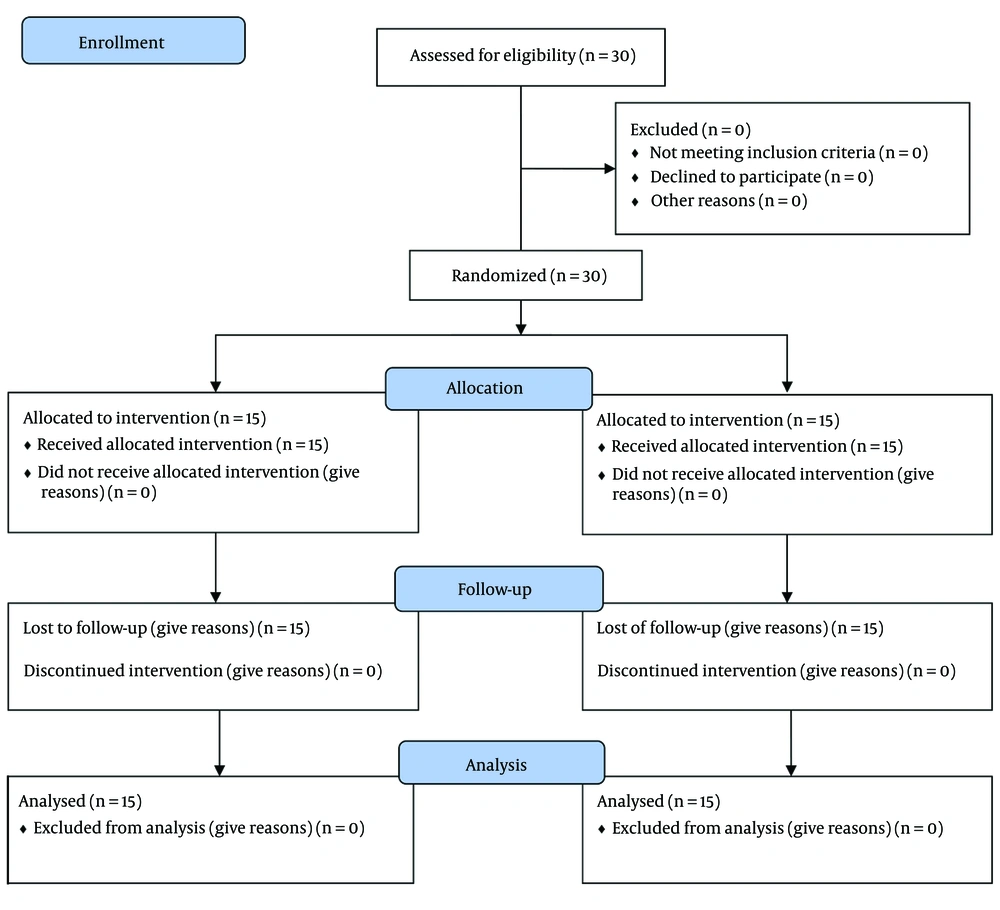
Figure 1.
CONSORT flow diagram
4.2. Baseline Data
There were no statistically significant differences between two groups in demographic characteristics. The intervention group were 60% male and 40% female, while the control group were 26.7% male and 73.3% female (P = 0.139). 18 individuals (60.0%) held bachelor’s degrees, 10 (33.3%) held diplomas, and two (6.7%) held associate degrees, education level was similar between groups (P = 0.061; Table 1).
Table 1.Demographic Information of the Participants a
| Variables | Sex | Education | |||
|---|---|---|---|---|---|
| Female | Male | Less than Diploma | Diploma | Bachelor | |
| Control | 11 (73.3) | 4 (26.7) | 12 (80) | 3 (20) | 0 |
| Intervention | 6 (40.0) | 9 (60.0) | 6 (40) | 7 (46.7) | 2 (13.3) |
| P-value | 0.139 | 0.061 | |||
a Values are expressed as No. (%).
4.3. Numbers Analyzed
An intention-to-treat methodology was used to analyze all 30 randomized participants in the groups to which they were initially assigned.
4.4. Outcomes and Estimation
4.4.1. Wisconsin Card Sorting Test
There was significant improvement in the intervention in perseveration errors at trend of time (P < 0.001). No significant change was noted in number of categories (P = 0.949; Table 2).
Table 2.Differences in Change Scores Between Rehabilitation and Control Groups a
| Test; Time | Control Group | Intervention Group | Between Group P-Value | Time | Within-Group P-Values | |
|---|---|---|---|---|---|---|
| Control Group | Intervention Group | |||||
| Wisconsin test | ||||||
| Changes in number of categories | ||||||
| Baseline | 2.60 ± 1.40 | 1.73 ± 1.53 | 0.118 | 4 vs baseline | 1 | 0.007 |
| 4 wk | 2.73 ± 1.48 | 2.33 ± 1.87 | 0.523 | 8 vs baseline | 0.028 | 0.827 |
| 8 wk | 3.73 ± 1.33 | 2.27 ± 2.34 | 0.044 | 12 vs baseline | 0.016 | 0.217 |
| 12 wk | 3.66 ± 1.23 | 2.26 ± 2.05 | 0.033 | Trend | 0.736 | 0.949 |
| P-value | 0.0003 | - | - | - | - | |
| Changes in perseveration errors | ||||||
| Baseline | 22.67 ± 15.98 | 16.40 ± 5.97 | 0.166 | 4 vs baseline | 0.384 | 0.002 |
| 4 wk | 22.47 ± 15.51 | 13.07 ± 7.72 | 0.045 | 8 vs baseline | 0.051 | 0.008 |
| 8 wk | 19.27 ± 13.50 | 10.87 ± 5.87 | 0.036 | 12 vs baseline | 0.019 | 0.0004 |
| 12 wk | 17.46 ± 12.68 | 9.00 ± 4.67 | 0.026 | Trend | 0.614 | < 0.001 |
| P-value | < 0.001 | - | - | - | - | |
| Digit span test | ||||||
| Changes in forward digits | ||||||
| Baseline | 3.87 ± 1.45 | 6.00 ± 1.60 | 0.001 | 4 vs baseline | 0.546 | 0.005 |
| 4 wk | 3.73 ± 1.48 | 7.53 ± 2.06 | 0.00005 | 8 vs baseline | 0.67 | 0.000005 |
| 8 wk | 3.80 ± 1.56 | 10.33 ± 1.58 | 0.00001 | 12 vs baseline | 0.719 | 0.068 |
| 12 wk | 3.80 ± 1.32 | 7.06 ± 2.18 | 0.000009 | Trend | 0.99 | 0.001 |
| P-value | < 0.000 | - | - | - | - | |
| Changes in backward digits | ||||||
| Baseline | 2.33 ± 1.17 | 3.47 ± 1.35 | 0.021 | 4 vs baseline | 1 | 0.026 |
| 4 wk | 2.33 ± 1.17 | 4.47 ± 1.06 | 0.000003 | 8 vs baseline | 0.719 | 0.016 |
| 8 wk | 2.27 ± 1.48 | 4.60 ± 1.35 | 0.00004 | 12 vs baseline | 0.719 | 0.61 |
| 12 wk | 2.26 ± 1.48 | 3.60 ± 1.18 | 0.008 | Trend | 0.989 | 0.058 |
| P-value | < 0.001 | - | - | - | - | |
| Stroop test | ||||||
| Changes in congruent correct | ||||||
| Baseline | 29.01 ± 11.42 | 28.27 ± 10.77 | 1 | 4 vs baseline | 0.095 | 0.004 |
| 4 wk | 28.73 ± 10.57 | 32.33 ± 9.88 | 0.344 | 8 vs baseline | 0.006 | 0.081 |
| 8 wk | 27.13 ± 10.59 | 32.67 ± 10.88 | 0.17 | 12 vs baseline | 0.003 | 0.003 |
| 12 wk | 25.86 ± 9.64 | 36.06 ± 9.06 | 0.006 | Trend | 0.115 | 0.062 |
| P-value | 0.007 | - | - | - | - | |
| Changes in incongruent correct | ||||||
| Baseline | 17.96 ± 10.48 | 18.13 ± 11.23 | 1 | 4 vs baseline | 0.792 | 0.015 |
| 4 wk | 18.20 ± 10.80 | 20.60 ± 10.92 | 0.55 | 8 vs baseline | 0.873 | 0.006 |
| 8 wk | 19.33 ± 11.17 | 23.53 ± 12.91 | 0.349 | 12 vs baseline | 0.827 | 0.004 |
| 12 wk | 20.53 ± 11.14 | 29.26 ± 12.00 | 0.048 | Trend | 0.977 | 0.021 |
| P-value | 0.001 | - | - | - | - | |
| Changes in congruent errors | ||||||
| Baseline | 6.73 ± 4.86 | 5.20 ± 3.68 | 0.339 | 4 vs baseline | 0.582 | 0.09 |
| 4 wk | 6.60 ± 4.20 | 3.60 ± 3.01 | 0.033 | 8 vs baseline | 0.597 | 0.017 |
| 8 wk | 7.00 ± 5.61 | 2.40 ± 3.56 | 0.01 | 12 vs baseline | 0.128 | 0.002 |
| 12 wk | 8.00 ± 6.38 | 1.93 ± 2.49 | 0.003 | Trend | 0.772 | 0.031 |
| P-value | 0.227 | - | - | - | - | |
| Changes in incongruent error | ||||||
| Baseline | 18.73 ± 9.00 | 9.93 ± 9.42 | 0.014 | 4 vs baseline | 0.217 | 0.007 |
| 4 wk | 18.47 ± 8.46 | 7.53 ± 6.64 | 0.001 | 8 vs baseline | 0.554 | 0.001 |
| 8 wk | 19.13 ± 9.47 | 4.53 ± 4.56 | 0.00003 | 12 vs baseline | 0.565 | 0.003 |
| 12 wk | 19.26 ± 9.60 | 3.80 ± 4.55 | 0.00002 | Trend | 0.968 | 0.008 |
| P-value | < 0.001 | - | - | - | - | |
| Changes in congruent reaction time | ||||||
| Baseline | 1465.93 ± 165.66 | 1470.20 ± 96.66 | 0.932 | 4 vs baseline | 0.953 | 0.194 |
| 4 wk | 1465.87 ± 165.68 | 1439.87 ± 95.77 | 0.603 | 8 vs baseline | 0.135 | 0.01 |
| 8 wk | 1549.60 ± 119.32 | 1377.40 ± 112.06 | 0.0001 | 12 vs baseline | 0.864 | 0.001 |
| 12 wk | 1444.33 ± 400.63 | 1342.86 ± 125.86 | 0.357 | Trend | 0.508 | 0.066 |
| P-value | 0.032 | - | - | - | - | |
| Changes in incongruent reaction time | ||||||
| Baseline | 1471.71 ± 346.19 | 1645.00 ± 121.05 | 0.078 | 4 vs baseline | 0.542 | 0.2 |
| 4 wk | 1467.13 ± 340.56 | 1595.13 ± 123.74 | 0.182 | 8 vs baseline | 0.376 | 0.0001 |
| 8 wk | 1568.27 ± 222.19 | 1491.13 ± 118.42 | 0.25 | 12 vs baseline | 0.345 | 0.00002 |
| 12 wk | 1575.73 ± 231.53 | 1438.00 ± 119.60 | 0.05 | Trend | 0.476 | 0.003 |
| P-value | 0.604 | - | - | - | - | |
| PNASS test | ||||||
| Changes in positive symptoms | ||||||
| Baseline | 10.47 ± 8.39 | 10.13 ± 1.72 | 0.002 | 12 vs baseline | 0.357 | 0.284 |
| 12 wk | 9.00 ± 8.05 | 9.76 ± 1.79 | 0.001 | - | - | - |
| P-value | 0.552 | - | - | - | - | |
| Changes in negative symptoms | ||||||
| Baseline | 15.53 ± 7.04 | 14.93 ± 4.59 | 0.784 | 12 vs baseline | 0.546 | 0.08 |
| 12 wk | 15.66 ± 7.51 | 12.80 ± 4.24 | 0.209 | - | - | - |
| P-value | 0.266 | - | - | - | - | |
| Changes in overall symptoms | ||||||
| Baseline | 51.33 ± 17.99 | 52.07 ± 10.36 | 0.006 | 12 vs baseline | 0.136 | 0.241 |
| 12 wk | 48.00 ± 18.08 | 49.83 ± 10.26 | 0.003 | - | - | - |
| P-value | 0.605 | - | - | - | - | |
| Ray memory test | ||||||
| Changes in immediate auditory | ||||||
| Baseline | 2.26 ± 0.70 | 3.20 ± 0.86 | 0.003 | 4 vs baseline | 0.061 | 0.0028 |
| 4 wk | 3.53 ± 1.18 | 4.60 ± 1.18 | 0.02 | 8 vs baseline | 0.221 | 0.0003 |
| 8 wk | 3.93 ± 1.38 | 4.93 ± 1.57 | 0.076 | 12 vs baseline | 0.123 | < 0.001 |
| 12 wk | 4.26 ± 1.48 | 6.33 ± 2.12 | 0.005 | Trend | 0.344 | 0.017 |
| P-value | 0.001 | - | - | - | - | |
| Changes in delayed auditory | ||||||
| Baseline | 3.20 ± 1.78 | 4.06 ± 2.28 | 0.256 | 4 vs baseline | 0.195 | 0.264 |
| 4 wk | 4.13 ± 1.92 | 5.53 ± 2.13 | 0.069 | 8 vs baseline | 0.071 | 0.004 |
| 8 wk | 9 4.73 ± 2.25 | 7.00 ± 2.50 | 0.015 | 12 vs baseline | 0.098 | 0.013 |
| 12 wk | 4.46 ± 2.16 | 6.33 ± 2.31 | 0.031 | Trend | 0.741 | 0.236 |
| P-value | 0.118 | - | - | - | - | |
| Changes in immediate visual | ||||||
| Baseline | 19.33 ± 4.62 | 21.56 ± 4.80 | 0.205 | 4 vs baseline | 0.063 | 0.2 |
| 4 wk | 19.90 ± 4.75 | 23.90 ± 4.98 | 0.033 | 8 vs baseline | 0.171 | 0.001 |
| 8 wk | 20.06 ± 4.75 | 25.66 ± 5.19 | 0.005 | 12 vs baseline | 0.098 | 0.007 |
| 12 wk | 17.66 ± 5.28 | 26.60 ± 5.20 | < 0.001 | Trend | 0.341 | 0.351 |
| P-value | 0.552 | - | - | - | - | |
| Changes in delayed visual M | ||||||
| Baseline | 10.36 ± 5.32 | 13.36 ± 5.32 | 0.134 | 4 vs baseline | 0.073 | 0.134 |
| 4 wk | 10.86 ± 5.34 | 15.13 ± 5.77 | 0.045 | 8 vs baseline | 0.161 | 0.036 |
| 8 wk | 10.90 ± 5.42 | 16.56 ± 6.46 | 0.015 | 12 vs baseline | 0.077 | 0.016 |
| 12 wk | 10.90 ± 5.50 | 17.40 ± 6.62 | 0.007 | Trend | 1 | 0.612 |
| P-value | 0.522 | - | - | - | - | |
a Values are expressed as mean ± SD.
4.4.2. Digit Span Test
There was significant improvement in forward digit spans in the intervention group at trend of time (P < 0.001), but no significant improvement was seen in the backward digit spans (P = 0.058; Table 2).
4.4.3. Stroop Test
There were significant reductions in incongruent corrects, congruent errors, incongruent errors, and incongruent reaction time in the intervention group over the trend time of study (P = 0.021, 0.031, 0.008, 0.003). The changes in congruent correct and congruent reaction time at trend time were not significant (P = 0.066, 0.062; Table 2).
4.4.4. PANSS Test
There were not significant within-group improvements in the intervention group for positive, negative, and general symptom scores (P = 0.284, 0.08, 0.241). These changes were not significant in group comparisons for any PANSS subscale (P = 0.552, 0.266, 0.605; Table 2).
4.4.5. Rey Auditory and Visual Memory Test
There was significant change in immediate auditory memory scores at trend of time in intervention group (P = 0.017) but changes in delayed auditory, immediate visual and delayed visual memory scores were not significant at trend of time (P = 0.236, 0.351, 0.612). The control group showed no significant changes (Table 2).
4.5. Side Effects
No adverse effects or harms were seen in either group during the study time.
5. Discussion
Cognition encompasses the mental activities necessary to acquire, process, and organize information. These functions also enable individuals to gather and utilize relevant information to engage in meaningful interactions with their environment and with others. Cognitive deficits are a defining characteristic of schizophrenia and are often present at the onset of symptoms and throughout the duration of the illness. In most cases, these deficits remain stable for the remainder of a patient’s life, with a direct correlation between the severity of cognitive impairment and responsiveness to treatment (19, 20). Cognitive deficits in schizophrenia are distinct from those in other psychological and neurological disorders, affecting memory, attention, reasoning, problem-solving, and social cognition. Several studies have identified seven cognitive factors that are disturbed in patients with schizophrenia: Processing speed, attention and vigilance, working memory, learning and visual memory, reasoning, problem-solving, and perception (21-23). Cognitive rehabilitation is a therapeutic approach that aims to enhance a person’s cognitive abilities, including memory, attention, understanding, learning, planning, and judgment, through structured activities and interventions such as cognitive exercises, computer-aided training, compensatory techniques, assistive devices, communication skills training, aerobics, music, and art (24-26).
This study was a randomized clinical trial involving 30 patients that compared the effectiveness of computer-based cognitive rehabilitation in improving cognitive deficits in patients with schizophrenia. The PANSS test, Wisconsin Card Sorting Test, digit span test, Stroop test, and Ray memory questionnaires were employed. In Wisconsin Card Sorting Test, a significant reduction was observed in perseveration errors, indicating improved in executive function. In the digit span test, a significant difference was observed in the number of forward digits, indicating improved concentration in patients with the digit sequence initially ascending and then descending. However, no significant changes were observed in the other areas. In the Stroop test, the incongruent corrects, congruent errors, incongruent errors, and incongruent reaction time showed a downward and significant change, leading to increased processing speed in patients with schizophrenia, although other areas were significant in some weeks, but the trend of changes was not significant, possibly because of the slowness of improvement. In the Ray memory test, the immediate auditory memory item showed a significant upward trend. The immediate and delayed visual memory items exhibited a significant audio trend in some weeks, but the overall trend was not significant, likely due to the slowness of the changes.
In the PANSS test, all items related to positive, negative, and general symptoms were not significant in the intervention group and the difference between the two groups was not significant, making it clear whether the improvement was not due to the intervention and probably because of drug treatment.
In the Treichler et al.’s study, 46 patients were divided into two groups for either traditional cognitive rehabilitation or auditory-targeted cognitive training (TCT). While cognitive performance improved in terms of memory and executive function, mental cognitive dimensions remained unchanged in the TCT group. Additionally, no significant relationship was found between mental cognitive dimensions and the symptoms of depression and hallucinations. The study results indicated that the lack of improvement in subjective symptoms may be related to depression, lack of motivation, and patient satisfaction (27). In our study, we observed significant changes in memory domains, but no significant changes in response speed and selective attention, which differs from the results of another study. Our study also examined the effects of lack of motivation, satisfaction, and depression symptoms, which are crucial in test-taking. Both studies suggested that computer-based cognitive exercises improve memory and attention.
In 2018, Pena et al. (28) randomly assigned 110 patients with schizophrenia to a 4-month computer-assisted cognitive training program. This study found that processing speed and verbal memory improved but other social cognitive domains and negative symptoms remained unchanged. This study, in line with our findings, showed significant improvements in cognitive processing speed, working memory, and verbal skills. However, our study also demonstrated significant changes in positive and negative symptoms of schizophrenia. Additionally, our study had a larger sample size and utilized the UCSD Performance-Based Skills Assessment (UPSA) tool to evaluate cognitive domains. The results of both studies suggest that cognitive rehabilitation treatment for at least 3 - 4 months can be effective in improving attention, memory, and processing speed. Our study, in agreement with many previous studies, showed that cognitive rehabilitation had a significant impact on memory, processing speed, executive function, and visual memory (29, 30).
In another study cognitive areas such as attention/vigilance, verbal working memory, and verbal learning were found to differ significantly from those of the control group, while there was no change in non-verbal working memory and learning. Additionally, there was no change in processing speed or functional outcomes. This suggests that cognitive rehabilitation is suitable for patients with schizophrenia but does not improve their performance. Like the present study, a significant difference was observed in attention and working memory. However, unlike in the present study, there was no significant change in cognitive processing speed. Moreover, there was no significant change in executive performance. It seems that cognitive rehabilitation in patients with schizophrenia leads to improvement in many cognitive domains but does not affect executive function. This finding suggests the need for longer interventions to investigate this further (31).
In Jamilian et al.’s study, participants received cognitive rehabilitation sessions three times a week for 40 min each session. The researchers assessed memory, number pronunciation, visual memory, and word pronunciation, before and after the intervention. The results showed that the experimental group had improved scores in listening memory, visual memory, and word pronunciation compared with the control group. Similar to the present study, this study found significant improvements in auditory memory and number pronunciation through cognitive rehabilitation but did not investigate other cognitive domains, such as executive function or attention (32).
5.1. Conclusions
Schizophrenia is a severe mental disorder that persists throughout a person’s life, affecting individuals from all socioeconomic backgrounds. Cognitive impairment is a hallmark of this disease and can impede daily functioning. The relationship between cognitive deficits and psychosocial functioning is complex and influenced by various factors, such as positive and negative symptoms, as well as comorbid depression. Because schizophrenia impairs daily functioning, it is crucial to investigate treatment strategies for cognitive disorders. However, antipsychotic medications have limited effects on negative and cognitive symptoms. On the other hand, computer-based cognitive rehabilitation has shown promise in improving cognitive deficits by providing targeted practice conditions. There is a need to study the effects of computer-based cognitive rehabilitation on schizophrenia symptoms. The present study aimed to confirm the clinical effectiveness of these exercises in cognitive deficits in schizophrenia patients. The results revealed that computer-based cognitive rehabilitation improved working memory, selective attention, cognitive processing speed, and immediate auditory memory but had no significant impact on other areas. It is suggested that future interventions be conducted in groups that are more homogeneous in terms of age, disease duration, and symptom type, with a larger sample size. Moreover, cognitive rehabilitation should be carried out more frequently, and the evaluation of the desired outcomes should be done over a longer period to assess the sustainability of the rehabilitation’s effectiveness

