


1. Background
Acute myeloid leukemia (AML) is a clinically heterogeneous disease characterized by bone marrow failure symptoms, including anemia, thrombocytopenia, and infection (1, 2). Despite the identification of several prognostic factors and new therapeutic strategies, the long-term prognosis for AML, especially in elderly patients, remains poor (3, 4). Leukemia is a multi-stage process involving various genetic changes, including genes related to iron metabolism, such as the transferrin receptor 1 gene and the hemochromatosis (HFE) gene. It appears that leukemic cells undergo changes that increase their ability to absorb iron and decrease iron export (5). It has been observed that most AML patients have elevated ferritin levels at diagnosis, even those who have not received a blood transfusion (6). This suggests that high ferritin levels at diagnosis may be caused by an underlying inflammatory condition. Additionally, the antioxidant effect of ferritin may reduce the effectiveness of cytotoxic chemotherapy drugs, including anthracyclines (7-9). Numerous studies have shown that high ferritin levels are associated with a poor response to treatment, early death, relapse, and overall survival (OS) (10-12).
2. Objectives
In this study, we aimed to analyze the prognostic impact of baseline serum ferritin levels in intensively treated AML patients and its relationship with other prognostic factors.
3. Methods
3.1. Patients
This historical cohort study aimed to examine the correlation between serum ferritin levels and the prognosis of AML patients undergoing standard chemotherapy. The study included all AML patients who received the standard 7+3 chemotherapy regimen at the Hematology-Oncology departments of Namazi Hospital between June 2013 and 2023.
Inclusion criteria: (1) Presence of serum ferritin and C-reactive protein (CRP) in the patient's file without blood transfusion before starting the treatment; (2) clinical and pathological diagnosis of AML; (3) received the standard chemotherapy regimen (7+3 regimen); (4) age between 18 - 65 years.
Exclusion criteria: (1) Patients with comorbidities such as renal failure, liver disease, lung disease, or diabetes mellitus; (2) patients with a previous history of MDS that transformed to AML or had a history of blood transfusions in the past; (3) absence of bone marrow biopsy results 14 days after receiving chemotherapy for response assessment; (4) relapsed AML.
After evaluating all AML files, 67 patients were enrolled in the study.
At the start of AML diagnosis and prior to beginning induction chemotherapy (7+3 regimen), it is important to measure the ferritin level. Ferritin is an acute phase reactant, meaning it increases in response to inflammatory diseases or malignancies. To ensure accurate results and avoid any distortion of the study's objectives, the serum CRP level was also measured to account for this factor. If CRP was in the normal range (less than 1.0 mg/dL), there was no need to correct ferritin. If the CRP level was high, the level of serum ferritin should be adjusted according to: Corrected serum ferritin = Serum ferritin × 0.67 (13).
After obtaining the corrected serum ferritin levels, the patients were divided into two groups: The high serum ferritin group (with serum ferritin levels ≥ 1000 ng/mL) and the Low Serum ferritin group (with serum ferritin levels < 1000 ng/mL). We conducted an evaluation of bone marrow aspiration and biopsy on the 14th day after completion of induction chemotherapy in order to assess response.
Initially, we reviewed the files of 94 new cases of AML for inclusion in the study. However, 27 of these patients were excluded due to a history of blood transfusion, MDS, or the absence of a bone marrow sample on the 14th day. Our statistical analysis was based on the remaining 67 patients. Unfortunately, due to incomplete information on cytogenetic and karyotype, these factors were not included in the study. Ultimately, we compared the two groups with high and low serum ferritin levels in terms of complete remission rate and event-free survival (EFS) since the onset of the disease.
3.2. Statistical Analysis
The data were analyzed using IBM SPSS software version 26. Descriptive results were presented as frequencies, means, and standard deviations (SD) or medians and ranges in cases of non-normal distribution. The Kolmogorov-Smirnov test was used to check the normality of the data distribution. The chi-square test was used to compare the complete remission rate between the two groups of patients with serum ferritin levels ≥ 1000 and < 1000 ng/mL. The Mann-Whitney test was used to compare the serum ferritin levels between the two groups of patients with and without complete remission. The EFS curves were illustrated using the Kaplan-Meier method and compared using the Log Rank test between the two groups of patients with high and low serum ferritin levels. A P-value less than 0.05 was considered statistically significant.
This study was approved by the ethics committee of Shiraz University of Medical Sciences (IR.SUMS.MED.REC.1401.284), and since this study deals with human subjects, the standards of information confidentiality were observed, and the information of the participants in the study will be preserved.
4. Results
The average age of the patients was 44.80 ± 12.8 years, with a range of 19 - 65 years. Out of the total number of patients, 38 (56.7%) were male. The average duration of follow-up for patients was 16 ± 13.1 months, as shown in Table 1. The CRP levels were elevated in 48 (71.6%) patients, while 19 (28.4%) had normal levels.
Table 1.Demographic Information of Patients
| Variables | Values |
|---|---|
| Age (y) | |
| Mean ± SD | 44.8 ± 12.8 |
| Min - max | 19 - 65 |
| Sex | |
| Male | 38 |
| Female | 29 |
| Follow up duration (mo) | |
| Mean ± SD | 16 ± 13.1 |
| Min - max | 2 - 64 |
| WBC (count/mL) | |
| Median | 12000 |
| Min - max | 600 - 241400 |
| LDH (U/L) | |
| Median | 742 |
| Min - max | 246 - 4560 |
| Serum ferritin (ng/mL) | |
| Median | 565 |
| Min - max | 48 - 2131 |
Abbreviation: SD, standard deviation.
The median serum ferritin level was 565 (48 - 2131) ng/mL in all patients, 496 (53.4 - 1570) ng/ml in patients with complete remission, and 630 (48.7 - 2131) ng/mL in patients with primary refractory disease (P = 0.568). It is worth noting that the average serum corrected ferritin was 620 ng/mL in patients who achieved complete remission, while it was 736.51 ng/mL in patients with primary refractory disease.
During the follow-up period, 34 out of 67 patients (50.7%) experienced a relapse, while 9 patients (13.4%) were unable to be monitored for recurrence. Of the remaining 24 patients, 35.8% were still in remission. The number of deaths during the follow-up period was 25 (37.3%), while 28 patients (41.8%) were still alive. Unfortunately, 14 patients (20.8%) could not be tracked for mortality.
Interestingly, 8 out of 15 patients (53.3%) with high serum ferritin levels achieved complete remission, compared to 34 out of 52 patients (65.4%) in the low serum ferritin group. However, this difference was not statistically significant (P = 0.395). Patients with a serum ferritin level less than 1000 ng/mL had a significantly longer EFS compared to those with a serum ferritin level of ≥ 1000 ng/mL [estimated mean and 95% CI: 25.65 (19.29 - 32) vs 11.6 (8.19 - 15.13) months, P = 0.018]; (Figure 1).
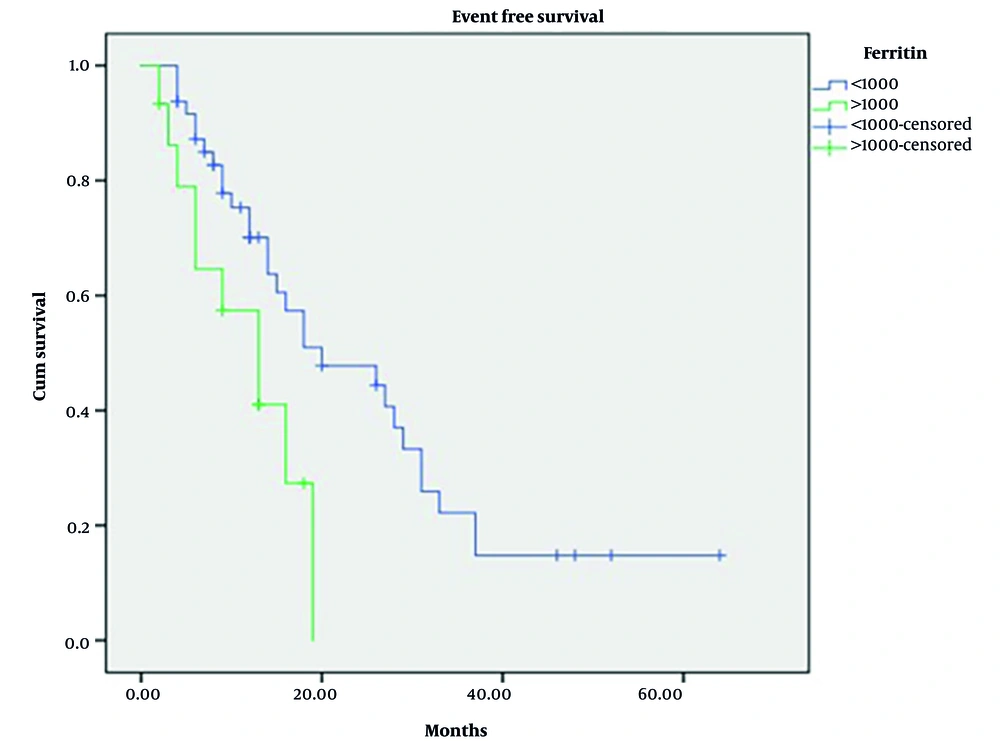
Figure 1.
Event-free survival (EFS) of acute myeloid leukemia (AML) patients based on serum ferritin levels
5. Discussion
Recently, studies have been published reporting a negative correlation between serum ferritin levels and the prognosis of AML patients, specifically in terms of OS and EFS. These studies have found that patients with higher serum ferritin levels tend to have a poorer response to treatment. The concept of a negative relationship between blood iron levels, serum ferritin, and the prognosis of AML was first proposed in patients undergoing stem cell transplantation (14-18). In other words, patients with higher serum ferritin levels prior to bone marrow transplantation had a lower OS rate. Hyperferritinemia in these patients may be caused by repeated blood transfusions prior to allogenic SCT (19).
In a study by Lebon et al., it was found that 79% of AML patients with intermediate cytogenetic risk had ferritin levels above the upper normal limit (10). As a catalyst, iron plays a crucial role in the production of reactive oxygen species (ROS) and is considered a facilitator of their production. While ROS is known to activate blood cell production signals and regulate their normal biological activity, its excess can lead to frequent reduction reactions and increase the likelihood of errors in DNA repair during cell division and the production of malignant cells (20-24).
The increased expression of the transferrin receptor 1 and 2 genes in leukemic cells compared to healthy cells is an intriguing finding (25-27). It has been observed that leukemic cells with a lower level of differentiation exhibit a higher level of transferrin receptor 1 gene expression than cells with a higher level of differentiation (25). Additionally, leukemic cells have shown a decreased level of ferroprotein, a transporter responsible for removing iron from the cell. This suggests decreased iron excretion by leukemic cells and a high demand for iron (28). Furthermore, there is a higher expression of ferritin heavy and light chains in leukemia cells compared to normal and healthy cells in the bone marrow (6). These findings provide evidence for the role of ferritin in the progression of the disease.
Łęcka et al. (29) conducted a study to assess the prognostic significance of ferritin levels in children with acute leukemia. The results showed a notable difference in long-term outcomes between patients with high ferritin levels, regardless of whether they underwent hematopoietic cell transplantation (HCT) or not. The study found that a serum ferritin concentration of > 1,000 µg/L is a negative prognostic indicator for survival in children with acute leukemia who are treated with chemotherapy, with or without HCT.
In a study conducted by Ihlow et al. (12), it was found that the median OS was significantly higher in patients with a serum ferritin level of less than 750 µg/L compared to those with a ferritin level of more than 750 µg/L [20.2 months (95% CI 8.6 - 31.9) vs. 11.8 months (95% CI 7.8 - 15.8), P = 0.015]. The 5-year OS rate was 40% in the low ferritin group, but only 16% in the high ferritin group. However, in the current study, there was no statistically significant relationship found between the complete remission rate and serum ferritin level. Previous studies have shown a correlation between higher serum ferritin levels and a lower chance of remission (30). In our study, patients with high ferritin levels had a significantly lower EFS compared to those with lower ferritin levels, which is consistent with the findings of other studies (11, 12, 29).
Targeting iron metabolism may be an effective approach in the management of acute leukemia. Recent studies have demonstrated that by targeting iron metabolism in cells, leukemic cells can be differentiated and killed without harming healthy cells due to their high demand for iron (31-33). The aforementioned cases, as well as the repeated blood transfusions during and after diagnosis and treatment, have prompted further investigation into the potential benefits of iron chelation therapy for diseases such as MDS and AML. Yang et al. have demonstrated that appropriate treatment with iron chelators can lead to improved OS rates for patients (34). The use of iron chelation, when administered at the correct dosage and duration, has shown promising results in the treatment of leukemia. This is due to its dual effects of both combating leukemia and neutralizing excess iron accumulation resulting from multiple blood transfusions (31, 32). Recent studies have also shown that these drugs can increase the sensitivity of leukemic cells to traditional chemotherapy drugs, such as doxorubicin and cytarabine (35).
5.1. Conclusions
The level of ferritin at the time of diagnosis is a significant predictor of survival for AML patients. Those with a serum ferritin level above 1000 ng/mL had a shorter EFS compared to those with a ferritin level below 1000 ng/mL.
5.2. Suggestions
Despite the strong evidence supporting the negative impact of high serum ferritin levels on the prognosis of AML patients in this study and others, further investigation is needed. Conducting more detailed and larger clinical trials on this issue would be a crucial step in improving the prognosis of AML patients.

