


1. Background
Intrahepatic cholestasis of pregnancy (ICP) is a liver disorder that occurs during pregnancy due to the accumulation of bile acids in the mother's bloodstream. This condition can lead to adverse outcomes for both the mother and the fetus. In ICP, bile acids build up within the liver, resulting in increased concentrations in the blood (1). However, this condition does not always present with clinical symptoms. Although the clinical course of ICP is generally benign, affected women are considered to have high-risk pregnancies and require special care (2). Symptoms of ICP typically emerge during the third trimester of pregnancy (3). Severe itching, the most common symptom, is often felt on the palms of the hands and soles of the feet but may spread to other parts of the body. This itching tends to worsen at night, significantly affecting the mother’s quality of life. The itching usually subsides within 48 hours after delivery and completely resolves over time (4). Laboratory findings include elevated levels of aminotransferases (two to ten times above normal) and increased fasting serum bile acids, which are considered the most sensitive markers for diagnosing ICP (1, 5).
While ICP poses minimal risks to the mother, it carries significant dangers for the fetus. These include preterm birth, meconium-stained amniotic fluid, respiratory distress syndrome (RDS), fetal distress, and sudden intrauterine fetal death (6, 7). The exact cause of these complications remains unclear. However, research suggests that elevated bile acid levels may cause spasms in placental blood vessels, reducing blood flow through the intervillous space of the placenta. This leads to decreased oxygen delivery, functional hypoxia-ischemia, and impaired nutrient transfer from maternal circulation to the fetus, ultimately resulting in fetal distress and developmental issues (8-10).
2. Objectives
Given the importance of the issue and the necessity of prompt diagnosis of ICP to reduce associated risks, and considering the uncertainty regarding the relationship between ICP and pregnancy outcomes for both mothers and fetuses, the present study was designed to investigate maternal and fetal findings in women with ICP and compare them with healthy pregnant women. Moreover, since limited data exist on ICP in the southwest of Iran, this study focuses on the population of Ahvaz, a major city with unique demographic and environmental characteristics that may influence the prevalence and outcomes of ICP in this region.
3. Methods
This case-control study was conducted using hospital-based data from Imam Khomeini Hospital affiliated with Ahvaz Jundishapur University of Medical Sciences. The study population included 111 pregnant women diagnosed with ICP between 2019 and 2023 as the case group, and 111 healthy pregnant women as the control group. The control group was selected using frequency matching on maternal age. Specifically, controls were recruited so that their overall age distribution corresponded closely to that of the case group. Participants were selected through convenience sampling from registered cases of ICP until the required sample size was achieved. For each ICP case, one healthy pregnant woman was recruited as a control. Data collection involved completing a checklist that included demographic information (age, BMI, and comorbidities), pregnancy-related variables, and maternal and fetal outcomes.
The inclusion criteria for the case group consisted of pregnant women diagnosed with ICP, characterized by pruritus and serum bile acid levels ≥ 10 μmol/L, with a gestational age > 28 weeks and singleton pregnancies. The control group included healthy pregnant women without an ICP diagnosis, matched to the case group based on age, and also limited to singleton pregnancies. Exclusion criteria applied to both groups included chronic liver diseases caused by infectious hepatitis (B or C), congenital liver disorders such as Wilson’s disease or primary biliary cirrhosis, cytomegalovirus or Epstein-Barr virus infections, symptomatic gallstones or cholecystitis, acute fatty liver of pregnancy, and HELLP syndrome.
The ICP diagnosis was based on pruritus and serum bile acid levels ≥ 10 μmol/L, supported by biochemical findings and clinical examinations. Serum bile acids were measured in non-fasting blood samples. Maternal and fetal outcomes were evaluated and recorded for both groups during the study period. The sample size was calculated based on the prevalence of RDS in neonates born to mothers with ICP compared to controls, as reported by Arthuis et al. (14). The RDS was selected as the primary endpoint because it is a clinically significant neonatal complication directly associated with ICP and demonstrated a substantial difference in prevalence between groups (17.1% vs. 4.5%). Using these estimates, and considering the alpha = 0.05 and power = 0.8, a minimum of 111 participants per group was required to achieve adequate statistical power using the following formula:
Descriptive statistics were used to summarize data: Mean ± standard deviation for continuous variables and frequency and percentage for categorical variables. The Kolmogorov-Smirnov test assessed the normality of distribution for continuous variables. Comparisons between groups were performed using the chi-square test for categorical variables and the independent t-test for continuous variables. Missing data were minimal (< 5% across all variables). For participants with incomplete data on specific variables, listwise exclusion was applied in the corresponding analyses. No imputation methods were used. All analyses were conducted using SPSS software version 22, with significance set at P < 0.05.
4. Results
A total of 111 pregnant women diagnosed with ICP, based on pruritus and serum bile acid levels ≥ 10 μmol/L, were recruited through convenience sampling from registered cases until the target sample size was achieved. For each ICP case, one healthy pregnant woman matched by convenience sampling was selected as a control, resulting in two groups with equal sample sizes (N = 111 each). The flow of participant inclusion and exclusion is depicted in the following flow diagram (Figure 1).
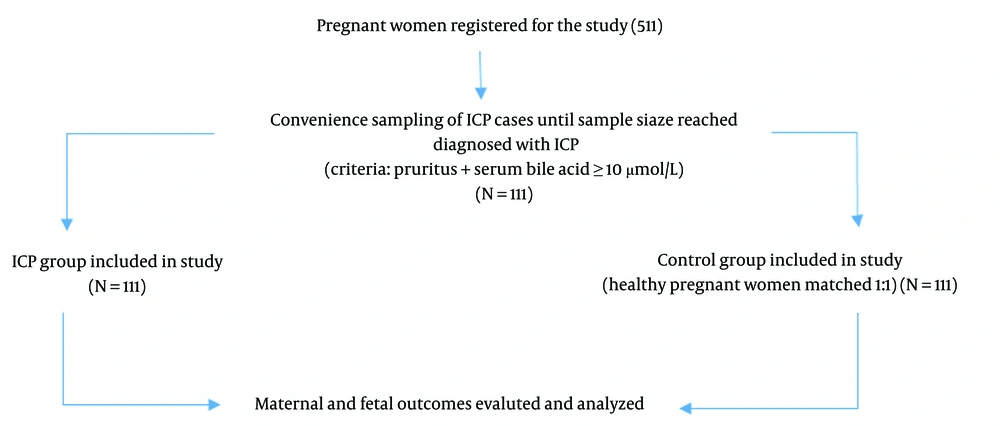
Figure 1.
Flow diagram of participant selection and inclusion
This study involved a case-control comparison of 111 patients with ICP and 111 healthy pregnant women. The comparison of maternal and clinical characteristics between patients with ICP and healthy pregnant women revealed significant differences in several parameters. Liver enzyme levels (AST and ALT) were markedly elevated in the ICP group compared to controls, indicating liver dysfunction associated with the disease (P < 0.001 for both). Patients with ICP had a lower BMI (28.39 ± 3.82 vs. 31.3 ± 6.01, P < 0.001), fewer pregnancies (gravidity: P < 0.001), and fewer live births (parity: P < 0.001). Additionally, measurements for right and left uterine parameters were significantly higher in the ICP group (P = 0.006 and P = 0.04, respectively). However, no significant difference was observed in abortion rates between the two groups (P = 0.30) (Table 1). The average bile acid level in ICP patients was 18.51 ± 8.75, with a range of 1.3 to 49.
Table 1.Comparison of Demographic and Clinical Characteristics Between Intrahepatic Cholestasis of Pregnancy Patients and Healthy Pregnant Women a
| Variables | Patients with ICP | Patients Without ICP | P-Value b |
|---|---|---|---|
| Age (y) | 29.97 ± 5.70 | 31.12 ± 5.66 | 0.13 |
| BMI (Kg/m2) | 28.39 ± 3.82 | 31.3 ± 6.01 | < 0.001 |
| Right uterine | 0.91 ± 0.37 | 0.67 ± 0.17 | 0.006 |
| Left uterine | 0.95 ± 0.42 | 0.75 ± 0.21 | 0.04 |
| AST | 93.93 ± 76.37 | 29.95 ± 39.95 | < 0.001 |
| ALT | 140.05 ± 127.94 | 30.39 ± 57.06 | < 0.001 |
| Gravidity (number) | 2.21 ± 1.58 | 3.75 ± 1.46 | < 0.001 |
| Parity (number) | 1.84 ± 1.24 | 3.22 ± 1.21 | < 0.001 |
| Abortion (number) | 0.31 ± 0.73 | 0.44 ± 0.82 | 0.30 |
Abbreviation: ICP, intrahepatic cholestasis of pregnancy.
a Values are expressed as mean ± SD.
b Student t-test.
The reported analysis in Table 2 revealed significant differences in liver disease prevalence, with ICP patients showing a 7.5-fold higher rate compared to controls (13.51% vs. 1.80%, P = 0.002), consistent with ICP’s known association with hepatic dysfunction. While diabetes (9.91% vs. 3.60%), asthma (6.31% vs. 0.90%), and gestational hypertension (9.91% vs. 5.41%) were more common in the ICP group, these differences did not reach statistical significance (P = 0.11, P = 0.65, and P = 0.31, respectively). No significant differences were observed in anemia or hypothyroidism prevalence between groups (P > 0.05).
Table 2.Comparison of Maternal Comorbidities Between Intrahepatic Cholestasis of Pregnancy Patients and Healthy Pregnant Women a
| Variables | Patients with ICP | Patients Without ICP | P-Value b |
|---|---|---|---|
| Anemia | 7 (6.31) | 5 (4.50) | 0.56 |
| Liver disease | 15 (13.51) | 2 (1.80) | 0.002 |
| Gestational hypertension | 11 (9.91) | 6 (5.41) | 0.31 |
| Diabetes | 11 (9.91) | 4 (3.60) | 0.11 |
| Hypothyroidism | 15 (13.51) | 12 (10.81) | 0.68 |
| Asthma | 7 (6.31) | 1 (0.90) | 0.065 |
Abbreviation: ICP, intrahepatic cholestasis of pregnancy.
a Values are expressed as No. (%).
b Chi-square test.
The comparison of maternal and fetal outcomes between patients with ICP and healthy pregnant women is presented in Table 3. Preterm delivery was markedly higher in the ICP group (24.32% vs. 3.60%, P < 0.001). The study found a significantly higher incidence of RDS in neonates born to mothers with ICP, occurring in 7.21% of ICP cases compared to 0.9% in controls (P = 0.035). The NICU hospitalization rates were also significantly higher among neonates born to ICP mothers (18.92% vs. 6.31%, P = 0.008). Gestational age was significantly lower in the ICP group (36.32 vs. 37.82 weeks, P < 0.001). Neonatal weight was also significantly reduced in the ICP group compared to controls (2991.18 ± 836.70 g vs. 3173.88 ± 438.42 g, P = 0.043), and a higher proportion of neonates in the ICP group had birth weights below the 5th percentile (13.51% vs. 3.60%, P = 0.008). Apgar scores at both 1 minute (7.82 vs. 8.04, P = 0.01) and 5 minutes (8.86 vs. 9.06, P = 0.01) were slightly lower in the ICP group. No significant differences were observed in rates of preeclampsia (P = 0.50), cesarean (P = 0.13), and meconium-stained fluid (P = 0.76). Importantly, no cases of neonatal death or stillbirth were reported in either group.
Table 3.Comparison of Maternal and Fetal Outcomes Between Intrahepatic Cholestasis of Pregnancy Patients and Healthy Pregnant Women a
| Variables | Patients with ICP | Patients Without ICP | P-Value b |
|---|---|---|---|
| Categorical | |||
| Cesarean | 71 (63.96) | 60 (54.05) | 0.13 |
| Preeclampsia | 6 (5.41) | 3 (2.70) | 0.50 |
| RDS | 8 (7.21) | 1 (0.90) | 0.035 |
| NICU hospitalization | 21 (18.92) | 7 (6.31) | 0.008 |
| Meconium-stained fluid | 5 (4.50) | 6 (5.41) | 0.76 |
| Pre-term delivery | 27 (24.32) | 4 (3.60) | < 0.001 |
| Weight percentile ≤ 5 | 15 (13.51) | 4 (3.60) | 0.008 |
| Continuous | |||
| Gestational age (wk) | 36.32 ± 1.49 | 37.82 ± 0.77 | < 0.001 |
| Neonate weight (g) | 2991.18 ± 836.70 | 3173.88 ± 438.42 | 0.043 |
| Apgar (1-min) | 7.82 ± 0.72 | 8.04 ± 0.54 | 0.01 |
| Apgar (5-min) | 8.86 ± 0.65 | 9.06 ± 0.47 | 0.01 |
Abbreviations: ICP, intrahepatic cholestasis of pregnancy; RDS, respiratory distress syndrome.
a Values are expressed as No. (%).
b Chi-square test for categorical variables and t-test for continuous variables.
5. Discussion
The present study aimed to compare maternal and fetal outcomes between women with ICP and healthy pregnant women. The findings revealed significant differences between the two groups, highlighting the impact of ICP on maternal health and pregnancy outcomes. Women with ICP showed elevated liver enzyme levels (AST and ALT), indicating liver dysfunction associated with the condition. Additionally, uterine measurements were higher in the ICP group. Regarding fetal outcomes, preterm delivery was significantly more frequent among ICP patients, with newborns in this group exhibiting lower birth weights, an increased rate of NICU admissions, and a higher percentage of infants with birth weights below the fifth percentile and RDS. Despite these complications, no instances of neonatal death or stillbirth were observed in either group, indicating that appropriate management strategies may help reduce some of the risks associated with ICP.
Consistent with the findings of our study, several studies, including those by Kant et al. (15) and Jhirwal et al. (16), also reported a significant increase in preterm delivery among women with ICP. However, Senocak and Yilmaz (17) observed a higher rate of preterm delivery (40%) compared to our study (24.32%). This discrepancy may be due to differences in diagnostic criteria for ICP or variations in clinical management practices, such as the timing of labor induction. Our findings regarding reduced neonatal weight in the ICP group align with those of Wang et al. (8), who confirmed lower birth weights in ICP pregnancies. However, Aftab et al. (18) found that maternal bile acid levels above 40 μmol/L were associated with more severe reductions in birth weight, whereas in our study, significant weight reduction was observed even at lower bile acid levels (≥ 10 μmol/L). Results of the conducted meta-analysis study by Li et al. (19) showed that neonatal birth weight is lower in ICP patients. Moreover, early-onset ICP is associated with a lower birth weight than late-onset ICP. This difference may stem from variations in study populations or genetic factors influencing outcomes.
Similar to Granese et al. (20), our study demonstrated an increased prevalence of maternal complications, such as liver dysfunction, in the ICP group. However, unlike Granese’s findings, we did not observe significant differences in gestational diabetes or preeclampsia between the two groups. This inconsistency could be attributed to differences in clinical definitions or the smaller sample size in our study. In line with our results, studies by Senocak and Yilmaz (17) and Granese et al. (20) also reported no cases of stillbirth or neonatal death among ICP patients. However, Jhirwal et al. (16) documented intrauterine fetal death in cases of severe ICP during the third trimester. This divergence may be explained by stricter monitoring protocols and planned early deliveries implemented in our study to mitigate risks.
The Royal College of Obstetricians and Gynaecologists (RCOG) recommends that healthcare professionals engage in discussions with women diagnosed with ICP about the potential benefits and risks of inducing labor after 37 weeks of gestation. This approach aims to mitigate the risk of adverse perinatal outcomes, including complications such as stillbirth, by ensuring timely and informed decision-making (21). The findings of our study align with Zecca et al. (22) in demonstrating a significant association between ICP and neonatal RDS. It seems that bile acids might impair surfactant synthesis via phospholipase A2 activity, a mechanism potentially explaining the elevated RDS rates observed in ICP pregnancies. Moreover, it is crucial to acknowledge that prematurity is a major contributing factor to RDS in this population. Our results demonstrate a significantly higher rate of preterm delivery in the ICP group compared to controls, and therefore, the greater incidence of RDS is likely influenced substantially by the earlier gestational age at delivery. This dual impact of elevated maternal bile acids and prematurity should be considered when interpreting neonatal respiratory outcomes in ICP. Future studies might further delineate the relative contributions of these factors through stratified analyses or adjustment for gestational age.
The significant elevation of AST and ALT observed in the ICP group aligns with findings from Kant et al. (15) and Wang et al. (8), confirming liver dysfunction associated with ICP. The rise in liver enzymes is reported in various studies and constitutes a diagnostic criterion for ICP (17). However, Jhirwal et al. (16) reported a stronger correlation between bile acid levels and liver enzymes, which might reflect differences in laboratory methods or variations within study populations.
The findings of this study have practical implications for improving maternal and fetal outcomes in ICP. By highlighting the increased risks of preterm delivery and low birth weight, healthcare providers can implement closer monitoring and timely interventions to mitigate these risks. This involves implementing early labor induction when indicated and providing enhanced prenatal care to ensure optimal health outcomes for both the mother and the fetus.
The present study has several limitations that should be acknowledged. First, the use of hospital-based data from a single center (Imam Khomeini Hospital) may limit the generalizability of the findings to other populations or healthcare settings. Conducting the study at a single center may restrict variability in patient demographics and clinical management, which could affect the applicability of results to broader or differing populations. Second, although the control group was matched to cases based on age and gestational age, other potential confounding factors such as socioeconomic status or lifestyle variables were not accounted for, which could influence the outcomes. Additionally, the exclusion of women with multiple pregnancies and chronic liver diseases other than ICP, while minimizing confounding, could introduce selection bias. This exclusion might have led to an underestimation of the severity and spectrum of maternal and fetal outcomes related to ICP, as patients with such comorbidities may experience more complicated clinical courses. Future studies with larger cohorts and sufficient statistical power are needed to apply outcome-specific multivariable models and to better account for potential confounders such as BMI, parity, and socioeconomic status. Furthermore, this study’s retrospective design and reliance on clinical records may have led to underreporting or misclassification of certain outcomes, especially mild or subclinical conditions such as mild preeclampsia. Variability in clinical documentation might introduce information bias, potentially affecting the accuracy and reliability of the reported findings. Future prospective studies with standardized data collection protocols are recommended to mitigate this limitation. Finally, the retrospective nature of data collection and reliance on clinical records may lead to incomplete or inaccurate documentation, potentially affecting the reliability of the findings.
5.1. Conclusions
The findings reveal that ICP is associated with liver dysfunction and notable changes in maternal characteristics, including altered uterine parameters. On the fetal side, ICP contributes to adverse outcomes such as preterm delivery, neonatal RDS, reduced neonatal weight, and higher NICU admission rates. The results emphasize the importance of early diagnosis and proactive care for women with ICP to optimize pregnancy outcomes. Further research is needed to explore the underlying mechanisms of ICP and address its broader implications across diverse populations.

