


1. Background
Breast cancer is a major global health concern and stands as the most frequently diagnosed cancer as well as the primary cause of cancer-related deaths among women, with approximately 2.3 million new cases reported worldwide in 2022 (1). In the Iranian population, breast cancer has also emerged as the most prevalent form of cancer among women, with epidemiological data indicating a persistent and notable rise in its incidence rates over recent years (2). Therefore, to facilitate the early detection of breast cancer — which is associated with improved prognosis and enhanced quality of life — the Iranian Ministry of Health emphasizes regular mammographic screening as a key secondary prevention measure, in alignment with World Health Organization (WHO) guidelines (2, 3).
The COVID-19 pandemic has caused significant and widespread disruptions to healthcare across global healthcare systems (4). These disruptions have been especially reported in the management of non-communicable diseases (NCDs) such as cancer, where the continuity of routine screening and uninterrupted therapeutic interventions is essential (5, 6). Such interruptions threaten to exacerbate morbidity and mortality associated with the disease (7). Several research projects have shown significant reductions in breast cancer screening rates during the pandemic. For instance, during the early months of the COVID-19 pandemic, the United States experienced a dramatic reduction of nearly 90% in mammography screenings compared to pre-pandemic rates (8). Additionally, evidence from Iran indicates that a substantial number of opportunities for health screening were missed, which in turn contributed to negative health outcomes. This phenomenon was largely attributable to a significant proportion of patients delaying or avoiding necessary medical care due to concerns about contracting COVID-19 within healthcare environments (9).
While these challenges are increasingly recognized globally, there remains a significant lack of region-specific data from Southern Iran, particularly concerning Fars province, the fifth most populous province in Iran. This gap is noteworthy given that Shiraz, the provincial capital, serves as a major referral center for cancer care in southern Iran, providing services to a diverse population from both urban and rural areas with varying access to healthcare (10). Furthermore, most existing research has concentrated on the immediate effects of the pandemic and the early lockdown period, leaving the longer-term consequences of COVID-19 on breast cancer screening and treatment insufficiently explored. This knowledge gap is particularly concerning in settings with heterogeneous healthcare resource distribution, where sustained disruptions may have pronounced and lasting impacts on cancer detection, timely treatment, and ultimately, patient outcomes. The enduring effects of these disruptions highlight the need for comprehensive analyses that extend beyond the initial phase of the pandemic.
Given these considerations, there is a critical need for conducting pre- and post-pandemic research that assesses changes in breast cancer screening and treatment rates in the context of a fatal pandemic like COVID-19.
2. Objectives
The present study seeks to address this knowledge gap by evaluating the impact of the pandemic on breast cancer screening and treatment in Shiraz to provide valuable evidence for enhancing resilience planning and developing effective public health strategies in low- and middle-income countries (LMICs) facing similar challenges in maintaining cancer care during global health crises.
3. Methods
This cross-sectional study utilized data from breast cancer screening (mammography) obtained from the electronic records of health insurance organizations and social security insurance in Fars province between 2019 and 2022. The dataset included all insured individuals in Fars province who underwent mammography screening during this period. In addition, data on breast cancer surgeries were extracted from electronic medical records of patients admitted for surgery at a breast cancer surgery referral hospital. This hospital is the most important referral center for breast cancer surgery in Fars province. Furthermore, data from the breast cancer registry of Fars province were also incorporated into the study. The data from 2019 were considered to represent the pre-COVID-19 period, while data from 2020 to 2022 were categorized as the post-COVID-19 period.
In this study, demographic and clinical variables were collected from official electronic sources, including insurance records, hospital information systems, and the Fars province cancer registry. Age was recorded as a continuous variable (in years), while gender and marital status were categorized. Clinical data included mammography results (suspicious or non-suspicious), disease stage based on the TNM classification (stage I to IV), and patient outcome (alive or deceased). A standardized data collection checklist was developed, including clear definitions for each variable. Data from 2019 were classified as the pre-COVID-19 period, and data from 2020 to 2022 were considered the post-COVID-19 period. To ensure data accuracy and consistency, information was cross-checked across multiple sources and verified by the research team.
Eligibility criteria included: (1) Female gender, (2) age 20 years or older, and (3) having a valid health insurance record during the study period. Patients were excluded if their medical records were incomplete, if they had a previous diagnosis of breast cancer before 2019, or if they received treatment outside the province, which could not be verified through the local data systems. Participants were identified through insurance databases, and their screening and surgical information were cross-referenced with hospital records and the Fars breast cancer registry to ensure completeness and accuracy. In total, 2,460 patient records were collected from cancer registry registrations and mammography screening data.
This study was approved by the Ethics Committee of Shiraz University of Medical Sciences (IR.SUMS.MED.REC.1401.590). The normality of the quantitative data was assessed using the Kolmogorov-Smirnov test. For continuous variables, mean and standard deviation were calculated, while for categorical variables, frequencies and percentages were reported. The relationship between categorical variables was assessed using the chi-square test. To compare the means of quantitative variables between two independent groups, independent sample t-tests were performed. The trend analysis of breast cancer and mammography from 2019 to 2022 was performed using the Cochran-Armitage trend test. All statistical analyses were conducted using SPSS version 22, with a significance level set at 0.05.
4. Results
In this study, 2,460 patients' records were evaluated between 2019 and 2022. Of these, 1,414 patients were recorded before the COVID-19 pandemic, and 1,046 patients were recorded after the pandemic. The mean age of patients before the pandemic was 50.32 ± 11.99 years, and after the pandemic, it was 50.57 ± 12.59 years, with no statistically significant difference observed. In terms of sex distribution, 1,374 (97.17%) females and 40 (2.82%) males were referred for further evaluation and screening before the pandemic. Table 1 presents a comparison of the demographic, clinical, and outcome characteristics of patients before and after the COVID-19 pandemic between 2019 and 2022.
Table 1.Comparison of the Clinical and Demographic Characteristics Before and After COVID-19 a
| Variables | Before COVID-19 (2019) | After COVID-19 | P-Value | ||
|---|---|---|---|---|---|
| 2020 | 2021 | 2022 | |||
| Age | 0.799 b | ||||
| Mean ± SD | 50.42 ± 11.15 | 49.95 ± 12.37 | 51.18 ± 13.22 | 50.78 ± 12.32 | |
| Median (interquartile range) | 50.00 (43.00, 58.00) | 48.00 (40.00, 58.00) | 50.00 (42.00, 60.00) | 49.00 (42.00, 59.25) | |
| Min-max | 22 - 89 | 17 - 96 | 26 - 92 | 27 - 94 | |
| Gender | 0.034 c | ||||
| Male | 27 (3.80) | 8 (2.00) | 5 (1.70) | 9 (2.70) | |
| Female | 684 (96.20) | 399 (98.00) | 296 (98.30) | 329 (97.30) | |
| Marital status | 0.043 c | ||||
| Single | 45 (6.90) | 37 (9.60) | 22 (7.90) | 25 (7.70) | |
| Married | 556 (85.00) | 320 (83.10) | 241 (86.70) | 289 (89.20) | |
| Divorce | 15 (2.30) | 11 (2.90) | 7 (2.50) | 6 (1.80) | |
| Widow | 38 (5.30) | 17 (4.40) | 8 (2.90) | 4 (1.20) | |
| Stage | 0.129 c | ||||
| I | 86 (21.11) | 8 (40.00) | 54 (32.00) | 67 (22.40) | |
| II | 183 (48.70) | 12 (60.00) | 70 (41.40) | 159 (53.40) | |
| III | 96 (25.50) | 0 (0.00) | 42 (24.90) | 64 (21.50) | |
| No tumor | 11 (1.50) | 0 (0.00) | 3 (1.80) | 8 (2.70) | |
| Diagnostic mammogram | 0.001 | ||||
| Total number of mammography | 31965 (35.15) | 17819 (19.58) | 10217 (11.22) | 30988 (34.05) | |
| Number of bilateral mammography | 30898 (34.99) | 16983 (19.22) | 9679 (10.95) | 30789 (34.84) | |
| Number of unilateral mammography | 1067 (40.44) | 836 (31.66) | 538 (20.37) | 199 (7.53) | |
| Final outcome | 0.004 c | ||||
| Discharge | 694 (97.60) | 388 (95.30) | 283 (94.00) | 324 (95.90) | |
| Deceased | 17 (2.40) | 19 (4.70) | 18 (6.00) | 14 (4.10) | |
a Values are expressed as No. (%) unless indicated.
b One sample t-test.
c Chi-square test.
The mean of patient ages showed no significant differences across the years (P = 0.799). Regarding gender, most patients in all years were female, with a statistically significant difference observed (P = 0.034). Marital status showed a significant difference between the years (P = 0.003); while most patients were married, the proportions of single, divorced, and widowed patients varied slightly. In terms of disease stage, most patients were classified as stage II, but no significant difference was found in the distribution of stages over the years (P = 0.129). Notably, no patients in stage III or without a tumor were recorded in 2020. The number of diagnostic mammograms significantly declined in 2020 and 2021 but increased again in 2022 (P = 0.001).
The results of the Cochran-Armitage trend test indicated that the changes in the number of male and female patients over time were statistically significant, showing a marked decreasing trend in both genders (P < 0.001). Also, the trend test for mammography showed a significant decreasing trend (P < 0.001).
The analysis of final outcomes among breast cancer patients from 2019 to 2022 revealed significant changes in discharge and mortality rates. In 2019, 97.6% of patients were discharged, and 2.4% died. In 2020, the discharge rate decreased to 95.3%, while the mortality rate increased to 4.7%. This upward trend in mortality continued in 2021, with 94% discharged and 6% deceased. In 2022, the discharge rate slightly improved to 95.9%, and the mortality rate declined to 4.1%. Statistical analysis showed that these changes in patient outcomes over the years were statistically significant (P = 0.004). More details are provided in Table 1.
The mean and standard deviation of the age of deceased patients in the pre-pandemic period was 62.65 ± 8.73 years, and during the pandemic period, it was 59.96 ± 15.61 years. Additionally, the mean age of discharged patients in the pre-pandemic period was 50.11 ± 11.08 years, and during the pandemic period, it was 49.93 ± 12.16 years. Based on the independent t-test, the difference in mean age between groups was statistically significant (P < 0.001).
In terms of gender, the difference between groups was not statistically significant (P = 0.650), but in all groups, most patients were female. In particular, among patients who died during the pandemic, 96.1% were female, and only 3.9% were male. Regarding marital status, the difference between groups was not statistically significant (P = 0.330), but among all groups, the highest frequency was for married individuals. For example, among patients discharged during the pandemic, 86.7% were married.
In terms of the stage of disease, the difference between the groups was statistically significant (P = 0.002). In the group of deceased patients, the highest frequency was related to stage I and II of the disease (64.7% and 35.3% before the pandemic, and 51.0% and 45.1% during the pandemic, respectively). While in the group of discharged patients, the frequency of stages II and III was higher. Specifically, during the pandemic, 50.1% of discharged patients were in stage II and 23.9% in stage III. Table 2 shows these results.
Table 2.Comparison of Clinical and Demographic Characteristics Between Deceased and Discharged Patients a
| Variables | Died | Discharged | P-Value b | ||
|---|---|---|---|---|---|
| Before COVID-19 | COVID-19 Pandemic | Before COVID-19 | COVID-19 Pandemic | ||
| Age | 62.65 ± 8.73 | 59.96 ± 15.61 | 50.11 ± 11.08 | 49.93 ± 12.16 | < 0.001 c |
| Gender | 0.650 d | ||||
| Male | 2 (11.80) | 2 (3.90) | 24 (3.60) | 20 (2.10) | |
| Female | 15 (88.20) | 49 (96.10) | 649 (96.40) | 954 (97.90) | |
| Marital status | 0.330 d | ||||
| Single | 1 (6.30) | 3 (5.90) | 44 (7.10) | 79 (8.60) | |
| Married | 11 (68.80) | 41 (80.40) | 528 (85.20) | 794 (86.70) | |
| Divorce | 0 (0.00) | 1 (2.00) | 15 (2.50) | 22 (2.40) | |
| Widow | 4 (25.00) | 6 (11.80) | 33 (5.30) | 21 (2.30) | |
| Stage | 0.002 d | ||||
| I | 11 (64.70) | 26 (51.00) | 69 (19.30) | 101 (23.20) | |
| II | 6 (35.30) | 23 (45.10) | 176 (49.20) | 218 (50.10) | |
| III | 0 (0.00) | 2 (3.90) | 96 (26.80) | 104 (23.90) | |
| No tumor | 0 (0.00) | 0 (0.00) | 11 (3.10) | 11 (2.50) | |
| Fibrocystic | 0 (0.00) | 0 (0.00) | 4 (1.10) | 1 (0.20) | |
| Metastasis | 0 (0.00) | 0 (0.00) | 1 (0.30) | 0 (0.00) | |
| Residual carcinoma | 0 (0.00) | 0 (0.00) | 1 (0.30) | 0 (0.00) | |
a Values are expressed as No. (%) or mean ± SD.
b P-value for comparison died and discharged group.
c One sample t-test.
d Chi-square test.
Figure 1 shows the trend of breast cancer patient referrals from 2019 to 2022 by gender. In all years, women accounted for the largest number of referrals. The highest number of referrals was observed in 2019, followed by a relative decrease in 2020. However, an increasing trend is observed again in 2022. In the case of men, although the number of referrals is much lower than that of women, similar annual changes are observed.
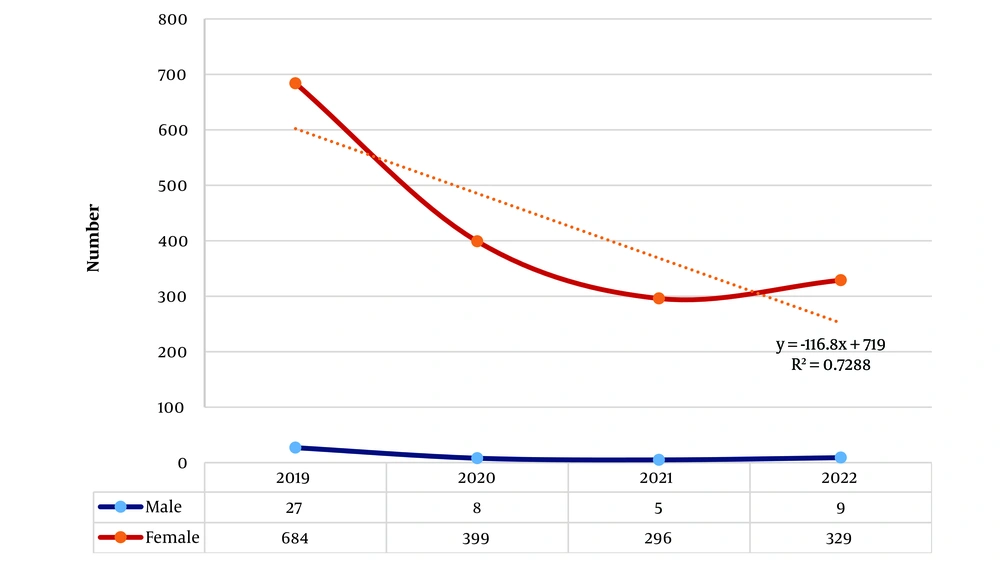
Figure 1.
The trend of breast cancer patients referred to a referral hospital in Fars province by year and gender during 2019 - 2022.
Figure 2 illustrates the annual trend of mammograms from 2019 to 2022. According to this graph, the number of mammograms performed in 2020 and 2021 decreased significantly. After that, a gradual increase in the number of mammograms was observed in 2022. Figure 3 also shows the trend of breast cancer and total mammography during the years 2019 - 2022.
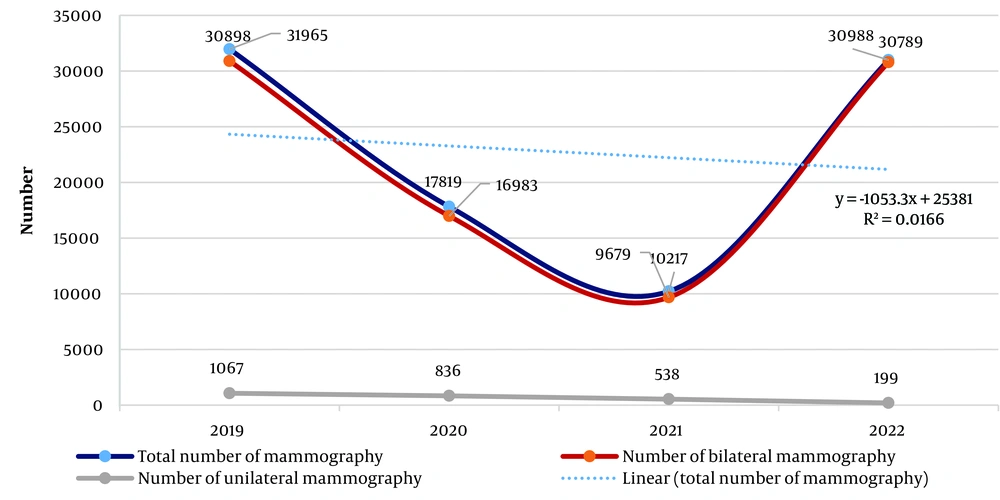
Figure 2.
The trend of mammography per-year during 2019 - 2022
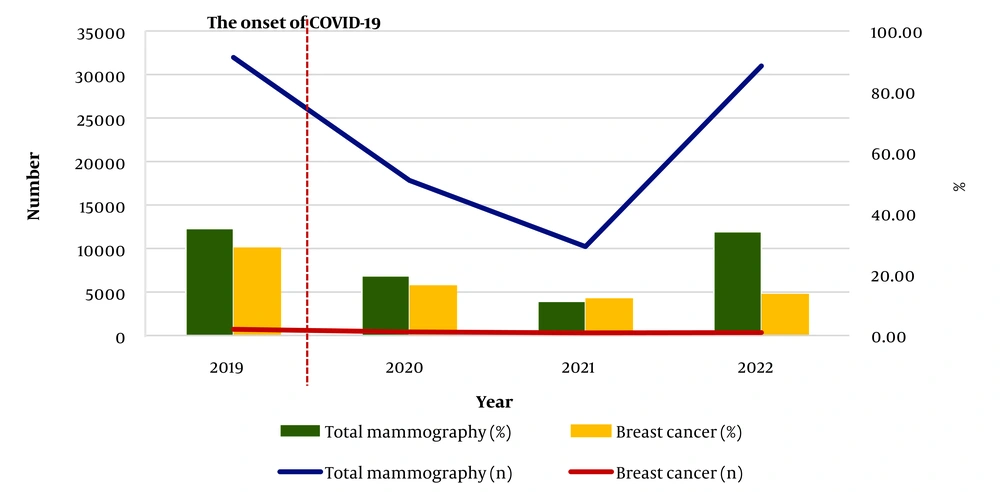
Figure 3.
The trend of breast cancer and total mammography during 2019 - 2022
5. Discussion
Our findings indicate that there was a considerable decrease in the diagnosis of breast cancer in the year 2020, which coincidentally was the peak time of the COVID-19 pandemic. The rate of detection went down from 2019 to 2022. In addition to the decrease in diagnosis, our findings show that the proportion of patients with late stages (stage 3 and 4) increased in 2020 compared to previous years. This shift suggests that delays in screening and diagnosis could have led to disease progression before detection. Furthermore, the data revealed a reduction in screening mammograms performed, especially among younger populations, and a notable postponement in the gap between symptom emergence and diagnosis during the pandemic (P < 0.001). These findings collectively demonstrate that COVID-19 not only interrupted normal screening but also postponed patient presentation and access to diagnostic procedures, with potential consequences of late-stage diagnosis and poorer prognoses.
The COVID-19 pandemic profoundly impacted breast cancer screening practices globally, with reduced screening rates, delayed diagnosis, and an increased trend towards more advanced disease at diagnosis. Findings indicate that the detection of small tumors (T1) dropped by 38%, while the proportion of advanced cancers (T3, T4) rose by 80% during the pandemic (11). These findings align with our research, which showed a reduction in the number of breast cancers diagnosed in 2020 compared to 2019. Prior to the pandemic, best practices for breast cancer screening had been adopted, greatly facilitating early diagnosis and treatment, with a consequent reduction in mortality (12). This arrangement was impacted by the shift towards virtual consultations and the temporary interruption of routine screening programs during the initial phase of COVID-19. News sources reported that nearly 3.9 million fewer breast cancers were screened in the U.S. alone in 2020 due to the pandemic (13).
Our study also reflects the impact of this disruption, with a similar decline in the number of patients presenting for diagnostic evaluation over the same time period. Delayed screening and diagnosis not only resulted in a smaller number of overall breast cancer diagnoses but also was linked to an increased proportion of patients diagnosed with more advanced disease in our study. Furthermore, our findings confirm global concerns about the long-term effects of disrupted breast cancer screening during the COVID-19 pandemic. The rise in breast cancer mortality in 2020 aligns with global estimates of excess deaths due to delayed diagnosis (14). However, our study provides early evidence that this impact may have already begun, rather than appearing in future years.
We observed an increase in late-stage diagnoses in the pandemic year, with stage III cases rising from 1.2% in 2019 to 6.6% in 2020, reflecting a concerning trend towards later-stage detection most likely due to delays in screening and diagnosis. This is in line with Cairns et al., which found a considerable increase in patients presenting with advanced breast cancer presentations (stage III or more) in the COVID-19 era, with a reported incidence of 7.79% for such presentations (15). This increase is likely linked to rising mortality, as late-stage breast cancer has poorer survival rates and more complex treatment requirements (16). Furthermore, modeling studies indicate that delays in diagnosis may lead to an additional thousand deaths annually for five years, reflecting the longer-term consequences of screening interruptions during the pandemic (17, 18).
In addition, access to healthcare was significantly compromised during the pandemic due to several barriers. Studies observed that patients became afraid of going to health centers for fear of contracting COVID-19, thus reducing screening and treatment (19). For instance, many patients delayed undergoing surgical procedures, which are critical to the successful control of breast cancer (20). The combination of these factors (diagnostic and treatment delay) has been estimated to have caused a rise in breast cancer mortality associated with the COVID-19 pandemic (21).
To address this, several public health recommendations have been proposed, including the implementation of catch-up screening programs, prioritization of high-risk patients for diagnostic services, strengthening telemedicine for timely consultations, and ensuring continuity of cancer care even during public health crises (22).
Of specific interest, we noted an increase in the pandemic's mean age at death among patients, as well as a higher percentage of mortality in the widowed population. This finding could be interpreted as indicating that older and more socially isolated groups were disproportionately affected. This trend is particularly alarming, as it highlights a vulnerable demographic whose heightened risk may signal systemic gaps in care, support, and timely intervention — underscoring the need for urgent public health attention. These groups may have found it more difficult to access services or navigate the healthcare system under lockdowns.
The psychological and socio-economic impacts of the pandemic have added an additional layer of complexity to patient outcomes. Isolation, economic strain, and the psychological impact of cancer treatment during a global health crisis have been said to negatively impact the mental and physical health of breast cancer patients (23, 24). These psychosocial aspects can further complicate treatment adherence and overall patient outcomes, potentially leading to higher mortality rates. Together, these trends highlight the importance of keeping access to early detection and treatment services available to vulnerable groups during times of public health emergency. They also indicate that socially isolated individuals might need special interventions because they may perceive heightened risk during crises.
Disruption of normal healthcare services, public fear of hospital visits, and diversion of medical resources to COVID-19 care most likely led to the decline. These findings are consistent with global trends published concurrently and highlight the imperative demand for robust healthcare systems that can maintain indispensable cancer screening activities despite public health crises (20, 24).
5.1. Conclusions
This study demonstrated that the COVID-19 pandemic had a significant impact on patient diagnosis and outcomes. The notable decline in diagnostic mammography during 2020 and 2021, particularly at the peak of the pandemic, likely contributed to delayed diagnoses and increased mortality rates during this period. Additionally, older age and marital status — specifically being widowed — were key demographic factors associated with poorer outcomes. The higher proportion of widowed patients among the deceased highlights the potential importance of social and family support in treatment outcomes. Based on these findings, it is recommended that future healthcare and screening strategies be more carefully planned during similar crises to prevent delays in diagnosis and treatment. Special attention should also be given to high-risk groups, such as elderly and widowed patients, to improve clinical outcomes.
5.2. Strengths
This study has several notable strengths. First, the relatively large sample size of 2,460 patients over a four-year period provides sufficient statistical power for analysis. Additionally, dividing the patients into pre- and post-COVID-19 periods allows for a clear comparison of the pandemic's impact on diagnostic processes and patient outcomes.
5.3. Limitations
The study also has limitations. The lack of detailed treatment data — such as treatment type, duration, or therapeutic response — could influence the results. Lastly, the significant decline in diagnostic mammography during the pandemic could have affected disease staging accuracy and, consequently, the interpretation of outcomes.



