


1. Background
Cataract is the predominant cause of reversible blindness and visual impairment worldwide. Blindness due to cataracts is more prevalent in persons with low socioeconomic levels and in developing nations compared to developed countries. The only curative treatment for cataracts is surgical management (1). Cataract surgery is among the most prevalent operations conducted globally. Improvements in intraocular lens (IOL) replacement technologies have accompanied breakthroughs in cataract surgical procedures. Cataract surgery is regarded as one of the most successful interventions in medicine (2).
Despite the high safety of cataract surgery and the favorable visual outcomes, postoperative problems can occur even with optimal technique. A significant concern following cataract surgery is the increased chance of postoperative endophthalmitis. Postoperative endophthalmitis is more likely to happen if there is a posterior capsular rupture, the surgery lasts longer than expected, the wound leaks, or the surgeon is not very experienced. Endophthalmitis primarily occurs during cataract surgery, where a corneal incision is created in the anterior chamber of the eye to excise the cataractous lens, allowing the ingress of ocular surface fluid harboring bacterial flora (3, 4).
Endophthalmitis is an uncommon yet serious ocular inflammatory condition resulting from infection of the intraocular cavity, potentially causing irreversible vision loss if not addressed promptly and appropriately. The infection can be categorized as exogenous or endogenous, depending on its transmission route. Exogenous endophthalmitis arises when infectious agents enter the eye through direct inoculation, such as during intraocular surgery, penetrating trauma, or contiguous spread from neighboring tissues (5).
Diverse operational and nonoperative strategies have been proposed to prevent this major complication. Topical povidone-iodine is commonly utilized for preoperative antisepsis of the periocular region and is regarded as the fundamental standard for preventing intraoperative ocular infections, but chlorhexidine is favored in certain countries. Antibiotic prophylaxis is a frequently employed preventive strategy. Proposed antibiotic prophylaxis protocols exhibit considerable variability in the agents utilized (e.g., aminoglycosides, cephalosporins, fluoroquinolones, chloramphenicol), routes of administration (topical, intraocular, subconjunctival, oral, intravenous), and timing (preoperative, intraoperative, perioperative, postoperative) (6).
By reviewing the findings of multiple research studies that suggest various strategies and recommendations for endophthalmitis prevention, it appears that a consensus on this issue is lacking. Nonetheless, due to the hazardous nature and importance of this complication, it should be eliminated to the greatest extent possible. A straightforward and economical approach is the incorporation of vancomycin into the irrigation solution during cataract surgery, a practice selectively adopted by certain ophthalmic surgeons, resulting in an ongoing debate among their peers. Due to the importance of endophthalmitis following cataract surgery and its prevention strategies, this study was designed to investigate the epidemiological incidence of its occurrence in two major ophthalmology referral centers in Iran. Consequently, we chose to examine the impact of vancomycin in the irrigation solution on the occurrence of postoperative acute endophthalmitis.
2. Objectives
To investigate the epidemiological incidence of post-cataract surgery endophthalmitis in two major ophthalmology referral centers in western and northwestern Iran, and the impact of perioperative vancomycin as a prophylactic option.
3. Methods
This research was a retrospective cohort study. The sample population included patients who underwent cataract surgery using the phacoemulsification procedure from January 2017 to January 2024 at two referral centers: Imam Khomeini Hospital in Kermanshah, Kermanshah, Iran, and Nikookari Hospital in Tabriz, East Azerbaijan, Iran. The study was approved by the local ethical committee of the Kermanshah University of Medical Sciences (IR.KUMS.MED.REC.1403.100) and complied with the tenets of the Declaration of Helsinki.
Considering the minimal occurrence of endophthalmitis post-phacoemulsification cataract surgery, we opted to utilize data from two referral ophthalmology centers: Imam Khomeini Hospital in Kermanshah and Nikookari Hospital in Tabriz. Both institutions are public university teaching hospitals and exhibit similarities in the ratio of assistants to attending surgeries. The surgical methodologies and disposable instruments employed in these two facilities are predominantly identical. The surgical techniques employed in these two centers are identical, differing solely in the administration of vancomycin in irrigation fluid throughout the procedure. At Nikookari Hospital, the standard protocol dictates the administration of vancomycin at a dosage of 10 mg in 500 mL of balanced salt solution (BSS) for all cataract procedures, while Imam Khomeini Hospital does not utilize vancomycin in the irrigation solution. In brief, vancomycin powder is reconstituted per manufacturer instructions to 50 mg/mL with sterile water for injection in a laminar flow hood. It is then diluted 5:1 in normal saline and divided in a sterile manner into single-use syringes containing 10 mg vancomycin/1.0 mL normal saline. The vancomycin mixture is injected by the circulating nurse into the 500 mL BSS bottle immediately before each surgical case, giving a final concentration of 20 μg/mL (7). All solutions were prepared according to typewritten protocols by hospital pharmacists between 30 minutes before their use.
The subjects of this experiment are patients who received cataract surgery between January 2017 and January 2024 at two referral centers: Imam Khomeini Hospital in Kermanshah and Nikookari Hospital in Tabriz. All patients who underwent cataract surgery using the phacoemulsification technique were included in the study through a census method. Patients who underwent cataract surgery by methods other than phacoemulsification, including extra-capsular cataract extraction (ECCE), intra-capsular cataract extraction (ICCE), and pars plana lensectomy, those under 18 years of age, and those with traumatic cataract were excluded. All instances of acute endophthalmitis occurring within six weeks post-cataract surgery with phacoemulsification over the preceding seven years were retrieved with assistance from the infection control department and analyzed between the two centers. It is important to note that additional underlying factors in patients, such as the number of educational surgeries, duration of surgery, medical history (including diabetes and immunodeficiency), and other potential risk factors for endophthalmitis, were obtained from the patient records of both centers. Patients were categorized and standardized according to confounding characteristics, including age, gender, and other factors listed in the variable table. Furthermore, patients who encountered intraoperative problems or presented with cataracts in conjunction with other ophthalmic conditions, including uveitis, glaucoma, or other intraocular inflammatory illnesses, underwent subgroup analysis.
A questionnaire was employed to gather data for this investigation. The initial section of the questionnaire collected demographic data, including name, gender, age, education level, and residential location in urban or rural areas, for each patient. In the subsequent section, additional information concerning independent and dependent variables was compiled, including the cataract type (traumatic, congenital, senile complication), the hospitalization date for surgery, the existence of underlying and concomitant diseases, the occurrence of acute endophthalmitis during examinations conducted within six weeks post-surgery, the diagnosis date, and the treatment initiation date, among others. Due to the unavailability of essential data in the patients' documents and records (specifically, a lack of access to clinical examination data and demographic variables), the information was supplemented following communication with the patients. The data collected from questionnaires were input into SPSS software version 25 and analyzed utilizing descriptive statistics (frequency and percentage) as well as inferential statistical tests, including Fisher's exact test, chi-square test, and independent t-test.
4. Results
This retrospective cohort study examined two major ophthalmology referral centers in Iran over a 7-year period, including 54,071 phaco cataract surgeries. Of these, 71 patients developed endophthalmitis, an incidence of 13 per 10,000 patients (0.131%). This rate also decreased from 0.231% in 2017 to 0.031% in 2023 over seven years. This research included 20,444 cataract surgeries performed in Imam Khomeini Ophthalmology Center, Kermanshah, Iran without vancomycin in the serum (group A) and 33,627 surgeries performed in Nikookari Eye Center, Tabriz, Iran with vancomycin (group B). Fifty-two cases of acute post-cataract surgery endophthalmitis were identified in group A, resulting in an incidence of 0.254%, in contrast, 19 cases occurred in group B, with an incidence of 0.056%. The incidence of endophthalmitis was significantly lower in the vancomycin-exposed group compared to the non-exposed group. vancomycin reduced the incidence by 0.061% (0.154% vs. 0.092%, ARR: 0.061%, P = 0.02). This rate also decreased from 0.469% and 0.104% in 2017 to 0.050% and 0.017% in 2023 over seven years, respectively, in groups A and B (Figure 1).
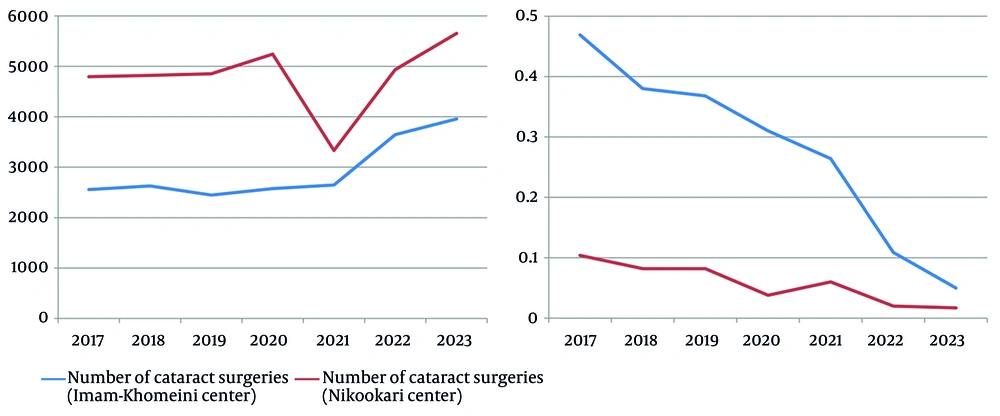
Figure 1.
Number of cataract surgeries (left graph) and the incidence of endophthalmitis (right graph) in the Imam-Khomeini Center (non-vancomycin group) and Nikookari Center (vancomycin group) over seven years. As can be seen, the incidence of endophthalmitis in the vancomycin group is lower than in the other group, and this rate also decreased over time in both centers.
This research includes 71 eyes from 71 participants with acute post-cataract surgery endophthalmitis. Fifty-two underwent cataract surgery without vancomycin in BSS (group A), while nineteen received vancomycin (group B). The two groups were similar regarding age and gender distribution (P = 0.8 and P = 0.075, respectively). Most patients were over 70 years old, and the least were under 50. All patients were discharged with topical antibiotics and corticosteroid eye drops; however, 3 patients had not used their drops, and systemic antibiotics were administered to some of those with intraoperative complications (posterior capsule rupture and vitreous loss), according to the clinical judgment of the surgeon. Additional data are provided in Table 1.
Table 1.Demographic Data and History of Patients
| Variables | Group A | Group B | P-Value |
|---|---|---|---|
| No. of phaco cataract surgery | 20444 | 33627 | - |
| No. of acute endophthalmitis (rate %) | 52 (0.254%) | 19 (0.056%) | 0.02 |
| Gender | 0.75 | ||
| Male | 29 | 10 | |
| Female | 23 | 9 | |
| Age (mean ± SD) | 63.17 ± 15.36 | 63.63 ± 16.19 | 0.978 |
| Eyes (OD/OS) | 52 (31) | 19 (12) | 0.78 |
| Posterior capsule rupture and VL (%) | 18 (34.61) | 5 (26.31%) | 0.508 |
| Attending/resident case | 43/9 | 10/9 | 0.01 |
| Systemic antibiotic use | 6 | 2 | 0.9 |
| Topical antibiotic use | 49 | 18 | 0.7 |
| Any past medical history (diabetes) | 39 (17) | 14 (6) | 0.991 |
Abbreviations: OD, right eye; OS, left eye; SD, standard deviation; VL, vitreous loss.
The mean interval between the incidence of endophthalmitis and surgery was 6.77 days in group A versus 8.16 days in group B (P = 0.186). The most common presentation was the combination of pain and loss of vision (33.8%). The most common visual acuity (59.5%) at presentation was hand motion (HM), and there was no significant difference between the two groups regarding visual acuity (P = 0.9). The rate of intraoperative complications (including posterior capsule rupture and vitreous loss) was 18/52 in group A and 5/19 in group B, which were statistically insignificant (P = 0.508). There was no vancomycin-associated hemorrhagic occlusive retinal vasculitis in group B. Surprisingly, most of the patients were operated on by the attending (53 of 71 patients), and the endophthalmitis rate was significantly higher than for the residents P-value = 0.03), suggesting potential differences in the higher number of surgeries, surgical complexity, or case selection (prone to complications such as posterior capsule rupture and vitreous loss).
5. Discussion
This retrospective cohort study examined 54,071 phaco cataract surgeries in two major referral ophthalmology centers, which is considered the most extensive epidemiological study on the incidence of endophthalmitis in Iran. The overall incidence of endophthalmitis was 0.131%, with rates of 0.254% and 0.056% in Imam Khomeini Ophthalmology Center, Kermanshah, Iran, and Nikookari Eye Center, Tabriz, Iran, respectively. This study analyzed 71 eyes from 71 patients who underwent cataract surgery and developed acute post-surgery endophthalmitis, and investigated the perioperative role of prophylactic vancomycin. The overall incidence of post-cataract surgery endophthalmitis was significantly lower in the vancomycin-exposed group (0.057%) compared to the non-vancomycin group (0.254%, P = 0.02), reinforcing the potential protective role of intracameral vancomycin in preventing infection. The overall incidence of acute post-cataract surgery endophthalmitis in this research is equivalent to the incidence rate reported in developed countries (8, 9). Of course, it is clear that in this comparison, the conditions of Iran as a developing country with special resource limitations and unique challenges (limited personal protective equipment availability and high surgical volume) must also be taken into account. However, in a review of epidemiological studies around the world, these factors can strongly influence this (10). Also, the overall incidence of post-cataract surgery endophthalmitis decreased over time, which has also been reported in some long-term epidemiological studies, possibly due to corrective measures, equipment advancements, and reduced complications (11).
Shorstein et al. reported endophthalmitis rates of 0.02% and 0.013% in 216,141 surgeries within 90 days for those with intracameral moxifloxacin and cefuroxime injection, respectively. Our study showed similar rates, although a slight difference could be related to the use of intra-fluid vancomycin in this study rather than intracameral injection, which maintains a higher dose of antibiotic for a longer period (12). Another meta-analysis included eight studies with a total of 123,819 eyes and found that an anterior chamber injection of moxifloxacin significantly reduces the risk of endophthalmitis after cataract surgery. However, there were no significant differences between the moxifloxacin and non-moxifloxacin groups regarding uncorrected and best-corrected visual acuity, intraocular pressure, corneal edema, central corneal thickness, or endothelial cell density (13). A systematic review and meta-analysis by Kato et al. showed a 0.066% rate of endophthalmitis after 6,809,732 surgeries, with the highest protection against endophthalmitis achieved by using intracameral vancomycin (odds ratio: 0.03), followed by cefazolin, cefuroxime, and moxifloxacin (14). In a retrospective cohort study, 422 cases of 1,457,172 cataract surgeries developed post-operative endophthalmitis (0.029%). This study found that intra-operative complications, higher age, male gender, and not using intracameral antibiotics were risk factors for endophthalmitis (15). A study by Falahati and Jadidi included 1,281 patients, of which 539 had vancomycin in their cataract surgery serum and others did not. They reported no statistical difference between the two groups in the frequency of postoperative endophthalmitis; however, the short follow-up time (2 weeks) and relatively small sample size were limitations of this study (16).
Our study had some limitations, the most important of which include its retrospective design, which may introduce recall bias, and unmeasured confounders, such as pre-operative ocular surface disease. We suggest conducting comparative clinical trials with a large number of cases to better evaluate the protective effects of vancomycin as a perioperative prophylactic option on endophthalmitis. Additionally, the prognosis of endophthalmitis induced in each group was not evaluated in this study; thus, further studies to compare the visual prognosis between patients with or without vancomycin should be conducted. In conclusion, our study shows promising preventive effects of perioperative vancomycin on the occurrence of post-cataract surgery endophthalmitis.

