
1. Introduction
Intussusception is among the most common abdominal emergencies and a leading cause of intestinal obstruction in young children. Prompt diagnosis and effective treatment are critical to prevent serious complications, including ischemia, necrosis, and death (1). The condition occurs when a segment of the intestine telescopes into an adjacent segment and most commonly involves the ileocolic region. Although intussusception can occur at any age, it predominantly affects children aged 2 months to 2 years. Approximately 90% of cases are idiopathic, whereas the remainder are associated with infections, anatomical abnormalities (eg, Meckel diverticulum), polyps, or genetic conditions (2).
Only about one-third of children present with the classic triad of red currant jelly stools, a palpable abdominal mass, and intermittent abdominal pain. Many children initially present with nonspecific symptoms, such as nausea, agitation, anorexia, or lethargy, which can delay diagnosis. These delays may lead to intestinal ischemia, necrosis, perforation with peritonitis, an increased need for surgical intervention, and, rarely, death (3-5). Because clinical evaluation alone is often insufficient, imaging modalities, particularly abdominal ultrasonography, play an essential role in diagnosis (6).
Management of intussusception includes both nonsurgical and surgical approaches. Nonsurgical reduction is typically achieved with a contrast enema (air, saline, or barium), which increases intraluminal pressure (7). Reported success rates for barium, fluid, or air enemas range from 60% to 90% (8). Factors such as intraperitoneal fluid, enlarged lymph nodes, and longer affected segments are associated with lower success rates of saline enema reduction. In these more challenging cases, colonoscopy may offer a preferable alternative (9, 10).
Surgical intervention, primarily laparotomy, is reserved for patients in whom nonsurgical methods fail or when complications such as perforation, peritonitis, or severe infection are present (11, 12). Given its invasive nature and associated risks, surgery is generally considered a last resort in pediatric patients, underscoring the value of less invasive options such as colonoscopy (6).
Although colonoscopy was originally used for diagnosis, it has increasingly been employed as a therapeutic modality for intussusception reduction (13, 14). The procedure allows direct visualization of the bowel and, when indicated, manual reduction or removal of pathological lead points (13-16). It therefore provides both diagnostic and therapeutic benefits, particularly in patients with suspected lead points or those who fail enema reduction. Compared with ultrasound-guided enema, colonoscopy is more invasive, requires sedation or anesthesia, and carries risks of bleeding and perforation (13). Optimization of sedation protocols may improve procedural tolerance and safety during colonoscopy, as shown in studies evaluating adjunctive sedative agents (17). Rare additional concerns include dissemination of malignant lesions, venous air embolism from repeated manipulation, and bowel perforation secondary to edema or ischemia (18, 19).
Despite these potential advantages, the precise therapeutic role of colonoscopy in pediatric intussusception remains unclear. Available data on efficacy, safety, and long-term outcomes are scattered and methodologically inconsistent. To date, no systematic review has synthesized the available evidence. The present study is the first systematic review on this topic. Its objectives are to define the safety profile of colonoscopy in pediatric intussusception, critically evaluate therapeutic outcomes, and integrate current knowledge. By addressing this gap, this review aims to clarify the therapeutic value of colonoscopy, assess its safety and outcomes, and determine its potential to influence contemporary management strategies for this challenging condition. The findings may help inform clinical guidelines and support the development of standardized protocols to ensure the most effective and safest treatments for pediatric intussusception.
2. Methods
2.1. Search Strategy
This systematic review was conducted in accordance with the PRISMA guidelines (20). A comprehensive literature search was performed from inception to August 30, 2025, using PubMed, Embase, Scopus, Web of Science, Google Scholar, ScienceDirect, and the Cochrane Library. Boolean operators were used to combine MeSH terms and free-text keywords. The PubMed search strategy was as follows:
("Intussusception" [Mesh] OR "paediatric intussusception" OR "childhood intussusception") AND ("Colonoscopy" [Mesh] OR "colonoscopy" OR "endoscopic reduction" OR "endoscopic management") AND ("efficacy" OR "safety" OR "outcome" OR "success rate" OR "complication").
The reference lists of the included studies were manually screened to identify additional relevant articles. Two independent reviewers screened citations for eligibility, and discrepancies were resolved through discussion with a senior author. No language or publication-date restrictions were applied. Owing to the small number and heterogeneity of eligible studies, a quantitative meta-analysis was not performed; only a qualitative synthesis is presented.
2.2. Selection Criteria
Studies were included if they were randomized controlled trials, cohort studies, case-control studies, or case series involving pediatric patients (< 18 years) with intestinal intussusception; used colonoscopy or endoscopic reduction as the primary intervention; and reported efficacy and/or safety outcomes.
2.3. Exclusion Criteria
Studies were excluded if they were single case reports, reviews, editorials, letters, conference abstracts without full text, or animal studies; if they were ongoing or incomplete; or if they lacked extractable data on colonoscopy efficacy or safety. Three reviewers independently confirmed eligibility decisions, and disagreements were resolved by consensus.
2.4. Data Extraction and Outcomes
Two reviewers independently extracted data into Excel spreadsheets. Extracted variables included the first author, publication year, country, study design, number of patients, mean or median age, sex distribution, site of intussusception, and efficacy and safety outcomes. The primary outcomes were the resolution of intussusception and procedural success. Secondary outcomes were complications and recurrence.
2.5. Quality of Included Studies
Study quality was assessed using an eight-item checklist covering sample size, mean age, symptoms, target location, recurrence, complications, and outcomes (Table 1). General study characteristics were also summarized (Table 2).
Table 1.
Eight-Item Checklist for Study Quality Assessment
Table 2.
Summary of Included Studies
| Author | Year | Country | Sampling method | Study design | Female to male | Sample size | Age, median (range) | Study population |
|---|---|---|---|---|---|---|---|---|
| Tafner et al. (13) | 2017 | Brazil | Convenience | Retrospective | 0.5 | 30 | 17 months | Children with intussusception |
| Shahramian et al. (16) | 2020 | Iran | Convenience | Retrospective | 0.07 | 15 | 36.6 ± 28.7 months | Children with ileocecal intussusception |
| Naghizadeh et al. (21) | 2024 | Iran | Convenience | Retrospective | 0.3 | 16 | 13.38 ± 8.36 months | Children with ileocecal and colocolic intussusception |
| Shahramian et al. (3) | 2025 | Iran | Convenience | Retrospective | 0.5 | 60 | 29.5 ± 26.6 months | Children with ileocecal intussusception |
3. Results
3.1. Literature Search Results
A total of 1895 records were identified through database searches (PRISMA flow diagram, Figure 1). After removal of 1376 duplicates, 519 records remained. Title and abstract screening excluded 487 records. Thirty-two full-text articles were assessed for eligibility. Of these, 15 were review articles or meta-analyses, 7 were case reports, 6 involved populations outside the pediatric scope, and 4 were editorials or letters. Ultimately, four retrospective studies met the inclusion criteria and were included in the qualitative synthesis.
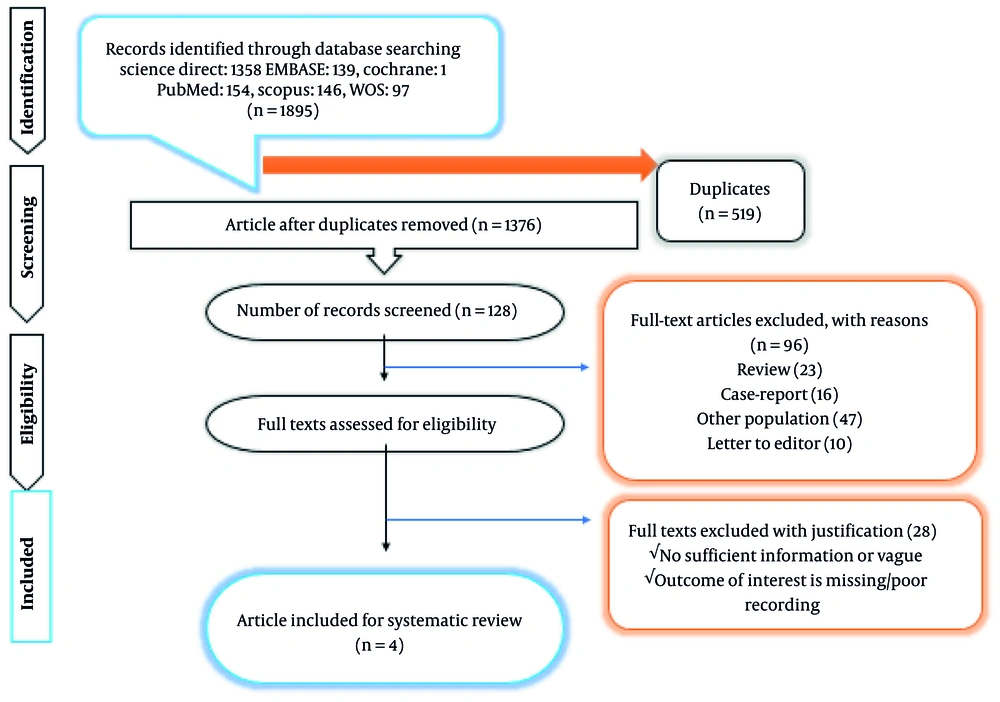
Figure 1.
PRISMA flow diagram
3.2. Study Characteristics
The review included 4 retrospective studies involving 121 pediatric patients with intestinal intussusception who underwent colonoscopy. Three studies were conducted in Iran, and one was conducted in Brazil. Sample sizes ranged from 15 to 60 patients. The median or mean patient age ranged from 13.38 to 36.6 months.
3.3. Outcomes and Complications
Ileocolic intussusception was the most common type, followed by colocolic intussusception. The predominant symptoms were vomiting, abdominal pain, anorexia, currant jelly stool, and hematochezia. The overall success rate of colonoscopic reduction was 88.4% (range, 66.7% in Tafner et al. (13) to 100% in Shahramian et al. (16)). In the Tafner study, 10 patients (33%) required surgery after failed colonoscopic reduction. Recurrence within 24 hours occurred in 11 patients (9.1%; range, 6.2%–26.7%). No colonoscopy-related complications were reported in any study (Table 3).
Table 3.
Colonoscopic Reduction Success, Failure, and Recurrence Rates
| Author | Year | Country | Target location | Key symptoms | Recurrence | Outcome | Complications |
|---|---|---|---|---|---|---|---|
| Tafner et al. (13) | 2017 | Brazil | Not specified | Vomiting 66.6%, diarrhea 47.6%, hematochezia 42.8%, abdominal distension 9.5% | 2 (6.7%) | Success 20 (66.7%), failure 10 (33.3%) | 0 (0%) |
| Shahramian et al. (16) | 2020 | Iran | Ileocolic 13 (86.7%) | Anorexia 100%, abdominal pain 80%, currant jelly stool 47%, hematochezia 27%, nausea 66.7% | 4 (26.7%) | Success 15 (100%), failure 0 | 0 (0%) |
| Naghizadeh et al. (21) | 2024 | Iran | Ileocolic 14 (87.5%), colocolic 2 (12.5%) | Not detailed | 1 (6.2%) | Success 13 (81.2%), failure 3 (18.7%) | 0 (0%) |
| Shahramian et al. (3) | 2025 | Iran | Ileocecal | Vomiting 95%, currant jelly stool 35%, stomach discomfort 77.5%, olive sign 1.2% | 4 (6.7%) | Success 59 (98.3%), failure 1 (1.6%) | 0 (0%) |
4. Discussion
Current standard management of pediatric intussusception relies primarily on air or saline enema reduction, with surgery reserved for cases of failure or complications (22). This systematic review examined colonoscopy as a safe and effective therapeutic option. Although most prior reports of therapeutic colonoscopy for intestinal obstruction have focused on adults, the present findings demonstrate an overall success rate of 88.4%, with recurrence within 24 hours below 10%. These results suggest that colonoscopy is an excellent alternative, even in acutely symptomatic children.
Supporting evidence includes Yan et al. (23), who achieved 87.5% success with colonoscopic polypectomy for juvenile polyp-induced colonic intussusception, and Park et al. (14), who highlighted the diagnostic and therapeutic value of colonoscopy in bowel obstruction. Shahramian et al. (24) also successfully reduced a transanal prolapsed ileocolic intussusception via colonoscopy, thereby avoiding immediate laparotomy.
Naghizadeh et al. (21) directly compared saline enema and colonoscopy and reported comparable success rates (84% vs 81%), with no significant difference. Free intraperitoneal fluid and interloop lymph nodes reduced the success of saline enema but did not affect colonoscopy outcomes, suggesting that colonoscopy may be preferable in these scenarios. Age also influences the choice of modality: ultrasound-guided saline enema is often favored in younger infants to avoid sedation, whereas colonoscopy may be more suitable for older children who tolerate the procedure well (25, 26, 27).
No definitive predictors of colonoscopic failure were identified across studies. However, Naghizadeh et al. noted a higher failure rate in ileocolic cases than in colocolic cases, whereas Tafner et al. observed that most failures presented with the classic clinical triad, suggesting a possible association with a palpable mass (13, 21). Although rare, potential risks of colonoscopy include perforation, bleeding, lesion dissemination, and air embolism; none were observed in the included studies.
4.1. Limitations and Future Research
This review has several limitations, including the small number of studies, their exclusively retrospective design, and modest sample sizes. Some studies provided incomplete reporting of factors influencing outcomes, including age, location, and symptoms. Future prospective studies with larger cohorts are needed to confirm these findings and identify optimal patient-selection criteria.
4.2. Conclusions
Colonoscopic reduction of pediatric intussusception achieved an overall success rate of 88.4%, with a 9.1% recurrence rate within 24 hours and no reported complications. Therefore, colonoscopy can be considered a safe and highly effective treatment, especially for children in whom saline enema reduction fails.