


1. Introduction
| Syndrome | Associated Gene |
|---|---|
| Adenomatous polyposis syndromes | |
| Familial adenomatous polyposis (FAP) | APC |
| MYH-associated polyposis (MAP) | MYH |
| Non-polyposis syndrome | |
| Hereditary non-polyposis colorectal cancer (HNPCC) | MSH2. MLH1, MSH6, PMS2 |
| Hamartomatous polyp syndrome | |
| Peutz-Jeghers (PJS) | LKB1 |
| Juvenile polyposis (JPS) | SMAD4, BMPR1A |
| Cowden disease, including Bannayan-Ruvalcaba-Riley-syndrome | PTEN |
2. MutYH Gene and Protein
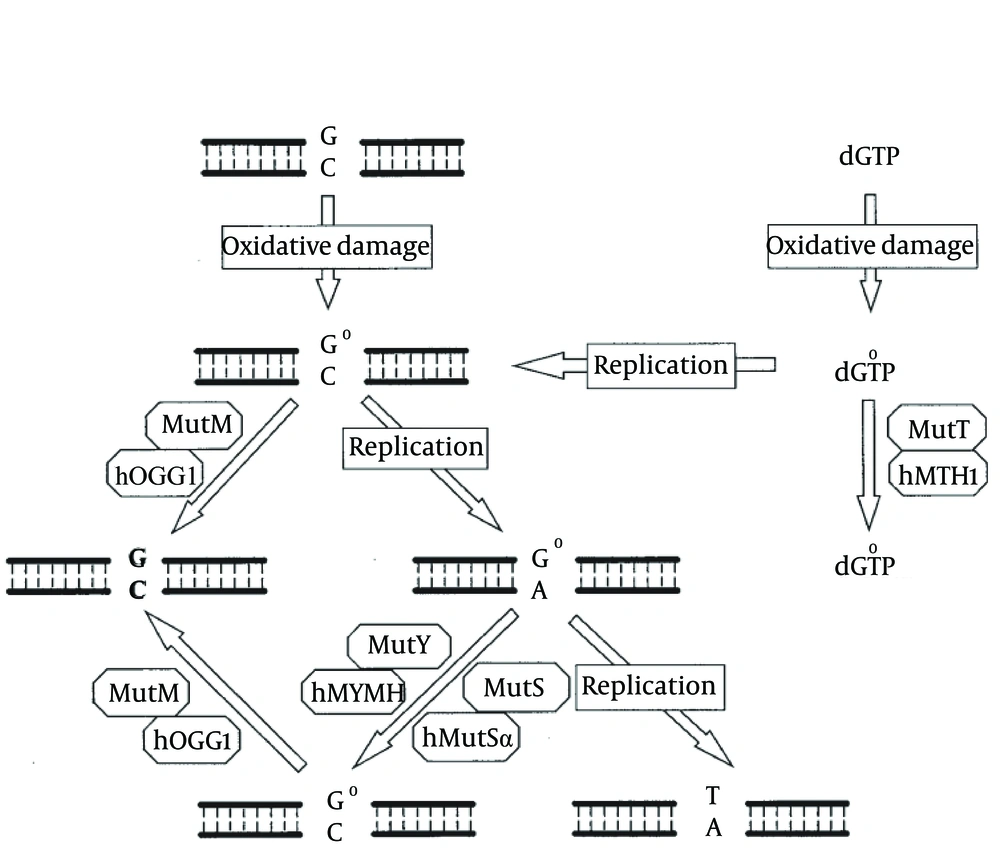
In E. coli, MutT, MutM, and MutY are involved in defending against the mutagenic effects of 8-oxoG lesions. The MutT protein hydrolyzes 8-oxo-dGTP (dG°TP) to 8-oxo-dGMP (dG°MP) and pyrophosphate. GO (G°) in DNA can be derived from oxidation of guanine or the misincorporation of dG°TP during replication. MutM glycosylase removes GO adducts while it is paired with cytosine. When C/GO is not repaired by MutM, adenines are frequently incorporated in opposite GO bases by DNA polymerase III during DNA replication. A/GO mismatches are repaired to C/GO by the MutY-dependent or MutS-dependent pathway. Cells defective in the MutM, MutY, and MutS repair pathways will have high mutation frequency of G:C to T:A transversions. Human MutY glycosylase homolog (hMYH), 8-oxoG glycosylase (hOGG1), MutT homolog (hMTH1), and MutS homologs (hMutSα), function like their E. coli homologs to protect the cell from the mutagenic effects of 8-oxoG. A dysfunctional MUTYH protein increases the occurrence of somatic G > T transversions. For instance, somatic mutations in the APC gene in MAP tumors involve almost exclusively G > T transversions, an observation that led to the discovery of the MAP syndrome. Similarly, the most prevalent KRAS2 mutation in MAP tumors is a G > T transversion at codon 12 (c.34G > T), which was reported to be present in 64% of MAP carcinomas (17).
3. Identification and Characterization of MAP (MYH-Associated Polyposis)
4. Mutation spectrum
5. MutYH Mutation and CRC Risk
6. Molecular PROFILE of MAP Tumors
7. Genotype - Phenotype Correlation
8. MYH and Sporadic Cancers
9. Extracolonic Manifestations in MAP
10. Discussion
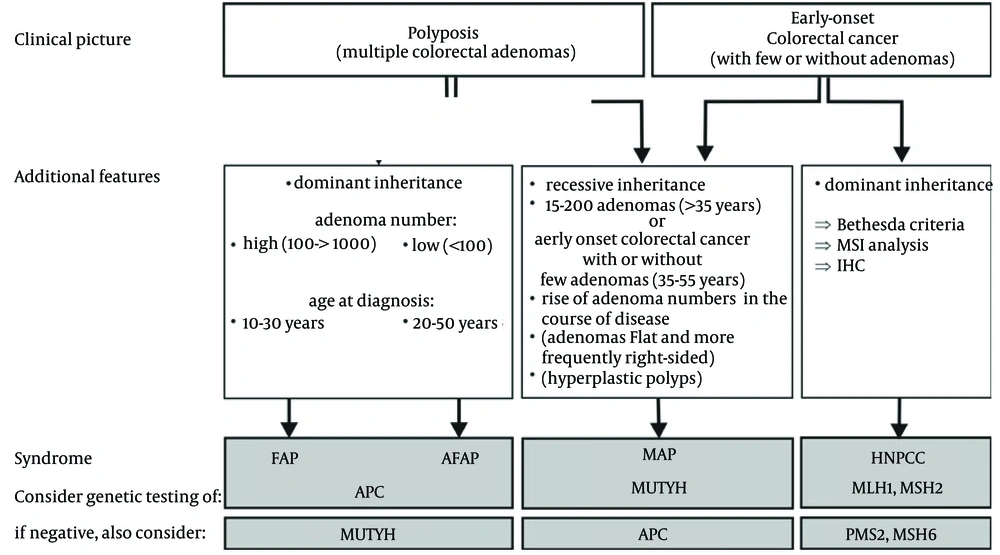
FAP, familial adenomatous polyposis; AFAP, attenuated FAP; MAP, MUTYH-associated polyposis; HNPCC, hereditary non-polyposis colorectal cancer; MSI, microsatellite instability; IHC, immunohistochemistry.
